
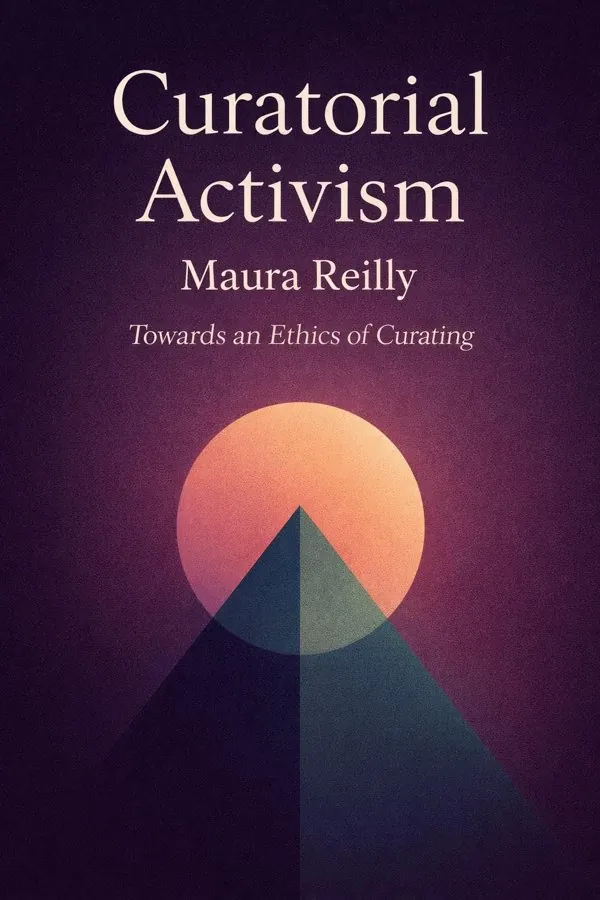
Curatorial Activism: Towards an Ethics of Curating: Summary & Key Insights
by Maura Reilly
 10 min9 chaptersAudio available
Key Takeaways from Curatorial Activism: Towards an Ethics of Curating
What looks like neutrality in a museum is often the quietest form of bias.
The canon changes only when someone is willing to challenge who built it.
An exhibition can critique colonialism while still operating through colonial habits.
What institutions fail to show often determines what society fails to remember.
Institutions often claim inclusion is difficult until a powerful exhibition proves otherwise.
What Is Curatorial Activism: Towards an Ethics of Curating About?
Curatorial Activism: Towards an Ethics of Curating by Maura Reilly is a art_history book spanning 9 pages. Curatorial Activism: Towards an Ethics of Curating argues that exhibitions are never neutral. Every curatorial choice—who is included, who is omitted, which histories are emphasized, and which standards of quality are treated as universal—helps shape the public story of art. In this urgent and influential book, Maura Reilly shows how museums, galleries, and biennials have long reinforced hierarchies of gender, race, sexuality, and geography, even while claiming to present objective accounts of artistic achievement. Her central claim is both simple and radical: curators have an ethical obligation to challenge those exclusions rather than reproduce them. Reilly writes with unusual authority. As a curator, scholar, and founding curator of the Elizabeth A. Sackler Center for Feminist Art at the Brooklyn Museum, she brings together institutional experience, historical knowledge, and political clarity. The book combines critical theory with concrete case studies, tracing how feminist, postcolonial, queer, and decolonial exhibitions have transformed curatorial practice. For anyone interested in museums, art history, cultural power, or social justice, this book offers a compelling framework for understanding how exhibitions can become tools not just of display, but of repair.
This FizzRead summary covers all 9 key chapters of Curatorial Activism: Towards an Ethics of Curating in approximately 10 minutes, distilling the most important ideas, arguments, and takeaways from Maura Reilly's work. Also available as an audio summary and Key Quotes Podcast.
Curatorial Activism: Towards an Ethics of Curating
Curatorial Activism: Towards an Ethics of Curating argues that exhibitions are never neutral. Every curatorial choice—who is included, who is omitted, which histories are emphasized, and which standards of quality are treated as universal—helps shape the public story of art. In this urgent and influential book, Maura Reilly shows how museums, galleries, and biennials have long reinforced hierarchies of gender, race, sexuality, and geography, even while claiming to present objective accounts of artistic achievement. Her central claim is both simple and radical: curators have an ethical obligation to challenge those exclusions rather than reproduce them.
Reilly writes with unusual authority. As a curator, scholar, and founding curator of the Elizabeth A. Sackler Center for Feminist Art at the Brooklyn Museum, she brings together institutional experience, historical knowledge, and political clarity. The book combines critical theory with concrete case studies, tracing how feminist, postcolonial, queer, and decolonial exhibitions have transformed curatorial practice. For anyone interested in museums, art history, cultural power, or social justice, this book offers a compelling framework for understanding how exhibitions can become tools not just of display, but of repair.
Who Should Read Curatorial Activism: Towards an Ethics of Curating?
This book is perfect for anyone interested in art_history and looking to gain actionable insights in a short read. Whether you're a student, professional, or lifelong learner, the key ideas from Curatorial Activism: Towards an Ethics of Curating by Maura Reilly will help you think differently.
- ✓Readers who enjoy art_history and want practical takeaways
- ✓Professionals looking to apply new ideas to their work and life
- ✓Anyone who wants the core insights of Curatorial Activism: Towards an Ethics of Curating in just 10 minutes
Want the full summary?
Get instant access to this book summary and 100K+ more with Fizz Moment.
Get Free SummaryAvailable on App Store • Free to download
Key Chapters
What looks like neutrality in a museum is often the quietest form of bias. Reilly begins by exposing a foundational myth of art institutions: that they merely preserve and present the best art. In practice, museums and galleries have historically acted as gatekeepers, deciding which artists enter the canon and which remain invisible. Those decisions have rarely been impartial. They have favored white, male, heterosexual, Western artists, while treating women, artists of color, queer artists, and artists from the Global South as marginal or exceptional.
This historical overview matters because exclusion is not accidental; it is structural. Reilly traces how academies, museums, and commercial galleries built prestige through selective collecting and display, often presenting a narrow slice of artistic production as if it represented universal excellence. Once certain artists entered textbooks, permanent collections, and blockbuster exhibitions, their authority became self-reinforcing. Curators inherited these systems and too often repeated them.
Reilly urges readers to see curating as an ethical and political act. An exhibition checklist is not just a list of objects; it is a public argument about who matters. A museum wall can affirm dominant history or interrupt it. For example, a modern art survey that includes only token women or non-Western artists does not solve inequality; it simply decorates exclusion with diversity language.
The practical implication is clear: curators must question inherited narratives rather than assume them. Audit collections, examine past exhibition records, identify patterns of omission, and treat representation as a matter of institutional accountability. The actionable takeaway: before organizing any exhibition, ask not only “What belongs?” but also “Who has been systematically left out, and why?”
The canon changes only when someone is willing to challenge who built it. Reilly presents feminist curating as one of the most important and sustained interventions in modern exhibition history. Feminist curators did more than add women artists to existing frameworks; they questioned the patriarchal assumptions behind those frameworks in the first place. Why had women been excluded from major surveys? Why were subjects associated with domesticity, embodiment, or craft treated as secondary? Why did artistic genius so often wear a masculine face?
Reilly draws on landmark exhibitions and her own institutional work to show how feminist curating can reshape public understanding. Exhibitions such as Womanhouse, WACK!, Global Feminisms, and projects linked to artists like Judy Chicago made visible not only neglected artists but neglected methods, themes, and histories. Feminist exhibitions often broadened the meaning of art itself by embracing collaboration, activism, performance, textile work, and community-based practices.
Importantly, feminist curating is not simply about numerical balance. Reilly emphasizes that token inclusion leaves patriarchal structures intact. A truly feminist curatorial approach asks how gender intersects with race, class, sexuality, and geography. It also addresses institutional habits: acquisition patterns, staffing, funding priorities, and educational framing.
For practitioners, feminist curating offers a model of sustained corrective work. It means researching forgotten artists, commissioning scholarship, revising wall texts, and refusing the excuse that quality and diversity are in conflict. A museum can, for instance, redesign a permanent collection hang to place women artists at the center of historical movements rather than in isolated side rooms.
The actionable takeaway: treat feminist curating not as a special topic, but as an ongoing method for exposing and correcting the gendered assumptions embedded in art history.
An exhibition can critique colonialism while still operating through colonial habits. That tension sits at the center of Reilly’s discussion of postcolonial and decolonial curatorial strategies. She argues that institutions in Europe and North America have long organized art through imperial maps, placing the West at the center and everything else at the periphery. Non-Western artists have often been framed as ethnographic, regional, or derivative rather than as equal participants in modern and contemporary art.
Postcolonial and decolonial curating seek to undo that hierarchy, but Reilly warns against superficial multiculturalism. Simply adding artists from Africa, Asia, Latin America, or Indigenous communities does not dismantle colonial frameworks if the exhibition still defines value through Western categories. Decolonial work asks deeper questions: Who gets to interpret these works? What histories of extraction, violence, and misrepresentation shape the collection? Which languages, archives, and local knowledges have been ignored?
Reilly points to exhibitions that have expanded the map of art history by foregrounding transnational exchanges, anti-colonial struggle, migration, and cultural hybridity. Strong decolonial curating often involves collaboration with artists, communities, and scholars outside dominant institutions. It may also require rethinking classification systems, collection labels, and the authority of the museum itself.
In practice, this can mean involving community advisors, commissioning new scholarship from underrepresented regions, returning context to objects previously stripped of it, and rejecting the idea that Western modernism is the universal benchmark. A curator planning a global survey, for example, should avoid grouping non-Western artists as a separate category while treating Europe and the United States as the default center.
The actionable takeaway: decolonize not just the roster of artists, but the framework, language, expertise, and power relations through which the exhibition is produced.
What institutions fail to show often determines what society fails to remember. Reilly’s discussion of LGBTQ+ curatorial practice demonstrates how exhibitions shape public visibility and historical recognition. For decades, queer artists and queer themes were omitted, coded, or sidelined, even when they were central to artistic innovation. Museums often preferred ambiguity over acknowledgment, especially when sexuality or gender identity challenged social norms.
Curatorial activism in this area works on several levels. It recovers neglected histories, makes queer identities legible, and resists heteronormative readings of art. Reilly shows that queer curating is not simply about assembling works by LGBTQ+ artists. It also involves reinterpreting archives, exposing the politics of silence, and questioning binary structures that organize both exhibition design and institutional language.
Queer exhibitions can be especially powerful because they complicate fixed categories. They may explore performance, embodiment, desire, AIDS activism, chosen family, or trans visibility in ways that traditional art historical narratives cannot easily contain. At their best, they make clear that queer art is not a niche supplement to the canon; it is central to understanding contemporary visual culture.
Practically, queer-inclusive curating might involve naming identities when historically appropriate, consulting artists and estates about preferred framing, and ensuring that educational programming addresses the political conditions surrounding the work. It also means avoiding reductive identity labels that flatten complex practices. A museum revisiting a twentieth-century collection, for instance, can correct decades of erasure by integrating queer narratives into the main historical storyline rather than isolating them in a themed sidebar.
The actionable takeaway: use exhibitions to transform silence into visibility, and make queer histories part of the institution’s central memory rather than its occasional exception.
Institutions often claim inclusion is difficult until a powerful exhibition proves otherwise. One of Reilly’s strongest contributions is her use of case studies showing that activist curating is not merely theoretical. Across feminist, postcolonial, queer, and anti-racist practice, she examines exhibitions that changed expectations about who could be shown, how art history could be framed, and what audiences were ready to engage.
These landmark exhibitions matter because they model alternative curatorial logics. Some corrected historical absences by recovering overlooked artists. Others challenged stylistic or geographic hierarchies by placing marginalized artists at the center of major narratives. Still others used exhibition design, catalog essays, and public programming to connect art to broader social struggles. Reilly is attentive to both the achievements and limitations of these projects, recognizing that no exhibition escapes institutional constraints entirely.
What makes these examples especially useful is their practicality. They show the impact of rigorous research, bold framing, coalition-building, and institutional persistence. A successful activist exhibition does not emerge from good intentions alone. It requires evidence, persuasive argumentation, and strategic negotiation with boards, directors, lenders, and audiences. It also requires the courage to accept backlash as part of meaningful change.
For curators and cultural workers, these case studies function like a toolkit. They demonstrate how to justify a revisionist exhibition, how to build a narrative around structural exclusion, and how to measure success beyond attendance numbers. A curator advocating for an exhibition on underrepresented artists can use past models to argue that revising the canon is not fringe work but serious scholarly and public service.
The actionable takeaway: study exhibitions that shifted the field, then adapt their strategies—research depth, narrative clarity, and institutional persistence—to your own curatorial context.
A museum cannot challenge bias effectively if it refuses to see itself as part of the problem. Reilly’s discussion of institutional critique expands curatorial activism beyond exhibition content to include the museum’s own structures of authority. Collections, endowments, donor influence, leadership demographics, acquisition policies, and marketing strategies all shape what becomes visible and valuable. If these systems remain unchanged, even progressive exhibitions risk becoming symbolic gestures.
Institutional critique asks museums to turn the analytical lens inward. Why are certain artists absent from permanent collections? Who sits on acquisition committees? Who writes labels and catalog essays? Which communities feel welcomed by the museum, and which experience it as alienating or hostile? Reilly insists that curatorial ethics cannot be separated from these operational realities.
This perspective is especially important because institutions often celebrate diversity through temporary programming while preserving inequality at the structural level. A museum may host a groundbreaking exhibition by women artists while continuing to collect overwhelmingly male artists. It may present decolonial discourse while maintaining a leadership structure with little connection to the communities it represents.
Practical institutional critique involves data gathering and transparency. Museums can publish collection demographics, track exhibition representation over time, diversify hiring and leadership pipelines, and reassess the criteria used for acquisitions and interpretation. Curators can advocate for permanent collection rehanging, long-term partnership models, and changes to decision-making processes rather than relying solely on one-off corrective shows.
The actionable takeaway: evaluate exhibitions as part of a larger institutional ecosystem, and push for reforms in collecting, staffing, governance, and interpretation so inclusion becomes structural rather than seasonal.
Inclusion without accountability can become a performance. Reilly frames curatorial activism as an ethical practice, meaning that the curator’s responsibility goes beyond taste, scholarship, or innovation. Ethics enters wherever there is power: the power to select, interpret, elevate, contextualize, and exclude. Because curators shape cultural memory, they must ask not only whether an exhibition is compelling, but whether it is just.
An ethical framework for curating involves several commitments. First, it recognizes historical inequity and treats redress as necessary, not optional. Second, it values transparency: curators should be clear about their criteria, methods, and positionality. Third, it prioritizes respectful representation, especially when working with communities that have been misrepresented or exploited. Fourth, it resists extractive practices in which institutions benefit symbolically from marginalized artists without sharing authority or resources.
Reilly encourages curators to move from abstract commitments to concrete standards. Ethical curating may involve paying consultants and community collaborators fairly, ensuring accessibility in exhibition design, crediting intellectual labor accurately, and avoiding sensationalized framing. It also means being willing to revise plans when critiques emerge. Ethics is not a statement on the wall; it is a process of ongoing reflection and responsibility.
A practical example would be a museum developing an exhibition with Indigenous artists and scholars from the earliest planning stages, rather than inviting them to endorse a nearly completed project. Another would be reconsidering labels that use outdated or imposed terminology simply because they are institutionally familiar.
The actionable takeaway: define curatorial ethics in operational terms—shared authority, transparency, fair compensation, respectful language, and accessibility—so values are embedded in practice, not just rhetoric.
The desire for change matters little without methods to carry it out. Reilly is especially valuable when she turns from diagnosis to implementation, showing how curatorial activism can be practiced within real institutions, budgets, and constraints. Her argument is not that every curator must work outside the system, but that those inside institutions can push them in more just directions through deliberate choices.
Practical strategies begin with research. Curators can expand bibliographies, consult alternative archives, build relationships with overlooked artists and estates, and seek expertise beyond familiar academic networks. From there, activist curating shapes the entire exhibition process: artist selection, thematic framing, label writing, catalog essays, public programming, and outreach. It also includes internal advocacy—making evidence-based arguments to directors, trustees, and funders about why inclusive exhibitions are intellectually stronger and publicly necessary.
Reilly also implies that scale matters less than consistency. A curator may not immediately transform a museum’s entire collection, but they can change how one exhibition is framed, who is invited into the process, and what audiences are addressed. Small interventions accumulate. Revising labels, commissioning essays from marginalized scholars, or integrating underrepresented artists into standard surveys can all shift institutional norms over time.
Importantly, activist curating requires planning for reception. Challenging exhibitions should be accompanied by programming that supports public understanding rather than assuming audiences will supply the missing context themselves. This can include talks, reading groups, school materials, and digital resources.
The actionable takeaway: turn values into a repeatable workflow—research broadly, collaborate intentionally, frame clearly, advocate internally, and design public engagement so inclusion is built into every phase of curatorial practice.
If curatorial activism were easy, the canon would already look different. Reilly closes the circle by acknowledging the difficulties, contradictions, and limits of activist curating. Institutions face financial pressures, political sensitivities, donor influence, bureaucratic inertia, and audience expectations. Curators themselves work within systems they may wish to transform, and even well-intentioned projects can fall into tokenism, simplification, or overcorrection.
Reilly does not present these obstacles as reasons for retreat. Instead, she treats them as part of the ethical reality of the field. Activist curating is imperfect because institutions are imperfect, archives are incomplete, and histories of exclusion cannot be repaired instantly. A revisionist exhibition may receive criticism for who is still absent. A museum may celebrate diversity while failing to change leadership. A curatorial intervention may create visibility without redistributing power.
Yet these limitations do not invalidate the project; they clarify its stakes. Reilly’s point is that curators must remain self-critical, historically informed, and open to correction. The goal is not moral purity but sustained transformation. Progress often takes the form of cumulative pressure: one exhibition changes discourse, another changes acquisitions, another changes teaching, and eventually the canon shifts.
For practitioners, this means measuring success in layered ways. Attendance and reviews matter, but so do longer-term effects such as acquisitions, scholarly citations, artist opportunities, and changes in institutional policy. Curators should document what worked, what failed, and what remains unresolved.
The actionable takeaway: expect resistance, learn from critique, and treat activist curating as ongoing work of revision rather than a single exhibition that solves the problem of exclusion.
All Chapters in Curatorial Activism: Towards an Ethics of Curating
About the Author
Maura Reilly is an American curator, writer, and scholar best known for her work on feminist art, institutional critique, and the politics of representation in museums. She was the founding curator of the Elizabeth A. Sackler Center for Feminist Art at the Brooklyn Museum, where she helped establish a major platform for the study and exhibition of feminist practice. Throughout her career, Reilly has organized influential exhibitions and written extensively about the exclusion of women, queer artists, artists of color, and non-Western artists from mainstream art history. Her work combines rigorous scholarship with practical curatorial experience, making her a leading voice in debates about diversity, canon formation, and museum ethics. Curatorial Activism reflects her longstanding commitment to rethinking how institutions shape cultural value.
Get This Summary in Your Preferred Format
Read or listen to the Curatorial Activism: Towards an Ethics of Curating summary by Maura Reilly anytime, anywhere. FizzRead offers multiple formats so you can learn on your terms — all free.
Available formats: App · Audio · PDF · EPUB — All included free with FizzRead
Download Curatorial Activism: Towards an Ethics of Curating PDF and EPUB Summary
Key Quotes from Curatorial Activism: Towards an Ethics of Curating
“What looks like neutrality in a museum is often the quietest form of bias.”
“The canon changes only when someone is willing to challenge who built it.”
“An exhibition can critique colonialism while still operating through colonial habits.”
“What institutions fail to show often determines what society fails to remember.”
“Institutions often claim inclusion is difficult until a powerful exhibition proves otherwise.”
Frequently Asked Questions about Curatorial Activism: Towards an Ethics of Curating
Curatorial Activism: Towards an Ethics of Curating by Maura Reilly is a art_history book that explores key ideas across 9 chapters. Curatorial Activism: Towards an Ethics of Curating argues that exhibitions are never neutral. Every curatorial choice—who is included, who is omitted, which histories are emphasized, and which standards of quality are treated as universal—helps shape the public story of art. In this urgent and influential book, Maura Reilly shows how museums, galleries, and biennials have long reinforced hierarchies of gender, race, sexuality, and geography, even while claiming to present objective accounts of artistic achievement. Her central claim is both simple and radical: curators have an ethical obligation to challenge those exclusions rather than reproduce them. Reilly writes with unusual authority. As a curator, scholar, and founding curator of the Elizabeth A. Sackler Center for Feminist Art at the Brooklyn Museum, she brings together institutional experience, historical knowledge, and political clarity. The book combines critical theory with concrete case studies, tracing how feminist, postcolonial, queer, and decolonial exhibitions have transformed curatorial practice. For anyone interested in museums, art history, cultural power, or social justice, this book offers a compelling framework for understanding how exhibitions can become tools not just of display, but of repair.
You Might Also Like

Studies In Impressionism
John Rewald
10 min
Art Since 1900: Modernism, Antimodernism, Postmodernism
Hal Foster, Rosalind E. Krauss, Yve-Alain Bois, Benjamin H. D. Buchloh
10 min
Art Since 1940: Strategies of Being
Jonathan Fineberg
10 min
Color and Meaning: Art, Science, and Symbolism
John Gage
10 min
Color: Travels Through the Paintbox
Victoria Finlay
10 min
How to Read a Painting: From Giotto to Jackson Pollock
Patrick De Rynck
10 minBrowse by Category
Ready to read Curatorial Activism: Towards an Ethics of Curating?
Get the full summary and 100K+ more books with Fizz Moment.