
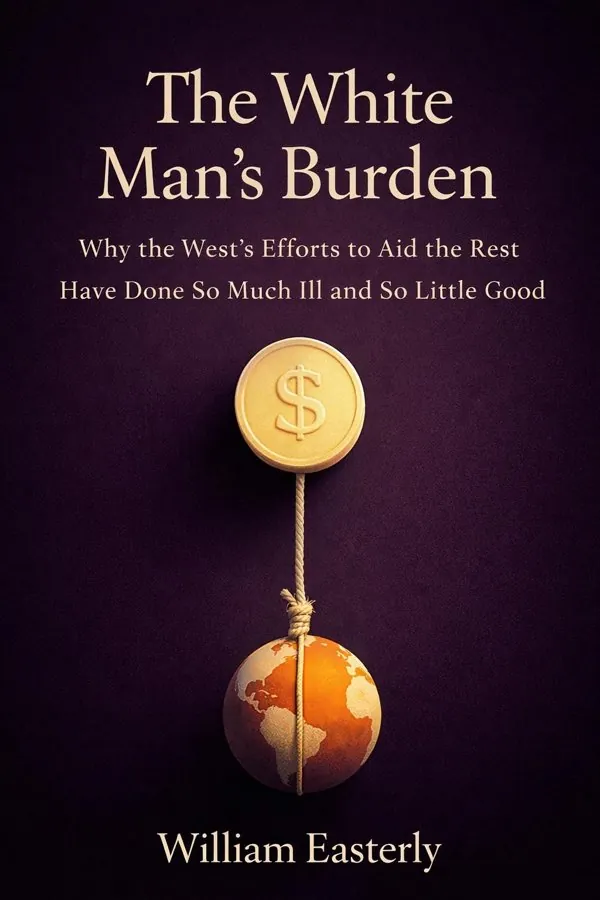
The White Man’s Burden: Why the West’s Efforts to Aid the Rest Have Done So Much Ill and So Little Good: Summary & Key Insights
 10 min9 chaptersAudio available
Key Takeaways from The White Man’s Burden: Why the West’s Efforts to Aid the Rest Have Done So Much Ill and So Little Good
The most dangerous ideas in development are often the most inspiring.
One successful historical episode can mislead generations of policymakers.
Big ambitions can disguise weak understanding.
Good intentions are not a substitute for responsibility.
People closest to a problem usually know something outsiders do not.
What Is The White Man’s Burden: Why the West’s Efforts to Aid the Rest Have Done So Much Ill and So Little Good About?
The White Man’s Burden: Why the West’s Efforts to Aid the Rest Have Done So Much Ill and So Little Good by William Easterly is a economics book spanning 9 pages. In The White Man’s Burden, economist William Easterly delivers a sharp, unsettling critique of foreign aid and the grand development schemes that have shaped global policy for decades. Rather than asking whether rich countries care enough about poverty, Easterly asks a more uncomfortable question: why have so many well-funded efforts produced so little lasting progress? His answer is that development has too often been driven by distant experts, sweeping targets, and moral certainty, while ignoring the realities, incentives, and knowledge of the people these programs are meant to help. Drawing on his years at the World Bank, along with historical evidence and economic analysis, Easterly contrasts “Planners,” who design top-down solutions, with “Searchers,” who respond to local needs through trial, feedback, and accountability. The result is not an argument against compassion, but against arrogant, centralized problem-solving. For readers interested in economics, public policy, philanthropy, or social change, this book remains one of the most important challenges to conventional thinking about how development really happens.
This FizzRead summary covers all 9 key chapters of The White Man’s Burden: Why the West’s Efforts to Aid the Rest Have Done So Much Ill and So Little Good in approximately 10 minutes, distilling the most important ideas, arguments, and takeaways from William Easterly's work. Also available as an audio summary and Key Quotes Podcast.
The White Man’s Burden: Why the West’s Efforts to Aid the Rest Have Done So Much Ill and So Little Good
In The White Man’s Burden, economist William Easterly delivers a sharp, unsettling critique of foreign aid and the grand development schemes that have shaped global policy for decades. Rather than asking whether rich countries care enough about poverty, Easterly asks a more uncomfortable question: why have so many well-funded efforts produced so little lasting progress? His answer is that development has too often been driven by distant experts, sweeping targets, and moral certainty, while ignoring the realities, incentives, and knowledge of the people these programs are meant to help. Drawing on his years at the World Bank, along with historical evidence and economic analysis, Easterly contrasts “Planners,” who design top-down solutions, with “Searchers,” who respond to local needs through trial, feedback, and accountability. The result is not an argument against compassion, but against arrogant, centralized problem-solving. For readers interested in economics, public policy, philanthropy, or social change, this book remains one of the most important challenges to conventional thinking about how development really happens.
Who Should Read The White Man’s Burden: Why the West’s Efforts to Aid the Rest Have Done So Much Ill and So Little Good?
This book is perfect for anyone interested in economics and looking to gain actionable insights in a short read. Whether you're a student, professional, or lifelong learner, the key ideas from The White Man’s Burden: Why the West’s Efforts to Aid the Rest Have Done So Much Ill and So Little Good by William Easterly will help you think differently.
- ✓Readers who enjoy economics and want practical takeaways
- ✓Professionals looking to apply new ideas to their work and life
- ✓Anyone who wants the core insights of The White Man’s Burden: Why the West’s Efforts to Aid the Rest Have Done So Much Ill and So Little Good in just 10 minutes
Want the full summary?
Get instant access to this book summary and 100K+ more with Fizz Moment.
Get Free SummaryAvailable on App Store • Free to download
Key Chapters
The most dangerous ideas in development are often the most inspiring. Easterly argues that efforts to help poor countries usually fall into two camps: Planners and Searchers. Planners believe poverty can be solved by experts with enough money, data, and ambition. They create global targets, national blueprints, and comprehensive strategies. Searchers, by contrast, start with a humbler assumption: nobody fully knows the answer in advance, so progress comes through experimentation, feedback, and adaptation.
This distinction sits at the heart of the book. Planners are attractive because they offer certainty. They can promise to halve poverty, achieve universal education, or end disease by a certain date. But their strength is also their weakness: they often answer to donors and political institutions rather than to the poor themselves. Searchers do not promise sweeping transformation. They look for what works in a specific village, school, clinic, or market. They test small solutions, learn from failure, and change course when reality disagrees with theory.
A practical example is the difference between building a nationwide school system from a capital-city office versus finding out why local children are not attending the school that already exists. Maybe the teacher is absent, maybe the road is unsafe, or maybe children are needed for farm work. A Searcher starts there.
Easterly’s broader lesson is that development is less like engineering and more like entrepreneurship. It requires responsiveness, not just resources. If you want to help solve social problems, favor approaches that learn from real people, reward results, and stay open to correction.
One successful historical episode can mislead generations of policymakers. Easterly explains that much modern foreign aid was shaped by the post-World War II success of the Marshall Plan, which rebuilt Europe and seemed to prove that massive financial transfers and centralized planning could rapidly restore prosperity. The mistake was assuming that what worked in one context would work everywhere.
Europe after the war was not a blank slate. It already had functioning institutions, educated populations, industrial capacity, and relatively stable states. External money helped restart systems that already existed. Many poor countries, however, faced entirely different challenges: weak governance, limited accountability, corruption, conflict, and fragile infrastructure. Treating them as if they simply lacked capital ignored the much deeper institutional and political obstacles to development.
Easterly shows how this historical misunderstanding fed decades of optimism about aid-led transformation. Rich countries repeatedly launched large initiatives on the assumption that poverty persisted because the poor lacked a financial “push.” Yet when money entered environments without strong incentives or functioning institutions, it often produced waste, elite capture, or dependency rather than broad-based growth.
This argument matters beyond foreign aid. In business, education, and public policy, leaders often copy visible success stories while ignoring the hidden conditions that made them work. A startup cannot replicate Apple just by copying product launches; a school system cannot replicate Finland by importing slogans.
The actionable takeaway is simple: before applying a proven solution from one setting to another, examine the underlying conditions. Ask not just, “Did it work there?” but, “What made it work there, and do those conditions exist here?”
Big ambitions can disguise weak understanding. Easterly argues that development institutions have repeatedly embraced sweeping plans to end poverty, hunger, disease, and illiteracy, but these plans often fail because they are detached from the everyday mechanisms that make improvement possible. The problem is not noble intention; it is the illusion that large-scale social change can be designed from the top and delivered on schedule.
Grand plans tend to prioritize announcements over implementation. They produce impressive reports, donor conferences, and measurable targets, but often neglect the details that determine success: who is responsible, what incentives they face, how local conditions vary, and what happens when the original plan stops working. In practice, a central authority may promise more clinics, more schools, or more roads, yet no one ensures medicines arrive, teachers show up, or roads remain passable in the rainy season.
Easterly is especially critical of the culture of target-setting in global development. If success is defined by declarations rather than outcomes, institutions can keep claiming progress while the poor see little change. A village may be listed as having access to education because a building exists, even if students learn almost nothing there.
This critique applies widely. Organizations frequently mistake strategy documents for strategy itself. A company may launch a transformation initiative with elegant slides but no frontline buy-in. A nonprofit may expand programs before proving the first ones work.
The practical lesson is to break big goals into accountable, testable steps. Instead of asking, “How do we solve poverty?” ask, “How do we reduce teacher absenteeism in this district over the next six months?” Progress becomes real when plans are small enough to be corrected by evidence.
Good intentions are not a substitute for responsibility. One of Easterly’s strongest arguments is that aid often fails because the people funding programs are not the same people benefiting from them, and the agencies implementing those programs are rarely held accountable by the poor. In markets, customers can stop buying. In democracies, citizens can vote leaders out. In aid systems, the intended recipients often have neither power.
This creates a dangerous chain of weak accountability. Donors answer to taxpayers, politicians, or foundations. Aid agencies answer to donors. Contractors answer to grant requirements. But who answers directly to the family whose well is broken, whose medicine never arrives, or whose child sits in an empty classroom? Too often, no one. As a result, aid organizations can survive repeated failure as long as they remain persuasive to funders.
Easterly emphasizes that incentives shape behavior. If agencies are rewarded for money disbursed, reports written, or projects launched, they will optimize for those metrics. If they are rewarded for measurable improvements in lives, verified independently and locally, their behavior changes. This is why he favors systems that create feedback loops between providers and recipients.
A practical analogy is customer service. A restaurant that ignores diners will close; a public kitchen funded regardless of quality may continue indefinitely. The more distant the feedback, the weaker the pressure to improve.
The takeaway is clear: design any helping system so beneficiaries can influence outcomes. Build complaint mechanisms, transparent reporting, local oversight, and consequences for poor performance. If the people you serve cannot reward success or punish failure, the system will drift away from their needs.
People closest to a problem usually know something outsiders do not. Easterly insists that development fails when external experts assume they understand local needs better than local communities themselves. Poverty is real, but it is also specific. The constraints facing a farmer in rural Kenya, a street vendor in Bolivia, and a mother in an urban slum in India are not interchangeable. Effective solutions emerge when those details are taken seriously.
Top-down development often treats poor populations as abstract categories rather than decision-makers with preferences, trade-offs, and insight. A donor may fund mosquito nets, school uniforms, irrigation systems, or fertilizer subsidies based on a broad theory of need, yet the intended users may face different priorities. Maybe the irrigation technology is too expensive to maintain. Maybe the school uniform policy solves one barrier while ignoring teacher absence. Maybe the health clinic exists, but women avoid it because of distance, cost, or distrust.
Easterly’s point is not that outsiders can never help. It is that they help best when they observe, listen, test, and adapt. In this sense, development resembles product design. The best companies do not simply imagine what customers need; they watch behavior, gather feedback, and iterate relentlessly.
This principle is useful in management, policy, and daily life. Leaders often impose systems without consulting the people who must use them. Teachers may redesign classrooms without asking students what blocks learning. Employers may roll out software that workers immediately workaround.
The actionable takeaway is to make local feedback a starting point, not a formality. Before scaling any solution, spend time understanding how people currently solve the problem, what constraints they face, and what trade-offs matter most to them.
Money can finance services, but it cannot manufacture legitimacy. Easterly argues that one of the deepest misconceptions in development is the belief that external aid can bypass or compensate for bad governance. When political institutions are weak, predatory, or unaccountable, aid often does not reach the poor in the intended way. Instead, it may strengthen the very systems that keep them trapped.
In countries with corrupt or authoritarian governments, foreign assistance can be diverted, politicized, or used to reward allies. Even when donors try to avoid governments and work through international agencies or NGOs, they still face the same political environment. Rules are distorted, information is unreliable, and local actors may respond to aid in strategic rather than constructive ways. Easterly highlights that development is not merely a technical problem of transferring resources. It is also a political problem involving rights, institutions, and power.
This helps explain why some countries improve dramatically with modest aid while others absorb vast sums with little progress. The difference often lies not in the generosity of donors but in the quality of governance: property rights, legal predictability, public accountability, and basic civil freedoms.
The wider lesson is that systems matter more than slogans. A poorly governed organization can waste even abundant resources, while a well-governed one can achieve much with little.
The practical takeaway is to treat institutions as central, not secondary. When evaluating any social intervention, ask whether it strengthens accountability, transparency, and local agency. If a program works only because outsiders are constantly supervising it, it is probably not building durable progress.
There is enduring appeal in the idea that poverty persists because poor countries are stuck below a threshold and simply need one massive infusion of capital to escape. Easterly calls this the “Big Push” theory, and he challenges it forcefully. The theory suggests that a large enough external investment in infrastructure, health, education, and industry can launch self-sustaining growth. It is emotionally satisfying because it promises a decisive fix. But Easterly argues that evidence for it is weak.
Over decades, many poor countries received substantial aid without experiencing the expected takeoff. If capital alone were the missing ingredient, those transfers should have produced more consistent growth. Instead, outcomes varied widely. Some countries stagnated despite aid; others grew with limited aid. This suggests that development depends less on one dramatic jump and more on institutions, incentives, entrepreneurship, and cumulative problem-solving.
The Big Push mindset also encourages overconfidence. It leads donors to think in terms of financing gaps rather than implementation realities. A spreadsheet may show how many billions are “needed” to achieve development goals, but it says little about whether funds will be used productively or whether systems exist to support them.
This idea extends to personal and organizational change. People often seek one transformative intervention: a giant reorganization, a major investment, a total life overhaul. More often, lasting improvement comes from repeated small gains.
The takeaway is to be skeptical of one-shot solutions. When someone claims a complex problem can be solved mainly by spending more at scale, ask what mechanisms will convert money into results. Sustainable progress usually grows from many local successes, not one grand leap.
Development is not just about meeting needs; it is about expanding choices. Easterly argues that societies make lasting progress when individuals have the freedom to innovate, trade, move, speak, and respond to opportunities. Markets matter in this framework not because they are perfect, but because they create decentralized processes for discovery. Entrepreneurs test ideas, consumers reward value, and unsuccessful efforts are corrected through feedback.
Easterly does not romanticize markets as a cure-all. Rather, he sees them as part of a broader system of freedom and accountability that outperforms centralized direction. Where people can start businesses, own property, access information, and keep the gains from their effort, development often emerges from below. Where states or donor systems suppress initiative, progress is slower and more fragile.
This argument also challenges a paternalistic impulse in aid. If poor people are treated mainly as passive recipients, their capabilities are underestimated. But many of the most meaningful improvements in living standards come from the choices of ordinary people responding to incentives: farmers adopting better methods, merchants creating supply chains, parents investing in education, and local builders solving housing shortages.
In practice, this means development policy should focus less on commanding outcomes and more on removing barriers. Licensing obstacles, insecure property rights, arbitrary regulation, and restricted political freedoms can do more damage than lack of aid can repair.
The actionable takeaway is to ask, in any system, whether people are free to solve problems themselves. If the rules block initiative, reform the rules. Help is most powerful when it enlarges agency rather than replacing it.
The central moral lesson of Easterly’s book is that humility is more useful than heroism. He does not argue that the rich world should stop caring about the poor. He argues that caring without listening, measuring, or respecting local agency often makes matters worse. Development should be rethought not as a mission to save others, but as a process of supporting problem-solvers on the ground.
This shift has several implications. First, success should be judged by outcomes that matter to poor people, not by the volume of aid or the elegance of strategy documents. Second, interventions should be small enough to test and flexible enough to change. Third, local institutions, entrepreneurs, activists, and communities deserve more trust than distant experts usually give them. Fourth, rights and accountability are not luxuries to be addressed after growth; they are part of the conditions that enable growth.
Easterly’s critique also has a moral dimension. The title deliberately evokes the paternalism of colonial attitudes. When outsiders assume they know what is best for others and claim moral superiority while ignoring failure, development becomes less an act of solidarity than an assertion of control.
This insight travels well beyond economics. In leadership, parenting, teaching, and philanthropy, people often rush to impose solutions instead of helping others build their own.
The practical takeaway is to replace savior thinking with partnership thinking. Start with listening, define success from the perspective of those affected, and create structures that reward learning over image management. The best help often looks less dramatic than grand rescue stories, but it is far more likely to last.
All Chapters in The White Man’s Burden: Why the West’s Efforts to Aid the Rest Have Done So Much Ill and So Little Good
About the Author
William Easterly is an American economist, author, and professor known for his influential critiques of foreign aid and top-down development policy. He spent 16 years working at the World Bank, where he gained firsthand experience with the promises and shortcomings of large-scale international aid efforts. Later, he joined New York University as a professor of economics and became widely recognized for his writing on development, institutions, incentives, and economic freedom. Easterly’s work challenges the assumption that poverty can be solved primarily through expert planning and external financing. Instead, he emphasizes accountability, local knowledge, individual rights, and bottom-up problem-solving. Through books such as The White Man’s Burden, he has become one of the most prominent and controversial voices in debates about how the world should respond to poverty.
Get This Summary in Your Preferred Format
Read or listen to the The White Man’s Burden: Why the West’s Efforts to Aid the Rest Have Done So Much Ill and So Little Good summary by William Easterly anytime, anywhere. FizzRead offers multiple formats so you can learn on your terms — all free.
Available formats: App · Audio · PDF · EPUB — All included free with FizzRead
Download The White Man’s Burden: Why the West’s Efforts to Aid the Rest Have Done So Much Ill and So Little Good PDF and EPUB Summary
Key Quotes from The White Man’s Burden: Why the West’s Efforts to Aid the Rest Have Done So Much Ill and So Little Good
“The most dangerous ideas in development are often the most inspiring.”
“One successful historical episode can mislead generations of policymakers.”
“Big ambitions can disguise weak understanding.”
“Good intentions are not a substitute for responsibility.”
“People closest to a problem usually know something outsiders do not.”
Frequently Asked Questions about The White Man’s Burden: Why the West’s Efforts to Aid the Rest Have Done So Much Ill and So Little Good
The White Man’s Burden: Why the West’s Efforts to Aid the Rest Have Done So Much Ill and So Little Good by William Easterly is a economics book that explores key ideas across 9 chapters. In The White Man’s Burden, economist William Easterly delivers a sharp, unsettling critique of foreign aid and the grand development schemes that have shaped global policy for decades. Rather than asking whether rich countries care enough about poverty, Easterly asks a more uncomfortable question: why have so many well-funded efforts produced so little lasting progress? His answer is that development has too often been driven by distant experts, sweeping targets, and moral certainty, while ignoring the realities, incentives, and knowledge of the people these programs are meant to help. Drawing on his years at the World Bank, along with historical evidence and economic analysis, Easterly contrasts “Planners,” who design top-down solutions, with “Searchers,” who respond to local needs through trial, feedback, and accountability. The result is not an argument against compassion, but against arrogant, centralized problem-solving. For readers interested in economics, public policy, philanthropy, or social change, this book remains one of the most important challenges to conventional thinking about how development really happens.
More by William Easterly

You Might Also Like

Business Adventures
John Brooks
10 min
Nudge
Richard H. Thaler, Cass R. Sunstein
10 min
The Hitchhiker"s Guide to the Galaxy
Douglas Adams
10 minThe Muqaddimah
Ibn Khaldun
10 minThe Outsiders
William N. Thorndike
10 min
A Little History of Economics
Niall Kishtainy
10 minBrowse by Category
Ready to read The White Man’s Burden: Why the West’s Efforts to Aid the Rest Have Done So Much Ill and So Little Good?
Get the full summary and 100K+ more books with Fizz Moment.