
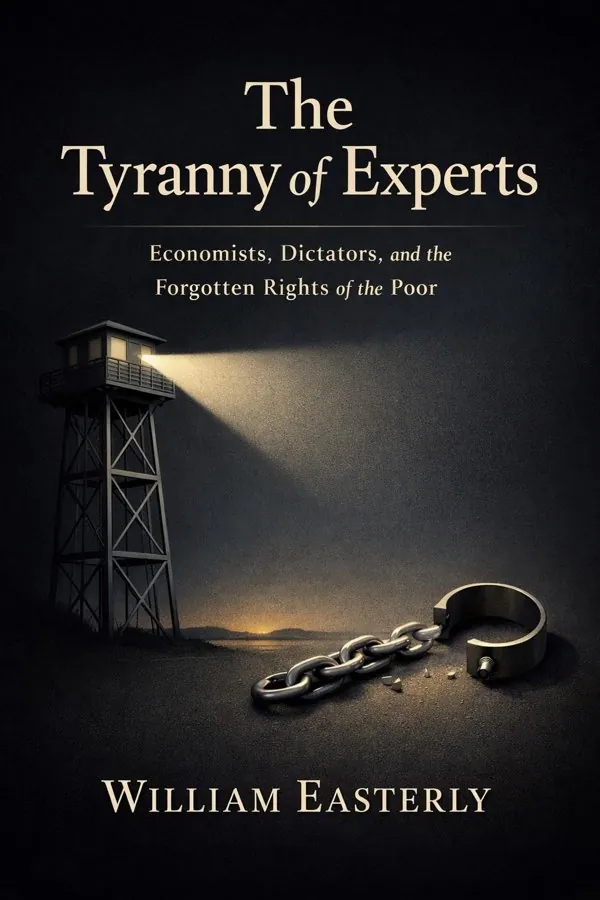
The Tyranny of Experts: Economists, Dictators, and the Forgotten Rights of the Poor: Summary & Key Insights
 10 min10 chaptersAudio available
Key Takeaways from The Tyranny of Experts: Economists, Dictators, and the Forgotten Rights of the Poor
A troubling idea sits beneath much of development policy: that poor societies can be improved mainly through expert management.
One of Easterly’s boldest arguments is that the development world repeatedly falls for the fantasy of the benevolent autocrat.
China is often presented as the ultimate rebuttal to Easterly’s argument.
Easterly’s most important moral claim is simple and radical: poor people are not problems to be solved; they are rights-bearing individuals.
Easterly offers a pointed critique of the global development establishment, including aid agencies, multilateral lenders, and foreign policy actors.
What Is The Tyranny of Experts: Economists, Dictators, and the Forgotten Rights of the Poor About?
The Tyranny of Experts: Economists, Dictators, and the Forgotten Rights of the Poor by William Easterly is a economics book spanning 10 pages. In The Tyranny of Experts, William Easterly delivers a sharp and provocative critique of modern development thinking. His central claim is unsettling: many of the world’s most respected anti-poverty efforts fail not because experts lack intelligence or good intentions, but because they treat poverty as a technical problem while ignoring the political rights and individual freedoms of the poor. In place of liberty, accountability, and choice, the development industry often substitutes planning, targets, and top-down control. Easterly argues that this mindset has deep historical roots, stretching back to colonial rule and continuing through contemporary institutions that praise growth even when it is achieved under authoritarian governments. He challenges the popular belief that enlightened rulers and skilled technocrats can engineer prosperity from above. Instead, he insists that lasting development emerges when ordinary people are free to act, innovate, own property, speak openly, and hold power accountable. The book matters because it forces readers to rethink what progress really means. Easterly writes with unusual authority: as a former World Bank economist and one of the most influential critics of foreign aid orthodoxy, he combines insider experience, economic reasoning, and moral urgency to question some of development’s most cherished assumptions.
This FizzRead summary covers all 10 key chapters of The Tyranny of Experts: Economists, Dictators, and the Forgotten Rights of the Poor in approximately 10 minutes, distilling the most important ideas, arguments, and takeaways from William Easterly's work. Also available as an audio summary and Key Quotes Podcast.
The Tyranny of Experts: Economists, Dictators, and the Forgotten Rights of the Poor
In The Tyranny of Experts, William Easterly delivers a sharp and provocative critique of modern development thinking. His central claim is unsettling: many of the world’s most respected anti-poverty efforts fail not because experts lack intelligence or good intentions, but because they treat poverty as a technical problem while ignoring the political rights and individual freedoms of the poor. In place of liberty, accountability, and choice, the development industry often substitutes planning, targets, and top-down control.
Easterly argues that this mindset has deep historical roots, stretching back to colonial rule and continuing through contemporary institutions that praise growth even when it is achieved under authoritarian governments. He challenges the popular belief that enlightened rulers and skilled technocrats can engineer prosperity from above. Instead, he insists that lasting development emerges when ordinary people are free to act, innovate, own property, speak openly, and hold power accountable.
The book matters because it forces readers to rethink what progress really means. Easterly writes with unusual authority: as a former World Bank economist and one of the most influential critics of foreign aid orthodoxy, he combines insider experience, economic reasoning, and moral urgency to question some of development’s most cherished assumptions.
Who Should Read The Tyranny of Experts: Economists, Dictators, and the Forgotten Rights of the Poor?
This book is perfect for anyone interested in economics and looking to gain actionable insights in a short read. Whether you're a student, professional, or lifelong learner, the key ideas from The Tyranny of Experts: Economists, Dictators, and the Forgotten Rights of the Poor by William Easterly will help you think differently.
- ✓Readers who enjoy economics and want practical takeaways
- ✓Professionals looking to apply new ideas to their work and life
- ✓Anyone who wants the core insights of The Tyranny of Experts: Economists, Dictators, and the Forgotten Rights of the Poor in just 10 minutes
Want the full summary?
Get instant access to this book summary and 100K+ more with Fizz Moment.
Get Free SummaryAvailable on App Store • Free to download
Key Chapters
A troubling idea sits beneath much of development policy: that poor societies can be improved mainly through expert management. Easterly argues that this belief did not appear out of nowhere. It emerged from a longer history in which colonial administrators, social planners, and early development thinkers treated entire populations as objects to be governed rather than citizens with rights. Poverty became something to be measured, administered, and corrected from above.
This historical background matters because it shaped the language still used today. Development agencies often speak of "delivering solutions," "building capacity," and "managing outcomes," as if progress were a technical engineering project. Yet this framing tends to ignore who gets to make decisions, who bears the costs, and whether people are free to reject what experts prescribe. Easterly shows how this mindset can coexist comfortably with coercion, because it prioritizes order and output over consent and liberty.
Consider large-scale state-led modernization efforts that relocate communities, impose farming schemes, or direct economic life through centralized plans. Even when intended to raise productivity, these policies often fail because they dismiss local knowledge and suppress dissent. The issue is not simply bad implementation; it is a deeper assumption that experts know best and ordinary people should comply.
In modern settings, the same pattern can appear in subtler forms: donor-designed reforms, statistical targets that overshadow lived reality, or praise for governments that hit growth benchmarks while limiting freedom. Easterly’s point is that development cannot be separated from power.
Actionable takeaway: whenever you evaluate a poverty-reduction plan, ask not only whether it is efficient, but also who decides, who benefits, and whether the people affected retain the right to choose.
One of Easterly’s boldest arguments is that the development world repeatedly falls for the fantasy of the benevolent autocrat. This is the belief that a strong ruler, unconstrained by democratic politics or civil liberties, can push through reforms and produce rapid economic gains for the poor. It sounds efficient. It also sounds historically plausible when people point to a handful of success stories. But Easterly insists the idea is both morally compromised and empirically weak.
The problem is incentive. If rulers are not accountable to citizens, why assume they will use power wisely? Authoritarian governments may occasionally generate growth, but they can also censor critics, reward loyalists, seize property, and reverse gains at any moment. Even if a dictator launches useful reforms, the public has no secure mechanism to challenge abuse or preserve progress. Development becomes dependent on the goodwill of a leader instead of the rights of individuals.
Easterly pushes readers to notice a revealing asymmetry: experts often demand high standards of evidence for market solutions or grassroots approaches, yet they accept thin evidence when praising strong states. A few visible examples of economic growth under authoritarian rule can obscure the many cases where concentrated power brought stagnation, corruption, or violence.
This idea has practical implications today. Investors, aid agencies, and international institutions may applaud "stability" in repressive regimes because projects move faster without opposition. But speed is not the same as justice, and growth without freedom can leave poor people permanently vulnerable.
Actionable takeaway: resist judging governments only by economic performance indicators; always ask whether citizens can criticize leaders, protect their property, organize freely, and replace rulers without fear.
China is often presented as the ultimate rebuttal to Easterly’s argument. Here, critics say, is a country that lifted hundreds of millions from poverty under authoritarian rule. Easterly does not deny China’s economic achievements, but he argues that using China as proof of the authoritarian-development model is far too simplistic. Exceptional outcomes do not validate a general principle, especially when they come with severe restrictions on freedom.
He emphasizes that development debates often confuse correlation with causation. Did China succeed because it was authoritarian, or because it gradually allowed more market activity, local experimentation, and room for individual initiative? Easterly leans toward the latter interpretation. China’s growth followed reforms that reduced some forms of central control and gave people more opportunities to trade, migrate, produce, and profit. In other words, progress came not from unlimited state power alone, but from loosening that power in crucial areas.
The Chinese case also raises a moral issue often sidelined in policy conversations. Even if authoritarianism can coexist with growth for a period, should that excuse censorship, repression, and the denial of political rights? Easterly argues no. People are not merely containers for rising income statistics; they are individuals entitled to freedom and dignity.
This lesson extends beyond China. Policymakers frequently cherry-pick visible high-growth states while overlooking hidden costs such as surveillance, labor coercion, political imprisonment, or ethnic repression. A country can improve material conditions while still denying its citizens basic liberties.
Actionable takeaway: when evaluating celebrated development models, separate economic outcomes from political legitimacy and ask what freedoms people had to surrender for those gains.
Easterly’s most important moral claim is simple and radical: poor people are not problems to be solved; they are rights-bearing individuals. Development institutions often talk about needs such as food, health, education, and infrastructure. These are undeniably important. But when the conversation focuses only on needs, it can slide into paternalism. Experts decide what the poor require, deliver services from above, and judge success by technical indicators, all while neglecting freedom, agency, and equal dignity.
By emphasizing rights, Easterly changes the frame. Rights mean that poor people should not have to wait for enlightened rulers or international agencies to grant them opportunities. They should already possess the freedom to speak, organize, own property, start businesses, move, access justice, and hold those in power accountable. Without these protections, anti-poverty programs may relieve suffering temporarily while leaving the underlying structure of domination untouched.
A practical example is land rights. A government might subsidize agricultural inputs to help farmers, but if those same farmers lack secure ownership or legal protection against expropriation, they remain vulnerable. Similarly, a donor might finance schools, but if parents cannot challenge corruption or abuse, education quality may remain poor. Rights create the environment in which practical improvements become durable.
Easterly’s argument also corrects a common blind spot in humanitarian language. Compassion alone is not enough. Seeing the poor primarily as victims can unintentionally strip them of political standing. Respect requires recognizing their capacity to choose and their entitlement to liberty.
Actionable takeaway: in any discussion of poverty policy, shift at least one question from "What do the poor need?" to "What rights are they being denied, and how can those rights be protected?"
Easterly offers a pointed critique of the global development establishment, including aid agencies, multilateral lenders, and foreign policy actors. His concern is not that these institutions are malicious, but that their incentives push them toward visible, measurable, top-down interventions and toward cooperation with powerful governments rather than accountability to ordinary citizens. In practice, this can mean rewarding regimes for delivering projects or hitting macroeconomic targets even when those same regimes suppress freedom.
International organizations prefer partners who can sign agreements, implement plans, and report progress. Authoritarian governments are often good at this. They can centralize decisions, quiet opposition, and mobilize bureaucracy quickly. For outsiders, this creates the appearance of effectiveness. Yet what gets lost is the question of whether citizens consent to these policies or benefit from them equally.
Easterly argues that the metrics favored by donors can reinforce this bias. School enrollment, vaccination rates, road construction, and GDP growth all matter, but they are incomplete. A government can improve numbers while imprisoning dissidents, confiscating land, or silencing minority communities. If institutions celebrate such regimes as development success stories, they may strengthen the very powers that keep people politically powerless.
This critique applies to philanthropy and NGOs too. Programs designed in distant capitals may overlook local priorities, underestimate unintended consequences, or substitute donor visibility for genuine empowerment. The issue is less about generosity than about accountability.
Actionable takeaway: when assessing aid or development organizations, look beyond outputs and ask whether their work increases local choice, transparency, and the ability of citizens to challenge both their own governments and external actors.
Another central theme in the book is the distinction between knowledge and power. Easterly argues that experts may possess technical knowledge, but they rarely have enough contextual understanding to direct millions of lives from above. Local people know details about customs, incentives, social networks, markets, and constraints that no centralized planner can fully grasp. When development relies on concentrated authority, it often mistakes limited knowledge for legitimate control.
This insight helps explain why so many grand plans fail. A ministry may design an agricultural reform based on national data, but farmers in different regions face different soil conditions, weather patterns, labor arrangements, and informal rules. A city planner may relocate slum residents into standardized housing, only to discover that the new location destroys access to jobs, childcare networks, or customer traffic. The experts were not necessarily foolish; they were operating with incomplete knowledge. The tragedy arises when power allows them to impose decisions despite that ignorance.
Easterly’s argument echoes a broader defense of decentralized problem-solving. Societies progress when individuals are free to experiment, learn from failure, and adapt to local conditions. Markets, civil society, community associations, and open public debate all help surface dispersed knowledge. Authoritarian systems suppress precisely these feedback mechanisms, making mistakes harder to detect and harder to correct.
For readers, this idea has relevance beyond global development. In business, education, or public policy, leaders often assume better data justifies tighter control. Easterly reminds us that real understanding is distributed and often tacit.
Actionable takeaway: before supporting any large-scale reform, ask what local knowledge might be missing and what mechanisms exist for ordinary people to correct expert mistakes in real time.
Easterly challenges the idea that poor countries need authoritarian discipline before they can enjoy freedom. He points to historical cases showing that development often emerged through gradual expansions of individual liberty, secure rights, and accountability rather than through benevolent command. These counterexamples matter because they undermine the claim that repression is a necessary stage on the road to prosperity.
The standard technocratic story says that poor nations first need order, infrastructure, and state capacity; rights can come later. Easterly reverses this logic. He suggests that rights are not a luxury to be postponed until after growth. They are part of the mechanism through which growth happens. Secure property encourages investment. Freedom of expression exposes policy failures. Open entry into markets invites innovation. Political accountability limits predation by elites.
History is messy, and Easterly does not pretend every free society developed smoothly or justly. But he insists that the broad lesson still holds: systems that protect pluralism and individual autonomy create more room for self-correcting progress than systems built on coercion. The supposed efficiency of authoritarianism often looks attractive only when we ignore its hidden failures or compare idealized dictatorships to imperfect democracies.
This perspective changes how we interpret reform. Rather than waiting for a strong state to modernize society, we should examine which institutions already enable people to act for themselves. Small gains in legal equality, market access, or freedom of association can have large cumulative effects.
Actionable takeaway: when someone argues that liberty must wait until after development, ask for historical evidence and consider whether rights might actually be part of the path to prosperity rather than its reward.
One of the most striking questions Easterly raises is why expert-driven development remains so influential despite a long record of disappointment. Plans fail, targets are missed, aid fashions come and go, and yet the core mindset survives. Easterly suggests this persistence comes from institutional incentives, moral vanity, and the seductive appeal of control. It feels reassuring to believe poverty can be solved by sufficiently smart people with enough data, funding, and administrative authority.
Technocracy also flatters elites. It casts economists, planners, and international organizations as indispensable problem-solvers. If progress depends mainly on expert design, then development professionals remain central actors. By contrast, a rights-based perspective shifts attention away from heroic interventions and toward slower, less glamorous changes such as legal reform, political accountability, and individual freedom. These are harder to package, fund, and measure.
Another reason the mindset persists is that failure can be reinterpreted as insufficient expertise rather than a flawed model. When a plan disappoints, institutions often call for better coordination, improved data, or more capacity-building, not a rethinking of whether centralized solutions were appropriate in the first place. This creates a self-protective cycle.
You can see similar patterns in many sectors. When organizations become attached to metrics and managerial control, they may double down even as frontline experience suggests the model is broken. Easterly’s critique is therefore partly about intellectual humility.
Actionable takeaway: when a policy repeatedly underperforms, do not assume the answer is automatically better management; consider whether the underlying framework ignores freedom, feedback, and human agency.
Easterly refuses to let development remain a conversation about efficiency alone. Beneath debates over aid, growth, and institutions lies a moral question: do the poor possess the same rights as everyone else, or are they treated as exceptions because they are poor? The technocratic approach often claims neutrality, as if experts are simply applying science to improve welfare. Easterly argues that this neutrality is misleading. Choosing to prioritize results over rights is itself a moral choice.
This matters because many development successes are judged by aggregate outcomes. If average income rises, infant mortality falls, or infrastructure expands, policymakers may declare victory. But Easterly asks readers to consider what is being traded away. Can forced evictions be justified by urban modernization? Can censorship be excused by faster reform? Can political imprisonment be ignored because GDP is rising? His answer is clear: human beings are not means to development; development should serve human freedom.
The moral dimension also sharpens accountability. Experts often defend questionable alliances with authoritarian regimes by claiming that practical improvements must come first. Easterly counters that abandoning rights in the name of compassion can become a sophisticated form of indifference. It suggests that poor people should settle for less liberty than wealthy citizens would ever accept for themselves.
For contemporary readers, this is a warning against ethical compartmentalization. We should not separate economics from justice too neatly. Material gains matter deeply, but dignity, consent, and freedom matter too.
Actionable takeaway: the next time you hear a policy praised as effective, ask an additional question: effective by what moral standard, and for whom?
Easterly’s ultimate alternative to technocratic development is not passivity or cynicism. He does not argue that poverty should be ignored or that institutions do not matter. Rather, he calls for a different starting point: respect for the freedom and agency of ordinary people. Sustainable progress, in his view, comes from below through experimentation, entrepreneurship, voluntary exchange, civic action, and political rights, not from grand designs imposed by distant experts.
This reframing has practical consequences. It suggests that development policy should spend less energy searching for universal blueprints and more energy removing barriers that prevent people from improving their own lives. These barriers can include corruption, restrictions on movement, insecure property rights, lack of legal equality, censorship, and monopolies protected by the state. Instead of asking how outsiders can engineer progress, we should ask what prevents insiders from creating it themselves.
Examples abound. Street vendors often do not need a complex anti-poverty program as much as they need freedom from harassment and arbitrary licensing. Small farmers may benefit more from secure land claims and open market access than from centrally planned subsidies. Young innovators may need internet freedom, contract enforcement, and room to start businesses more than they need a national development master plan.
Easterly’s vision is demanding because it offers no quick fix. Rights-based development is often slower, more decentralized, and less photogenic than top-down campaigns. But it treats the poor as active citizens rather than passive recipients.
Actionable takeaway: if you want to support real development, prioritize policies and institutions that expand people’s ability to choose, create, speak, and organize for themselves.
All Chapters in The Tyranny of Experts: Economists, Dictators, and the Forgotten Rights of the Poor
About the Author
William Easterly is an American economist and one of the most prominent critics of top-down development policy. He is a professor of economics at New York University and co-director of the NYU Development Research Institute. Before entering academia, he spent many years at the World Bank, where his experience with international aid and policy shaped his later skepticism toward technocratic approaches to poverty reduction. Easterly is known for challenging the assumptions of the aid industry and arguing for the importance of individual freedom, local knowledge, and accountability in development. In addition to The Tyranny of Experts, he is the author of influential books such as The Elusive Quest for Growth and The White Man’s Burden. His work sits at the intersection of economics, political philosophy, and global justice.
Get This Summary in Your Preferred Format
Read or listen to the The Tyranny of Experts: Economists, Dictators, and the Forgotten Rights of the Poor summary by William Easterly anytime, anywhere. FizzRead offers multiple formats so you can learn on your terms — all free.
Available formats: App · Audio · PDF · EPUB — All included free with FizzRead
Download The Tyranny of Experts: Economists, Dictators, and the Forgotten Rights of the Poor PDF and EPUB Summary
Key Quotes from The Tyranny of Experts: Economists, Dictators, and the Forgotten Rights of the Poor
“A troubling idea sits beneath much of development policy: that poor societies can be improved mainly through expert management.”
“One of Easterly’s boldest arguments is that the development world repeatedly falls for the fantasy of the benevolent autocrat.”
“China is often presented as the ultimate rebuttal to Easterly’s argument.”
“Easterly’s most important moral claim is simple and radical: poor people are not problems to be solved; they are rights-bearing individuals.”
“Easterly offers a pointed critique of the global development establishment, including aid agencies, multilateral lenders, and foreign policy actors.”
Frequently Asked Questions about The Tyranny of Experts: Economists, Dictators, and the Forgotten Rights of the Poor
The Tyranny of Experts: Economists, Dictators, and the Forgotten Rights of the Poor by William Easterly is a economics book that explores key ideas across 10 chapters. In The Tyranny of Experts, William Easterly delivers a sharp and provocative critique of modern development thinking. His central claim is unsettling: many of the world’s most respected anti-poverty efforts fail not because experts lack intelligence or good intentions, but because they treat poverty as a technical problem while ignoring the political rights and individual freedoms of the poor. In place of liberty, accountability, and choice, the development industry often substitutes planning, targets, and top-down control. Easterly argues that this mindset has deep historical roots, stretching back to colonial rule and continuing through contemporary institutions that praise growth even when it is achieved under authoritarian governments. He challenges the popular belief that enlightened rulers and skilled technocrats can engineer prosperity from above. Instead, he insists that lasting development emerges when ordinary people are free to act, innovate, own property, speak openly, and hold power accountable. The book matters because it forces readers to rethink what progress really means. Easterly writes with unusual authority: as a former World Bank economist and one of the most influential critics of foreign aid orthodoxy, he combines insider experience, economic reasoning, and moral urgency to question some of development’s most cherished assumptions.
More by William Easterly

You Might Also Like

Business Adventures
John Brooks
10 min
Nudge
Richard H. Thaler, Cass R. Sunstein
10 min
The Hitchhiker"s Guide to the Galaxy
Douglas Adams
10 minThe Muqaddimah
Ibn Khaldun
10 minThe Outsiders
William N. Thorndike
10 min
A Little History of Economics
Niall Kishtainy
10 minBrowse by Category
Ready to read The Tyranny of Experts: Economists, Dictators, and the Forgotten Rights of the Poor?
Get the full summary and 100K+ more books with Fizz Moment.