
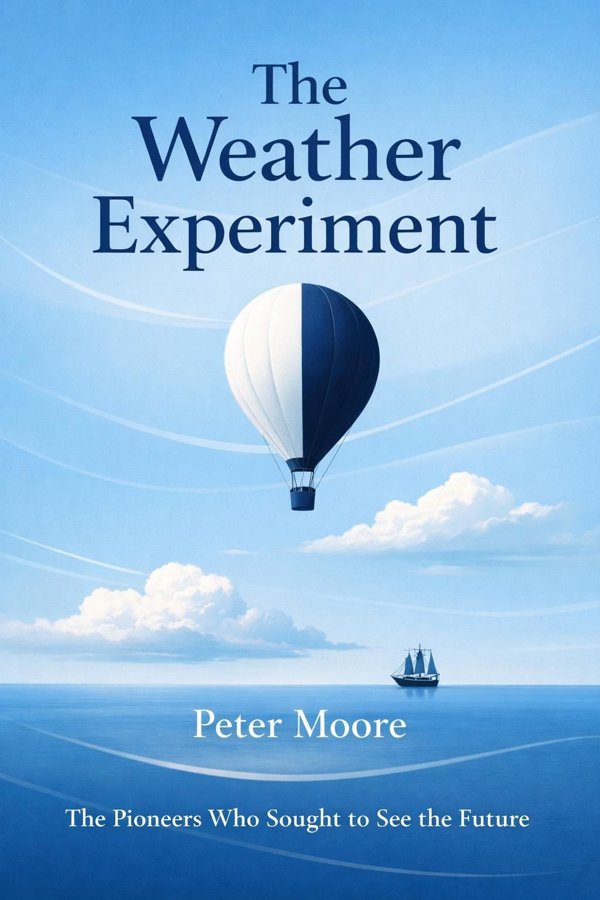
The Weather Experiment: The Pioneers Who Sought to See the Future: Summary & Key Insights
by Peter Moore
 10 min6 chaptersAudio available
What Is The Weather Experiment: The Pioneers Who Sought to See the Future About?
The Weather Experiment: The Pioneers Who Sought to See the Future by Peter Moore is a world_history book spanning 6 pages. The Weather Experiment tells the story of the nineteenth-century scientists, sailors, and adventurers who first sought to understand and predict the weather. Peter Moore traces the lives and discoveries of figures such as Robert FitzRoy, Luke Howard, and James Glaisher, whose work laid the foundations for modern meteorology. Through their experiments, observations, and daring balloon flights, they transformed weather from a matter of superstition into a science that could save lives and shape the modern world.
This FizzRead summary covers all 6 key chapters of The Weather Experiment: The Pioneers Who Sought to See the Future in approximately 10 minutes, distilling the most important ideas, arguments, and takeaways from Peter Moore's work. Also available as an audio summary and Key Quotes Podcast.
The Weather Experiment: The Pioneers Who Sought to See the Future
The Weather Experiment tells the story of the nineteenth-century scientists, sailors, and adventurers who first sought to understand and predict the weather. Peter Moore traces the lives and discoveries of figures such as Robert FitzRoy, Luke Howard, and James Glaisher, whose work laid the foundations for modern meteorology. Through their experiments, observations, and daring balloon flights, they transformed weather from a matter of superstition into a science that could save lives and shape the modern world.
Who Should Read The Weather Experiment: The Pioneers Who Sought to See the Future?
This book is perfect for anyone interested in world_history and looking to gain actionable insights in a short read. Whether you're a student, professional, or lifelong learner, the key ideas from The Weather Experiment: The Pioneers Who Sought to See the Future by Peter Moore will help you think differently.
- ✓Readers who enjoy world_history and want practical takeaways
- ✓Professionals looking to apply new ideas to their work and life
- ✓Anyone who wants the core insights of The Weather Experiment: The Pioneers Who Sought to See the Future in just 10 minutes
Want the full summary?
Get instant access to this book summary and 100K+ more with Fizz Moment.
Get Free SummaryAvailable on App Store • Free to download
Key Chapters
When I first encountered Luke Howard’s story, I understood how revolutionary simplicity can be. Howard was not an official scientist, but a Quaker chemist by trade—an amateur with an extraordinary habit of observation. In the early years of the nineteenth century, he sat before the London sky and realized humanity’s need for a common language to describe clouds. Until then, clouds were metaphors: sublime, divine, mysterious. Howard gave them taxonomy—Cumulus, Cirrus, Stratus—as elegant and systematic as Linnaeus’s classification of plants. His act marked the birth of descriptive meteorology.
Through his lens, poetry met precision. Goethe was so enchanted by Howard’s classification that he wrote tributes in verse, recognizing that naming the clouds meant taming the ephemeral. This intellectual shift may sound modest today, but at the time it bridged art and science, turning the heavens into a readable text rather than an ineffable canvas. Howard’s insight triggered a movement toward systemization: once clouds could be described, they could be measured, related to conditions on the ground, and eventually understood as part of a larger atmospheric machine.
Howard’s legacy resonates far beyond his lifetime. His vocabulary still underlies every meteorological chart and every weather forecast. I wrote this chapter as both homage and foundation—it is about seeing with discipline. He taught that understanding begins not with instruments but with attention, and that even the simplest act of naming can transform chaos into knowledge. Howard’s classified skies became maps of motion, and those maps led others to search deeper—to probe pressure, temperature, and altitude. His calm gaze upward became the point of departure for an age of discovery.
As Britain industrialized, weather stopped being a curiosity and became a force shaping lives and economies. Coal dust filled the air, ships carried goods across oceans, and storms could destroy fortunes overnight. Industrialization made timing and planning essential, so understanding atmospheric behavior gained urgency. The same period saw unprecedented global exploration—steamships and railways opened distant lands, and scientific curiosity accompanied every expedition.
In this context, weather transformed from local folklore into empirical necessity. Observations were recorded by sailors and explorers, compiled by naturalists, and exchanged through letters. Yet without coordination, these efforts remained isolated glimpses. The growing industrial world demanded systemic prediction: farmers, railway operators, and mariners alike needed forecasts to survive and profit.
I show how industrial Britain bred the infrastructure for meteorology itself—networks of stations, telegraph communication, precision instruments, and a mindset of measurement that prized data for its own sake. The steam age taught society to confront the future instead of waiting passively. In the hum of progress, the question arose: could weather, like machinery, be mastered? This moment is crucial to our story, for it merged scientific ambition with practical need, setting the stage for FitzRoy’s later mission. The weather was becoming a component of civilization, and those who sought to predict it were architects of a new kind of control.
+ 4 more chapters — available in the FizzRead app
All Chapters in The Weather Experiment: The Pioneers Who Sought to See the Future
About the Author
Peter Moore is a British writer and historian known for his works on science, exploration, and cultural history. He studied English literature and has written for publications such as The Guardian and The Times. His books often explore the intersection of human curiosity and scientific discovery.
Get This Summary in Your Preferred Format
Read or listen to the The Weather Experiment: The Pioneers Who Sought to See the Future summary by Peter Moore anytime, anywhere. FizzRead offers multiple formats so you can learn on your terms — all free.
Available formats: App · Audio · PDF · EPUB — All included free with FizzRead
Download The Weather Experiment: The Pioneers Who Sought to See the Future PDF and EPUB Summary
Key Quotes from The Weather Experiment: The Pioneers Who Sought to See the Future
“When I first encountered Luke Howard’s story, I understood how revolutionary simplicity can be.”
“As Britain industrialized, weather stopped being a curiosity and became a force shaping lives and economies.”
Frequently Asked Questions about The Weather Experiment: The Pioneers Who Sought to See the Future
The Weather Experiment: The Pioneers Who Sought to See the Future by Peter Moore is a world_history book that explores key ideas across 6 chapters. The Weather Experiment tells the story of the nineteenth-century scientists, sailors, and adventurers who first sought to understand and predict the weather. Peter Moore traces the lives and discoveries of figures such as Robert FitzRoy, Luke Howard, and James Glaisher, whose work laid the foundations for modern meteorology. Through their experiments, observations, and daring balloon flights, they transformed weather from a matter of superstition into a science that could save lives and shape the modern world.
You Might Also Like
The Age of Capital
Eric Hobsbawm
10 min
The Gulag Archipelago
Aleksandr Solzhenitsyn
10 min
Jerusalem: The Biography
Simon Sebag Montefiore
10 min
The Anglo-Saxons
James Campbell
10 min
The Boer War
Thomas Pakenham
10 min
The Industrial Revolutionaries: The Making of the Modern World 1776–1914
Gavin Weightman
10 minBrowse by Category
Ready to read The Weather Experiment: The Pioneers Who Sought to See the Future?
Get the full summary and 100K+ more books with Fizz Moment.