
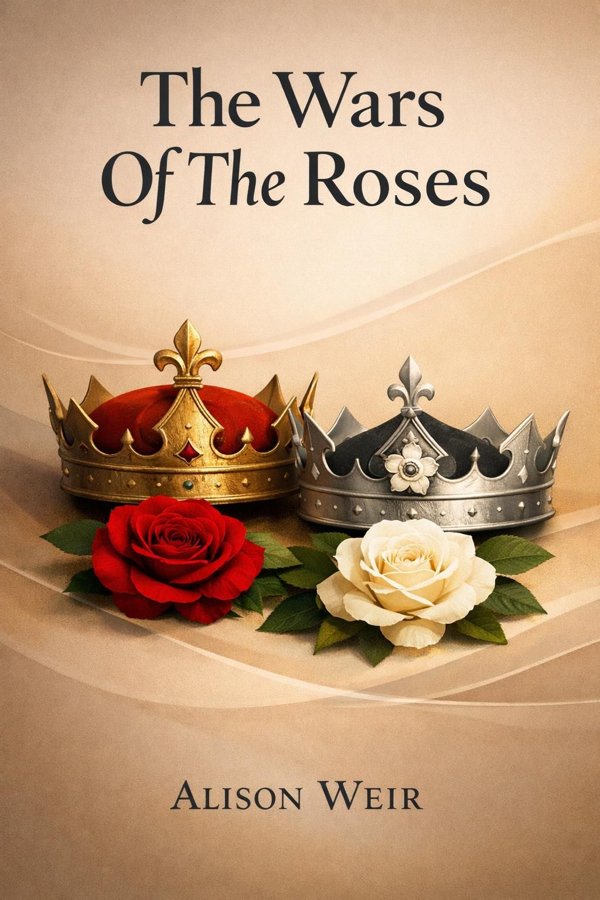
The Wars Of The Roses: Summary & Key Insights
by Alison Weir
 10 min9 chaptersAudio available
Key Takeaways from The Wars Of The Roses
Civil wars rarely begin with a single battle; they begin when institutions stop commanding trust.
When a kingdom cannot decide who should govern, the man who claims to restore order may soon claim the crown itself.
In dynastic politics, bloodline is never just genealogy; it is strategy, propaganda, and power.
Victory in war does not end instability unless the victor can turn conquest into governance.
The most dangerous power in a weak state often belongs not to the ruler, but to the man who can make rulers.
What Is The Wars Of The Roses About?
The Wars Of The Roses by Alison Weir is a world_history book spanning 5 pages. The Wars of the Roses is Alison Weir’s sweeping account of the dynastic struggle that convulsed fifteenth-century England, pitting the rival houses of Lancaster and York against one another in a brutal contest for legitimacy, power, and survival. More than a tale of crowns changing heads, this book reveals how weak kingship, noble ambition, personal vengeance, and shifting loyalties pushed a kingdom into repeated civil war. Weir brings to life famous figures such as Henry VI, Margaret of Anjou, Richard, Duke of York, Edward IV, Richard III, and Henry Tudor, while also showing how the conflict affected the wider political nation beyond the battlefield. What makes the book especially compelling is its balance of narrative drive and historical depth: battles matter, but so do marriages, propaganda, inheritance claims, and private grudges. Weir’s authority as a historian of English royalty gives the story clarity without draining it of drama. The result is an accessible yet richly textured history that helps readers understand not only how England descended into chaos, but how that chaos cleared the way for the Tudor age.
This FizzRead summary covers all 9 key chapters of The Wars Of The Roses in approximately 10 minutes, distilling the most important ideas, arguments, and takeaways from Alison Weir's work. Also available as an audio summary and Key Quotes Podcast.
The Wars Of The Roses
The Wars of the Roses is Alison Weir’s sweeping account of the dynastic struggle that convulsed fifteenth-century England, pitting the rival houses of Lancaster and York against one another in a brutal contest for legitimacy, power, and survival. More than a tale of crowns changing heads, this book reveals how weak kingship, noble ambition, personal vengeance, and shifting loyalties pushed a kingdom into repeated civil war. Weir brings to life famous figures such as Henry VI, Margaret of Anjou, Richard, Duke of York, Edward IV, Richard III, and Henry Tudor, while also showing how the conflict affected the wider political nation beyond the battlefield. What makes the book especially compelling is its balance of narrative drive and historical depth: battles matter, but so do marriages, propaganda, inheritance claims, and private grudges. Weir’s authority as a historian of English royalty gives the story clarity without draining it of drama. The result is an accessible yet richly textured history that helps readers understand not only how England descended into chaos, but how that chaos cleared the way for the Tudor age.
Who Should Read The Wars Of The Roses?
This book is perfect for anyone interested in world_history and looking to gain actionable insights in a short read. Whether you're a student, professional, or lifelong learner, the key ideas from The Wars Of The Roses by Alison Weir will help you think differently.
- ✓Readers who enjoy world_history and want practical takeaways
- ✓Professionals looking to apply new ideas to their work and life
- ✓Anyone who wants the core insights of The Wars Of The Roses in just 10 minutes
Want the full summary?
Get instant access to this book summary and 100K+ more with Fizz Moment.
Get Free SummaryAvailable on App Store • Free to download
Key Chapters
Civil wars rarely begin with a single battle; they begin when institutions stop commanding trust. Alison Weir shows that the Wars of the Roses emerged from a long deterioration in royal authority under Henry VI, whose reign exposed how vulnerable England had become after the triumphs of Henry V. Crowned as an infant, Henry VI inherited not only a throne but impossible expectations. He lacked his father’s force of character, military skill, and political command. Worse, periods of mental collapse left a dangerous vacuum at the center of government. In that vacuum, rival magnates competed for influence, offices, and control over the king.
Weir explains that the roots of the conflict lay in both personality and structure. England’s losses in France damaged royal prestige and intensified domestic tensions. Powerful nobles maintained private followings, regional feuds simmered, and factional politics at court turned every appointment into a struggle for advantage. Queen Margaret of Anjou became a forceful political player, but her activism also sharpened divisions. At the same time, questions of dynastic legitimacy never fully disappeared. Descendants of Edward III carried competing claims, and as confidence in Henry VI waned, those claims became politically explosive.
A practical way to understand this is to think of any organization where weak leadership meets unresolved succession issues. Even a legitimate leader can lose control if decision-making stalls, trusted intermediaries fail, and ambitious subordinates begin acting like alternatives. The Wars of the Roses reminds us that legitimacy is not just inherited; it must be exercised.
Actionable takeaway: When studying political or organizational collapse, look first at where authority became weak, contested, or absent, because conflict usually grows from that gap.
When a kingdom cannot decide who should govern, the man who claims to restore order may soon claim the crown itself. Weir presents Richard, Duke of York, as a figure driven by both principle and ambition. He was not merely a rebel eager for upheaval. He had a serious dynastic claim to the throne through descent from Edward III, and at first he positioned himself as a reformer seeking to correct misgovernment rather than overthrow Henry VI outright.
York’s early role is crucial because it shows how constitutional tension can become military conflict. He objected to the influence of royal favorites and the failures of Lancastrian leadership, especially after defeats in France and the king’s mental breakdown. For a time, York was appointed Protector of the Realm, a role that gave him authority while preserving Henry’s kingship. But this arrangement depended on political cooperation that did not exist. Margaret of Anjou saw York as a threat to her husband and her son’s inheritance. Court rivalries hardened into armed camps.
Weir traces how the dispute crossed a point of no return. The First Battle of St Albans in 1455 was not yet a full civil war, but it shattered the expectation that elite conflict could remain contained. Violence now became a political instrument. The duke who had sought recognition and influence through council and precedent increasingly faced a reality in which only force could secure position.
The broader lesson is familiar in many settings: once parties lose faith in neutral institutions, they begin building power outside them. In politics, business, or public life, conflict escalates when one side concludes that procedure no longer protects its future.
Actionable takeaway: Notice the moment when reform rhetoric turns into power struggle, because that transition often marks the true beginning of open conflict.
In dynastic politics, bloodline is never just genealogy; it is strategy, propaganda, and power. One of Weir’s central achievements is showing that the Wars of the Roses were fought not only on battlefields but in arguments about rightful rule. Both Lancastrians and Yorkists had to persuade nobles, clergy, and local elites that their cause was lawful, divinely favored, and politically safer than the alternative.
The House of Lancaster held the throne through Henry IV’s seizure of power in 1399, an act that always carried a stain of usurpation. As long as Lancastrian kings were strong, that weakness could be managed. But under Henry VI, the issue resurfaced. Richard of York could point to a superior hereditary claim in some respects, and later his son Edward IV would combine military success with arguments of dynastic right. These claims mattered because medieval kingship depended on recognition. A king was not simply the strongest noble; he had to be accepted as the anointed ruler.
Weir also highlights the role of Parliament, oaths, marriage alliances, and public ceremony in manufacturing legitimacy. The Act of Accord, for example, attempted to settle succession by recognizing York as Henry VI’s heir, disinheriting Prince Edward. It solved nothing because legitimacy on parchment could not overcome a mother’s determination or a faction’s fear. Similarly, later controversies around Edward IV’s children and Richard III reveal how quickly legal and moral arguments could be weaponized.
Modern readers can apply this insight beyond monarchy. Leadership transitions in any institution require more than formal succession rules. They also require a convincing story about why the transfer is fair, stable, and in the common interest. Without that story, every succession becomes vulnerable.
Actionable takeaway: Whenever power changes hands, ask not only who has authority on paper, but who can make that authority feel legitimate to others.
Victory in war does not end instability unless the victor can turn conquest into governance. Weir shows that Edward IV’s rise marked a dramatic turning point in the Wars of the Roses because he possessed something his father lacked: battlefield charisma combined with the practical instincts of a ruler. After Richard of York’s death, the Yorkist cause passed to a younger, more dynamic leader. Edward’s triumph at Towton in 1461, one of the bloodiest battles fought on English soil, effectively secured the throne for the House of York and drove Henry VI’s regime into collapse.
But Edward’s reign was not a simple restoration of order. Weir stresses that kingship after civil war required constant management. Edward had to reward supporters without empowering them excessively, reconcile former enemies where possible, and project confidence in a realm exhausted by conflict. His unexpected marriage to Elizabeth Woodville complicated this effort. The match angered powerful allies, especially Richard Neville, Earl of Warwick, who had expected to shape royal policy through foreign marriage diplomacy and aristocratic patronage.
Edward’s story is a reminder that successful leaders often stumble not in winning power but in distributing it afterward. His reign demonstrates the difficulty of balancing personal choice with political necessity. He was capable, energetic, and often effective, yet his decisions created resentments that would later destabilize the Yorkist settlement. Still, compared with Henry VI, Edward represented decisive kingship, and that mattered enormously.
In practical terms, this pattern appears whenever a new leader enters office after a crisis. The coalition that wins power is rarely the coalition that can govern harmoniously. Promises made in struggle become liabilities in peace.
Actionable takeaway: After any victory, focus immediately on coalition management, because unresolved resentments among allies can undo what opponents failed to destroy.
The most dangerous power in a weak state often belongs not to the ruler, but to the man who can make rulers. Weir’s treatment of Richard Neville, Earl of Warwick, explains why the Wars of the Roses were so unstable even after major victories. Warwick helped place Edward IV on the throne and became famous as the “Kingmaker,” yet his influence rested on a fragile mix of military reputation, wealth, family networks, and personal ambition. He was indispensable until he became intolerable.
Warwick expected deference and strategic control, especially in diplomacy and patronage. Edward IV’s independent streak, and particularly his secret marriage to Elizabeth Woodville, challenged that expectation. The rise of the Woodville family threatened Warwick’s access to power. Weir shows how personal affront, political disagreement, and dynastic anxiety fused into open rebellion. In one of the most startling reversals of the period, Warwick abandoned the Yorkist king he had elevated and allied with his former enemy, Margaret of Anjou, to restore Henry VI.
This episode captures a central truth of the wars: loyalty was often conditional, and political identities were less fixed than later memory suggests. Nobles changed sides not always because they lacked principles, but because survival, kinship, regional interests, and wounded prestige mattered alongside ideology. The brief “Readeption” of Henry VI exposed how reversible victories could be in a landscape where elite support was transactional.
Modern readers can see parallels in coalition politics, corporate boards, or revolutionary movements. Influential backers may support a leader only while they believe their status is secure. When excluded, they can become the most dangerous opponents because they know the system from within.
Actionable takeaway: Never confuse an ally’s usefulness with permanent loyalty; stable leadership requires reducing dependency on power brokers who expect to rule from behind the throne.
History often remembers the names of kings, but civil war is endured most painfully by those who never sought power. Weir does not reduce the Wars of the Roses to a pageant of noble rivalry; she also reveals the wider human cost of repeated instability. Armies had to be raised, supplied, and quartered. Local communities were pulled into magnate feuds. Merchants suffered from disrupted trade, landowners faced confiscation, and families could be ruined by association with the losing side.
Although the conflict did not engulf every region continuously, the uncertainty it created was itself damaging. If a title, estate, or office depended on political favor, each regime change generated fear. Attainders allowed victors to strip enemies of lands and rights, turning defeat into hereditary disaster. Men were expected to serve powerful lords; refusal could be dangerous, but service could prove fatal if fortunes changed. Even those far from battle lived under the pressure of rumors, taxation, and arbitrary enforcement.
Weir’s approach helps readers avoid a common mistake: imagining medieval dynastic war as distant from everyday life. In reality, legitimacy disputes at the top shaped property, law, and physical safety below. This insight remains relevant. Political instability may begin among elites, but it spreads through institutions that affect ordinary people’s livelihoods.
A practical application is to read political crises not only in terms of leadership drama but in terms of who bears secondary consequences. When governments break down, the burden often falls on those with the least power to influence events.
Actionable takeaway: In any historical or contemporary conflict, ask how changes at the top alter security, law, and livelihood for ordinary people, because that is where the true cost becomes visible.
A regime can survive military threats more easily than moral suspicion. Weir��s account of Richard III focuses on the speed with which Yorkist power unraveled after Edward IV’s death in 1483. Edward left behind a seemingly secure dynasty, but his heir, Edward V, was a child. That reopened the central problem of the age: what happens when kingship depends on protecting a vulnerable succession in a world of ambitious relatives and mistrustful nobles?
Richard, Duke of Gloucester, initially moved as protector of his nephew, but events rapidly escalated. The marriage of Edward IV and Elizabeth Woodville was declared invalid, their children were proclaimed illegitimate, and Richard took the crown. The disappearance of the princes in the Tower became the defining shadow over his reign. Weir treats the episode with attention to evidence and uncertainty, but she also emphasizes a crucial historical fact: whether or not Richard ordered their deaths, many contemporaries believed him capable of it. In politics, damaging belief can matter as much as proven guilt.
Richard III was not without ability. He attempted legal reforms, sought to govern actively, and cultivated support in the north. Yet his title was insecure, and every rumor amplified his vulnerability. Buckingham’s rebellion and the persistence of exiled opposition showed that a king who seemed to have seized power from his own kin faced an uphill battle in winning trust.
The larger lesson is stark. Leaders who inherit crises must understand that process and perception are inseparable. If the path to power appears tainted, later competence may not be enough to restore confidence.
Actionable takeaway: Protecting legitimacy during succession matters as much as securing office itself, because once public trust collapses, even effective rule may come too late.
Founding myths are often born from messy victories. Weir presents the Battle of Bosworth in 1485 as both an ending and a beginning: the defeat of Richard III closed the main Yorkist phase of the wars, but Henry Tudor’s triumph did not instantly resolve England’s dynastic fragility. Henry’s claim to the throne was relatively weak by blood. What made him king was victory, political opportunity, and the exhaustion of a nation desperate for settlement.
Henry understood that force alone would not secure a lasting dynasty. His marriage to Elizabeth of York symbolically united the rival houses and allowed him to present the Tudor regime as reconciliation rather than merely replacement. Yet Weir makes clear that this image was carefully constructed. Henry dated his reign from the day before Bosworth so that those who fought against him could be treated as traitors. He moved swiftly against rivals and later faced Yorkist challenges, including pretenders such as Lambert Simnel and Perkin Warbeck.
Bosworth matters because it reveals how new regimes consolidate power: by controlling the narrative of victory, neutralizing remaining claimants, and converting a battlefield success into a durable legal and dynastic order. Henry VII was not a romantic peacemaker in the modern sense. He was cautious, calculating, and determined to prevent the nobility from regaining the autonomy that had fueled earlier disorder.
For modern readers, the lesson is that transitions after prolonged conflict require both symbolism and systems. Public gestures of unity must be backed by administrative control, financial discipline, and credible enforcement.
Actionable takeaway: After any decisive turning point, watch how the new leadership transforms victory into institutions, because peace lasts only when narrative and structure reinforce each other.
The way a conflict is remembered can shape history almost as much as the conflict itself. One of the lasting values of Weir’s book is that it helps readers separate the historical Wars of the Roses from the dramatic myths that later surrounded them. Tudor chroniclers had strong incentives to depict the preceding decades as a nightmare of chaos redeemed by Tudor peace. Shakespeare later transformed key figures, especially Richard III, into enduring cultural symbols. These portrayals are powerful, but they can flatten a complicated reality.
Weir restores complexity by showing that the wars were not continuous, simple, or inevitable. They unfolded in phases, with periods of uneasy stability between eruptions of violence. Individuals were not cardboard villains or heroes; they acted within a world where honor, inheritance, affinity, piety, and survival overlapped. Even notorious figures become more understandable when placed within the pressures of the time. This does not excuse brutality, but it prevents lazy judgment.
Why does this matter now? Because every age inherits political stories that simplify the past into morality tales. If we accept those stories uncritically, we miss how institutions fail, how legitimacy is built, and how fear distorts choice. The Wars of the Roses becomes more useful when read not as a medieval melodrama, but as a study in how states fracture when succession is unstable and elites stop trusting common rules.
A practical reading strategy is to compare narrative history with the motives behind sources. Ask who benefits from a particular version of events and what later regime had reason to shape public memory.
Actionable takeaway: Read famous historical conflicts with suspicion toward inherited myths, because understanding the gap between event and memory is essential to understanding both history and power.
All Chapters in The Wars Of The Roses
About the Author
Alison Weir is a British historian and bestselling author celebrated for her accessible, deeply researched books on English royal history. She has written widely on medieval and Tudor subjects, including biographies of kings, queens, and noblewomen whose lives shaped the English monarchy. Weir is especially admired for translating complex dynastic politics into clear, compelling narrative, making her work popular with both general readers and dedicated history enthusiasts. Her books often blend strong storytelling with close attention to primary sources, chronology, and historical debate. Because much of her scholarship centers on succession, court politics, and the personalities of royal power, she is particularly well qualified to write about the Wars of the Roses, a period defined by disputed claims, fragile kingship, and dramatic political change.
Get This Summary in Your Preferred Format
Read or listen to the The Wars Of The Roses summary by Alison Weir anytime, anywhere. FizzRead offers multiple formats so you can learn on your terms — all free.
Available formats: App · Audio · PDF · EPUB — All included free with FizzRead
Download The Wars Of The Roses PDF and EPUB Summary
Key Quotes from The Wars Of The Roses
“Civil wars rarely begin with a single battle; they begin when institutions stop commanding trust.”
“When a kingdom cannot decide who should govern, the man who claims to restore order may soon claim the crown itself.”
“In dynastic politics, bloodline is never just genealogy; it is strategy, propaganda, and power.”
“Victory in war does not end instability unless the victor can turn conquest into governance.”
“The most dangerous power in a weak state often belongs not to the ruler, but to the man who can make rulers.”
Frequently Asked Questions about The Wars Of The Roses
The Wars Of The Roses by Alison Weir is a world_history book that explores key ideas across 9 chapters. The Wars of the Roses is Alison Weir’s sweeping account of the dynastic struggle that convulsed fifteenth-century England, pitting the rival houses of Lancaster and York against one another in a brutal contest for legitimacy, power, and survival. More than a tale of crowns changing heads, this book reveals how weak kingship, noble ambition, personal vengeance, and shifting loyalties pushed a kingdom into repeated civil war. Weir brings to life famous figures such as Henry VI, Margaret of Anjou, Richard, Duke of York, Edward IV, Richard III, and Henry Tudor, while also showing how the conflict affected the wider political nation beyond the battlefield. What makes the book especially compelling is its balance of narrative drive and historical depth: battles matter, but so do marriages, propaganda, inheritance claims, and private grudges. Weir’s authority as a historian of English royalty gives the story clarity without draining it of drama. The result is an accessible yet richly textured history that helps readers understand not only how England descended into chaos, but how that chaos cleared the way for the Tudor age.
You Might Also Like
The Age of Capital
Eric Hobsbawm
10 min
The Gulag Archipelago
Aleksandr Solzhenitsyn
10 min
Jerusalem: The Biography
Simon Sebag Montefiore
10 min
The Anglo-Saxons
James Campbell
10 min
The Boer War
Thomas Pakenham
10 min
The Industrial Revolutionaries: The Making of the Modern World 1776–1914
Gavin Weightman
10 minBrowse by Category
Ready to read The Wars Of The Roses?
Get the full summary and 100K+ more books with Fizz Moment.