
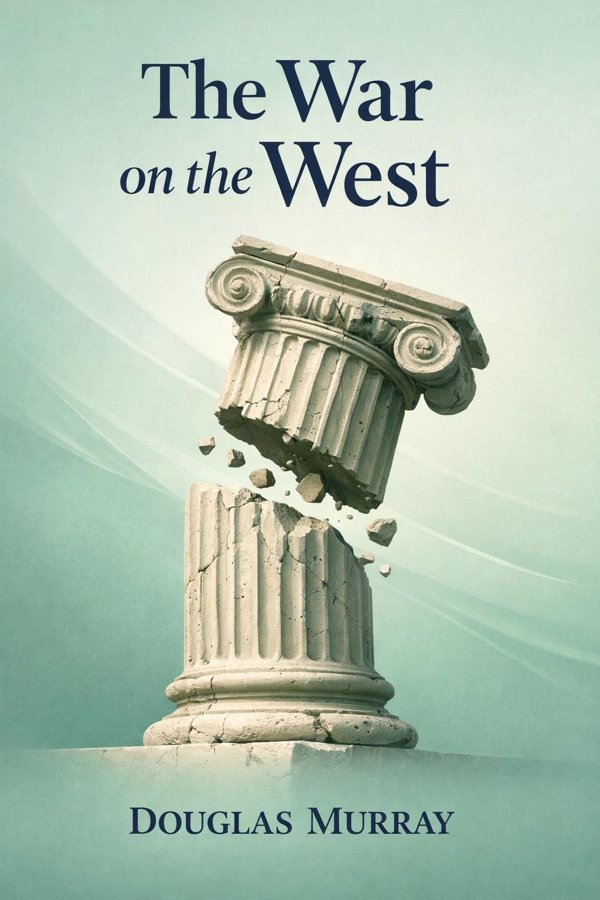
The War on the West: Summary & Key Insights
 10 min10 chaptersAudio available
Key Takeaways from The War on the West
A civilization can survive external attack more easily than sustained internal contempt.
How a society talks about race reveals what it believes about justice, memory, and human possibility.
A society loses its bearings when it treats history as a courtroom but ignores evidence that complicates the verdict.
Ideas that begin in seminar rooms often end up governing headlines, HR policies, and public morality.
A culture in decline often begins by distrusting its own masterpieces.
What Is The War on the West About?
The War on the West by Douglas Murray is a politics book spanning 10 pages. The War on the West is Douglas Murray’s forceful defense of Western civilization at a moment when many of its own citizens have become deeply suspicious of its history, institutions, and moral legitimacy. Murray argues that the West is increasingly judged not by the totality of its achievements, but by a selective retelling of its failures—especially around empire, slavery, race, religion, and national identity. In his view, this has created a culture of guilt that often ignores context, rejects nuance, and encourages self-rejection rather than honest reform. The book matters because these arguments now shape education, media, politics, museums, and everyday language, influencing how societies understand both their past and their future. Murray does not claim the West is blameless. Instead, he insists that its defining strength has been its capacity for self-criticism, self-correction, and the expansion of liberty. As a British author and political commentator known for writing on culture and identity, Murray brings a polemical but informed perspective to one of the most divisive debates of our time.
This FizzRead summary covers all 10 key chapters of The War on the West in approximately 10 minutes, distilling the most important ideas, arguments, and takeaways from Douglas Murray's work. Also available as an audio summary and Key Quotes Podcast.
The War on the West
The War on the West is Douglas Murray’s forceful defense of Western civilization at a moment when many of its own citizens have become deeply suspicious of its history, institutions, and moral legitimacy. Murray argues that the West is increasingly judged not by the totality of its achievements, but by a selective retelling of its failures—especially around empire, slavery, race, religion, and national identity. In his view, this has created a culture of guilt that often ignores context, rejects nuance, and encourages self-rejection rather than honest reform. The book matters because these arguments now shape education, media, politics, museums, and everyday language, influencing how societies understand both their past and their future. Murray does not claim the West is blameless. Instead, he insists that its defining strength has been its capacity for self-criticism, self-correction, and the expansion of liberty. As a British author and political commentator known for writing on culture and identity, Murray brings a polemical but informed perspective to one of the most divisive debates of our time.
Who Should Read The War on the West?
This book is perfect for anyone interested in politics and looking to gain actionable insights in a short read. Whether you're a student, professional, or lifelong learner, the key ideas from The War on the West by Douglas Murray will help you think differently.
- ✓Readers who enjoy politics and want practical takeaways
- ✓Professionals looking to apply new ideas to their work and life
- ✓Anyone who wants the core insights of The War on the West in just 10 minutes
Want the full summary?
Get instant access to this book summary and 100K+ more with Fizz Moment.
Get Free SummaryAvailable on App Store • Free to download
Key Chapters
A civilization can survive external attack more easily than sustained internal contempt. Murray begins by tracing how criticism of the West evolved from a healthy moral reckoning into something more sweeping and accusatory. After the catastrophes of the twentieth century, especially the Holocaust and the collapse of empires, many Western thinkers understandably asked whether the civilization they inherited carried deep moral flaws. That question, Murray argues, was legitimate. The problem arose when reflection hardened into a habit of interpreting nearly every Western achievement through the lens of oppression.
He suggests that in universities, cultural theory, and political discourse, a framework emerged in which the West became uniquely guilty. Colonialism, slavery, capitalism, Christianity, borders, and national traditions were increasingly treated not as subjects for balanced study but as evidence in a moral prosecution. In this framework, historical complexity gives way to a simplified narrative of victims and oppressors. Murray’s concern is not that wrongdoing is examined, but that all roads lead to the same conclusion: Western civilization is structurally illegitimate.
This idea has practical effects. A student may learn more about historical crimes than about the institutions that abolished slavery, developed constitutional government, or expanded individual rights. A public debate may reward moral denunciation over careful comparison with other civilizations. Murray argues that this distorts the past and weakens confidence in the present.
His broader point is that self-criticism becomes destructive when it ceases to aim at improvement and begins to nourish civilizational disgust. The actionable takeaway: examine historical criticism closely and ask whether it seeks truth and reform, or whether it assumes guilt before inquiry even begins.
How a society talks about race reveals what it believes about justice, memory, and human possibility. Murray argues that contemporary discussions of race often portray the West as singularly defined by slavery and racism, despite the fact that Western societies were also the places where anti-slavery movements, civil rights reforms, and ideals of legal equality gained extraordinary force. His claim is not that racism was minor or that injustice is over. It is that the dominant story has become radically imbalanced.
He challenges the tendency to frame all disparities as proof of permanent racial guilt embedded in Western culture. In his view, this can encourage a worldview where people are reduced to inherited moral categories: some are taught to see themselves as oppressors, others as permanent victims. Such thinking may feel morally serious, but Murray argues that it can freeze individuals inside historical roles rather than treating them as citizens with agency and shared obligations.
He also points to the irony that Western nations uniquely publicize, debate, and institutionalize criticism of their own racial failures. Museums, schools, corporations, and governments devote enormous attention to these questions. For Murray, this openness should be seen not only as evidence of past wrongdoing but also as a sign of moral seriousness and self-correction.
In practice, his argument invites a more precise conversation. We can condemn slavery, segregation, and discrimination while also acknowledging abolition, integration, and rights-based progress. We can oppose racism without embracing narratives that make reconciliation impossible. The actionable takeaway: when discussing race, reject both denial and fatalism, and insist on a fuller story that includes injustice, reform, and the possibility of common civic identity.
A society loses its bearings when it treats history as a courtroom but ignores evidence that complicates the verdict. Murray argues that one of the central problems in current debates about the West is the stripping away of context. Historical figures, events, and institutions are often judged by present-day standards without sufficient attention to what alternatives existed at the time, how norms differed, or how contested those issues already were within Western societies themselves.
This does not mean historical actors should be excused. Murray’s point is that context is what makes moral understanding possible. A statesman who held views common in his age may still deserve criticism, but that criticism becomes more meaningful when we also ask what else he stood for, what reforms he advanced, and how his society changed. Without context, history becomes a competition in moral simplification. Statues, books, and national narratives are then evaluated almost entirely on whether they satisfy current ideological demands.
Murray sees this in controversies over monuments, school curricula, and museum displays. Once a culture learns to define its past chiefly through sin, it may begin to believe it has inherited nothing worth defending. But a mature historical consciousness can hold two truths at once: people and nations can achieve great things while also committing grave wrongs.
In everyday terms, this means reading history comparatively, not tribally. Ask how a society confronted its own evils, not just whether those evils existed. Ask what principles it generated that later made reform possible. The actionable takeaway: whenever a historical judgment seems too neat, restore context by asking what the full record shows, what standards prevailed at the time, and what institutions enabled later progress.
Ideas that begin in seminar rooms often end up governing headlines, HR policies, and public morality. Murray argues that academia has played a decisive role in turning critique of the West into an organizing worldview. Universities, in his account, have increasingly rewarded theories that interpret culture through power, identity, and inherited oppression. Over time, these frameworks moved from specialized scholarship into mainstream discourse, where they now influence everything from school teaching to corporate training.
Murray is particularly concerned that many institutions of higher learning no longer prioritize open inquiry as strongly as they once did. Instead, some campuses encourage moral conformity by treating dissent from fashionable views as evidence of insensitivity or hostility. When this happens, students may become less able to test arguments, compare evidence, or tolerate disagreement. The result is not better scholarship but a narrowing of acceptable thought.
He also notes how administrative growth and diversity bureaucracies can institutionalize particular ideological assumptions. Concepts that were once debated become embedded in policies, language rules, and mandatory programs. A university then stops being merely a place where ideas are examined and becomes a place where certain conclusions are pre-approved.
The practical implications are wide. Graduates carry these assumptions into journalism, law, publishing, education, and government. That is why Murray treats campus culture not as a fringe issue but as a major engine of social change.
His argument is ultimately a defense of intellectual pluralism. If a civilization is to examine itself honestly, it needs institutions where competing interpretations can be argued rather than enforced. The actionable takeaway: in educational settings, defend viewpoint diversity and ask whether an institution is teaching students what to think, or how to think.
A culture in decline often begins by distrusting its own masterpieces. Murray argues that the contest over the West is not only political or academic; it is also aesthetic. Literature, painting, music, architecture, and public monuments have become battlegrounds in a wider struggle over moral legitimacy. Increasingly, cultural works are judged less by artistic achievement or historical significance than by whether their creators or subjects conform to present ethical expectations.
Murray worries that this leads to a flattening of culture. Great works are reduced to evidence files in a case against dead authors, empires, men, Christians, or Europeans. Instead of asking why a novel endures, why a symphony moves listeners, or why a painting reveals something profound about human experience, institutions may foreground a checklist of ideological concerns. That can be informative in moderation, but when it becomes the dominant lens, aesthetic appreciation gives way to moral suspicion.
He does not argue that art should be insulated from criticism. Rather, he objects to a pattern in which criticism aims less to understand than to delegitimize. A museum that contextualizes an imperial artifact may enrich understanding. A museum that treats an entire artistic tradition as morally tainted may train visitors to approach inheritance with embarrassment rather than curiosity.
This has consequences beyond elite culture. School reading lists, theater programming, publishing trends, and even streaming recommendations increasingly reflect judgments about what deserves preservation. When standards become mainly political, societies risk severing younger generations from the cultural language that shaped them.
The actionable takeaway: engage classic works with honesty and context, but resist pressures to discard them simply because they emerge from an imperfect civilization. Cultural inheritance should be examined critically, not abandoned reflexively.
When older moral frameworks weaken, new orthodoxies often rush in to replace them. Murray explores how the decline of Christianity in Western societies has not eliminated moral fervor but redirected it. In his view, many contemporary political movements borrow the emotional structure of religion—sin, guilt, confession, heresy, excommunication—without retaining the balancing elements of forgiveness, humility, or universal human fallibility.
He argues that this helps explain the intensity of modern ideological battles. If politics becomes the place where people seek purity, meaning, and redemption, then disagreement no longer looks like ordinary difference; it looks like moral corruption. In such a climate, debates over race, gender, nationalism, or history can take on a quasi-religious tone. Public confession is demanded, language is policed, and some offenders are treated as beyond rehabilitation.
Murray does not insist that a society must be traditionally religious to remain healthy. His deeper point is that moral systems matter, and when inherited ones collapse, replacement systems may arise that are harsher and less self-aware. Christianity, for all its institutional failures, helped transmit ideas of conscience, mercy, repentance, and the equal worth of souls. If those are discarded while guilt remains, societies may become punitive rather than compassionate.
A practical example is online outrage culture, where a single statement can trigger ritual denunciation without proportion or path back. Murray sees this not as secular rationality but as moral drama detached from grace.
The actionable takeaway: whether religious or not, cultivate moral seriousness alongside mercy. In public life, resist ideological purity tests and preserve space for apology, learning, and human complexity.
The fiercest attacks on the West often focus on the very countries that most relentlessly expose their own flaws. Murray pays special attention to the United States and the United Kingdom, arguing that they have become symbolic targets in the wider campaign against Western history and values. This is partly because of their global influence, partly because of their imperial and racial histories, and partly because English-speaking institutions dominate media, academia, and popular culture.
In Murray’s reading, both countries are habitually interpreted through their worst episodes: slavery, colonialism, class hierarchy, war, and discrimination. Those realities deserve study, but he argues that they are increasingly treated as the essence of these nations rather than as part of a larger story that also includes parliamentary government, free speech traditions, scientific advances, literary richness, anti-slavery activism, civil rights reform, and broadening democratic inclusion.
He is particularly interested in the asymmetry of judgment. Western nations are expected to rehearse their sins constantly, while non-Western powers or historical empires often face less scrutiny in mainstream debate. This does not make Western crimes smaller; it suggests, in Murray’s view, that the issue is not only justice but a civilizational double standard.
Practically, this matters because narratives about America and Britain influence allies, institutions, and educational systems around the world. If these countries are taught to see themselves as little more than engines of exploitation, their citizens may lose confidence in the constitutional and cultural inheritance that still underpins reform.
The actionable takeaway: assess national histories in full. Criticize wrongs honestly, but also identify the institutions, values, and traditions that made self-correction possible and remain worth preserving.
A healthy society remembers its crimes without making them its entire identity. Murray argues that the proper response to Western guilt is neither denial nor masochism, but proportion. He rejects the false choice between whitewashing history and surrendering to a narrative of permanent moral disgrace. Instead, he calls for a posture of responsible inheritance: receiving the past truthfully, acknowledging its injustices, and still defending what is noble, useful, and humane within it.
This requires confidence. Citizens must be willing to say that the West produced extraordinary goods: constitutional government, legal equality as an ideal, scientific inquiry, artistic brilliance, protections for dissent, and a distinctive willingness to criticize itself. These achievements do not erase slavery, conquest, or prejudice. But neither should those wrongs erase everything else.
Murray’s practical response includes resisting lazy generalizations, defending institutions under indiscriminate attack, and refusing collective guilt narratives that assign present moral status by ancestry. He believes people should learn history deeply rather than sloganistically, and should distinguish reform from repudiation. A school can teach empire critically without teaching students to despise their civilization. A museum can examine exploitation without framing all inheritance as contamination.
At a personal level, Murray encourages readers not to retreat into silence when confronted by simplified accusations. Thoughtful disagreement matters. Social trends become orthodoxies partly because too few people challenge them clearly and calmly.
The actionable takeaway: adopt a both-and approach to history—both honest about wrongdoing and confident about achievement. In conversation, education, and civic life, defend nuance, reject inherited guilt, and contribute to reform without joining in cultural self-loathing.
Ideas about history do not stay in books; they shape whether people believe their society is worth sustaining. Murray argues that the long-term consequence of relentless Western self-denunciation is not moral enlightenment but civilizational weakening. If citizens are taught that their traditions are mainly oppressive, their heroes mainly fraudulent, and their institutions mainly masks for domination, they may stop trusting the very frameworks that protect liberty and pluralism.
This loss of confidence can appear in many forms. Public institutions become hesitant to defend national narratives. Teachers fear presenting balanced accounts of history. Political leaders adopt the language of apology without the language of stewardship. Younger generations inherit cynicism before they inherit responsibility. In such a climate, reform becomes harder because people no longer agree on what, if anything, deserves preservation.
Murray also suggests that self-rejection creates strategic vulnerability. A society uncertain of its legitimacy will struggle to defend itself against external rivals or internal extremism. If every expression of national pride is viewed as suspect, then even legitimate attachment to country, culture, and continuity may be stigmatized. Yet stable democracies require more than procedures; they require citizens who feel some loyalty to the civilization that sustains them.
The practical implication is not triumphalism. Murray is not calling for blind patriotism. He is warning that shame, when made foundational, can become politically corrosive. Societies need gratitude as well as critique, continuity as well as correction.
The actionable takeaway: notice where criticism becomes delegitimization. Support forms of education, leadership, and public memory that encourage reform from within a framework of belonging, rather than teaching people to despise the civilization they are tasked with improving.
All Chapters in The War on the West
About the Author
Douglas Murray is a British author, journalist, and political commentator known for his writing on culture, immigration, identity, religion, and the future of Western societies. He is an associate editor of The Spectator and has contributed to numerous major publications and public debates in the UK, Europe, and the United States. Murray is widely recognized for his sharp, polemical style and his willingness to challenge prevailing orthodoxies on topics such as multiculturalism, nationalism, free speech, and social fragmentation. His bestselling books include The Strange Death of Europe, The Madness of Crowds, and The War on the West. Whether praised as a principled defender of liberal civilization or criticized as a controversial public intellectual, Murray remains an influential voice in contemporary political and cultural discussion.
Get This Summary in Your Preferred Format
Read or listen to the The War on the West summary by Douglas Murray anytime, anywhere. FizzRead offers multiple formats so you can learn on your terms — all free.
Available formats: App · Audio · PDF · EPUB — All included free with FizzRead
Download The War on the West PDF and EPUB Summary
Key Quotes from The War on the West
“A civilization can survive external attack more easily than sustained internal contempt.”
“How a society talks about race reveals what it believes about justice, memory, and human possibility.”
“A society loses its bearings when it treats history as a courtroom but ignores evidence that complicates the verdict.”
“Ideas that begin in seminar rooms often end up governing headlines, HR policies, and public morality.”
“A culture in decline often begins by distrusting its own masterpieces.”
Frequently Asked Questions about The War on the West
The War on the West by Douglas Murray is a politics book that explores key ideas across 10 chapters. The War on the West is Douglas Murray’s forceful defense of Western civilization at a moment when many of its own citizens have become deeply suspicious of its history, institutions, and moral legitimacy. Murray argues that the West is increasingly judged not by the totality of its achievements, but by a selective retelling of its failures—especially around empire, slavery, race, religion, and national identity. In his view, this has created a culture of guilt that often ignores context, rejects nuance, and encourages self-rejection rather than honest reform. The book matters because these arguments now shape education, media, politics, museums, and everyday language, influencing how societies understand both their past and their future. Murray does not claim the West is blameless. Instead, he insists that its defining strength has been its capacity for self-criticism, self-correction, and the expansion of liberty. As a British author and political commentator known for writing on culture and identity, Murray brings a polemical but informed perspective to one of the most divisive debates of our time.
More by Douglas Murray
You Might Also Like
Antifa: The Anti-Fascist Handbook
Mark Bray
10 min
Attack from Within: How Disinformation Is Sabotaging America
Barbara McQuade
10 min
Coercion, Capital, and European States, AD 990–1992
Charles Tilly
10 min
Digital Democracy: Concepts, Methodologies, Tools, and Applications
Various Authors
10 min
Fascism
Stanley G. Payne
10 min
Fire And Fury: Inside The Trump White House
Michael Wolff
10 minBrowse by Category
Ready to read The War on the West?
Get the full summary and 100K+ more books with Fizz Moment.