
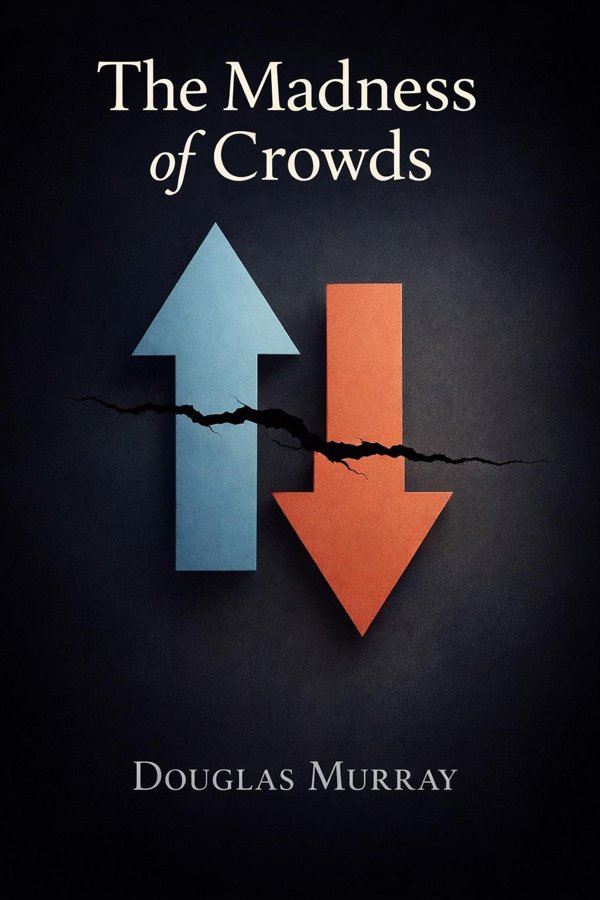
The Madness of Crowds: Gender, Race and Identity: Summary & Key Insights
 10 min10 chaptersAudio available
Key Takeaways from The Madness of Crowds: Gender, Race and Identity
When societies lose shared beliefs, they rarely become neutral; they often invent new forms of moral certainty.
One of the book’s most striking observations is that social victories do not always produce social clarity.
A culture can proclaim equality while becoming more confused about what equality means.
The past matters, but when history is reduced to a single moral script, understanding gives way to accusation.
Some of the fiercest modern conflicts emerge when compassion, biology, law, and language collide.
What Is The Madness of Crowds: Gender, Race and Identity About?
The Madness of Crowds: Gender, Race and Identity by Douglas Murray is a politics book spanning 10 pages. Douglas Murray’s The Madness of Crowds examines one of the defining tensions of modern Western life: why public discussions about gender, race, sexuality, and identity have become so emotionally charged, morally absolutist, and resistant to nuance. Murray argues that as traditional sources of meaning and moral authority have weakened, identity politics has increasingly filled the gap, bringing with it new orthodoxies, rituals of public shaming, and a shrinking tolerance for dissent. Rather than denying the reality of discrimination or the importance of social progress, he asks whether legitimate causes have been overtaken by ideological excess, institutional fear, and a culture that rewards outrage over reflection. Drawing on journalism, political commentary, history, and contemporary examples from media, universities, and corporate life, Murray presents a critique of how moral seriousness can harden into dogma. The book matters because it addresses a climate many people recognize but struggle to describe: one in which honest questions can carry severe social risk. As a prominent British writer and commentator known for his work on culture and free speech, Murray writes with the authority of someone deeply engaged in the public arguments he dissects.
This FizzRead summary covers all 10 key chapters of The Madness of Crowds: Gender, Race and Identity in approximately 10 minutes, distilling the most important ideas, arguments, and takeaways from Douglas Murray's work. Also available as an audio summary and Key Quotes Podcast.
The Madness of Crowds: Gender, Race and Identity
Douglas Murray’s The Madness of Crowds examines one of the defining tensions of modern Western life: why public discussions about gender, race, sexuality, and identity have become so emotionally charged, morally absolutist, and resistant to nuance. Murray argues that as traditional sources of meaning and moral authority have weakened, identity politics has increasingly filled the gap, bringing with it new orthodoxies, rituals of public shaming, and a shrinking tolerance for dissent. Rather than denying the reality of discrimination or the importance of social progress, he asks whether legitimate causes have been overtaken by ideological excess, institutional fear, and a culture that rewards outrage over reflection. Drawing on journalism, political commentary, history, and contemporary examples from media, universities, and corporate life, Murray presents a critique of how moral seriousness can harden into dogma. The book matters because it addresses a climate many people recognize but struggle to describe: one in which honest questions can carry severe social risk. As a prominent British writer and commentator known for his work on culture and free speech, Murray writes with the authority of someone deeply engaged in the public arguments he dissects.
Who Should Read The Madness of Crowds: Gender, Race and Identity?
This book is perfect for anyone interested in politics and looking to gain actionable insights in a short read. Whether you're a student, professional, or lifelong learner, the key ideas from The Madness of Crowds: Gender, Race and Identity by Douglas Murray will help you think differently.
- ✓Readers who enjoy politics and want practical takeaways
- ✓Professionals looking to apply new ideas to their work and life
- ✓Anyone who wants the core insights of The Madness of Crowds: Gender, Race and Identity in just 10 minutes
Want the full summary?
Get instant access to this book summary and 100K+ more with Fizz Moment.
Get Free SummaryAvailable on App Store • Free to download
Key Chapters
When societies lose shared beliefs, they rarely become neutral; they often invent new forms of moral certainty. Murray’s central claim is that contemporary identity politics has taken on many features once associated with religion: original sin, heresy, public confession, ritual denunciation, and the promise of redemption through correct belief. In this framework, people are not judged primarily by argument or character, but by category and by their willingness to repeat approved moral formulas.
He suggests that this helps explain why debates over language, representation, and historical guilt feel so emotionally absolute. Social media functions like a giant public altar where people confess, accuse, and seek absolution. Institutions often respond in the same spirit, issuing statements of repentance or symbolic loyalty rather than encouraging serious thought. The result is not deeper understanding, but a culture of performance in which moral status becomes a form of social currency.
A practical example can be seen in workplace diversity discussions. A useful conversation about fairness can quickly become an exercise in scripted affirmation, where employees fear asking clarifying questions lest they be seen as morally suspect. In universities, students may learn which opinions are safe before they learn how to test ideas critically.
Murray’s concern is not that moral passion is wrong, but that moral passion without humility becomes coercive. When a movement treats disagreement as blasphemy, it stops persuading and starts policing.
Actionable takeaway: Notice when a public debate is asking for evidence and when it is demanding ritual agreement. In those moments, choose curiosity over performance and ask what problem is actually being solved.
One of the book’s most striking observations is that social victories do not always produce social clarity. Murray argues that movements can succeed in their original aims and then, lacking a stopping point, drift into new and less coherent demands. He uses the story of gay rights as a key example. A campaign once centered on ending criminalization, prejudice, and exclusion achieved extraordinary success in much of the West. Yet instead of settling into a broadly shared understanding of equality, parts of the conversation expanded into increasingly complex and unstable theories about sex, identity, and desire.
His point is not that progress for gay people was a mistake; on the contrary, he sees it as one of the great liberal achievements of recent decades. The problem arises when a movement that has won broad public support continues to define itself through permanent grievance or merges with causes whose assumptions may conflict with its own. This can create confusion among supporters who were comfortable defending equal treatment but are less certain about fast-changing ideological claims.
You can see this pattern in organizations that continue escalating rhetoric even after laws and norms have changed substantially. Campaigns may move from securing rights to demanding total affirmation of every theoretical position associated with an identity group. At that stage, disagreement is often treated not as uncertainty but as hostility.
Murray invites readers to distinguish between protecting people and enforcing doctrine. Liberal societies can defend dignity, rights, and safety without requiring everyone to pretend that every new conceptual framework is settled truth.
Actionable takeaway: Support equal rights consistently, but separate basic fairness from ideological pressure. Ask whether a claim expands liberty for all or simply compels conformity.
A culture can proclaim equality while becoming more confused about what equality means. In Murray’s discussion of women, he explores the tension between long-standing efforts to correct injustice and newer ideological trends that treat ordinary human differences as evidence of oppression. He argues that important gains for women in law, work, and public life are sometimes overshadowed by narratives that depict society as an almost total system of hidden domination.
Murray is especially attentive to the way modern debates flatten complexity. Men and women can be equal in dignity and rights while still differing, on average, in some preferences, behaviors, or life choices. Yet in highly politicized environments, any uneven outcome is quickly interpreted as proof of discrimination. This can make serious inquiry difficult. Questions about family structure, professional ambition, biology, sexual dynamics, or risk tolerance become ideologically loaded before they are even discussed.
He also notes that the language of victimhood can become both politically useful and personally limiting. If public rewards flow to those who can present themselves as most wronged, people and institutions are encouraged to intensify grievance rather than solve problems. For example, workplaces may adopt highly symbolic gender policies that generate headlines but do little to support childcare, flexible work, or practical advancement.
Murray’s broader warning is that a just cause can become unpersuasive when it insists on interpreting all ambiguity as oppression. Real fairness depends on legal equality, open opportunity, and honest assessment—not on punishing inquiry.
Actionable takeaway: In debates about women and power, focus on measurable barriers and real-world support rather than slogans. Ask whether a policy improves opportunity in practice or merely advertises moral virtue.
The past matters, but when history is reduced to a single moral script, understanding gives way to accusation. Murray’s chapter on race argues that Western societies are wrestling with genuine historical wrongs, yet often doing so through increasingly simplistic frameworks that divide people into permanent categories of guilt and innocence. He worries that anti-racism, in some forms, has shifted from opposing prejudice to reinterpreting all human interaction through racial power alone.
This creates several dangers. First, it can encourage people to inherit moral burdens or moral authority based on ancestry rather than conduct. Second, it can make honest disagreement impossible, because any challenge to a theory is treated as evidence of racial insensitivity. Third, it can undermine the universal principles that made civil rights progress possible in the first place: equal treatment, individual dignity, and shared citizenship.
Murray points to public debates in education, media, and institutions where complex histories are compressed into binary narratives. A curriculum might present national history only as oppression, leaving no room for reform, contradiction, or moral growth. A company may adopt mandatory training that assumes unconscious bias is everywhere but offers little evidence that its methods improve relations or outcomes.
His argument is not that racism has vanished, nor that history should be forgotten. Rather, he insists that a society obsessed with inherited identity can become less fair, not more. If every interaction is racialized, people are pushed away from common life and toward suspicion.
Actionable takeaway: Confront racism directly, but resist frameworks that erase individuality. In conversations about race, ask what advances equal treatment, mutual respect, and shared standards for everyone.
Some of the fiercest modern conflicts emerge when compassion, biology, law, and language collide. Murray treats the issue of transgender identity as one of the clearest examples of a society struggling to think clearly under moral pressure. He argues that a desire to protect vulnerable individuals is understandable and necessary, but that this concern has often been accompanied by demands to deny obvious realities, suppress legitimate questions, and punish dissent.
His focus is less on individual people than on the public rules now built around contested ideas. Can language be compelled? Should institutions redefine sex-based categories without debate? How should competing rights be balanced in schools, sports, medicine, and prisons? Murray believes these questions are too important to be settled by fear. Yet many professionals—teachers, journalists, academics, even clinicians—avoid asking them openly because the social cost can be severe.
A practical example appears in policy discussions about sports or single-sex spaces. People may support respect and safety for trans individuals while still believing that biological differences matter in certain contexts. But current discourse often frames any hesitation as hatred, making compromise nearly impossible.
Murray’s wider point is that language is being asked to do more than describe experience; it is being used to enforce ideology. Once words become compulsory markers of virtue, they stop functioning as tools of inquiry. A free society needs room for sympathy and skepticism at the same time.
Actionable takeaway: Approach trans issues with civility and care, but do not surrender the right to ask clear questions. Good policy begins by distinguishing kindness to people from automatic agreement with every claim.
A society that cannot forgive will eventually become impossible to live in. Murray argues that one of the most damaging features of contemporary identity politics is the collapse of forgiveness. In older moral systems, confession was linked to repentance and restoration. In today’s public culture, however, apology often brings no relief. People are expected to admit guilt, but the accusation remains permanent.
This creates a chilling effect far beyond the individuals caught in scandals. If there is no path back from error, people become defensive, dishonest, or silent. Institutions, too, become risk-averse. They may punish employees or speakers quickly not because truth has been established, but because mercy is less reputationally useful than condemnation. Public life then fills with moral spectatorship—crowds enjoying the destruction of others while imagining themselves virtuous.
Murray sees this as a profound distortion of justice. Human beings are imperfect, and serious moral progress depends on the possibility that people can learn. If someone misspeaks, uses an outdated term, or voices a clumsy question, the response should be proportionate. Without proportion, all mistakes are treated as evidence of bad character, and no one feels safe enough to think aloud.
A practical application is in schools or workplaces handling complaints. Instead of moving immediately to punishment, leaders can distinguish malice from misunderstanding, pattern from incident, and disagreement from harassment. Doing so strengthens trust rather than eroding it.
Actionable takeaway: Build proportionality into your judgments. When someone errs, ask not only what was wrong, but whether there is evidence of learning, context, and a realistic path toward repair.
People do not live by rights alone; they also need purpose, belonging, and a story about what their lives are for. Murray suggests that many contemporary identity conflicts are fueled by a deeper spiritual and cultural emptiness. As traditional religion, national narratives, and shared civic ideals have weakened, many people have turned to political identity as a source of meaning. This helps explain why debates that appear procedural or academic are experienced as existential.
If politics becomes the primary source of moral identity, compromise starts to feel like betrayal. Every disagreement becomes a test of the self. This is especially visible among educated elites who may be materially secure but morally disoriented. Lacking strong common frameworks, they seek significance through activism, symbolic purity, and participation in collective causes. The energy is real, but the object can be unstable.
Murray does not argue that everyone should return to older beliefs, nor that activism is insincere. His point is that when politics takes over the role once played by religion or durable communal life, it becomes overburdened. It promises redemption but delivers endless struggle. That leaves people angry, anxious, and always in search of the next sin to expose.
You can see this in institutional cultures that adopt grand moral missions yet offer little room for ordinary human complexity. Employees, students, and citizens are asked to be ideologically fluent at all times, as if private uncertainty were a public failing.
Actionable takeaway: Look for sources of meaning outside ideological conflict—friendship, family, local community, craft, faith, service, or art. A life not wholly dependent on political identity is more resistant to moral panic.
All Chapters in The Madness of Crowds: Gender, Race and Identity
About the Author
Douglas Murray is a British author, journalist, and political commentator known for his writing on culture, politics, identity, and free speech. He has written for major publications, appeared frequently in public debates and broadcast media, and served as an associate editor of The Spectator. Murray is recognized for his sharp, controversial, and often provocative analysis of contemporary Western society, particularly on questions of ideology, immigration, religion, and national identity. His books include The Strange Death of Europe, The War on the West, and Neoconservatism: Why We Need It. Whether praised as a defender of open inquiry or criticized for his polemical style, Murray has become an influential voice in arguments about modern liberalism, public discourse, and the social tensions shaping the West.
Get This Summary in Your Preferred Format
Read or listen to the The Madness of Crowds: Gender, Race and Identity summary by Douglas Murray anytime, anywhere. FizzRead offers multiple formats so you can learn on your terms — all free.
Available formats: App · Audio · PDF · EPUB — All included free with FizzRead
Download The Madness of Crowds: Gender, Race and Identity PDF and EPUB Summary
Key Quotes from The Madness of Crowds: Gender, Race and Identity
“When societies lose shared beliefs, they rarely become neutral; they often invent new forms of moral certainty.”
“One of the book’s most striking observations is that social victories do not always produce social clarity.”
“A culture can proclaim equality while becoming more confused about what equality means.”
“The past matters, but when history is reduced to a single moral script, understanding gives way to accusation.”
“Some of the fiercest modern conflicts emerge when compassion, biology, law, and language collide.”
Frequently Asked Questions about The Madness of Crowds: Gender, Race and Identity
The Madness of Crowds: Gender, Race and Identity by Douglas Murray is a politics book that explores key ideas across 10 chapters. Douglas Murray’s The Madness of Crowds examines one of the defining tensions of modern Western life: why public discussions about gender, race, sexuality, and identity have become so emotionally charged, morally absolutist, and resistant to nuance. Murray argues that as traditional sources of meaning and moral authority have weakened, identity politics has increasingly filled the gap, bringing with it new orthodoxies, rituals of public shaming, and a shrinking tolerance for dissent. Rather than denying the reality of discrimination or the importance of social progress, he asks whether legitimate causes have been overtaken by ideological excess, institutional fear, and a culture that rewards outrage over reflection. Drawing on journalism, political commentary, history, and contemporary examples from media, universities, and corporate life, Murray presents a critique of how moral seriousness can harden into dogma. The book matters because it addresses a climate many people recognize but struggle to describe: one in which honest questions can carry severe social risk. As a prominent British writer and commentator known for his work on culture and free speech, Murray writes with the authority of someone deeply engaged in the public arguments he dissects.
More by Douglas Murray

You Might Also Like

Antifa: The Anti-Fascist Handbook
Mark Bray
10 min
Attack from Within: How Disinformation Is Sabotaging America
Barbara McQuade
10 min
Coercion, Capital, and European States, AD 990–1992
Charles Tilly
10 min
Digital Democracy: Concepts, Methodologies, Tools, and Applications
Various Authors
10 min
Fascism
Stanley G. Payne
10 min
Fire And Fury: Inside The Trump White House
Michael Wolff
10 minBrowse by Category
Ready to read The Madness of Crowds: Gender, Race and Identity?
Get the full summary and 100K+ more books with Fizz Moment.