
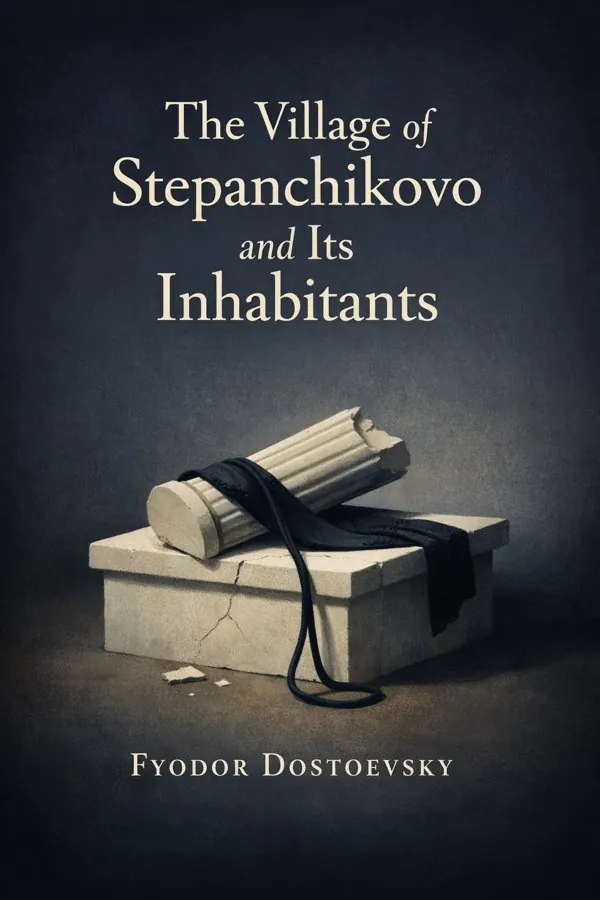
The Village of Stepanchikovo and Its Inhabitants: Summary & Key Insights
 10 min9 chaptersAudio available
Key Takeaways from The Village of Stepanchikovo and Its Inhabitants
The quickest way to understand a corrupt system is to enter it as an outsider, and that is precisely what happens when Sergey arrives at Stepanchikovo.
The most dangerous tyrants are not always the loudest or strongest; sometimes they are the ones who claim to suffer for everyone’s good.
Kindness without firmness can become a hidden form of irresponsibility.
Romantic conflict in Dostoevsky is rarely just about love; it is also about power, vulnerability, and dignity.
Sometimes the most important character in a chaotic environment is not the strongest one, but the one who still remembers what normality looks like.
What Is The Village of Stepanchikovo and Its Inhabitants About?
The Village of Stepanchikovo and Its Inhabitants by Fyodor Dostoevsky is a classics book spanning 9 pages. First published in 1859, The Village of Stepanchikovo and Its Inhabitants is one of Fyodor Dostoevsky’s most entertaining and underrated works: a sharp social comedy that doubles as a penetrating study of weakness, pride, and moral manipulation. Set on a provincial Russian estate, the novel follows the arrival of the young Sergey, who expects to find ordinary family life at his uncle Yegor Rostanev’s home. Instead, he enters a bizarre domestic regime dominated by Foma Fomich Opiskin, a ridiculous yet frightening impostor who rules the household through wounded vanity, theatrical morality, and psychological control. What begins as farce gradually reveals something deeper. Dostoevsky shows how tyranny does not survive by strength alone; it depends on the compliance of timid, kind, guilty, or self-deceiving people. Through scenes of absurd conflict, botched romance, and emotional blackmail, he exposes the ease with which language about virtue can become a tool of domination. Though lighter in tone than his major later novels, this book already displays Dostoevsky’s extraordinary insight into human contradiction. It matters because it shows, with comic brilliance, how households, institutions, and even societies can surrender themselves to manipulative personalities masquerading as moral guides.
This FizzRead summary covers all 9 key chapters of The Village of Stepanchikovo and Its Inhabitants in approximately 10 minutes, distilling the most important ideas, arguments, and takeaways from Fyodor Dostoevsky's work. Also available as an audio summary and Key Quotes Podcast.
The Village of Stepanchikovo and Its Inhabitants
First published in 1859, The Village of Stepanchikovo and Its Inhabitants is one of Fyodor Dostoevsky’s most entertaining and underrated works: a sharp social comedy that doubles as a penetrating study of weakness, pride, and moral manipulation. Set on a provincial Russian estate, the novel follows the arrival of the young Sergey, who expects to find ordinary family life at his uncle Yegor Rostanev’s home. Instead, he enters a bizarre domestic regime dominated by Foma Fomich Opiskin, a ridiculous yet frightening impostor who rules the household through wounded vanity, theatrical morality, and psychological control.
What begins as farce gradually reveals something deeper. Dostoevsky shows how tyranny does not survive by strength alone; it depends on the compliance of timid, kind, guilty, or self-deceiving people. Through scenes of absurd conflict, botched romance, and emotional blackmail, he exposes the ease with which language about virtue can become a tool of domination. Though lighter in tone than his major later novels, this book already displays Dostoevsky’s extraordinary insight into human contradiction. It matters because it shows, with comic brilliance, how households, institutions, and even societies can surrender themselves to manipulative personalities masquerading as moral guides.
Who Should Read The Village of Stepanchikovo and Its Inhabitants?
This book is perfect for anyone interested in classics and looking to gain actionable insights in a short read. Whether you're a student, professional, or lifelong learner, the key ideas from The Village of Stepanchikovo and Its Inhabitants by Fyodor Dostoevsky will help you think differently.
- ✓Readers who enjoy classics and want practical takeaways
- ✓Professionals looking to apply new ideas to their work and life
- ✓Anyone who wants the core insights of The Village of Stepanchikovo and Its Inhabitants in just 10 minutes
Want the full summary?
Get instant access to this book summary and 100K+ more with Fizz Moment.
Get Free SummaryAvailable on App Store • Free to download
Key Chapters
The quickest way to understand a corrupt system is to enter it as an outsider, and that is precisely what happens when Sergey arrives at Stepanchikovo. He comes with expectations of family warmth, rural simplicity, and perhaps a straightforward future. Instead, he finds a household that functions according to irrational emotional rules. Nothing is openly stable. Conversation is strained, relationships are distorted, and everyone seems to be adjusting themselves to the moods of one man.
This opening matters because Dostoevsky uses Sergey’s bewilderment as the reader’s guide. Through fresh eyes, the estate appears not merely eccentric but spiritually disordered. Yegor Rostanev, the kind-hearted owner, behaves less like a master of the house than a nervous guest. Family members and servants do not speak freely; they calculate. Ordinary domestic life has become theatrical, with everyone anticipating the next crisis. The comedy is immediate, but beneath it lies a serious point: people can become so accustomed to abnormal conditions that they stop recognizing them as abnormal.
This dynamic appears everywhere beyond the novel. In families ruled by an unstable relative, in workplaces dominated by a manipulative manager, or in communities led by someone who turns every disagreement into a moral spectacle, newcomers often notice dysfunction before insiders do. The outsider sees what habit has disguised.
Sergey’s arrival reminds us that confusion is often a symptom, not a personality quirk. When people are kind but constantly uneasy, something deeper is wrong. The estate’s false harmony is maintained through fear, guilt, and ritualized deference.
Actionable takeaway: When entering any group, pay attention to what people seem afraid to say. Silence, over-apology, and exaggerated politeness often reveal hidden power more clearly than formal titles do.
The most dangerous tyrants are not always the loudest or strongest; sometimes they are the ones who claim to suffer for everyone’s good. Foma Fomich Opiskin is one of Dostoevsky’s finest comic monsters because he combines pettiness with moral grandiosity. Once humiliated and dependent, he has transformed grievance into authority. He does not govern the household by law, competence, or affection, but by staging himself as a misunderstood prophet of virtue.
Foma’s genius lies in his manipulation of appearances. He presents his insults as moral correction, his vanity as sensitivity, and his domination as selfless concern. He turns every inconvenience into an ethical crisis and every challenge to his authority into proof that others are coarse, selfish, or spiritually inferior. In this way, he traps kind people. They submit not because they admire him, but because they fear seeming cruel.
Dostoevsky’s satire reaches far beyond one estate. Foma represents a recurring social type: the insecure moral performer who weaponizes language about goodness. We meet versions of him in public discourse, office politics, and intimate relationships. Such people often insist that they alone understand decency, while using that claim to shame others into obedience. Their power grows in environments where people value peace more than truth.
What makes Foma unsettling is that he is also ridiculous. His pretensions are absurd. Yet the household still bends around him. Dostoevsky suggests that absurdity does not neutralize power; often it protects it. People tolerate nonsense when resisting it feels exhausting or impolite.
Actionable takeaway: Learn to distinguish genuine moral concern from moral theater. If someone constantly turns disagreement into proof of your inferiority, step back and examine whether their ethics are serving truth or simply their ego.
Kindness without firmness can become a hidden form of irresponsibility. Yegor Rostanev, Sergey’s uncle, is one of the novel’s most sympathetic figures precisely because he is so decent. He is generous, affectionate, and fundamentally incapable of cruelty. Yet these virtues are compromised by his inability to defend order in his own home. His goodness lacks structure, and that weakness gives Foma room to rule.
Dostoevsky refuses to portray Yegor as foolish in a simple sense. He is not malicious, and he often perceives the pain around him. But he avoids conflict so consistently that he enables it. He wants everyone to be happy, and because he cannot bear causing distress, he repeatedly yields to emotional extortion. In practice, this means the most unreasonable person gains the greatest influence. The household suffers because Yegor confuses compassion with surrender.
This is one of the novel’s most enduring insights. Many dysfunctional systems are sustained not only by bullies, but also by benevolent people who will not act decisively. A parent who excuses manipulation to keep peace, a manager who tolerates toxic behavior to avoid confrontation, or a friend who lets one domineering personality control a group can all resemble Yegor. Their motives may be generous, but the result is harm.
Dostoevsky shows that moral life requires more than a good heart. It also requires judgment, boundaries, and the courage to disappoint others when justice demands it. Yegor’s tragedy is not that he loves too much, but that he mistakes passivity for virtue.
Readers can apply this lesson in everyday life. Being “nice” is not always noble if it leaves more vulnerable people exposed to manipulation. Sometimes the truly compassionate act is to say no clearly, early, and without apology.
Actionable takeaway: Ask yourself where your desire to avoid conflict may be enabling unhealthy behavior. Replace vague goodwill with one concrete boundary that protects both your values and the people around you.
Romantic conflict in Dostoevsky is rarely just about love; it is also about power, vulnerability, and dignity. The tension surrounding Nastenka reveals how deeply Foma’s influence has infected the household. What should be a matter of honest feeling and mutual respect becomes tangled in schemes, suspicion, and moral interference. Nastenka is not treated simply as a person with her own inner life, but as a figure through whom others pursue control, validation, and social order.
At the center of this conflict is Yegor’s affection and the confusion surrounding it, along with Sergey’s role as observer and possible participant in the household’s rescue. Foma exploits uncertainty masterfully. He inserts himself into emotional matters under the pretense of principle, interpreting motives, assigning guilt, and steering events to preserve his central position. In such an atmosphere, private feeling cannot remain private. Every relationship becomes public property, filtered through the tyrant’s ego.
Nastenka’s situation also highlights a recurring Dostoevskian concern: the fragility of the vulnerable in settings where authority is theatrical and unstable. She becomes a test of the household’s moral health. Can anyone protect innocence without appropriating it? Can love emerge honestly where everyone is performing for approval? The answer is uneasy until the final confrontations force clarity.
This aspect of the novel remains highly relevant. In many families and communities, emotional decisions are distorted by one controlling personality who claims to know what is best for everyone. Instead of direct conversation, there are intermediaries, guilt campaigns, and public pressure. The result is confusion masquerading as concern.
Healthy relationships require privacy, candor, and respect for agency. Once others begin narrating your motives for you, freedom shrinks quickly.
Actionable takeaway: In emotionally charged situations, speak directly to the person involved rather than through controlling intermediaries. Honest, calm conversation is often the first step in breaking patterns of manipulation.
Sometimes the most important character in a chaotic environment is not the strongest one, but the one who still remembers what normality looks like. Sergey plays this role in the novel. He is not a heroic conqueror in the conventional sense, yet his presence matters because he offers perspective. He observes, compares, judges, and gradually becomes involved in the moral disentangling of Stepanchikovo.
As a younger man entering an already diseased social order, Sergey combines innocence with increasing insight. He initially hopes for straightforward relationships, but what he encounters demands interpretation. Through him, Dostoevsky dramatizes the education of moral perception. Sergey must learn that absurdity can conceal cruelty and that good intentions are not enough to set things right. He also sees how sentimentality can be manipulated, especially in households where everyone wants to appear generous.
His role is especially valuable because he does not fully belong to the system he studies. This partial distance allows him to see connections insiders miss. He recognizes the imbalance between Foma’s actual worth and his inflated authority. He notices how Yegor’s kindness is being exploited. And he senses, earlier than many others, that restoring health requires plain truth rather than endless accommodation.
In real life, Sergey resembles the friend, colleague, or adult child who enters a dysfunctional environment and notices patterns longtime members have normalized. Such outsiders can help name what others have ceased to see. But they must do more than criticize; they need tact, patience, and the courage to intervene responsibly.
Dostoevsky suggests that moral clarity often begins with attention. Before systems can change, someone must describe them honestly.
Actionable takeaway: If you are the outsider in a confusing group, use your fresh perspective carefully. Write down what seems normal and what does not before the environment persuades you to doubt your own judgment.
One of Dostoevsky’s sharpest satirical targets is the person who talks endlessly about virtue while making everyone around him smaller. Foma’s speeches, judgments, and dramatic grievances are not random comic details; they reveal how hypocrisy operates when clothed in moral language. He does not merely demand obedience. He wants obedience to look like enlightenment.
This distinction is crucial. Ordinary selfishness is easy to recognize. Sanctimonious selfishness is harder because it borrows the vocabulary of ethics. Foma insists on refinement, dignity, sensitivity, and principle, but his actual behavior is vain, humiliating, and cruel. He measures others not by whether they are kind or truthful, but by whether they affirm his image as a moral authority. Even his suffering becomes performative. He cultivates the role of the injured, superior soul in order to dominate those who pity him.
Dostoevsky exposes a timeless pattern: people often submit more readily to self-righteousness than to brute force because they fear appearing immoral. In workplaces, social groups, and ideological circles, this can create environments where questioning a manipulator feels like committing a sin. The manipulator becomes untouchable not because he is right, but because he monopolizes moral vocabulary.
The novel teaches that true morality is often quieter, humbler, and less theatrical than counterfeit virtue. Genuine ethical authority does not demand constant admiration. It does not convert every disagreement into a test of loyalty. And it does not need an audience to prove its sincerity.
Readers can apply this insight by watching for a simple discrepancy: does a person’s moral speech enlarge the dignity of others, or only secure their own status? The answer usually reveals more than the rhetoric itself.
Actionable takeaway: Judge moral claims by their effects. If someone’s “principles” consistently produce fear, humiliation, and dependency, question the principles and not just your response to them.
Manipulators rarely succeed alone; they require an audience trained to adjust. One of the novel’s great achievements is its portrayal of collective complicity. Stepanchikovo is not controlled by Foma simply because he is cunning. It is controlled because nearly everyone around him participates, whether actively, timidly, or resentfully, in maintaining his importance.
Family members excuse him, servants adapt to him, and even those who despise him often respond in ways that reinforce his centrality. Some submit from fear, some from habit, some from confusion, and some from the hope that appeasing him will prevent greater disruption. This creates a social ecosystem in which absurdity flourishes. The cost is borne by the whole household: sincerity vanishes, direct speech becomes dangerous, and emotional energy is spent on managing one person’s vanity.
Dostoevsky is careful not to flatten these people into fools. They are human beings caught in a web of dependence, hierarchy, and emotional fatigue. That is what makes the portrait convincing. Many unhealthy systems endure not because everyone believes in them, but because no one wants to absorb the cost of opposing them. People tell themselves they are being practical, compassionate, or strategic. Over time, accommodation becomes culture.
This is a lesson with broad application. Toxic organizations, dysfunctional families, and status-driven communities often survive through small daily acts of compliance: laughing at what is not funny, staying silent when truth is needed, and rewarding dramatic behavior with attention. Reform begins when these habits are interrupted.
The novel reminds us that bystanders are never entirely neutral. Their silence has structure; it shapes what can continue.
Actionable takeaway: Identify one recurring behavior that rewards dysfunction in your environment—such as appeasing tantrums or avoiding honest feedback—and stop participating in that pattern consistently.
Every manipulative order depends on blurred perception, which is why moments of plain speech feel revolutionary. The climactic confrontations at Stepanchikovo matter not merely because tempers flare, but because reality is finally named. Foma’s inflated moral authority begins to crack when others stop treating his theatrics as sacred. The household moves toward liberation only when its members risk discomfort and reject the vocabulary that has kept them captive.
Dostoevsky stages this shift with comic force, but the principle is serious. Tyranny in intimate settings is often sustained by euphemism. People say someone is “sensitive” when they are domineering, “misunderstood” when they are manipulative, or “principled” when they are coercive. Such language protects the abuser and disorients the victim. The turning point comes when actions are described accurately.
This is why confrontation in the novel has moral weight. It is not aggression for its own sake. It is the reestablishment of proportion. Foma must be seen as he is: not a saintly conscience, but a vain and destructive intruder who has exploited the kindness and weakness of others. Once this naming occurs, the spell weakens.
In everyday life, similar breakthroughs happen when a team finally acknowledges a toxic leader, when a family admits that one member’s “moods” are actually abusive, or when a person stops rationalizing treatment that violates their dignity. Naming reality does not solve everything immediately, but it ends the loneliness of confusion.
Dostoevsky suggests that truth spoken at the right moment can reorder an entire moral landscape.
Actionable takeaway: Practice replacing soft, evasive labels with precise descriptions. Clarity is not cruelty. Often, the first step toward freedom is describing behavior exactly as it is.
All Chapters in The Village of Stepanchikovo and Its Inhabitants
About the Author
Fyodor Dostoevsky (1821–1881) was a Russian novelist, journalist, and philosopher widely regarded as one of the greatest writers in world literature. His fiction is known for its psychological intensity, moral seriousness, and deep exploration of guilt, suffering, freedom, faith, and redemption. After early literary success, his life was dramatically altered by arrest, a mock execution, and years of imprisonment and exile in Siberia, experiences that profoundly shaped his worldview. Dostoevsky went on to write some of the most influential novels ever published, including Crime and Punishment, The Idiot, Demons, and The Brothers Karamazov. Though best known for his darker masterpieces, he was also a brilliant satirist. The Village of Stepanchikovo and Its Inhabitants showcases his talent for comedy, social observation, and exposing the hidden motives beneath polite society.
Get This Summary in Your Preferred Format
Read or listen to the The Village of Stepanchikovo and Its Inhabitants summary by Fyodor Dostoevsky anytime, anywhere. FizzRead offers multiple formats so you can learn on your terms — all free.
Available formats: App · Audio · PDF · EPUB — All included free with FizzRead
Download The Village of Stepanchikovo and Its Inhabitants PDF and EPUB Summary
Key Quotes from The Village of Stepanchikovo and Its Inhabitants
“The quickest way to understand a corrupt system is to enter it as an outsider, and that is precisely what happens when Sergey arrives at Stepanchikovo.”
“The most dangerous tyrants are not always the loudest or strongest; sometimes they are the ones who claim to suffer for everyone’s good.”
“Kindness without firmness can become a hidden form of irresponsibility.”
“Romantic conflict in Dostoevsky is rarely just about love; it is also about power, vulnerability, and dignity.”
“Sometimes the most important character in a chaotic environment is not the strongest one, but the one who still remembers what normality looks like.”
Frequently Asked Questions about The Village of Stepanchikovo and Its Inhabitants
The Village of Stepanchikovo and Its Inhabitants by Fyodor Dostoevsky is a classics book that explores key ideas across 9 chapters. First published in 1859, The Village of Stepanchikovo and Its Inhabitants is one of Fyodor Dostoevsky’s most entertaining and underrated works: a sharp social comedy that doubles as a penetrating study of weakness, pride, and moral manipulation. Set on a provincial Russian estate, the novel follows the arrival of the young Sergey, who expects to find ordinary family life at his uncle Yegor Rostanev’s home. Instead, he enters a bizarre domestic regime dominated by Foma Fomich Opiskin, a ridiculous yet frightening impostor who rules the household through wounded vanity, theatrical morality, and psychological control. What begins as farce gradually reveals something deeper. Dostoevsky shows how tyranny does not survive by strength alone; it depends on the compliance of timid, kind, guilty, or self-deceiving people. Through scenes of absurd conflict, botched romance, and emotional blackmail, he exposes the ease with which language about virtue can become a tool of domination. Though lighter in tone than his major later novels, this book already displays Dostoevsky’s extraordinary insight into human contradiction. It matters because it shows, with comic brilliance, how households, institutions, and even societies can surrender themselves to manipulative personalities masquerading as moral guides.
More by Fyodor Dostoevsky



You Might Also Like






Browse by Category
Ready to read The Village of Stepanchikovo and Its Inhabitants?
Get the full summary and 100K+ more books with Fizz Moment.