
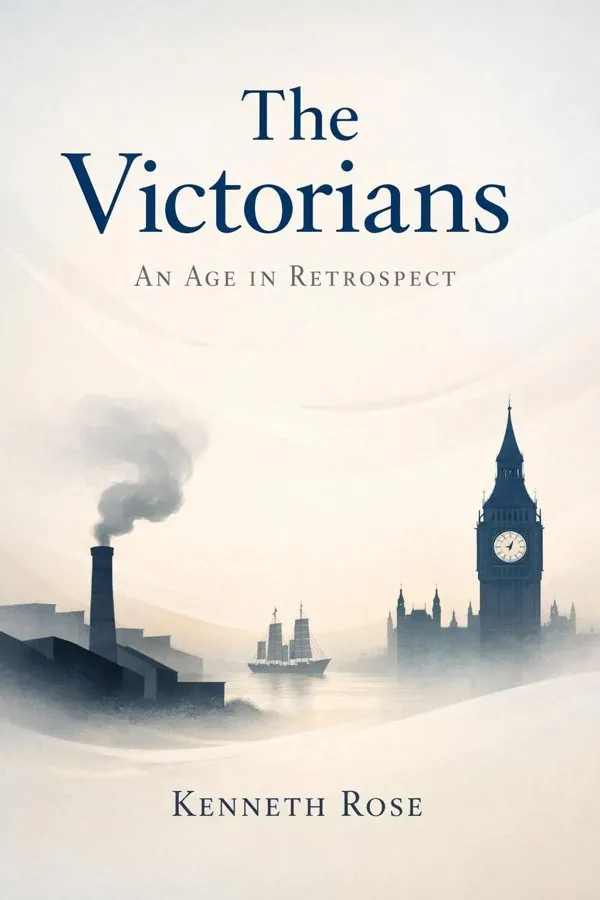
The Victorians: An Age in Retrospect: Summary & Key Insights
by Kenneth Rose
 10 min11 chaptersAudio available
What Is The Victorians: An Age in Retrospect About?
The Victorians: An Age in Retrospect by Kenneth Rose is a world_history book spanning 11 pages. A comprehensive historical study of Victorian Britain, Kenneth Rose’s 'The Victorians: An Age in Retrospect' examines the social, political, and cultural forces that shaped the era. Drawing on extensive archival research, Rose portrays the achievements and contradictions of the period, from imperial expansion and industrial progress to moral rigidity and class divisions.
This FizzRead summary covers all 11 key chapters of The Victorians: An Age in Retrospect in approximately 10 minutes, distilling the most important ideas, arguments, and takeaways from Kenneth Rose's work. Also available as an audio summary and Key Quotes Podcast.
The Victorians: An Age in Retrospect
A comprehensive historical study of Victorian Britain, Kenneth Rose’s 'The Victorians: An Age in Retrospect' examines the social, political, and cultural forces that shaped the era. Drawing on extensive archival research, Rose portrays the achievements and contradictions of the period, from imperial expansion and industrial progress to moral rigidity and class divisions.
Who Should Read The Victorians: An Age in Retrospect?
This book is perfect for anyone interested in world_history and looking to gain actionable insights in a short read. Whether you're a student, professional, or lifelong learner, the key ideas from The Victorians: An Age in Retrospect by Kenneth Rose will help you think differently.
- ✓Readers who enjoy world_history and want practical takeaways
- ✓Professionals looking to apply new ideas to their work and life
- ✓Anyone who wants the core insights of The Victorians: An Age in Retrospect in just 10 minutes
Want the full summary?
Get instant access to this book summary and 100K+ more with Fizz Moment.
Get Free SummaryAvailable on App Store • Free to download
Key Chapters
When Victoria ascended the throne in 1837, she embodied youthful promise in a country yearning for stability. Her early reign was marked by a delicate balance between the lingering aristocratic traditions and the emerging constitutional modernity that would define Britain for generations. In those first decades, the monarchy itself was reshaped—not by edict, but by perception. Victoria and her consort, Prince Albert, reinvented the crown as a moral institution. They portrayed domestic virtue as public virtue, creating an image of family monarchy that reflected middle-class respectability.
The nation she inherited was uneasy. Industrial growth had upended social hierarchies, reform movements challenged entrenched privilege, and popular unrest echoed through the streets. Yet, under the calm façade of constitutional monarchy, Britain found cohesion. The Reform Act of 1832 had begun the democratizing process, but political power still rested with an educated elite. Victoria’s reign lent legitimacy to this evolving balance of authority. With Albert’s intellectual discipline and her own sense of duty, the monarchy adapted—becoming not a medieval relic but a stabilizing symbol of a modern nation confident in its institutions.
These years also saw the ascendancy of figures like Peel and Disraeli, who navigated the complexities of governance in a time when tradition was both anchor and obstacle. Victoria’s conservatism often clashed with reformist impulses, yet she grew into the role of constitutional sovereign, accepting that her influence must be moral rather than political. In her person, the Victorians found a paradox—they revered her authority precisely because she restrained it.
Industrialization defined the Victorian age more than any other force, and with it came the transformation of Britain's economic base, its urban landscapes, and its collective conscience. The factory became the cathedral of the new age. Iron, coal, and steam powered not only machines, but the imagination of progress itself. Yet beneath the triumph of enterprise lay the shadow of inequity: the squalor of tenements, child labor, and the incessant hum of factories that measured human life in output.
I sought to capture this paradox—not merely as an economist’s chart, but as a human drama. The middle class, born of commerce and industry, flourished, while the working class bore its heavy cost. Urbanization created new rhythms of life: Manchester, Birmingham, and London became laboratories of modern civilization. But the old agrarian values crumbled under the pressure of mechanization; community gave way to competition. The new bourgeois ethic celebrated thrift and discipline, yet also bred anxiety—a fear of sliding backward into idleness or moral decay.
These contradictions were central to the Victorian sense of self. Progress was both triumph and torment. The faith in industry was a moral creed: to work was to serve God and society. Philanthropy and reform emerged not from guilt alone, but from conviction that virtue could be engineered like efficiency. The Victorians thus created the world’s first industrial civilization—and with it, the first modern conscience.
+ 9 more chapters — available in the FizzRead app
All Chapters in The Victorians: An Age in Retrospect
About the Author
Kenneth Rose (1924–2014) was a British journalist and historian known for his biographies and works on British society and monarchy. He wrote for The Sunday Telegraph and authored several acclaimed books on British history and personalities.
Get This Summary in Your Preferred Format
Read or listen to the The Victorians: An Age in Retrospect summary by Kenneth Rose anytime, anywhere. FizzRead offers multiple formats so you can learn on your terms — all free.
Available formats: App · Audio · PDF · EPUB — All included free with FizzRead
Download The Victorians: An Age in Retrospect PDF and EPUB Summary
Key Quotes from The Victorians: An Age in Retrospect
“When Victoria ascended the throne in 1837, she embodied youthful promise in a country yearning for stability.”
“Industrialization defined the Victorian age more than any other force, and with it came the transformation of Britain's economic base, its urban landscapes, and its collective conscience.”
Frequently Asked Questions about The Victorians: An Age in Retrospect
The Victorians: An Age in Retrospect by Kenneth Rose is a world_history book that explores key ideas across 11 chapters. A comprehensive historical study of Victorian Britain, Kenneth Rose’s 'The Victorians: An Age in Retrospect' examines the social, political, and cultural forces that shaped the era. Drawing on extensive archival research, Rose portrays the achievements and contradictions of the period, from imperial expansion and industrial progress to moral rigidity and class divisions.
You Might Also Like
The Age of Capital
Eric Hobsbawm
10 min
The Gulag Archipelago
Aleksandr Solzhenitsyn
10 min
Jerusalem: The Biography
Simon Sebag Montefiore
10 min
The Anglo-Saxons
James Campbell
10 min
The Boer War
Thomas Pakenham
10 min
The Industrial Revolutionaries: The Making of the Modern World 1776–1914
Gavin Weightman
10 minBrowse by Category
Ready to read The Victorians: An Age in Retrospect?
Get the full summary and 100K+ more books with Fizz Moment.