
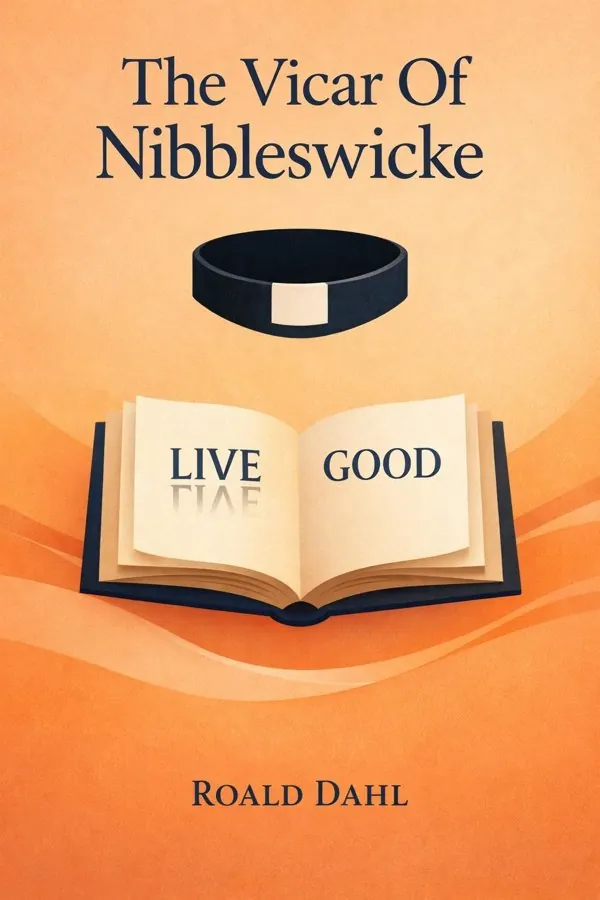
The Vicar Of Nibbleswicke: Summary & Key Insights
by Roald Dahl
 10 min8 chaptersAudio available
Key Takeaways from The Vicar Of Nibbleswicke
Big public roles often begin with private fear.
We rarely appreciate fluent speech until it falters.
A village can be warm, but it can also be quick to gossip.
Laughter is not always heartless; sometimes it is the gentlest way to approach discomfort.
Problems become less frightening when someone names them with care.
What Is The Vicar Of Nibbleswicke About?
The Vicar Of Nibbleswicke by Roald Dahl is a classics book spanning 5 pages. Roald Dahl’s The Vicar Of Nibbleswicke is a brief, playful story with a surprisingly generous heart. At first glance, it looks like a comic tale about a nervous young clergyman, Reverend Robert Lee, who arrives in a quiet English village only to develop a bizarre condition that makes him say certain words backwards. The result is a cascade of misunderstandings, embarrassment, and absurd situations that feel unmistakably Dahl: brisk, mischievous, and delightfully odd. But beneath the jokes lies a more humane purpose. Written in support of the Dyslexia Institute and published after Dahl’s death, the story uses comedy to draw attention to language difficulties without cruelty or condescension. What makes the book memorable is the way it transforms a potentially painful subject into something approachable. Dahl, one of the most beloved storytellers of the twentieth century, had a rare gift for balancing exaggeration with emotional truth. Here, he invites readers to laugh, but also to notice how quickly people judge what they do not understand. The book matters because it turns confusion into empathy, and because its humor opens the door to a gentler, more curious view of human difference.
This FizzRead summary covers all 8 key chapters of The Vicar Of Nibbleswicke in approximately 10 minutes, distilling the most important ideas, arguments, and takeaways from Roald Dahl's work. Also available as an audio summary and Key Quotes Podcast.
The Vicar Of Nibbleswicke
Roald Dahl’s The Vicar Of Nibbleswicke is a brief, playful story with a surprisingly generous heart. At first glance, it looks like a comic tale about a nervous young clergyman, Reverend Robert Lee, who arrives in a quiet English village only to develop a bizarre condition that makes him say certain words backwards. The result is a cascade of misunderstandings, embarrassment, and absurd situations that feel unmistakably Dahl: brisk, mischievous, and delightfully odd. But beneath the jokes lies a more humane purpose. Written in support of the Dyslexia Institute and published after Dahl’s death, the story uses comedy to draw attention to language difficulties without cruelty or condescension.
What makes the book memorable is the way it transforms a potentially painful subject into something approachable. Dahl, one of the most beloved storytellers of the twentieth century, had a rare gift for balancing exaggeration with emotional truth. Here, he invites readers to laugh, but also to notice how quickly people judge what they do not understand. The book matters because it turns confusion into empathy, and because its humor opens the door to a gentler, more curious view of human difference.
Who Should Read The Vicar Of Nibbleswicke?
This book is perfect for anyone interested in classics and looking to gain actionable insights in a short read. Whether you're a student, professional, or lifelong learner, the key ideas from The Vicar Of Nibbleswicke by Roald Dahl will help you think differently.
- ✓Readers who enjoy classics and want practical takeaways
- ✓Professionals looking to apply new ideas to their work and life
- ✓Anyone who wants the core insights of The Vicar Of Nibbleswicke in just 10 minutes
Want the full summary?
Get instant access to this book summary and 100K+ more with Fizz Moment.
Get Free SummaryAvailable on App Store • Free to download
Key Chapters
Big public roles often begin with private fear. Before Reverend Robert Lee ever says a backward word, Dahl shows us something deeply familiar: a young man stepping into his first serious responsibility and quietly wondering whether he is equal to it. Lee has completed his training and received what should be a dream appointment, the charming parish of Nibbleswicke. Yet excitement is mixed with dread. He worries about preaching well, guiding a community, and inhabiting the authority expected of a village vicar. That anxiety matters because it sets the emotional groundwork for everything that follows.
Dahl understands that embarrassment lands hardest when someone already feels fragile. Reverend Lee is not arrogant or overconfident; he is earnest, sincere, and eager to do right. That makes his later language mishaps funnier, but also more sympathetic. Readers do not laugh at a pompous fool getting his due. They laugh at a decent person trying very hard under pressure. The story’s comedy therefore grows out of vulnerability, which gives it warmth instead of meanness.
This opening idea also has practical relevance beyond the book. Many people begin new roles with the same hidden unease: teachers entering classrooms, managers leading teams, graduates starting careers, or parents navigating responsibilities they were never fully prepared for. Outwardly, they may look composed. Inwardly, they are improvising. The lesson is not that doubt disqualifies someone, but that doubt often accompanies commitment.
Dahl’s setup reminds us to treat first mistakes with generosity. When someone stumbles in a new position, our instinct should be curiosity rather than criticism. Anxiety can distort performance long before talent has a chance to settle.
Actionable takeaway: when entering a new role, expect nerves rather than fearing them, and give both yourself and others room to learn before passing judgment.
We rarely appreciate fluent speech until it falters. On the eve of Reverend Lee’s appointment, something extraordinary begins to happen: words start to come out reversed. Not all language collapses at once, but enough of it does to create confusion, alarm, and comic disorder. Dahl presents this “back-to-front dyslexia” as an exaggerated fictional condition, yet the effect is meaningful because it dramatizes a real truth: language difficulties can make an intelligent person appear incompetent to those who only notice the mistake.
The brilliance of this idea lies in how quickly a tiny disruption becomes socially explosive. A reversed word in private might be amusing. A reversed word in church, in ceremony, or in moral instruction can be disastrous. The vicar’s role depends on clarity, dignity, and verbal precision. So when language betrays him, it does more than create comic slips; it threatens his identity. He knows what he means, but cannot reliably say it. That gap between intention and expression is the emotional core of the book.
In everyday life, many people experience milder versions of this disconnect. Someone may know the answer but freeze during a presentation. A child may understand a text but struggle to read it aloud. A second-language speaker may have rich thoughts that emerge haltingly. Too often, listeners mistake difficulty in delivery for weakness in thinking.
Dahl’s comic exaggeration helps readers feel the frustration of that misreading. The point is not medical accuracy. It is social imagination. By making the problem visible and absurd, he makes the underlying vulnerability easier to notice.
Actionable takeaway: when someone’s words come out oddly, pause before assuming confusion or incompetence; ask what they meant, not just what they said.
A village can be warm, but it can also be quick to gossip. Once Reverend Lee begins speaking words backwards in front of his parishioners, Nibbleswicke reacts in the way many communities do when faced with unexplained behavior: with a mix of bafflement, suspicion, amusement, and rumor. This is one of the story’s sharpest observations. People do not simply witness difference; they interpret it, circulate it, and build stories around it. In a small parish, every odd phrase becomes evidence of something larger.
Dahl uses humor to show how thin the line is between concern and ridicule. The villagers are not necessarily malicious, yet their reactions expose a familiar social failure. When behavior falls outside expectation, many people prefer a dramatic explanation to a compassionate one. They may assume eccentricity, incompetence, irreverence, or even madness before considering a more humane possibility. That dynamic gives the story energy, but it also mirrors real life in schools, workplaces, and families.
The key insight here is that misunderstanding is rarely a private event. It becomes communal. Once a mistaken impression spreads, the person at the center must battle not only the original difficulty but the stories others have attached to it. Reverend Lee is trying to manage his own bewildering condition while also preserving his credibility. That double burden is what makes his predicament feel so unfair.
This idea applies today whenever someone is judged for a stutter, a typo-filled email, a delayed response, or a nervous public mistake. Group reactions can amplify shame far beyond the original error. Healthy communities learn to interpret anomalies with patience rather than performance.
Actionable takeaway: in any group, resist the urge to turn someone’s odd moment into a shared joke or rumor; choose clarification and kindness before commentary.
Laughter is not always heartless; sometimes it is the gentlest way to approach discomfort. One reason The Vicar Of Nibbleswicke works so well is that Dahl uses comedy not to mock disability, but to lower readers’ defenses. The premise is ridiculous, the reversals are funny, and the misunderstandings are delightfully theatrical. Yet underneath the silliness is a compassionate invitation: look more carefully at people whose minds or words do not behave in expected ways.
This balance is difficult to achieve. Humor can easily punch down, especially when it centers on difference. Dahl avoids that trap by making Reverend Lee fundamentally dignified and likable. The comedy comes from the situation and from the absurd mechanics of language, not from a claim that the vicar is foolish or lesser. Readers laugh, but they also root for him. That emotional alignment matters. It transforms amusement into empathy.
The story also suggests a practical communication principle: difficult subjects are sometimes easier to discuss when approached with playfulness. Parents, teachers, and caregivers often find that children engage more openly with frightening or confusing topics when stories create a buffer of imagination and wit. A humorous tale can make room for questions that a solemn lecture might shut down.
In modern contexts, this insight remains useful. Training about learning differences, neurodiversity, or communication challenges does not always need to be dry. Done well, wit can disarm stigma and make understanding memorable. The challenge is intention. Are we laughing at a person, or at the absurdity of human experience?
Actionable takeaway: use humor to create openness around difference, but make sure the joke protects the vulnerable rather than turning them into the target.
Problems become less frightening when someone names them with care. A turning point in the story comes when Reverend Lee’s baffling condition is recognized and interpreted rather than dismissed. Until that moment, he is trapped in confusion. Once there is a diagnosis, however eccentric the fictional framework may be, the chaos begins to feel manageable. Dahl quietly emphasizes something important: relief often starts not with an instant cure, but with being taken seriously.
This matters because unexplained struggles tend to invite self-blame. If you cannot read smoothly, speak reliably, remember names, or organize information the way others expect, it is easy to conclude that you are lazy or defective. But a thoughtful diagnosis changes the story. It shifts the question from “What is wrong with me?” to “What pattern am I experiencing, and how can I work with it?” That change can restore dignity even before any practical solution arrives.
The book’s comic “backward-walking cure” is fanciful, but its deeper logic is recognizable. Understanding a problem leads to experimentation, adaptation, and hope. In real life, students may benefit from educational assessments, adults from speech or occupational support, and professionals from simply having language to describe how they process information. Naming a challenge can reduce shame and improve communication with others.
Dahl also hints that experts matter. The right observer sees what others miss. A teacher, doctor, mentor, or patient friend can notice that an odd pattern is not random misbehavior but a meaningful difficulty.
Actionable takeaway: when a recurring struggle keeps appearing, seek understanding before judgment; careful listening and proper assessment are often the first real forms of help.
Not every remedy looks sensible at first glance. One of the story’s most memorable comic inventions is the proposed cure for Reverend Lee’s backward-speaking problem: he must learn to walk backwards. It is pure Dahl—playful, odd, and satisfyingly literal. If the words are reversing, perhaps the body must reverse too. While readers are not meant to treat this as medical advice, the idea carries a broader truth about adaptation: sometimes a problem requires creative, unconventional responses rather than stubborn insistence on normal methods.
What makes this episode effective is not simply the absurdity of the cure, but what it does for the vicar psychologically. A practical ritual, however strange, gives him agency. He is no longer passively waiting for humiliation. He is doing something. That matters because confidence often returns through action before certainty. Even an imperfect strategy can reduce panic if it helps a person feel engaged rather than helpless.
In everyday life, unusual supports often make an outsized difference. A student might read while listening to audio. A writer might dictate instead of typing. Someone with memory challenges might rely on color-coded systems and voice reminders. A speaker who jumbles words under pressure might pause to breathe and slow the pace rather than forcing fluency. These methods may look eccentric to outsiders, but usefulness matters more than appearance.
The story encourages intellectual flexibility. When a standard approach fails, it is worth asking not “Why can’t I do this normally?” but “What method lets me function well?” That reframing is liberating.
Actionable takeaway: if a challenge persists, experiment boldly with alternative strategies; the best solution is the one that works, not the one that looks most conventional.
A single repeated mistake can begin to feel like a total identity, unless we resist that reduction. Reverend Lee’s predicament is full of public blunders, awkward moments, and opportunities for humiliation. Yet Dahl does not let those moments define him completely. The vicar remains sincere in purpose, morally decent, and worthy of respect. This is one of the story’s quiet achievements: it separates a person’s errors from their character.
That distinction is easy to forget in real life. We often fuse performance with worth. The manager who fumbles a presentation becomes “bad at leadership.” The child who reads slowly becomes “not smart.” The friend who says the wrong thing in a stressful conversation becomes “insensitive.” But human beings are larger than their most visible difficulties. Reverend Lee’s backward words are disruptive, yes, but they do not erase his kindness or vocation.
This theme is especially important for readers dealing with learning differences or communication challenges. Shame grows when every slip feels like proof of inadequacy. Dignity returns when people are seen in full: intention, effort, humor, decency, and resilience included. Communities play a major role here. The more others respond to mistakes without contempt, the easier it becomes for someone to persist instead of withdrawing.
There is also a personal practice embedded in the story: self-respect can coexist with imperfection. One can acknowledge a limitation honestly without surrendering to it. Reverend Lee’s struggle is visible, but visibility need not mean defeat.
Actionable takeaway: when mistakes recur, refuse to let them become the whole story of who you are or who someone else is; judge character by more than performance.
All Chapters in The Vicar Of Nibbleswicke
About the Author
Roald Dahl (1916–1990) was one of the most celebrated storytellers of the twentieth century. Born in Wales to Norwegian parents, he first worked as a pilot and intelligence officer before becoming a writer. He is best known for children’s classics such as Charlie and the Chocolate Factory, Matilda, James and the Giant Peach, The BFG, and The Witches, all marked by dark humor, inventive fantasy, and a mischievous distrust of pompous adults. Dahl also wrote acclaimed short stories for adults, as well as screenplays and memoirs. His work often combines cruelty and kindness, absurdity and moral clarity, in a style instantly recognizable to generations of readers. The Vicar Of Nibbleswicke, published posthumously, reflects both his playful imagination and his interest in using fiction to promote empathy and awareness.
Get This Summary in Your Preferred Format
Read or listen to the The Vicar Of Nibbleswicke summary by Roald Dahl anytime, anywhere. FizzRead offers multiple formats so you can learn on your terms — all free.
Available formats: App · Audio · PDF · EPUB — All included free with FizzRead
Download The Vicar Of Nibbleswicke PDF and EPUB Summary
Key Quotes from The Vicar Of Nibbleswicke
“Big public roles often begin with private fear.”
“We rarely appreciate fluent speech until it falters.”
“A village can be warm, but it can also be quick to gossip.”
“Laughter is not always heartless; sometimes it is the gentlest way to approach discomfort.”
“Problems become less frightening when someone names them with care.”
Frequently Asked Questions about The Vicar Of Nibbleswicke
The Vicar Of Nibbleswicke by Roald Dahl is a classics book that explores key ideas across 8 chapters. Roald Dahl’s The Vicar Of Nibbleswicke is a brief, playful story with a surprisingly generous heart. At first glance, it looks like a comic tale about a nervous young clergyman, Reverend Robert Lee, who arrives in a quiet English village only to develop a bizarre condition that makes him say certain words backwards. The result is a cascade of misunderstandings, embarrassment, and absurd situations that feel unmistakably Dahl: brisk, mischievous, and delightfully odd. But beneath the jokes lies a more humane purpose. Written in support of the Dyslexia Institute and published after Dahl’s death, the story uses comedy to draw attention to language difficulties without cruelty or condescension. What makes the book memorable is the way it transforms a potentially painful subject into something approachable. Dahl, one of the most beloved storytellers of the twentieth century, had a rare gift for balancing exaggeration with emotional truth. Here, he invites readers to laugh, but also to notice how quickly people judge what they do not understand. The book matters because it turns confusion into empathy, and because its humor opens the door to a gentler, more curious view of human difference.
More by Roald Dahl

You Might Also Like






Browse by Category
Ready to read The Vicar Of Nibbleswicke?
Get the full summary and 100K+ more books with Fizz Moment.