
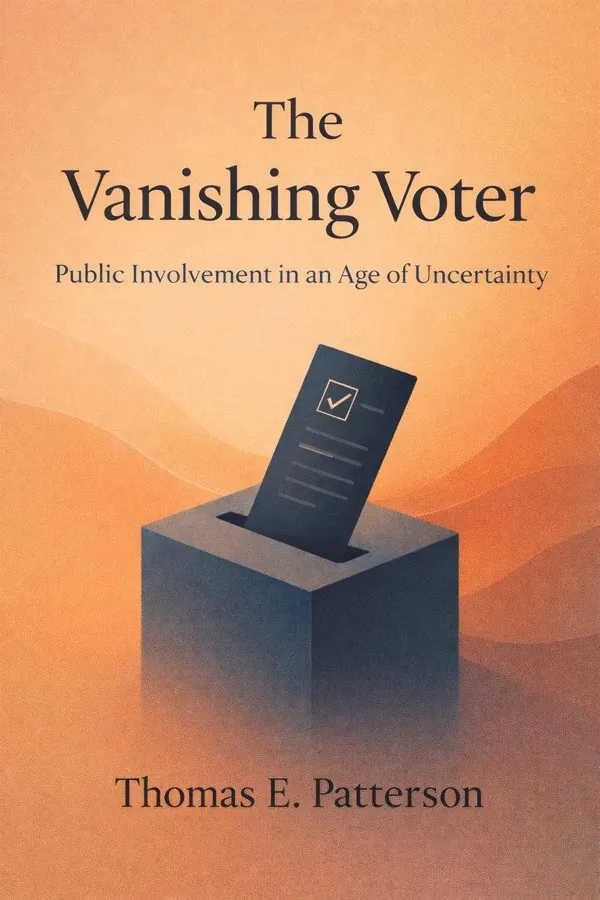
The Vanishing Voter: Public Involvement in an Age of Uncertainty: Summary & Key Insights
 10 min9 chaptersAudio available
Key Takeaways from The Vanishing Voter: Public Involvement in an Age of Uncertainty
A falling turnout rate is more than a statistic; it is a warning signal about the relationship between citizens and their democracy.
When political institutions stop organizing public life, citizens are left to navigate politics largely on their own.
The way politics is reported can either invite citizens into public life or push them away from it.
More campaigning does not necessarily produce more participation.
Political cynicism often looks like a personality trait, but Patterson shows that it is also a product of experience.
What Is The Vanishing Voter: Public Involvement in an Age of Uncertainty About?
The Vanishing Voter: Public Involvement in an Age of Uncertainty by Thomas E. Patterson is a politics book spanning 10 pages. Why do citizens in a democracy stop showing up? In The Vanishing Voter, Thomas E. Patterson tackles that unsettling question by examining the long decline of voter participation in the United States and the broader erosion of public involvement in politics. Drawing on research from Harvard’s Vanishing Voter Project, Patterson argues that disengagement is not simply the result of apathy or ignorance. Instead, it grows out of deep changes in political institutions, campaign strategy, media culture, and public trust. As parties weakened, campaigns became more candidate-centered, media coverage turned more tactical and negative, and politics began to feel less meaningful to ordinary citizens. The result is a democracy in which many people watch from the sidelines rather than participate. What makes this book especially valuable is Patterson’s combination of rigorous data analysis and sharp institutional insight. He does not romanticize an earlier golden age, but he does show how democratic systems can either invite or discourage participation. For readers trying to understand low turnout, public cynicism, and the health of modern democracy, this book remains a powerful and highly relevant guide.
This FizzRead summary covers all 9 key chapters of The Vanishing Voter: Public Involvement in an Age of Uncertainty in approximately 10 minutes, distilling the most important ideas, arguments, and takeaways from Thomas E. Patterson's work. Also available as an audio summary and Key Quotes Podcast.
The Vanishing Voter: Public Involvement in an Age of Uncertainty
Why do citizens in a democracy stop showing up? In The Vanishing Voter, Thomas E. Patterson tackles that unsettling question by examining the long decline of voter participation in the United States and the broader erosion of public involvement in politics. Drawing on research from Harvard’s Vanishing Voter Project, Patterson argues that disengagement is not simply the result of apathy or ignorance. Instead, it grows out of deep changes in political institutions, campaign strategy, media culture, and public trust. As parties weakened, campaigns became more candidate-centered, media coverage turned more tactical and negative, and politics began to feel less meaningful to ordinary citizens. The result is a democracy in which many people watch from the sidelines rather than participate. What makes this book especially valuable is Patterson’s combination of rigorous data analysis and sharp institutional insight. He does not romanticize an earlier golden age, but he does show how democratic systems can either invite or discourage participation. For readers trying to understand low turnout, public cynicism, and the health of modern democracy, this book remains a powerful and highly relevant guide.
Who Should Read The Vanishing Voter: Public Involvement in an Age of Uncertainty?
This book is perfect for anyone interested in politics and looking to gain actionable insights in a short read. Whether you're a student, professional, or lifelong learner, the key ideas from The Vanishing Voter: Public Involvement in an Age of Uncertainty by Thomas E. Patterson will help you think differently.
- ✓Readers who enjoy politics and want practical takeaways
- ✓Professionals looking to apply new ideas to their work and life
- ✓Anyone who wants the core insights of The Vanishing Voter: Public Involvement in an Age of Uncertainty in just 10 minutes
Want the full summary?
Get instant access to this book summary and 100K+ more with Fizz Moment.
Get Free SummaryAvailable on App Store • Free to download
Key Chapters
A falling turnout rate is more than a statistic; it is a warning signal about the relationship between citizens and their democracy. Patterson begins by showing that voter participation in the United States has declined significantly from earlier decades, especially when compared with periods in which elections drew broad public attention and stronger party loyalty. This pattern matters because turnout is one of the clearest indicators of whether people believe politics is worth their time. When fewer citizens vote, the system becomes less representative, and those who remain active gain disproportionate influence.
Patterson’s analysis challenges the easy explanation that Americans simply became lazy or indifferent. Instead, he shows that turnout declined gradually as politics became less socially rooted and less personally meaningful for many people. In earlier eras, party organizations connected citizens to politics through neighborhoods, local leaders, and shared identities. Voting was often part of community life. Over time, those bonds weakened. Elections became more distant, more media-driven, and more dependent on individuals making their own effort to stay informed and involved.
A practical example is the contrast between habitual and occasional voters. Habitual voters often have stronger partisan identities, higher education, and more access to information, so they keep voting even when politics becomes frustrating. Occasional voters, by contrast, are more likely to drop out when campaigns feel confusing, negative, or irrelevant to daily life. This means that low turnout is not random; it systematically excludes some voices more than others.
The broader lesson is that participation must be cultivated. Democracies cannot assume citizens will remain engaged automatically. Actionable takeaway: if we want stronger participation, we must rebuild the conditions that make voting feel consequential, accessible, and socially reinforced.
When political institutions stop organizing public life, citizens are left to navigate politics largely on their own. Patterson argues that one of the most important reasons for declining participation is the weakening of the party-centered system that once helped ordinary Americans connect to elections. Strong parties were not perfect, but they provided cues, mobilization, and a sense of political belonging. As those structures weakened, citizens faced a more fragmented political environment.
Candidate-centered politics replaced party-centered politics in many campaigns. Rather than relying on durable local party organizations, candidates increasingly built temporary campaign machines focused on image, fundraising, and advertising. This shift changed how politics reached voters. Instead of being drawn in by trusted community networks, citizens were exposed to politics as a stream of promotional messages and strategic attacks. That style of campaigning may help candidates win attention, but it does less to build long-term civic commitment.
The effect is especially visible among less engaged citizens. If someone has no strong party attachment and no local political network, they may struggle to understand what is at stake in an election. The process begins to feel like a personality contest rather than a meaningful choice among governing alternatives. For example, local party leaders once helped register voters, explain party platforms, and turn out the vote. In their absence, campaigns often focus resources only on likely supporters, leaving many potential voters untouched.
Patterson’s point is not that old party machines should return unchanged. It is that democratic participation depends on institutional connectors between government and the public. When those connectors disappear, disengagement rises. Actionable takeaway: strengthen civic and political organizations that help citizens interpret, discuss, and act on public issues rather than leaving them isolated consumers of campaign messaging.
The way politics is reported can either invite citizens into public life or push them away from it. Patterson shows that modern media do not merely transmit political information; they shape how people understand politics itself. As journalism increasingly emphasizes conflict, strategy, polling, and scandal, citizens learn to see politics as a game played by professionals rather than a process through which collective problems are solved.
This shift matters because many people rely heavily on media for political knowledge. If the dominant message is that campaigns are cynical contests for power, then public trust and motivation decline. Patterson is especially concerned with the rise of horse-race coverage, where media attention centers on who is ahead, who made a mistake, and how candidates manipulate the electorate. Such coverage may be dramatic and marketable, but it often leaves little room for serious discussion of policy choices, governing consequences, or civic responsibility.
Consider a typical election story that focuses on debate performance, ad strategy, or fundraising totals while devoting only a few lines to healthcare, taxation, or education. A highly informed political junkie may still extract value from that coverage, but an average voter may come away with the impression that politics is superficial, combative, and unworthy of investment. Over time, repeated exposure to this frame fosters skepticism rather than engagement.
Patterson does not argue that journalists should become cheerleaders for politics. Scrutiny is essential. But scrutiny without substance can deepen alienation. Citizens need reporting that clarifies choices, explains consequences, and connects public decisions to everyday life. Actionable takeaway: seek out political information that emphasizes issues, institutional context, and policy impact, and support media outlets that help citizens understand rather than merely spectate.
More campaigning does not necessarily produce more participation. Patterson argues that modern campaigns often saturate the public with political messaging while simultaneously undermining confidence in the political process. This is one of the book’s central paradoxes: citizens are exposed to more campaign communication than ever, yet many feel less informed, less respected, and less motivated to vote.
The reason lies partly in how campaigns are designed. Modern campaign strategy is highly professionalized, data-driven, and persuasive in a commercial sense. Consultants test messages, segment audiences, and use advertising techniques developed for consumer marketing. This can improve message efficiency, but it also changes the tone of political communication. Citizens are addressed less as members of a democratic community and more as targets to be influenced. The result can feel manipulative rather than engaging.
Negative advertising is a clear example. Attack ads may be effective at defining opponents and energizing supporters, but they often leave viewers with a darker view of politics overall. A voter who sees repeated messages about corruption, incompetence, or betrayal may not simply turn against one candidate; they may withdraw from the entire process. Long campaigns can intensify this effect. The longer the electoral season, the more opportunities there are for fatigue, cynicism, and emotional disengagement.
Patterson’s insight is useful beyond presidential races. Any organization seeking public participation should recognize that communication style matters. People become more involved when they feel informed and respected, not when they feel manipulated. Actionable takeaway: reform campaign communication toward clearer issue discussion, shorter cycles where possible, and voter outreach that treats citizens as participants in decision-making rather than mere persuasion targets.
Political cynicism often looks like a personality trait, but Patterson shows that it is also a product of experience. Citizens become cynical when repeated encounters with politics teach them that leaders are self-interested, institutions are unresponsive, and participation makes little difference. In that sense, disillusionment is not just a mood; it is a rational response to a political environment that appears untrustworthy.
Patterson traces how cynicism grows through several channels at once. Media emphasize conflict and strategy. Campaigns rely on negative appeals. Institutions seem gridlocked or remote. Citizens hear promises during elections and witness disappointment afterward. Over time, this creates a mental framework in which politics is assumed to be deceptive by default. The danger is that cynicism becomes self-reinforcing. The more people distrust politics, the less likely they are to participate. The less they participate, the easier it is for organized interests and political insiders to dominate.
This dynamic affects different groups in different ways. Highly educated citizens may remain active despite their cynicism, using their resources to influence outcomes. Less advantaged citizens are more likely to disengage altogether. For example, a disillusioned professional may still vote, donate, or lobby. A disillusioned low-income worker with limited time and weaker political efficacy may simply tune out.
Patterson does not claim that skepticism is always harmful. Healthy democracies require critical citizens. The problem arises when skepticism turns into blanket withdrawal. The challenge is to preserve public vigilance without eroding public involvement. Actionable takeaway: distinguish between critical engagement and total distrust by focusing on specific reforms, measurable accountability, and local opportunities where participation can produce visible results.
Sometimes citizens do not withdraw from politics because they are uninterested, but because the system is badly designed for participation. Patterson highlights how election timing, campaign length, and the sheer volume of political messaging can discourage involvement rather than stimulate it. These features of the electoral process may appear technical, yet they significantly influence whether people choose to engage.
One issue is the unusual complexity of American election administration. Registration rules, primary calendars, off-year elections, and varying local procedures create friction that can reduce turnout. When participation requires extra planning or specialized knowledge, some citizens are inevitably left behind. Another issue is election timing itself. Holding important elections at odd times or separating them from major contests often produces lower participation because many citizens are not paying attention. Turnout tends to be higher when elections are visible, consolidated, and easier to follow.
Campaign length is another factor. In theory, long campaigns give voters more time to learn. In practice, Patterson suggests they often create fatigue. Months of repetitive messaging, tactical speculation, and negative advertising can make politics feel exhausting before Election Day even arrives. Media saturation intensifies this problem. Instead of generating civic energy, nonstop political noise can encourage avoidance.
These insights have practical value. Institutions shape behavior. People are more likely to act when the pathway is simple, timely, and meaningful. If the system feels cumbersome or draining, many will opt out. Actionable takeaway: make participation easier through streamlined registration, well-timed elections, clearer procedures, and campaign rules that reduce unnecessary overload while preserving meaningful voter information.
A democracy can survive low enthusiasm for a time, but it cannot thrive when large segments of the public disengage. Patterson argues that declining participation has consequences far beyond election-day numbers. When fewer citizens vote or stay politically informed, the political system becomes narrower, less accountable, and more vulnerable to elite domination. The issue is not only who wins elections, but how public power is distributed.
One major consequence is representational imbalance. If the electorate is older, wealthier, better educated, and more politically attentive than the broader public, then policy outcomes are more likely to reflect those groups’ interests. Politicians, parties, and advocacy organizations rationally focus on people who vote, donate, and organize. Nonparticipants therefore lose influence twice: first by not showing up, and second by becoming less central to political strategy. This can deepen inequality and reinforce the belief that politics is not for everyone.
There is also a legitimacy problem. Democratic systems rely not just on legal procedures but on public belief that institutions are broadly responsive and fair. Persistent disengagement weakens that belief. Citizens may come to see government as something done to them rather than something shaped by them. This fosters frustration, conspiracy thinking, or attraction to anti-system appeals.
The effects are visible in everyday governance. School boards, city councils, primaries, and local referendums can be decided by tiny electorates, giving organized minorities enormous influence. The less engaged the broader public is, the easier it becomes for highly motivated factions to dominate outcomes.
Patterson’s warning is clear: participation is not a decorative feature of democracy. It is one of its operating requirements. Actionable takeaway: treat civic engagement as essential democratic infrastructure and invest in institutions, education, and public norms that widen meaningful participation.
If disengagement is rooted in institutions, media, and campaign practices, then meaningful reform must do more than urge citizens to care more. Patterson’s final contribution is to show that revitalizing participation requires rebuilding the links between public life and ordinary people’s experience. Reform is not about finding a single miracle fix. It is about making democracy easier to enter, easier to understand, and more worthy of trust.
Patterson points toward several types of remedies. Some are procedural, such as simplifying registration, improving access to the ballot, and designing election calendars that encourage turnout rather than suppress it. Others are communicative, including stronger issue-based journalism and campaign discourse that emphasizes governance instead of spectacle. Still others are civic and educational: schools, local associations, and community institutions can help citizens develop the habits and confidence needed for political participation.
A practical example is civic education that goes beyond memorizing branches of government. Students who learn how local decisions affect budgets, housing, policing, or schools are more likely to view politics as concrete and relevant. Likewise, communities that create public forums, local deliberation spaces, and visible channels for input can make participation feel consequential. People engage more when they can see the connection between voice and outcome.
Patterson’s approach is realistic. He does not promise the elimination of conflict or public frustration. Democracy will always involve disagreement. But institutions can either channel disagreement into participation or let it harden into withdrawal.
Actionable takeaway: focus on reforms that increase both access and meaning—make voting simpler, information better, public discussion more substantive, and citizen influence more visible in everyday political life.
All Chapters in The Vanishing Voter: Public Involvement in an Age of Uncertainty
About the Author
Thomas E. Patterson is an American political scientist best known for his work on political communication, elections, journalism, and civic participation. He serves as the Bradlee Professor of Government and the Press at Harvard University’s Kennedy School of Government, where his research has focused on how media institutions and campaign practices shape public understanding of politics. Patterson has written several influential books on American democracy, including Out of Order and Informing the News, and is widely respected for combining empirical research with accessible analysis. In The Vanishing Voter, he draws on the Harvard Vanishing Voter Project to examine why public participation has declined and what that decline means for democratic life. His work remains central to debates about media reform, voter engagement, and the health of modern democracy.
Get This Summary in Your Preferred Format
Read or listen to the The Vanishing Voter: Public Involvement in an Age of Uncertainty summary by Thomas E. Patterson anytime, anywhere. FizzRead offers multiple formats so you can learn on your terms — all free.
Available formats: App · Audio · PDF · EPUB — All included free with FizzRead
Download The Vanishing Voter: Public Involvement in an Age of Uncertainty PDF and EPUB Summary
Key Quotes from The Vanishing Voter: Public Involvement in an Age of Uncertainty
“A falling turnout rate is more than a statistic; it is a warning signal about the relationship between citizens and their democracy.”
“When political institutions stop organizing public life, citizens are left to navigate politics largely on their own.”
“The way politics is reported can either invite citizens into public life or push them away from it.”
“More campaigning does not necessarily produce more participation.”
“Political cynicism often looks like a personality trait, but Patterson shows that it is also a product of experience.”
Frequently Asked Questions about The Vanishing Voter: Public Involvement in an Age of Uncertainty
The Vanishing Voter: Public Involvement in an Age of Uncertainty by Thomas E. Patterson is a politics book that explores key ideas across 9 chapters. Why do citizens in a democracy stop showing up? In The Vanishing Voter, Thomas E. Patterson tackles that unsettling question by examining the long decline of voter participation in the United States and the broader erosion of public involvement in politics. Drawing on research from Harvard’s Vanishing Voter Project, Patterson argues that disengagement is not simply the result of apathy or ignorance. Instead, it grows out of deep changes in political institutions, campaign strategy, media culture, and public trust. As parties weakened, campaigns became more candidate-centered, media coverage turned more tactical and negative, and politics began to feel less meaningful to ordinary citizens. The result is a democracy in which many people watch from the sidelines rather than participate. What makes this book especially valuable is Patterson’s combination of rigorous data analysis and sharp institutional insight. He does not romanticize an earlier golden age, but he does show how democratic systems can either invite or discourage participation. For readers trying to understand low turnout, public cynicism, and the health of modern democracy, this book remains a powerful and highly relevant guide.
You Might Also Like
Antifa: The Anti-Fascist Handbook
Mark Bray
10 min
Attack from Within: How Disinformation Is Sabotaging America
Barbara McQuade
10 min
Coercion, Capital, and European States, AD 990–1992
Charles Tilly
10 min
Digital Democracy: Concepts, Methodologies, Tools, and Applications
Various Authors
10 min
Fascism
Stanley G. Payne
10 min
Fire And Fury: Inside The Trump White House
Michael Wolff
10 minBrowse by Category
Ready to read The Vanishing Voter: Public Involvement in an Age of Uncertainty?
Get the full summary and 100K+ more books with Fizz Moment.