
Thomas E. Patterson Books
Thomas E. Patterson is the Bradlee Professor of Government and the Press at Harvard University's Kennedy School of Government.
Known for: The Vanishing Voter: Public Involvement in an Age of Uncertainty
Books by Thomas E. Patterson
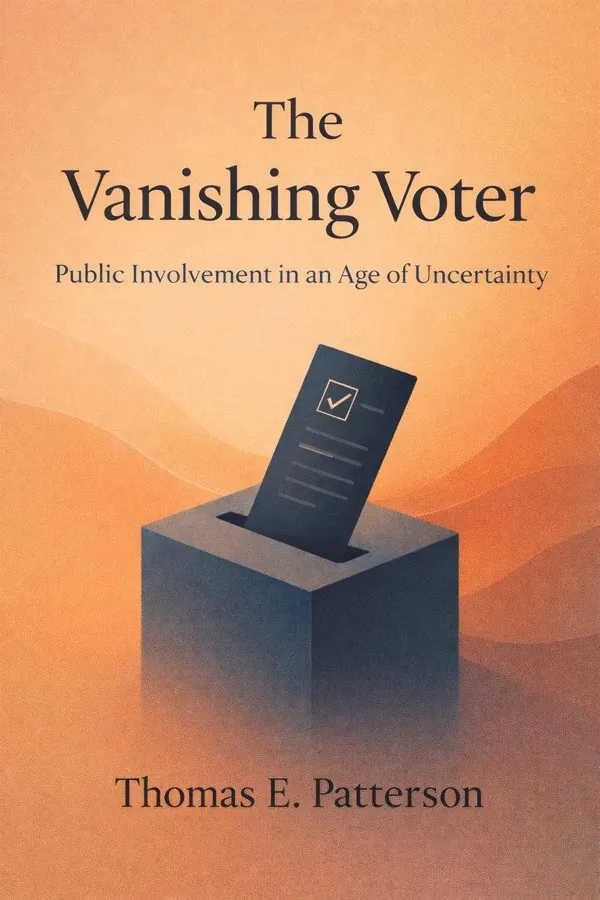
The Vanishing Voter: Public Involvement in an Age of Uncertainty
Why do citizens in a democracy stop showing up? In The Vanishing Voter, Thomas E. Patterson tackles that unsettling question by examining the long decline of voter participation in the United States and the broader erosion of public involvement in politics. Drawing on research from Harvard’s Vanishing Voter Project, Patterson argues that disengagement is not simply the result of apathy or ignorance. Instead, it grows out of deep changes in political institutions, campaign strategy, media culture, and public trust. As parties weakened, campaigns became more candidate-centered, media coverage turned more tactical and negative, and politics began to feel less meaningful to ordinary citizens. The result is a democracy in which many people watch from the sidelines rather than participate. What makes this book especially valuable is Patterson’s combination of rigorous data analysis and sharp institutional insight. He does not romanticize an earlier golden age, but he does show how democratic systems can either invite or discourage participation. For readers trying to understand low turnout, public cynicism, and the health of modern democracy, this book remains a powerful and highly relevant guide.
Read SummaryKey Insights from Thomas E. Patterson
The Long Decline in Voter Turnout
A falling turnout rate is more than a statistic; it is a warning signal about the relationship between citizens and their democracy. Patterson begins by showing that voter participation in the United States has declined significantly from earlier decades, especially when compared with periods in whi...
From The Vanishing Voter: Public Involvement in an Age of Uncertainty
How Political Structures Lost Their Grip
When political institutions stop organizing public life, citizens are left to navigate politics largely on their own. Patterson argues that one of the most important reasons for declining participation is the weakening of the party-centered system that once helped ordinary Americans connect to elect...
From The Vanishing Voter: Public Involvement in an Age of Uncertainty
Media Coverage Shapes Political Engagement
The way politics is reported can either invite citizens into public life or push them away from it. Patterson shows that modern media do not merely transmit political information; they shape how people understand politics itself. As journalism increasingly emphasizes conflict, strategy, polling, and...
From The Vanishing Voter: Public Involvement in an Age of Uncertainty
Campaigns Increase Exposure but Reduce Trust
More campaigning does not necessarily produce more participation. Patterson argues that modern campaigns often saturate the public with political messaging while simultaneously undermining confidence in the political process. This is one of the book’s central paradoxes: citizens are exposed to more ...
From The Vanishing Voter: Public Involvement in an Age of Uncertainty
Cynicism Is Learned, Not Inevitable
Political cynicism often looks like a personality trait, but Patterson shows that it is also a product of experience. Citizens become cynical when repeated encounters with politics teach them that leaders are self-interested, institutions are unresponsive, and participation makes little difference. ...
From The Vanishing Voter: Public Involvement in an Age of Uncertainty
Social Inequality Distorts Who Participates
Low turnout is not only a quantity problem; it is a representation problem. Patterson emphasizes that political disengagement does not affect all citizens equally. Participation is shaped by education, income, age, race, social networks, and civic skills. As a result, when turnout falls, the elector...
From The Vanishing Voter: Public Involvement in an Age of Uncertainty
About Thomas E. Patterson
Thomas E. Patterson is the Bradlee Professor of Government and the Press at Harvard University's Kennedy School of Government. His research focuses on political communication, media effects, and civic engagement. He is the author of several books on American politics and journalism, including 'Out o...
Read more
Thomas E. Patterson is the Bradlee Professor of Government and the Press at Harvard University's Kennedy School of Government. His research focuses on political communication, media effects, and civic engagement. He is the author of several books on American politics and journalism, including 'Out o...
Thomas E. Patterson is the Bradlee Professor of Government and the Press at Harvard University's Kennedy School of Government. His research focuses on political communication, media effects, and civic engagement. He is the author of several books on American politics and journalism, including 'Out of Order' and 'Informing the News.'


Frequently Asked Questions
Thomas E. Patterson is the Bradlee Professor of Government and the Press at Harvard University's Kennedy School of Government.
Read Thomas E. Patterson's books in 15 minutes
Get AI-powered summaries with key insights from 1 book by Thomas E. Patterson.