
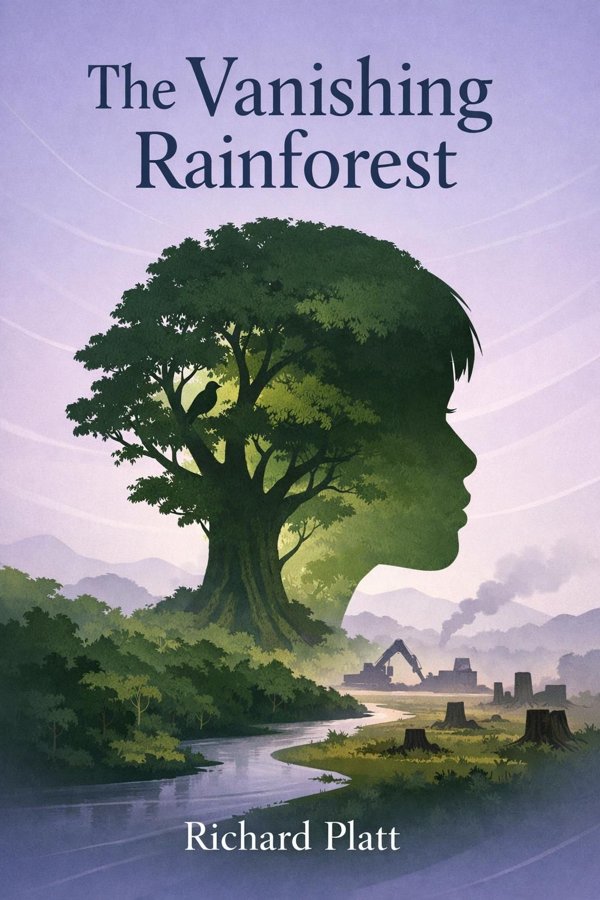
The Vanishing Rainforest: Summary & Key Insights
 10 min9 chaptersAudio available
Key Takeaways from The Vanishing Rainforest
A forest is easy to ignore when we think of it as scenery, but everything changes when we understand it as a living system.
The deepest environmental lessons often begin with a simple truth: people and place shape each other.
Destruction rarely arrives announcing itself as destruction; it often comes disguised as opportunity.
Many environmental struggles are not just about land; they are about vision.
Some of the most important knowledge in the world is never stored in laboratories or textbooks.
What Is The Vanishing Rainforest About?
The Vanishing Rainforest by Richard Platt is a environment book spanning 4 pages. The Vanishing Rainforest by Richard Platt is a powerful children’s book that turns a vast global issue into a story that feels personal, immediate, and unforgettable. Through the experience of Remaema, a young Indigenous boy living in the Amazon, readers enter a world of astonishing beauty, deep tradition, and growing danger. The rainforest is not presented as a distant wilderness, but as a living home filled with animals, plants, stories, skills, and relationships that have sustained communities for generations. As outsiders arrive with promises of roads, wealth, and progress, the book asks a difficult question: what happens when development threatens to destroy the very world it claims to improve? What makes this book so effective is its ability to blend narrative, environmental education, and moral reflection in a way that is accessible to young readers without oversimplifying the issues. Richard Platt, a respected British author of educational and children’s nonfiction, is known for making complex historical and environmental topics vivid and understandable. Here, he offers a moving introduction to conservation, cultural survival, and the urgent need to protect the rainforest before it disappears.
This FizzRead summary covers all 9 key chapters of The Vanishing Rainforest in approximately 10 minutes, distilling the most important ideas, arguments, and takeaways from Richard Platt's work. Also available as an audio summary and Key Quotes Podcast.
The Vanishing Rainforest
The Vanishing Rainforest by Richard Platt is a powerful children’s book that turns a vast global issue into a story that feels personal, immediate, and unforgettable. Through the experience of Remaema, a young Indigenous boy living in the Amazon, readers enter a world of astonishing beauty, deep tradition, and growing danger. The rainforest is not presented as a distant wilderness, but as a living home filled with animals, plants, stories, skills, and relationships that have sustained communities for generations. As outsiders arrive with promises of roads, wealth, and progress, the book asks a difficult question: what happens when development threatens to destroy the very world it claims to improve? What makes this book so effective is its ability to blend narrative, environmental education, and moral reflection in a way that is accessible to young readers without oversimplifying the issues. Richard Platt, a respected British author of educational and children’s nonfiction, is known for making complex historical and environmental topics vivid and understandable. Here, he offers a moving introduction to conservation, cultural survival, and the urgent need to protect the rainforest before it disappears.
Who Should Read The Vanishing Rainforest?
This book is perfect for anyone interested in environment and looking to gain actionable insights in a short read. Whether you're a student, professional, or lifelong learner, the key ideas from The Vanishing Rainforest by Richard Platt will help you think differently.
- ✓Readers who enjoy environment and want practical takeaways
- ✓Professionals looking to apply new ideas to their work and life
- ✓Anyone who wants the core insights of The Vanishing Rainforest in just 10 minutes
Want the full summary?
Get instant access to this book summary and 100K+ more with Fizz Moment.
Get Free SummaryAvailable on App Store • Free to download
Key Chapters
A forest is easy to ignore when we think of it as scenery, but everything changes when we understand it as a living system. In The Vanishing Rainforest, the Amazon is not just the setting for Remaema’s story. It is the source of food, shelter, medicine, knowledge, and identity. The book helps young readers see that the rainforest is alive with movement and connection: trees create shade and hold water, insects pollinate plants, birds spread seeds, rivers carry life through the land, and people depend on all of it in ways both practical and spiritual.
Richard Platt presents the forest as a place of abundance, but also of balance. Remaema’s community does not treat the rainforest as something separate from human life. They live within it, learning how to gather fruit, hunt carefully, travel by river, and recognize the signs of weather and animals. This view challenges a modern habit of seeing nature mainly as a resource to extract or a place to visit. In the book, the rainforest is a home and a teacher.
This idea matters because many environmental problems begin with emotional distance. If children only hear statistics about deforestation, they may understand the scale but not the meaning. By showing daily life in the forest, the book gives ecological concepts a human face. Readers begin to grasp why losing the rainforest means losing more than trees; it means unraveling a whole web of life.
A practical way to apply this idea is to encourage children to see local ecosystems with the same respect. A park, pond, garden, or woodland can be explored as a connected living world rather than empty space. The actionable takeaway: treat every natural place as a community of relationships, not just a backdrop.
The deepest environmental lessons often begin with a simple truth: people and place shape each other. One of the book’s most valuable contributions is its portrayal of the close bond between Indigenous life and the rainforest. Remaema’s world is not divided into “human culture” on one side and “nature” on the other. His traditions, routines, beliefs, and survival skills are all rooted in the land around him.
This matters because environmental debates are often framed too narrowly. Forests are discussed in terms of timber, land use, carbon, or biodiversity, while the people who have lived there for generations are treated as secondary. Platt’s story pushes back against that mindset. Through Remaema, readers see that the rainforest holds memory, identity, and inherited knowledge. Knowing where to fish, which plants can heal, when to move, and how to live without exhausting the land is a form of expertise built over generations.
The book also invites reflection on cultural loss. If the forest is cleared, it is not only habitats that disappear. Languages, stories, ceremonies, and ways of understanding the world are threatened too. This broadens the meaning of conservation. Protecting ecosystems also means respecting the communities whose lives are bound to them.
A practical application is to connect environmental education with human stories. Teachers and parents can discuss how different communities around the world live with deserts, oceans, forests, and mountains, and how geography shapes culture. This helps children see conservation as both ecological and human. The actionable takeaway: whenever you think about protecting nature, ask whose home, history, and knowledge are also being protected.
Destruction rarely arrives announcing itself as destruction; it often comes disguised as opportunity. In The Vanishing Rainforest, outsiders enter the Amazon with the language of development. They speak of roads, jobs, money, schools, and modern ways of living. These promises are not automatically evil, and that is what makes the conflict in the book especially thought-provoking. Progress can sound reasonable, even generous, until readers begin to ask who benefits, who pays the price, and what is lost forever.
Platt does not reduce the issue to a cartoon battle between good villagers and bad developers. Instead, he shows how tempting outside change can be. Better access to goods or services may seem attractive, especially to communities facing hardship or isolation. Yet those gains may come tied to logging, mining, land clearing, and cultural disruption. Once roads are cut into the forest, more people follow, and the pace of destruction often accelerates.
This section of the story helps young readers grasp a difficult real-world lesson: not every form of growth is healthy. A plan can be profitable in the short term while deeply harmful in the long term. Forests that took centuries to grow can be removed quickly, leaving behind damaged soil, displaced wildlife, and fractured communities.
A practical example is to compare local development debates, such as building on green spaces or expanding roads, with questions raised in the book. Children can learn to ask what the hidden costs might be. The actionable takeaway: whenever someone promises progress, look beyond the immediate benefits and ask what long-term damage may be ignored.
Many environmental struggles are not just about land; they are about vision. The conflict in The Vanishing Rainforest grows because different groups look at the same place and see completely different things. Remaema’s people see a home, a source of wisdom, and a living inheritance. Outsiders may see timber, profit, transport routes, or land waiting to be converted into something more “useful.” The tragedy begins when one vision is treated as superior and the other as backward.
This idea is especially important for young readers because it introduces the concept of perspective. Environmental damage often happens not because one side lacks intelligence, but because they value different outcomes. If the forest is measured only in money, it becomes easier to destroy. If it is understood as a network of life and culture, destruction becomes far harder to justify.
Platt’s storytelling encourages empathy without removing moral clarity. Readers can understand why conflict emerges, but they are also guided to notice which viewpoint preserves life and which threatens it. This helps children develop critical thinking about how values shape decisions.
In everyday life, this lesson can be applied by asking children to compare how different people might view the same place: a wetland could be seen as a building site, a flood barrier, a habitat, or a classroom for science. Such exercises build environmental literacy and moral imagination.
The actionable takeaway: practice asking not only “What is this place worth?” but also “Worth to whom, and in what way?”
Some of the most important knowledge in the world is never stored in laboratories or textbooks. In The Vanishing Rainforest, the elders represent a different kind of intelligence: knowledge gained through observation, experience, memory, and respect for the land. They understand the rhythms of the rainforest, the behavior of animals, the value of particular plants, and the responsibilities that come with taking from nature.
This is a crucial part of the book’s message. Modern societies often assume that expertise only comes from formal institutions, but Platt reminds readers that traditional ecological knowledge is both sophisticated and practical. The elders know how to live in a way that sustains the forest rather than exhausting it. Their wisdom includes restraint, not just skill. They understand that survival depends on preserving the systems that make life possible.
For children, this is a meaningful lesson in humility. It suggests that learning does not only happen in classrooms and that older generations can hold insights modern society urgently needs. It also challenges the false assumption that traditional cultures are primitive simply because they use different tools or values.
A practical application is to invite children to learn from family members, local naturalists, gardeners, farmers, fishers, or Indigenous voices about seasonal cycles, plant uses, and sustainable habits. This strengthens respect for lived knowledge and intergenerational learning.
The actionable takeaway: seek out the people who know a place deeply, and listen before assuming modern solutions are always the best ones.
Environmental destruction becomes more urgent when we realize that every damaged ecosystem leaves a human wound behind. The Vanishing Rainforest makes this connection clear by showing that deforestation is not only about felled trees or disappearing animals. It also brings fear, displacement, broken traditions, and uncertainty about the future. As the forest changes, the lives shaped by it begin to change too.
This is one of the book’s most powerful insights. Readers see that ecological loss is emotional and cultural as well as physical. If familiar hunting grounds vanish, if rivers are polluted, if sacred places are cut down, then a community loses more than resources. It loses stability, confidence, and continuity. Children can understand this instinctively when they imagine what it would feel like for their own home, school, or neighborhood to be destroyed.
The story therefore builds compassion alongside environmental awareness. It moves beyond abstract conservation and asks readers to consider justice. Who is forced to bear the consequences of decisions made by others? Often it is those who contributed least to the destruction in the first place.
A practical way to use this idea is in discussions about environmental justice close to home. Pollution, lack of green space, or unsafe water supplies often affect some communities more than others. Connecting local examples to the book helps children see that fairness and environmental care are linked.
The actionable takeaway: when thinking about environmental harm, always ask who is being hurt in daily life, not just what is being damaged on a map.
The most meaningful environmental stories do not simply warn; they also imagine a better way forward. Remaema’s journey points toward balance rather than rejection of all change. The book does not suggest that every form of development is wrong or that communities must remain frozen in time. Instead, it raises a more thoughtful question: how can people improve life without destroying the natural systems and cultural traditions that make life meaningful?
This nuance is what gives the book lasting value. Environmental debates are often presented as a harsh choice between untouched nature and total modernization. Platt offers a more constructive possibility. Roads, education, healthcare, and communication matter, but they should not come at the cost of clearing forests, silencing Indigenous voices, or treating living landscapes as disposable.
For young readers, this is an empowering message. It teaches that difficult problems do not always require extreme positions; they require wise choices, listening, and long-term thinking. Hope comes not from pretending the danger is small, but from recognizing that people can act differently.
A practical example is introducing children to real projects that support sustainable forestry, Indigenous land rights, reforestation, and community-led conservation. These examples help them see that protecting nature and supporting human dignity can go together.
The actionable takeaway: reject false choices and look for solutions that protect both people and the living world they depend on.
Sometimes a short illustrated story can achieve what long reports cannot. The Vanishing Rainforest proves that children’s literature can be a serious form of environmental education. By using vivid imagery, a relatable young protagonist, and a clear emotional arc, Richard Platt makes a large global issue understandable without making it dull or overwhelming.
This matters because the first step toward caring is often imagination. Facts tell us what is happening, but stories help us feel why it matters. A child may forget a statistic about rainforest loss, but remember Remaema’s fear, wonder, and attachment to his home. That emotional connection can become the foundation for lifelong concern about conservation, justice, and climate.
The book also models an effective teaching method: combine narrative with information. Readers are not lectured at. Instead, they learn through immersion in a character’s world. This approach respects children’s intelligence while still being accessible. It encourages questions rather than passive acceptance.
In practice, educators and parents can use stories like this alongside maps, science lessons, documentaries, or art projects. Children might draw food webs, research rainforest animals, or discuss the choices faced by communities under pressure. This creates a richer, more memorable learning experience.
The actionable takeaway: use stories as gateways to deeper learning, because empathy often opens the door that information alone cannot.
A book about the Amazon may seem far removed from everyday life, but its lessons become most powerful when they shape ordinary choices. The Vanishing Rainforest encourages readers to move beyond sympathy into responsibility. Even if children cannot stop deforestation directly, they can begin to understand that their lives are connected to global ecosystems through consumption, waste, and civic awareness.
This final lesson is about scale. The book presents a huge issue, yet it does so through one boy’s experience. That structure suggests an important truth: large problems are made up of many small actions, decisions, and relationships. In the same way, meaningful care for the planet begins with habits that seem modest but add up over time.
Practical applications are easy to identify. Families can reduce waste, avoid products linked to environmental destruction when possible, learn where materials such as wood or paper come from, support conservation groups, and talk about why forests matter. Schools can create lessons around biodiversity, recycling, habitat protection, and Indigenous rights. Children can write, draw, discuss, and ask informed questions. These acts may seem small, but they build awareness and values.
Most importantly, the book teaches that care begins with attention. When readers notice the beauty and fragility of the rainforest, they are more likely to notice the vulnerable places near them too.
The actionable takeaway: let concern become habit by choosing one concrete action that connects your daily life to the protection of nature.
All Chapters in The Vanishing Rainforest
About the Author
Richard Platt is a British author widely recognized for his children’s nonfiction and educational books. Over the course of his career, he has written on subjects ranging from history and exploration to science and the environment, earning praise for making complex topics clear, vivid, and engaging for younger readers. His work often blends factual accuracy with strong storytelling, allowing children to learn through narrative rather than instruction alone. That approach is especially effective in books like The Vanishing Rainforest, where environmental themes are made personal and emotionally accessible. Platt’s writing reflects a talent for turning global issues into stories that children can understand and care about. Because of this, he has become a trusted name for parents, teachers, and schools seeking informative books that also inspire curiosity, empathy, and thoughtful discussion.
Get This Summary in Your Preferred Format
Read or listen to the The Vanishing Rainforest summary by Richard Platt anytime, anywhere. FizzRead offers multiple formats so you can learn on your terms — all free.
Available formats: App · Audio · PDF · EPUB — All included free with FizzRead
Download The Vanishing Rainforest PDF and EPUB Summary
Key Quotes from The Vanishing Rainforest
“A forest is easy to ignore when we think of it as scenery, but everything changes when we understand it as a living system.”
“The deepest environmental lessons often begin with a simple truth: people and place shape each other.”
“Destruction rarely arrives announcing itself as destruction; it often comes disguised as opportunity.”
“Many environmental struggles are not just about land; they are about vision.”
“Some of the most important knowledge in the world is never stored in laboratories or textbooks.”
Frequently Asked Questions about The Vanishing Rainforest
The Vanishing Rainforest by Richard Platt is a environment book that explores key ideas across 9 chapters. The Vanishing Rainforest by Richard Platt is a powerful children’s book that turns a vast global issue into a story that feels personal, immediate, and unforgettable. Through the experience of Remaema, a young Indigenous boy living in the Amazon, readers enter a world of astonishing beauty, deep tradition, and growing danger. The rainforest is not presented as a distant wilderness, but as a living home filled with animals, plants, stories, skills, and relationships that have sustained communities for generations. As outsiders arrive with promises of roads, wealth, and progress, the book asks a difficult question: what happens when development threatens to destroy the very world it claims to improve? What makes this book so effective is its ability to blend narrative, environmental education, and moral reflection in a way that is accessible to young readers without oversimplifying the issues. Richard Platt, a respected British author of educational and children’s nonfiction, is known for making complex historical and environmental topics vivid and understandable. Here, he offers a moving introduction to conservation, cultural survival, and the urgent need to protect the rainforest before it disappears.
You Might Also Like
A Life on Our Planet: My Witness Statement and a Vision for the Future
David Attenborough
10 min
A Sky Full Of Birds
Matt Merritt
10 min
Carbon Zero: Imagining Cities That Can Save the Planet
Alex Steffen
10 min
Eaarth: Making a Life on a Tough New Planet
Bill McKibben
10 min
The Social Contract and Environmental Governance
Various Editors
10 min
The Wild Places
Robert Macfarlane
10 minBrowse by Category
Ready to read The Vanishing Rainforest?
Get the full summary and 100K+ more books with Fizz Moment.