
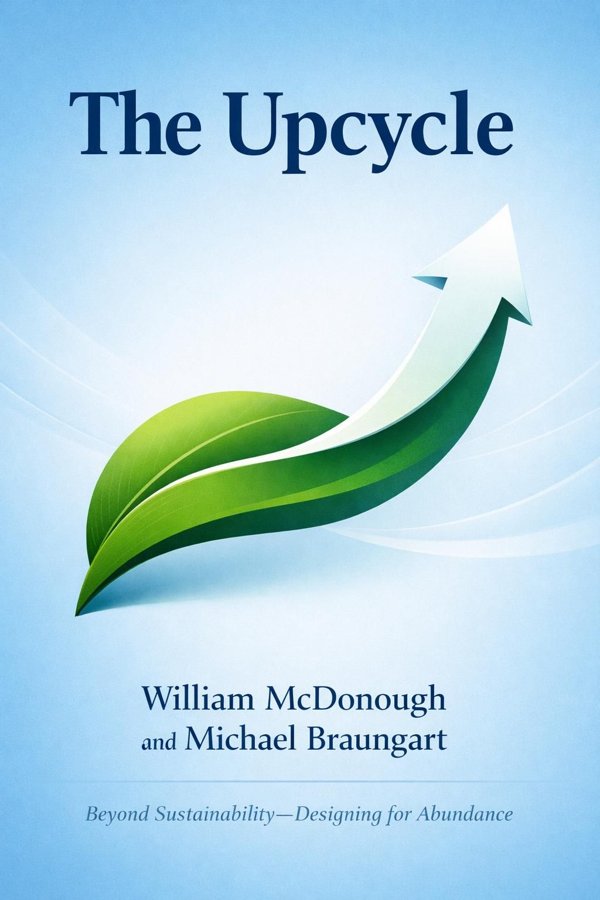
The Upcycle: Beyond Sustainability—Designing for Abundance: Summary & Key Insights
by William McDonough, Michael Braungart
 10 min10 chaptersAudio available
What Is The Upcycle: Beyond Sustainability—Designing for Abundance About?
The Upcycle: Beyond Sustainability—Designing for Abundance by William McDonough and Michael Braungart is a environment book spanning 10 pages. The Upcycle es una continuación del influyente libro 'Cradle to Cradle'. En esta obra, los autores exploran cómo el diseño puede ir más allá de la sostenibilidad para crear sistemas que generen abundancia y beneficios tanto para el medio ambiente como para la sociedad. Propone una visión optimista en la que los productos y procesos industriales se conciben para mejorar el mundo, no solo para reducir el daño.
This FizzRead summary covers all 10 key chapters of The Upcycle: Beyond Sustainability—Designing for Abundance in approximately 10 minutes, distilling the most important ideas, arguments, and takeaways from William McDonough and Michael Braungart's work. Also available as an audio summary and Key Quotes Podcast.
The Upcycle: Beyond Sustainability—Designing for Abundance
The Upcycle es una continuación del influyente libro 'Cradle to Cradle'. En esta obra, los autores exploran cómo el diseño puede ir más allá de la sostenibilidad para crear sistemas que generen abundancia y beneficios tanto para el medio ambiente como para la sociedad. Propone una visión optimista en la que los productos y procesos industriales se conciben para mejorar el mundo, no solo para reducir el daño.
Who Should Read The Upcycle: Beyond Sustainability—Designing for Abundance?
This book is perfect for anyone interested in environment and looking to gain actionable insights in a short read. Whether you're a student, professional, or lifelong learner, the key ideas from The Upcycle: Beyond Sustainability—Designing for Abundance by William McDonough and Michael Braungart will help you think differently.
- ✓Readers who enjoy environment and want practical takeaways
- ✓Professionals looking to apply new ideas to their work and life
- ✓Anyone who wants the core insights of The Upcycle: Beyond Sustainability—Designing for Abundance in just 10 minutes
Want the full summary?
Get instant access to this book summary and 100K+ more with Fizz Moment.
Get Free SummaryAvailable on App Store • Free to download
Key Chapters
The common language of sustainability has long revolved around reduction—less carbon, less waste, less energy. In practice, our collective imagination has been trained toward guilt, toward diminishment. We have celebrated doing less harm as if it were the ultimate moral triumph. Yet when a factory claims it has reduced its pollution by half, the world still suffers pollution. When a designer claims a product uses fifty percent fewer toxic materials, the product remains toxic. We must recognize that 'less bad' does not equal 'good.' The Upcycle begins by liberating us from this false morality of limits.
I remember standing on a factory floor years ago, listening to a manager proudly describe how his new wastewater treatment system had reduced contamination by twenty percent. I asked, 'What if your water left the factory cleaner than when it entered?' The man laughed, as if such a question belonged to fantasy. But within this laughter lies our greatest opportunity—to believe again in human creativity. 'Less bad' binds us to a logic of scarcity; 'more good' releases us into a logic of possibility. When we design with the intention to enhance, rather than to restrain, we invite abundance and innovation into our work.
From an industrial perspective, this transition demands courage. It means rethinking production not as the controlled application of damage, but as the cultivation of benefit. A fabric can purify air; a building can generate energy; a city can grow healthier as it grows larger. These outcomes are not miracles—they are the natural consequences of designing for abundance. Just as the forest does not ask how to minimize waste, so too should human industries become ecosystems of positive exchange.
If sustainability was the art of surviving within boundaries, abundance is the art of flourishing beyond them. The Upcycle argues that design must take inspiration from nature’s generosity. The Earth is not efficient, it is effective: it wastes nothing, because it transforms everything. We humans too can design within that magnificent logic.
In our architectural practice, we envisioned buildings that behave like trees. Such buildings clean air, channel carbon into productivity, harvest rainwater, and nourish community. The secret of abundance lies not in quantity, but in pattern. When we see the world as a network of nutrients and cycles, every output becomes input; every product becomes potential. Imagine a carpet that releases vitamins into the air instead of volatile toxins; imagine automobiles whose materials can be endlessly reused; imagine packaging that becomes fertilizer rather than landfill. These are not distant possibilities—they exist now in evolving industries that have embraced cradle-to-cradle certification.
Designing for abundance means rethinking the relationship between human intention and natural process. Where conventional ecology sought balance, regenerative design seeks symbiosis. Every action can contribute to the health of ecosystems. We move from the language of limits to the language of celebration—honoring diversity, culture, creativity, and growth as ecological virtues rather than threats. By redefining design as an act of giving, we unlock innovation that multiplies value for both industry and environment.
+ 8 more chapters — available in the FizzRead app
All Chapters in The Upcycle: Beyond Sustainability—Designing for Abundance
About the Authors
William McDonough es arquitecto y diseñador estadounidense, conocido por su trabajo en diseño sostenible y economía circular. Michael Braungart es químico alemán y fundador de EPEA, especializado en ecología industrial. Juntos son pioneros del concepto 'Cradle to Cradle'.
Get This Summary in Your Preferred Format
Read or listen to the The Upcycle: Beyond Sustainability—Designing for Abundance summary by William McDonough and Michael Braungart anytime, anywhere. FizzRead offers multiple formats so you can learn on your terms — all free.
Available formats: App · Audio · PDF · EPUB — All included free with FizzRead
Download The Upcycle: Beyond Sustainability—Designing for Abundance PDF and EPUB Summary
Key Quotes from The Upcycle: Beyond Sustainability—Designing for Abundance
“The common language of sustainability has long revolved around reduction—less carbon, less waste, less energy.”
“If sustainability was the art of surviving within boundaries, abundance is the art of flourishing beyond them.”
Frequently Asked Questions about The Upcycle: Beyond Sustainability—Designing for Abundance
The Upcycle: Beyond Sustainability—Designing for Abundance by William McDonough and Michael Braungart is a environment book that explores key ideas across 10 chapters. The Upcycle es una continuación del influyente libro 'Cradle to Cradle'. En esta obra, los autores exploran cómo el diseño puede ir más allá de la sostenibilidad para crear sistemas que generen abundancia y beneficios tanto para el medio ambiente como para la sociedad. Propone una visión optimista en la que los productos y procesos industriales se conciben para mejorar el mundo, no solo para reducir el daño.
You Might Also Like
A Life on Our Planet: My Witness Statement and a Vision for the Future
David Attenborough
10 min
A Sky Full Of Birds
Matt Merritt
10 min
Carbon Zero: Imagining Cities That Can Save the Planet
Alex Steffen
10 min
Eaarth: Making a Life on a Tough New Planet
Bill McKibben
10 min
The Social Contract and Environmental Governance
Various Editors
10 min
The Wild Places
Robert Macfarlane
10 minBrowse by Category
Ready to read The Upcycle: Beyond Sustainability—Designing for Abundance?
Get the full summary and 100K+ more books with Fizz Moment.