
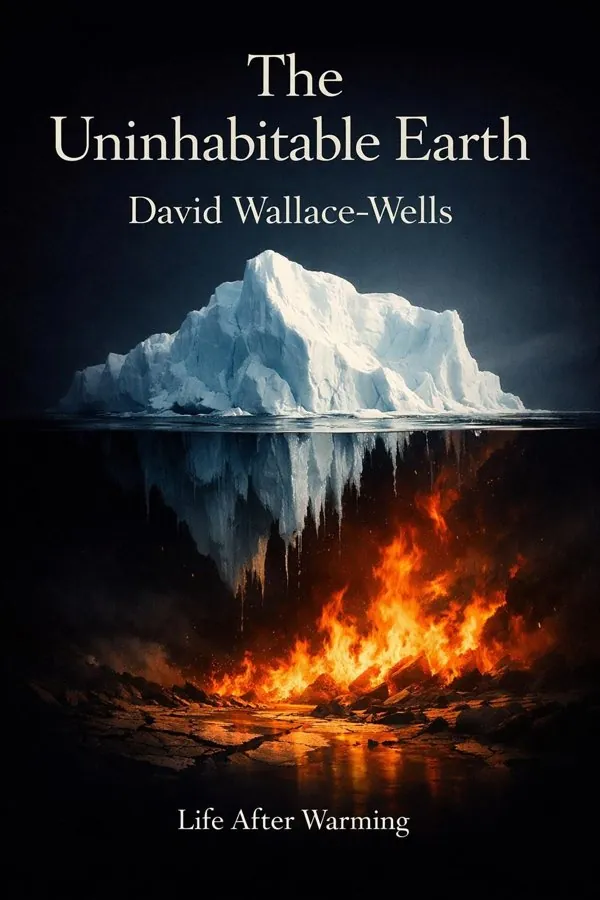
The Uninhabitable Earth: Life After Warming: Summary & Key Insights
 10 min12 chaptersAudio available
What Is The Uninhabitable Earth: Life After Warming About?
The Uninhabitable Earth: Life After Warming by David Wallace-Wells is a environment book spanning 12 pages. The Uninhabitable Earth: Life After Warming is a nonfiction book by journalist David Wallace-Wells that explores the potential consequences of climate change if current trends continue. Drawing on scientific research, it presents vivid scenarios of environmental, social, and economic disruption caused by global warming, emphasizing the urgency of collective action to mitigate its effects.
This FizzRead summary covers all 12 key chapters of The Uninhabitable Earth: Life After Warming in approximately 10 minutes, distilling the most important ideas, arguments, and takeaways from David Wallace-Wells's work. Also available as an audio summary and Key Quotes Podcast.
The Uninhabitable Earth: Life After Warming
The Uninhabitable Earth: Life After Warming is a nonfiction book by journalist David Wallace-Wells that explores the potential consequences of climate change if current trends continue. Drawing on scientific research, it presents vivid scenarios of environmental, social, and economic disruption caused by global warming, emphasizing the urgency of collective action to mitigate its effects.
Who Should Read The Uninhabitable Earth: Life After Warming?
This book is perfect for anyone interested in environment and looking to gain actionable insights in a short read. Whether you're a student, professional, or lifelong learner, the key ideas from The Uninhabitable Earth: Life After Warming by David Wallace-Wells will help you think differently.
- ✓Readers who enjoy environment and want practical takeaways
- ✓Professionals looking to apply new ideas to their work and life
- ✓Anyone who wants the core insights of The Uninhabitable Earth: Life After Warming in just 10 minutes
Want the full summary?
Get instant access to this book summary and 100K+ more with Fizz Moment.
Get Free SummaryAvailable on App Store • Free to download
Key Chapters
When we speak of climate change, we often imagine a series of discrete events: a flood here, a famine there, the loss of a coral reef, a wildfire. But in truth, these are not isolated phenomena—they cascade. The warming atmosphere links every system we depend upon, and disturbances in one ripple through the rest. The collapse of ice sheets accelerates sea-level rise; that rise erodes coastlines and displaces populations; this migration triggers political instability, which in turn hampers collective action. It is an Earthly Rube Goldberg machine of decline.
The concept of cascading effects is central to understanding why climate change cannot be managed as a single-issue problem. It magnifies all existing inequalities, amplifies feedback loops, and exposes how every level of modern civilization is embedded in environmental equilibrium. The global food chain, for example, rests on predictable weather patterns and fertile soils that are already beginning to fail. Financial systems depend on insurance markets that presume stability. And political systems rely on public trust, which buckles under repeated crises. Once these systems interact under the pressure of climate disruption, the damage multiplies beyond simple arithmetic.
What unnerves me most is that these cascades are already visible: Arctic warming disrupts the jet stream, producing erratic winters in Europe and North America; droughts in the Middle East intensify social unrest; heat waves in India coincide with spikes in migration. We are witnessing the first tremors of systemic shock. The future, unless radically redirected, will be defined by their synchrony—interlocking failures feeding one another in real time. That insight reframes everything: there is no such thing as a local climate story anymore.
At the heart of the disaster lies an ancient constant: heat. For most of human history, our bodies and civilizations have operated within a narrow thermal range. Beyond it lies not discomfort but death. As global temperatures rise, regions that were once merely humid will become intolerable to human metabolism. Hundreds of millions of people may experience wet-bulb conditions—combinations of heat and humidity that make evaporative cooling impossible. At such thresholds, the line between survival and collapse is measured in hours.
I explore in this chapter not only the physiology of heat but its psychological and social implications. Cities built for temperate climates begin to buckle under relentless summers; energy grids strain as air-conditioning becomes both lifeline and peril, since the energy it consumes often worsens the very problem it’s meant to solve. Labor, once taken for granted, becomes impossible in open air. Agricultural rhythms falter, and with them the economies that feed billions. The projections are staggering, but the deeper story is moral: heat strips away illusion. It forces us to confront the fact that comfort for some has been purchased through emissions that endanger all.
This is not abstract modeling. The 2003 European heat wave killed tens of thousands. In recent years, temperatures in Pakistan and the Persian Gulf have approached levels that test human endurance. By mid-century, entire regions could become physiologically uninhabitable without costly adaptation. Heat, I argue, is the most intimate and democratic of the crisis’s effects—it touches every breath, every field, every home.
+ 10 more chapters — available in the FizzRead app
All Chapters in The Uninhabitable Earth: Life After Warming
About the Author
David Wallace-Wells is an American journalist and deputy editor at New York magazine. He is known for his writing on climate change and environmental issues, particularly his 2017 essay and subsequent book The Uninhabitable Earth, which brought widespread attention to the potential catastrophic impacts of global warming.
Get This Summary in Your Preferred Format
Read or listen to the The Uninhabitable Earth: Life After Warming summary by David Wallace-Wells anytime, anywhere. FizzRead offers multiple formats so you can learn on your terms — all free.
Available formats: App · Audio · PDF · EPUB — All included free with FizzRead
Download The Uninhabitable Earth: Life After Warming PDF and EPUB Summary
Key Quotes from The Uninhabitable Earth: Life After Warming
“When we speak of climate change, we often imagine a series of discrete events: a flood here, a famine there, the loss of a coral reef, a wildfire.”
“At the heart of the disaster lies an ancient constant: heat.”
Frequently Asked Questions about The Uninhabitable Earth: Life After Warming
The Uninhabitable Earth: Life After Warming by David Wallace-Wells is a environment book that explores key ideas across 12 chapters. The Uninhabitable Earth: Life After Warming is a nonfiction book by journalist David Wallace-Wells that explores the potential consequences of climate change if current trends continue. Drawing on scientific research, it presents vivid scenarios of environmental, social, and economic disruption caused by global warming, emphasizing the urgency of collective action to mitigate its effects.
You Might Also Like
A Life on Our Planet: My Witness Statement and a Vision for the Future
David Attenborough
10 min
A Sky Full Of Birds
Matt Merritt
10 min
Carbon Zero: Imagining Cities That Can Save the Planet
Alex Steffen
10 min
Eaarth: Making a Life on a Tough New Planet
Bill McKibben
10 min
The Social Contract and Environmental Governance
Various Editors
10 min
The Wild Places
Robert Macfarlane
10 minBrowse by Category
Ready to read The Uninhabitable Earth: Life After Warming?
Get the full summary and 100K+ more books with Fizz Moment.