
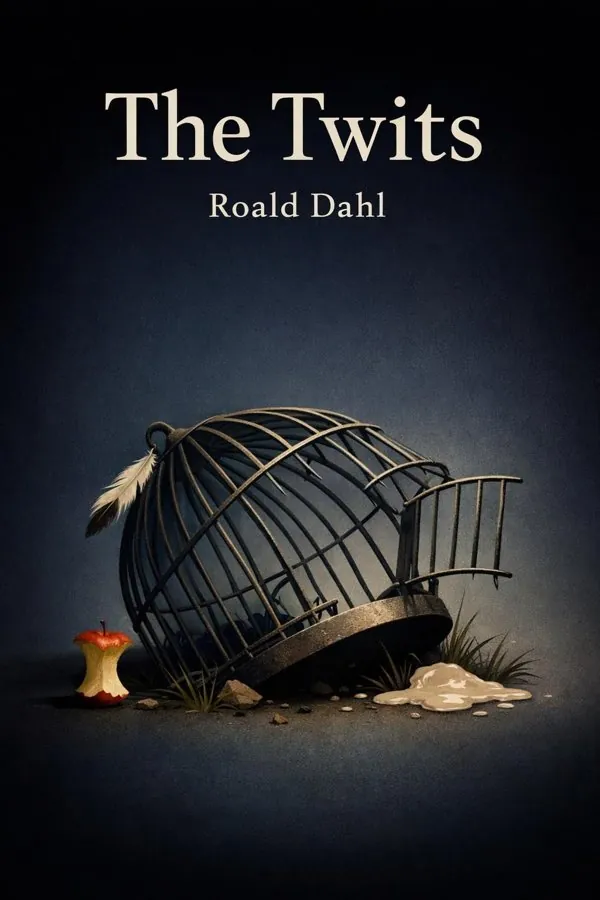
The Twits: Summary & Key Insights
by Roald Dahl
 10 min8 chaptersAudio available
Key Takeaways from The Twits
Sometimes the fastest way to understand a story is to look at the people no one would ever want to become.
A relationship without kindness does not become exciting; it becomes poisonous.
The clearest test of character is often how someone treats those with less power.
Kindness is most powerful when it appears in a world that expects selfishness.
Tyrants often seem unbeatable until the people beneath them begin to work together.
What Is The Twits About?
The Twits by Roald Dahl is a classics book spanning 6 pages. Roald Dahl’s The Twits is a short children’s classic with a surprisingly sharp bite. On the surface, it is the story of Mr. and Mrs. Twit, a filthy, spiteful married couple who spend their days tormenting each other, abusing animals, and spreading misery wherever they can. But beneath the outrageous pranks, sticky beards, and comic nastiness lies a clear moral vision: cruelty deforms the soul, while kindness creates freedom. Dahl turns exaggeration into a tool of truth, showing young readers that ugly thoughts and ugly actions eventually leave their mark. What makes The Twits endure is its balance of wicked humor and moral clarity. Children laugh at the absurd tricks and gleeful revenge, yet they also sense that Dahl is making an important point about character. The book is not simply about bad people getting punished; it is about how habits of meanness can trap us, and how cooperation can overcome brute power. Dahl, one of the most beloved children’s authors of the 20th century, was a master of mixing darkness, imagination, and justice. In The Twits, he delivers all three in a compact, unforgettable tale.
This FizzRead summary covers all 8 key chapters of The Twits in approximately 10 minutes, distilling the most important ideas, arguments, and takeaways from Roald Dahl's work. Also available as an audio summary and Key Quotes Podcast.
The Twits
Roald Dahl’s The Twits is a short children’s classic with a surprisingly sharp bite. On the surface, it is the story of Mr. and Mrs. Twit, a filthy, spiteful married couple who spend their days tormenting each other, abusing animals, and spreading misery wherever they can. But beneath the outrageous pranks, sticky beards, and comic nastiness lies a clear moral vision: cruelty deforms the soul, while kindness creates freedom. Dahl turns exaggeration into a tool of truth, showing young readers that ugly thoughts and ugly actions eventually leave their mark.
What makes The Twits endure is its balance of wicked humor and moral clarity. Children laugh at the absurd tricks and gleeful revenge, yet they also sense that Dahl is making an important point about character. The book is not simply about bad people getting punished; it is about how habits of meanness can trap us, and how cooperation can overcome brute power. Dahl, one of the most beloved children’s authors of the 20th century, was a master of mixing darkness, imagination, and justice. In The Twits, he delivers all three in a compact, unforgettable tale.
Who Should Read The Twits?
This book is perfect for anyone interested in classics and looking to gain actionable insights in a short read. Whether you're a student, professional, or lifelong learner, the key ideas from The Twits by Roald Dahl will help you think differently.
- ✓Readers who enjoy classics and want practical takeaways
- ✓Professionals looking to apply new ideas to their work and life
- ✓Anyone who wants the core insights of The Twits in just 10 minutes
Want the full summary?
Get instant access to this book summary and 100K+ more with Fizz Moment.
Get Free SummaryAvailable on App Store • Free to download
Key Chapters
Sometimes the fastest way to understand a story is to look at the people no one would ever want to become. That is exactly how Roald Dahl introduces Mr. and Mrs. Twit. They are not merely odd or unfriendly; they are designed as living symbols of moral decay. Mr. Twit’s beard, packed with old food and grime, becomes a comic image of neglect and greed. Mrs. Twit, with her glass eye and constant malice, is no less revolting. Their outer ugliness reflects something deeper: years of ugly thoughts.
Dahl makes a bold claim through these characters: what we repeatedly think and do shapes who we become. The Twits are not born as monsters in the fairy-tale sense. They become monstrous through habits of cruelty, selfishness, and contempt. Their home, their appearance, and their marriage all reveal lives built on meanness. This is why the opening chapters matter so much. They teach readers that character is not invisible. Sooner or later, it shows.
In practical terms, this idea reaches far beyond fiction. Children notice quickly that people who speak harshly, lie often, or enjoy humiliating others tend to create unhappy environments around them. Adults see the same pattern in workplaces, families, and friendships. Small acts of spite harden into personality over time.
Dahl’s exaggeration helps young readers grasp a simple truth: inner life becomes outer life. If we want warmth, trust, and beauty in our relationships, we must build them through daily choices, not appearances. Actionable takeaway: pay attention to repeated habits of thought and speech, because they are quietly shaping the kind of person you become.
A relationship without kindness does not become exciting; it becomes poisonous. Mr. and Mrs. Twit spend their marriage trying to outdo one another in nastiness. Mrs. Twit drops her glass eye into Mr. Twit’s drink to disgust him. Mr. Twit responds with the infamous frog in the bed, convincing her she has shrunk from a strange disease. Each prank is absurd and funny on the surface, but Dahl uses the humor to make a serious point: when people treat each other as enemies, they create lives full of fear and suspicion.
The Twits cannot relax, trust, or enjoy companionship. Every ordinary moment can become a trap. Their home is not a place of safety but a battlefield. That emotional atmosphere matters. Dahl shows that cruelty does not stay neatly contained inside a joke. It spreads, damages trust, and turns everyday life into misery.
This idea applies easily in real life. Many people excuse unkindness as teasing, sarcasm, or “just having fun.” But when one person regularly embarrasses, manipulates, or frightens another, the result is not closeness. It is insecurity. In families, friendships, classrooms, and workplaces, repeated small cruelties can be more damaging than one dramatic argument because they teach people to stay on guard.
Dahl’s genius is that he lets readers laugh while also recognizing the emptiness of the Twits’ existence. Their pranks are clever in a mechanical sense, but emotionally they reveal failure. Neither gains anything lasting. They only deepen their own unhappiness.
The lesson is practical and immediate: humor should build connection, not destroy it. Actionable takeaway: before making a joke or prank, ask whether it creates trust and shared laughter, or whether it humiliates someone and leaves harm behind.
The clearest test of character is often how someone treats those with less power. In The Twits, that test comes through the Muggle-Wump monkeys, whom Mr. and Mrs. Twit keep imprisoned. The monkeys are forced to stand on their heads all day as part of a plan to train them for a ridiculous circus act. They are beaten, confined, and denied freedom, not because it is necessary, but because the Twits enjoy control and profit.
Dahl gives the monkeys an important role. They are not background decoration; they represent innocence under oppression. Their suffering reveals that the Twits’ wickedness extends beyond their marriage and into the wider world. Cruel people rarely limit their cruelty to one target. Once someone gets used to domination, they carry it into every relationship where they hold power.
This matters because children encounter smaller versions of this behavior all the time. A stronger child may bully a quieter one. A group may exclude someone for entertainment. A person may mistreat animals because they cannot fight back. Dahl strips away excuses and makes the issue plain: abuse of power is ugly, whether it happens in a cage, a classroom, or a home.
The Muggle-Wumps also remind readers that suffering is often hidden. On the outside, the Twits’ yard might seem merely strange. But inside, living creatures are trapped. In real life, the same principle applies. Harm can exist behind closed doors or beneath laughter.
Dahl invites readers to see weakness not as something to exploit but as something to protect. Compassion begins when we notice who has the least freedom and ask what justice requires. Actionable takeaway: use moments of power, however small, to protect the vulnerable rather than control them.
Kindness is most powerful when it appears in a world that expects selfishness. The Roly-Poly Bird enters The Twits as a contrast to the ugliness around him. He is a creature capable of flight, beauty, and music, and his presence reminds readers that the world contains grace even near brutality. The Twits, however, see him only as something to capture and eat. Their first instinct is possession. The bird’s instinct, and eventually his choice, is solidarity.
What makes the Roly-Poly Bird important is not simply that he is pleasant. It is that he helps. He listens to the Muggle-Wumps, understands their suffering, and becomes part of the plan to free them. Dahl suggests that kindness is not passive niceness. It is active involvement in someone else’s liberation.
This distinction matters in everyday life. Many people feel sympathy when they witness unfairness, but sympathy alone changes very little. The Roly-Poly Bird moves from feeling to action. In modern terms, this could mean standing up for a classmate being mocked, helping a new coworker feel included, reporting mistreatment, or using one’s skills to solve a problem for others.
The bird also broadens the story’s emotional range. Without him, The Twits would be all filth and malice. With him, Dahl gives readers hope. Even in cruel settings, allies can appear. Beauty and decency are not erased by evil; they can become the force that undoes it.
The Roly-Poly Bird teaches that kindness gains real meaning when it takes risks on behalf of others. Actionable takeaway: when you see unfairness, do one concrete thing to help instead of assuming someone else will act.
Tyrants often seem unbeatable until the people beneath them begin to work together. That is the turning point of The Twits. The Muggle-Wumps cannot escape by strength alone, and the Roly-Poly Bird cannot solve everything by himself. But together they create a plan. They use glue, furniture, and the Twits’ own habits against them, making the house appear upside down and setting the stage for the final trick.
Dahl is careful here: the victory does not come from random luck. It comes from observation, patience, and teamwork. The animals study the Twits’ weaknesses. They understand how fear and foolishness shape the couple’s thinking. Because the Twits are vain, suspicious, and stupidly confident, they are easy to manipulate once someone thinks strategically.
This is an empowering message for younger readers. The story acknowledges that some people are bigger, louder, and more powerful. But it also insists that intelligence and cooperation can shift the balance. In schools, families, and communities, problems that overwhelm one person can often be solved by several people working with trust and creativity.
The idea also has emotional value. The animals’ alliance replaces the Twits’ model of life. The Twits believe every relationship is a contest. The animals show that shared purpose creates strength. One world runs on domination; the other runs on cooperation.
In practical terms, this lesson applies whenever people face unfair systems or difficult personalities. A child struggling with a bully may need friends, teachers, and parents involved. A team facing a toxic leader may need collective boundaries and strategy. Cleverness becomes powerful when it is shared.
Dahl’s deeper point is that wickedness often collapses when confronted by united courage. Actionable takeaway: when facing a difficult problem or overpowering person, stop trying to handle it alone and build a plan with trusted allies.
Stories for children often promise justice, but Dahl delivers it with theatrical flair. The animals’ scheme to make the Twits believe their house is upside down is one of the book’s most memorable episodes. It is ridiculous, inventive, and perfectly suited to the logic of the story. Because the Twits have spent their lives deceiving and tormenting others, they become easy prey for deception themselves. Their downfall is not arbitrary punishment; it feels like the natural consequence of how they think.
This upside-down revenge works on multiple levels. On the plot level, it is funny. On the symbolic level, it shows a moral reversal. The couple who kept others trapped lose control of reality. The people who imposed fear are governed by fear. Dahl gives readers the pleasure of seeing order restored through imagination rather than brute force.
There is also a subtle lesson here about poetic justice. The best consequences are often connected to the original wrongdoing. The Twits are not defeated by a lecture on morality. They are undone by their own foolishness, vanity, and superstition. In real life, unkind people often suffer from the mistrust and chaos they themselves create. Liars are not believed. Bullies end up isolated. Manipulative people cannot enjoy secure relationships because they have destroyed trust.
Still, the book does not encourage cruelty in return. The animals’ revenge aims at escape and liberation, not prolonged torture. That distinction matters. Justice seeks an end to oppression, not endless repetition of harm.
For readers, this chapter satisfies the desire to see wrongs corrected while reinforcing the idea that character has consequences. Actionable takeaway: when confronting harmful behavior, seek responses that restore fairness and freedom rather than simply copying the cruelty you oppose.
Freedom rarely arrives by accident; it usually begins when someone dares to imagine life differently. The imprisoned animals in The Twits could have surrendered to hopelessness. Instead, they hold onto the belief that captivity is not normal and not final. That inner resistance is the first step toward escape. Before they can become free in action, they must remain free in spirit.
Dahl makes this point gently but clearly. The Muggle-Wumps remember what it is like to live in trees, move naturally, and belong to themselves. That memory protects them from accepting the Twits’ version of reality. Oppressors often depend on people believing there is no alternative. The animals resist by refusing that lie.
This idea has wide relevance. People can become trapped not only by cages, but by unhealthy routines, toxic relationships, low expectations, or fear of speaking up. In many cases, change starts when someone imagines a better possibility and begins making plans. A student who thinks, “I do not deserve to be mocked every day,” has already taken a mental step toward freedom. An adult who realizes, “This workplace does not have to be this abusive,” has begun to reclaim agency.
Imagination in Dahl is never mere fantasy. It is practical. The animals turn an idea into a strategy. They observe, adapt, and act. Courage matters, but courage with a plan matters more.
The book therefore offers a hopeful message to readers of any age: even in ugly conditions, the mind can remain alert, creative, and resistant. Once that happens, change becomes possible. Actionable takeaway: when feeling stuck, define one clear picture of a better situation and take a small practical step toward it today.
One of Roald Dahl’s most famous ideas appears in The Twits: if a person has ugly thoughts, they begin to show on the face. It is a bold, almost fairy-tale claim, but its emotional truth is easy to recognize. People are shaped by what they repeatedly nurture inside themselves. Bitterness hardens expression. Generosity softens it. Even when physical appearance does not change in a magical way, atmosphere certainly does. Some people make rooms tense; others make them lighter.
Dahl uses this idea to move beyond simple manners. He is not saying that goodness is cosmetic. He is saying that thoughts are formative. The Twits become hideous because their inner lives are full of malice. By contrast, the helpful creatures in the story radiate life, movement, and vitality. Their beauty comes from freedom, kindness, and connection.
This lesson has practical depth for readers. In everyday life, we often focus on image management: how we look, how we are perceived, how we present ourselves. Dahl redirects attention to the source. What are we feeding the mind? Resentment, contempt, envy, and mockery eventually affect how we speak and behave. Gratitude, humor, empathy, and courage do the same in the opposite direction.
Parents and teachers often value this book because it gives children a vivid moral image. Instead of saying only “be nice,” it suggests that every thought is helping to build a face, a voice, and a world. Character is architecture.
The larger message is encouraging: beauty is not reserved for the naturally charming. It is something people cultivate through daily habits of mind. Actionable takeaway: choose one inner habit to strengthen this week—such as gratitude, patience, or kind speech—and notice how it changes your interactions.
All Chapters in The Twits
About the Author
Roald Dahl (1916–1990) was a British writer best known for his children’s books, though he also wrote acclaimed short stories for adults, screenplays, and poems. Born in Wales to Norwegian parents, Dahl served as a Royal Air Force pilot during the Second World War, an experience that later influenced some of his writing. He became one of the most beloved children’s authors in the world through books such as Charlie and the Chocolate Factory, Matilda, James and the Giant Peach, Fantastic Mr. Fox, The BFG, and The Twits. Dahl’s work is famous for its imaginative plots, dark humor, grotesque villains, and deep sympathy for clever, vulnerable children. His stories often combine fantasy with moral clarity, giving readers both delight and a powerful sense of justice.
Get This Summary in Your Preferred Format
Read or listen to the The Twits summary by Roald Dahl anytime, anywhere. FizzRead offers multiple formats so you can learn on your terms — all free.
Available formats: App · Audio · PDF · EPUB — All included free with FizzRead
Download The Twits PDF and EPUB Summary
Key Quotes from The Twits
“Sometimes the fastest way to understand a story is to look at the people no one would ever want to become.”
“A relationship without kindness does not become exciting; it becomes poisonous.”
“The clearest test of character is often how someone treats those with less power.”
“Kindness is most powerful when it appears in a world that expects selfishness.”
“Tyrants often seem unbeatable until the people beneath them begin to work together.”
Frequently Asked Questions about The Twits
The Twits by Roald Dahl is a classics book that explores key ideas across 8 chapters. Roald Dahl’s The Twits is a short children’s classic with a surprisingly sharp bite. On the surface, it is the story of Mr. and Mrs. Twit, a filthy, spiteful married couple who spend their days tormenting each other, abusing animals, and spreading misery wherever they can. But beneath the outrageous pranks, sticky beards, and comic nastiness lies a clear moral vision: cruelty deforms the soul, while kindness creates freedom. Dahl turns exaggeration into a tool of truth, showing young readers that ugly thoughts and ugly actions eventually leave their mark. What makes The Twits endure is its balance of wicked humor and moral clarity. Children laugh at the absurd tricks and gleeful revenge, yet they also sense that Dahl is making an important point about character. The book is not simply about bad people getting punished; it is about how habits of meanness can trap us, and how cooperation can overcome brute power. Dahl, one of the most beloved children’s authors of the 20th century, was a master of mixing darkness, imagination, and justice. In The Twits, he delivers all three in a compact, unforgettable tale.
More by Roald Dahl
You Might Also Like


Browse by Category
Ready to read The Twits?
Get the full summary and 100K+ more books with Fizz Moment.