
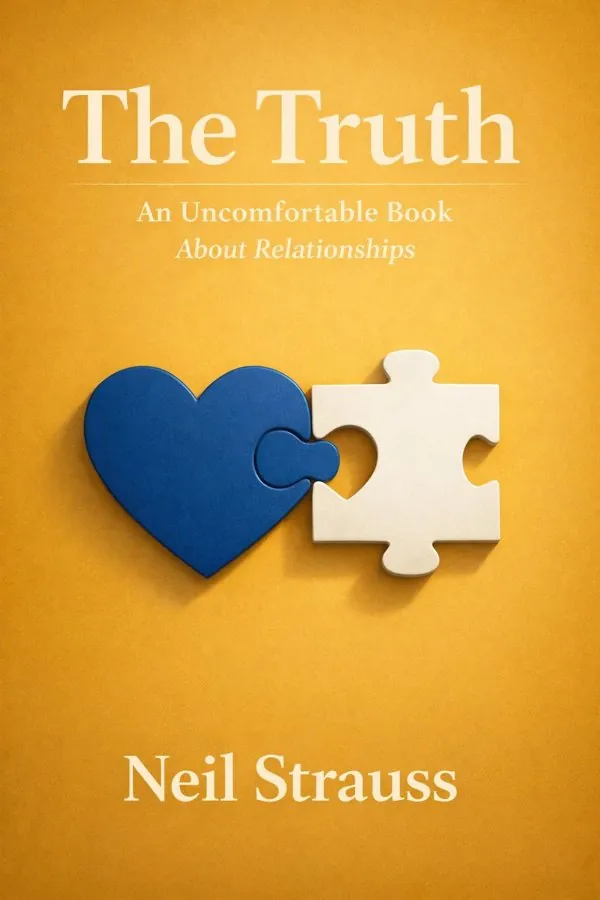
The Truth: An Uncomfortable Book About Relationships: Summary & Key Insights
by Neil Strauss
 10 min9 chaptersAudio available
Key Takeaways from The Truth: An Uncomfortable Book About Relationships
A life that looks exciting from the outside can still be emotionally bankrupt within.
Compulsive behavior is rarely the real problem; it is usually an attempted solution.
We do not enter relationships as blank slates; we bring our entire emotional history with us.
Most people lie in relationships long before they tell an explicit lie.
What many people call freedom is often just fear in stylish clothing.
What Is The Truth: An Uncomfortable Book About Relationships About?
The Truth: An Uncomfortable Book About Relationships by Neil Strauss is a biographies book spanning 5 pages. What happens when a man famous for teaching seduction realizes he has no idea how to love? In The Truth: An Uncomfortable Book About Relationships, Neil Strauss turns the lens inward and writes his most vulnerable book: an autobiographical investigation into sex addiction, emotional avoidance, intimacy, monogamy, trauma, and the possibility of real connection. Best known for The Game, Strauss had built a public identity around mastery of attraction and casual sex. But behind that success, he was unraveling. His relationships were unstable, his behaviors compulsive, and his inner life increasingly fractured. This book matters because it refuses easy answers. Rather than simply condemning promiscuity or idealizing monogamy, Strauss examines the deeper psychological wounds that shape romantic behavior. He moves through therapy, rehab, support groups, polyamory experiments, and painful self-confrontation in search of honesty. The result is part memoir, part relationship inquiry, and part recovery narrative. Strauss brings unusual authority to the subject because he writes not as a distant expert, but as someone willing to document his own contradictions. The Truth is ultimately about a difficult but universal challenge: becoming emotionally authentic enough to build love that lasts.
This FizzRead summary covers all 9 key chapters of The Truth: An Uncomfortable Book About Relationships in approximately 10 minutes, distilling the most important ideas, arguments, and takeaways from Neil Strauss's work. Also available as an audio summary and Key Quotes Podcast.
The Truth: An Uncomfortable Book About Relationships
What happens when a man famous for teaching seduction realizes he has no idea how to love? In The Truth: An Uncomfortable Book About Relationships, Neil Strauss turns the lens inward and writes his most vulnerable book: an autobiographical investigation into sex addiction, emotional avoidance, intimacy, monogamy, trauma, and the possibility of real connection. Best known for The Game, Strauss had built a public identity around mastery of attraction and casual sex. But behind that success, he was unraveling. His relationships were unstable, his behaviors compulsive, and his inner life increasingly fractured.
This book matters because it refuses easy answers. Rather than simply condemning promiscuity or idealizing monogamy, Strauss examines the deeper psychological wounds that shape romantic behavior. He moves through therapy, rehab, support groups, polyamory experiments, and painful self-confrontation in search of honesty. The result is part memoir, part relationship inquiry, and part recovery narrative. Strauss brings unusual authority to the subject because he writes not as a distant expert, but as someone willing to document his own contradictions. The Truth is ultimately about a difficult but universal challenge: becoming emotionally authentic enough to build love that lasts.
Who Should Read The Truth: An Uncomfortable Book About Relationships?
This book is perfect for anyone interested in biographies and looking to gain actionable insights in a short read. Whether you're a student, professional, or lifelong learner, the key ideas from The Truth: An Uncomfortable Book About Relationships by Neil Strauss will help you think differently.
- ✓Readers who enjoy biographies and want practical takeaways
- ✓Professionals looking to apply new ideas to their work and life
- ✓Anyone who wants the core insights of The Truth: An Uncomfortable Book About Relationships in just 10 minutes
Want the full summary?
Get instant access to this book summary and 100K+ more with Fizz Moment.
Get Free SummaryAvailable on App Store • Free to download
Key Chapters
A life that looks exciting from the outside can still be emotionally bankrupt within. One of the most striking tensions in The Truth is that Neil Strauss achieved the very lifestyle many people fantasize about after the success of The Game: status, access, sexual abundance, admiration, and influence. Yet instead of feeling fulfilled, he felt disconnected, anxious, and hollow. His public triumph masked a private inability to form stable, intimate bonds.
Strauss shows that external success often becomes a shield against deeper pain. Validation from strangers can temporarily soothe insecurity, but it cannot replace the safety of authentic attachment. In his case, seduction became less a form of freedom than a system of avoidance. The more he mastered techniques for attracting people, the less capable he felt of being fully known by them. Pleasure, novelty, and ego reinforcement were easy to pursue; vulnerability, consistency, and mutual trust were much harder.
This idea reaches beyond dating. Many people use achievement, charm, busyness, or social approval to avoid confronting loneliness. A successful career can distract from emotional neglect. A polished social identity can cover a fear of rejection. Even the appearance of confidence can be a defense against shame. Strauss’s story challenges the assumption that getting what you want automatically leads to peace.
A practical application is to examine where performance has replaced presence in your life. Are you seeking admiration instead of intimacy? Are you curating an identity rather than sharing your real feelings? Try asking yourself after a social or romantic interaction: Did I feel more impressive, or more connected? The distinction matters.
Actionable takeaway: Identify one area where outward success may be compensating for inner disconnection, and begin replacing performance with honest emotional presence.
Compulsive behavior is rarely the real problem; it is usually an attempted solution. In rehab and therapy, Strauss comes to understand that sex addiction is not simply about frequency, appetite, or moral failure. It is about using sexual behavior to regulate unbearable feelings: emptiness, anxiety, shame, loneliness, and unresolved trauma. The behavior on the surface is only the visible part of a much deeper wound.
This is one of the book’s most important insights. If someone tries to change destructive habits without understanding what emotional need those habits serve, the pattern usually returns in another form. Strauss learns that healing requires more than abstinence or self-control. It requires sitting with discomfort he had spent years avoiding. He has to notice what triggers his impulses, what fantasies promise him emotionally, and what early experiences shaped his need for validation and escape.
The lesson applies broadly, even to readers who do not identify with addiction. People overeat, overwork, overspend, scroll endlessly, or bounce between relationships for similar reasons. The common denominator is emotional anesthesia. The question is not only, “Why do I do this?” but also, “What feeling am I trying not to feel?” Strauss’s progress begins when he stops treating his behavior as a mystery and starts reading it as information.
A practical example is urge tracking. When you feel driven toward a compulsive habit, pause and write down what happened just before the urge. Were you rejected, criticized, bored, lonely, or ashamed? Over time, patterns emerge. This creates enough distance to choose a different response, such as calling a friend, going for a walk, or naming the emotion directly.
Actionable takeaway: The next time a compulsive urge appears, ask what pain or unmet need the behavior is trying to manage, and respond to that deeper issue first.
We do not enter relationships as blank slates; we bring our entire emotional history with us. A central thread in The Truth is Strauss’s growing realization that his adult romantic chaos did not begin in adulthood. His fears of intimacy, his dependence on validation, and his oscillation between pursuit and distance were connected to older attachment wounds. What looked like a dating problem was, in many ways, a developmental problem.
The book highlights a painful but liberating idea: many relationship struggles are rooted in unmet needs from early life. If affection was inconsistent, a person may become hypervigilant and needy. If vulnerability was unsafe, they may become emotionally unavailable. If love was tied to performance, they may seek constant approval. Strauss’s therapeutic work reveals that his patterns were not random flaws but adaptive strategies that once helped him survive emotionally.
Understanding this does not excuse harmful behavior, but it does make change possible. Shame says, “I am broken.” Insight says, “I learned this, and I can learn differently.” Readers can use this framework to examine recurring themes in their own relationships. Do you choose emotionally distant partners? Do you panic when someone gets too close? Do you chase intensity because calm feels unfamiliar? These may be attachment echoes rather than current reality.
A practical exercise is to map recurring relationship patterns across time. List your most important relationships and note what you feared most in each one: abandonment, engulfment, criticism, betrayal, boredom. Then ask where those fears first appeared. This can reveal how the past keeps directing the present.
Actionable takeaway: Treat your recurring relationship patterns as clues to old wounds, and begin exploring the original emotional story beneath your current reactions.
What many people call freedom is often just fear in stylish clothing. Strauss spends part of the book exploring alternatives to conventional monogamy, including polyamory and open relational structures. To the book’s credit, he does not dismiss these models outright. Instead, he investigates whether expanded sexual freedom can coexist with emotional integrity. His conclusion is nuanced: nontraditional arrangements are not inherently dishonest, but they become destructive when used to avoid commitment, accountability, or self-examination.
This distinction matters. The problem is not whether a relationship is monogamous or open; the problem is whether the people involved are mature enough to handle truth, boundaries, jealousy, and responsibility. Strauss finds that simply multiplying options does not resolve inner conflict. In some cases, more freedom creates more opportunities to rationalize avoidance. If a person is still driven by compulsion or narcissistic validation, changing the relationship structure will not fix the underlying issue.
For readers, the broader lesson is to question motives. Are you seeking freedom because it reflects your values, or because commitment terrifies you? Are you resisting exclusivity because you want honesty, or because you want access without accountability? Strauss demonstrates that any model can fail if it is built on self-deception.
A practical example is to evaluate relationship choices using three questions: Does this arrangement increase trust? Does it require emotional maturity from everyone involved? Does it align with my deeper values rather than my immediate impulses? If the answer is no, the choice may be more about escape than liberation.
Actionable takeaway: Before calling a relational choice “freedom,” examine whether it actually reflects courage and integrity, or simply protects you from vulnerability.
Love is not proven by intensity; it is proven by repair. One of the most moving parts of The Truth involves Strauss’s effort to reconnect with Ingrid, a woman who represents not fantasy but the possibility of genuine partnership. Their relationship forces him to confront a hard reality: deep connection cannot be sustained by grand declarations or emotional insight alone. Trust must be rebuilt through consistency, accountability, and changed behavior over time.
Strauss learns that apologies, while necessary, are insufficient. A person who has created pain must become trustworthy in practice. That includes transparency, follow-through, empathy, and a willingness to tolerate the other person’s uncertainty. For someone used to charm and improvisation, this kind of reliability is a different skill. It asks not for seduction, but for steadiness.
The lesson is highly practical. In damaged relationships, people often want quick forgiveness because lingering discomfort threatens their self-image. But trust heals at the speed of experience, not explanation. If someone has been lied to, neglected, or manipulated, they need more than words. They need repeated evidence that the pattern has changed. Strauss’s journey suggests that rebuilding trust is less about winning someone back and more about becoming someone safe.
Readers can apply this by focusing on measurable relational behaviors: showing up when you say you will, answering difficult questions without defensiveness, respecting boundaries, and acknowledging the impact of your actions. These small acts create a foundation stronger than dramatic promises.
Actionable takeaway: If trust has been damaged, stop trying to prove your sincerity with speeches and start proving it with consistent, observable behavior over time.
Many people know how to attract attention but not how to remain present once intimacy begins. Strauss’s earlier identity was built on strategy, performance, and control. In The Truth, he discovers that these qualities may help initiate connection, but they undermine depth if they become a permanent way of relating. Real intimacy requires showing up without scripts, manipulations, or a carefully managed persona.
Presence means being emotionally available in ordinary moments, not just dramatic ones. It means listening without planning your next move, staying grounded during conflict, and resisting the urge to retreat into distraction when vulnerability appears. Strauss gradually sees that connection grows not through novelty but through sustained attention. Love is built in the repeated choice to remain engaged when things are no longer exciting, flattering, or easy.
This insight is especially relevant in a culture saturated with image management. Dating apps, social media, and modern self-branding reward presentation. But long-term closeness depends on tolerating imperfection. If you are always trying to be impressive, you may never be truly known. Presence asks a harder question: Can you sit with another person’s reality, and your own, without escaping into performance?
A practical exercise is to notice how you react when a conversation becomes uncomfortable. Do you joke, intellectualize, seduce, defend, or shut down? These are often performance strategies. Try replacing them with one grounding behavior: slow down, maintain eye contact, and reflect back what the other person said before responding. This creates emotional contact instead of theatrical control.
Actionable takeaway: In your next important conversation, focus less on sounding good and more on staying fully present, especially when discomfort arises.
Commitment often fails not because people lack desire, but because they are at war with themselves. As Strauss moves through recovery and reflection, he begins to see that fidelity is not merely a moral decision imposed from outside. It becomes easier only when a person is less fragmented internally. If different parts of the self are hidden, ashamed, or denied, they tend to emerge in sabotage, secrecy, and contradiction.
The book suggests that self-acceptance is a prerequisite for sustainable commitment. This does not mean approving of every impulse. It means acknowledging your desires, fears, weaknesses, and history without splitting them off into a secret identity. A person who understands their own triggers and needs is less likely to be ruled by them unconsciously. Strauss’s progress comes from integration: bringing previously disconnected parts of himself into awareness and responsibility.
This insight helps explain why resolutions so often collapse. Someone may sincerely promise monogamy, honesty, or emotional availability, but if they have not accepted the parts of themselves that resist those goals, the hidden conflict remains active. Commitment becomes performative rather than embodied. Real change requires saying, in effect, “This is who I am, this is what I struggle with, and this is how I will take responsibility.”
A practical application is to replace idealized self-descriptions with accurate ones. Instead of saying, “I’m just a loyal person,” ask, “Under what conditions do I become deceptive or avoidant?” This invites realism and accountability. Self-knowledge strengthens commitment because it removes fantasy from the equation.
Actionable takeaway: Build commitment on honest self-awareness, not on an idealized image of who you wish you were.
The quality of a relationship often reflects the quality of the emotional work each person has done alone. One of the final lessons of The Truth is that partnership is not a shortcut around self-confrontation. Instead, relationships magnify what is unresolved. If you have not developed emotional regulation, conflict will expose it. If you have not healed attachment wounds, closeness will trigger them. If you do not know your values, desire and fear will make decisions for you.
Strauss’s journey shows that meaningful love is less about finding a perfect partner than becoming capable of participating in a healthy bond. This includes therapy, support systems, honest self-inquiry, and disciplined behavioral change. The romantic storyline matters, but the deeper narrative is about maturation. He moves from seeking stimulation to seeking integrity, from chasing chemistry to building character.
This key idea is empowering because it shifts attention from fantasy to agency. Instead of asking only, “Who is right for me?” readers can ask, “Am I becoming someone who can handle truth, repair conflict, and sustain intimacy?” The answer determines relationship outcomes more than compatibility alone.
A practical application is to evaluate your relational readiness in specific terms. Can you tolerate boredom without creating chaos? Can you name your needs without manipulation? Can you stay honest when the truth threatens your image? These capacities are built through practice, not wishful thinking.
Actionable takeaway: Treat every relationship difficulty as feedback about your own emotional development, and commit to personal work that makes healthier love possible.
All Chapters in The Truth: An Uncomfortable Book About Relationships
About the Author
Neil Strauss is an American author, journalist, and editor known for writing immersive nonfiction that blends cultural reporting with personal inquiry. He has contributed to major publications including Rolling Stone and The New York Times, and he has collaborated with high-profile public figures as a ghostwriter and co-author. Strauss became internationally famous with The Game, a controversial bestseller about pickup artist culture and the psychology of attraction. In later work, especially The Truth, he shifted from observing others to examining his own life, focusing on sex addiction, emotional healing, and the search for authentic relationships. His writing stands out for its narrative drive, insider access, and willingness to explore uncomfortable aspects of identity, desire, fame, and human behavior.
Get This Summary in Your Preferred Format
Read or listen to the The Truth: An Uncomfortable Book About Relationships summary by Neil Strauss anytime, anywhere. FizzRead offers multiple formats so you can learn on your terms — all free.
Available formats: App · Audio · PDF · EPUB — All included free with FizzRead
Download The Truth: An Uncomfortable Book About Relationships PDF and EPUB Summary
Key Quotes from The Truth: An Uncomfortable Book About Relationships
“A life that looks exciting from the outside can still be emotionally bankrupt within.”
“Compulsive behavior is rarely the real problem; it is usually an attempted solution.”
“We do not enter relationships as blank slates; we bring our entire emotional history with us.”
“Most people lie in relationships long before they tell an explicit lie.”
“What many people call freedom is often just fear in stylish clothing.”
Frequently Asked Questions about The Truth: An Uncomfortable Book About Relationships
The Truth: An Uncomfortable Book About Relationships by Neil Strauss is a biographies book that explores key ideas across 9 chapters. What happens when a man famous for teaching seduction realizes he has no idea how to love? In The Truth: An Uncomfortable Book About Relationships, Neil Strauss turns the lens inward and writes his most vulnerable book: an autobiographical investigation into sex addiction, emotional avoidance, intimacy, monogamy, trauma, and the possibility of real connection. Best known for The Game, Strauss had built a public identity around mastery of attraction and casual sex. But behind that success, he was unraveling. His relationships were unstable, his behaviors compulsive, and his inner life increasingly fractured. This book matters because it refuses easy answers. Rather than simply condemning promiscuity or idealizing monogamy, Strauss examines the deeper psychological wounds that shape romantic behavior. He moves through therapy, rehab, support groups, polyamory experiments, and painful self-confrontation in search of honesty. The result is part memoir, part relationship inquiry, and part recovery narrative. Strauss brings unusual authority to the subject because he writes not as a distant expert, but as someone willing to document his own contradictions. The Truth is ultimately about a difficult but universal challenge: becoming emotionally authentic enough to build love that lasts.
More by Neil Strauss


You Might Also Like

An American Marriage
Tayari Jones
10 min
Benjamin Franklin: An American Life
Walter Isaacson
10 min
I Know Why The Caged Bird Sings
Maya Angelou
10 min
Long Walk to Freedom
Nelson Mandela
10 min
Persepolis
Marjane Satrapi
10 min
Surely You're Joking, Mr. Feynman!
Richard P. Feynman
10 minBrowse by Category
Ready to read The Truth: An Uncomfortable Book About Relationships?
Get the full summary and 100K+ more books with Fizz Moment.