
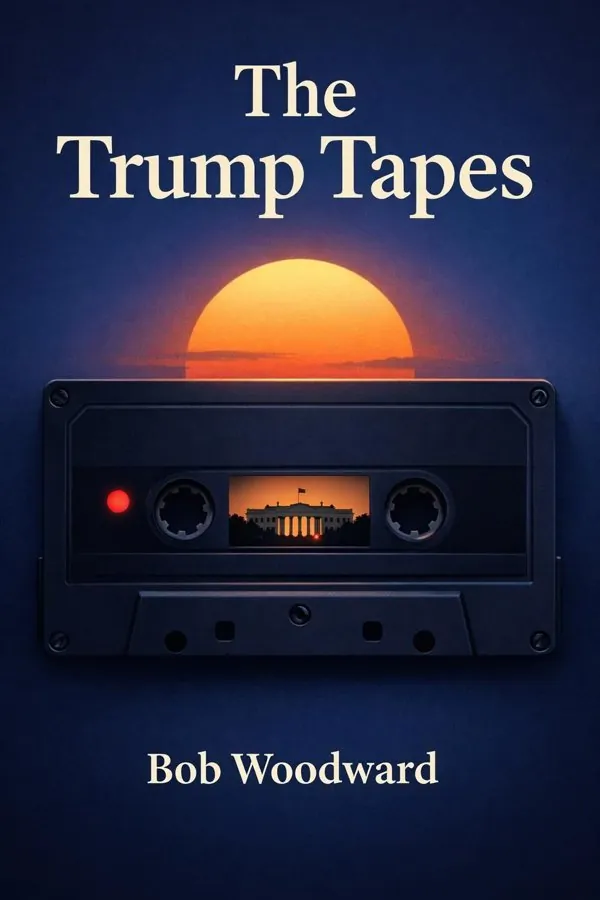
The Trump Tapes: Bob Woodward's Twenty Interviews with President Donald Trump: Summary & Key Insights
by Bob Woodward
 10 min9 chaptersAudio available
Key Takeaways from The Trump Tapes: Bob Woodward's Twenty Interviews with President Donald Trump
Power often begins as performance before it becomes policy.
Many leaders enter office talking about responsibility; Trump often talks about liberation.
Some leaders try to reduce friction; Trump repeatedly uses friction to govern.
Foreign policy in Trump’s telling is less about doctrine than about force of personality.
Military power is never only military; it is also symbolic.
What Is The Trump Tapes: Bob Woodward's Twenty Interviews with President Donald Trump About?
The Trump Tapes: Bob Woodward's Twenty Interviews with President Donald Trump by Bob Woodward is a politics book spanning 12 pages. The Trump Tapes is not a conventional political book. It is a record of power speaking in its own voice. Built from twenty interviews between legendary journalist Bob Woodward and President Donald Trump from 2016 to 2020, the book offers readers something unusually rare: unedited access to how a sitting president explained himself when he believed he was shaping history in real time. Rather than relying only on interpretation, Woodward lets Trump’s own words reveal his instincts on leadership, media, foreign affairs, crisis management, race, and the presidency itself. What makes the book especially important is the gap it exposes between public messaging, private candor, and political self-mythology. Trump appears as combative, improvisational, deeply image-conscious, and convinced that force of personality can substitute for process. The interviews also illuminate defining events of his presidency, especially the COVID-19 pandemic, impeachment, and the 2020 election. Woodward’s authority gives the material unusual weight. As one of America’s most respected investigative journalists, best known for Watergate and decades of presidential reporting, he understands both the mechanics of power and the historical value of preserving a leader’s exact words before memory, spin, and partisan interpretation take over.
This FizzRead summary covers all 9 key chapters of The Trump Tapes: Bob Woodward's Twenty Interviews with President Donald Trump in approximately 10 minutes, distilling the most important ideas, arguments, and takeaways from Bob Woodward's work. Also available as an audio summary and Key Quotes Podcast.
The Trump Tapes: Bob Woodward's Twenty Interviews with President Donald Trump
The Trump Tapes is not a conventional political book. It is a record of power speaking in its own voice. Built from twenty interviews between legendary journalist Bob Woodward and President Donald Trump from 2016 to 2020, the book offers readers something unusually rare: unedited access to how a sitting president explained himself when he believed he was shaping history in real time. Rather than relying only on interpretation, Woodward lets Trump’s own words reveal his instincts on leadership, media, foreign affairs, crisis management, race, and the presidency itself.
What makes the book especially important is the gap it exposes between public messaging, private candor, and political self-mythology. Trump appears as combative, improvisational, deeply image-conscious, and convinced that force of personality can substitute for process. The interviews also illuminate defining events of his presidency, especially the COVID-19 pandemic, impeachment, and the 2020 election. Woodward’s authority gives the material unusual weight. As one of America’s most respected investigative journalists, best known for Watergate and decades of presidential reporting, he understands both the mechanics of power and the historical value of preserving a leader’s exact words before memory, spin, and partisan interpretation take over.
Who Should Read The Trump Tapes: Bob Woodward's Twenty Interviews with President Donald Trump?
This book is perfect for anyone interested in politics and looking to gain actionable insights in a short read. Whether you're a student, professional, or lifelong learner, the key ideas from The Trump Tapes: Bob Woodward's Twenty Interviews with President Donald Trump by Bob Woodward will help you think differently.
- ✓Readers who enjoy politics and want practical takeaways
- ✓Professionals looking to apply new ideas to their work and life
- ✓Anyone who wants the core insights of The Trump Tapes: Bob Woodward's Twenty Interviews with President Donald Trump in just 10 minutes
Want the full summary?
Get instant access to this book summary and 100K+ more with Fizz Moment.
Get Free SummaryAvailable on App Store • Free to download
Key Chapters
Power often begins as performance before it becomes policy. In the earliest interview, conducted during the 2016 campaign, Trump projects not just optimism but inevitability. He speaks as if victory is less an uncertain democratic outcome than the natural reward for energy, instinct, and personal magnetism. This matters because it reveals a central feature of his political style: confidence is not simply self-belief; it is a governing tool intended to bend reality toward his preferred narrative.
Throughout the conversations, Trump returns to rallies, crowd size, media attention, and the emotional force of his connection with supporters. He treats politics less as coalition-building through careful persuasion and more as direct mass contact powered by momentum. In that worldview, hesitation looks weak, technical expertise looks secondary, and complexity looks like an obstacle to dominance. What Woodward captures is a leader who believes that if he can project certainty strongly enough, institutions, opponents, and even facts may eventually conform.
This dynamic extends beyond campaigns. The same confidence appears in his assessment of international rivals, domestic enemies, and policy disputes. Trump repeatedly frames himself as the essential variable in every equation. That can energize followers and unsettle opponents, but it can also create blind spots, especially when confidence substitutes for planning.
A practical lesson emerges for readers in politics, leadership, or business: charisma can create momentum, but momentum is not the same as durable governance. Confidence inspires, yet when it becomes a substitute for evidence, it can distort judgment. Actionable takeaway: admire conviction, but always ask what systems, facts, and preparation stand behind it.
Many leaders enter office talking about responsibility; Trump often talks about liberation. In the early presidency interviews, he describes the office as a chance to cut through what he sees as deadening bureaucracy, timid advisers, and years of national decline. His language suggests that government has been held back by excessive restraint and that his arrival unleashes action. The presidency, in his telling, is not mainly custodianship of institutions but an instrument for breaking through them.
Woodward’s interviews show how this mindset shaped Trump’s understanding of executive power. Rules, process, and interagency caution frequently appear to him as barriers rather than safeguards. He favors speed, disruption, and visible assertion. This helps explain his attraction to executive orders, public demands on agencies, and constant pressure on subordinates to produce dramatic outcomes. He is less interested in preserving procedural legitimacy than in demonstrating that someone is finally “doing something.”
There is genuine appeal in this style. Citizens frustrated with stagnation often want a leader who seems decisive rather than managerial. Yet the interviews also reveal the danger: complex systems exist because large democracies cannot be run entirely by impulse. Health policy, military deployments, and intelligence assessments require coordination, not just command presence.
In practical terms, this idea applies well beyond politics. Organizations often overcorrect toward caution, and a forceful leader can unlock movement. But disruption without discipline usually creates second-order problems. A company can slash approvals, but if it also weakens quality control, errors multiply. Actionable takeaway: challenge unnecessary bureaucracy, but preserve the processes that protect judgment, accountability, and long-term stability.
Some leaders try to reduce friction; Trump repeatedly uses friction to govern. One of the clearest patterns in The Trump Tapes is his comfort with conflict as a management style. He frames relationships with Congress, aides, cabinet officials, and critics through contest rather than collaboration. Pressure, rivalry, and public confrontation are not unfortunate side effects of leadership for him; they are mechanisms for energizing it.
Woodward’s interviews suggest that Trump believed people performed better when they were off balance and competing for his approval. He often valued loyalty, media skill, and combativeness alongside expertise. This made his administration dynamic but unstable. Advisers could gain influence quickly through alignment with his instincts, then lose it just as fast if they appeared cautious, disloyal, or overshadowing. In such an environment, decision-making becomes highly personalized. Instead of institutions settling disputes through process, the leader’s mood and attention become decisive.
This style also shaped his dealings with Congress. Trump often approached legislators not as coequal actors in a constitutional system but as negotiators in a pressure game. Public attacks, private flattery, threats, and sudden reversals all became part of the arsenal. Sometimes this produced movement. Often it deepened mistrust and made durable agreements harder.
For readers, the broader lesson is that conflict can be useful when it exposes complacency or forces clarity. But when used constantly, it shifts an organization from problem-solving to survival mode. Teams become more focused on internal positioning than on mission. Actionable takeaway: use conflict selectively to sharpen decisions, not habitually as a substitute for trust, structure, and coherent leadership.
Foreign policy in Trump’s telling is less about doctrine than about force of personality. Across the interviews, he describes world affairs through the language of winners, losers, respect, and leverage. Traditional diplomatic frameworks matter less to him than whether America appears strong and whether he personally can command deference from allies and adversaries. This gives his foreign policy a highly individualized logic: international order is not primarily maintained by institutions, but by leaders who project dominance.
Woodward’s conversations show Trump’s skepticism toward long-standing alliances and multilateral commitments. He often sees allies as free riders and negotiations as zero-sum contests. Trade deficits, military commitments, and defense spending become symbols of national humiliation unless reset on harder terms. At the same time, he expresses admiration for strongman leaders who seem decisive and unconstrained. This does not always translate into ideological alignment; rather, it reflects his respect for concentrated authority and direct bargaining.
The practical effect is a foreign policy that prizes disruption. Trump tries to unsettle assumptions and force renegotiation, whether on NATO contributions, trade, or bilateral relationships. Supporters may view this as realism after years of diplomatic softness. Critics may see it as reducing complex strategic relationships to personal chemistry and transactional bargaining.
This idea matters outside government too. In high-stakes negotiation, confidence and leverage do matter. But relationships built solely on pressure can become brittle. Long-term cooperation requires more than extracting concessions in the moment. Actionable takeaway: negotiate from strength, but distinguish between short-term wins and the durable partnerships that make future wins possible.
Military power is never only military; it is also symbolic. Trump’s discussions of defense and national security often reveal his fascination with strength as spectacle as well as strategy. He speaks in ways that emphasize deterrence, dominance, hardware, and the visible projection of command. In his worldview, showing power can itself become a form of power, because perception shapes how enemies, allies, and domestic audiences behave.
The interviews capture a recurring tension. On one hand, Trump is skeptical of open-ended wars and inherited military entanglements. He often presents himself as someone resisting the national security establishment’s default tendency toward prolonged intervention. On the other hand, he strongly values the image of toughness and the capacity to threaten overwhelming force. That combination creates a presidency that is rhetorically hawkish but also transactional, wary of costs, and impatient with abstract strategic commitments.
Woodward’s reporting context helps readers see how this approach can produce contradictory decisions. A leader may want to avoid war while also speaking in escalatory terms. He may distrust generals yet relish military display. He may resist nation-building while equating restraint with weakness. Such tensions are not unique to Trump, but in his case they are amplified by his instinct to treat public communication as an extension of command.
In practical settings, leaders often face a similar dilemma: how to project authority without becoming captive to the performance of authority. A CEO, coach, or manager may think strong messaging will maintain discipline, but overreliance on dramatic signaling can distort internal judgment. Actionable takeaway: use symbols of strength carefully, making sure public posture serves real strategy rather than replacing it.
In Trump’s political universe, economics and media are closely linked because both are contests over leverage. His approach to trade reflects a broader belief that America had allowed itself to be outmaneuvered by competitors and by elite assumptions. He sees tariffs, hard bargaining, and public pressure as tools for resetting the terms of exchange. But just as important, he treats the public explanation of those moves as part of the deal itself. Winning requires not only negotiating better terms but also convincing audiences that strength has returned.
Woodward’s interviews make clear that Trump thinks in branding terms even when discussing national policy. Trade deficits become emotional symbols of losing. Factories, jobs, and supply chains are not only economic issues but proof points in a story of national revival. The same logic drives his relentless war with the media. News coverage is never just information; it is a battlefield where legitimacy, momentum, and perception are constantly contested. If he cannot fully control policy outcomes, he can still fight to control interpretation.
This fusion of policy and narrative helps explain Trump’s endurance. He understood that many supporters judged him less by technical precision than by whether he appeared to be fighting on their behalf. At the same time, constant conflict with the media deepened polarization and made shared factual ground harder to sustain.
For readers, the lesson is highly practical. In any institution, strategy and communication cannot be separated. A company restructuring, a school reform, or a policy change fails if leaders ignore the story people tell about it. Yet spin cannot permanently rescue weak substance. Actionable takeaway: pair bold messaging with measurable results, because narrative can amplify reality but cannot replace it forever.
A crisis tests whether a leader’s public style can convert into operational competence. The COVID-19 interviews are among the most consequential in The Trump Tapes because they reveal a sharp contrast between what Trump sometimes acknowledged privately and what he emphasized publicly. Woodward’s now-famous exchanges on the virus show a president aware of the danger, transmissibility, and seriousness of the threat, yet still deeply focused on avoiding panic, preserving confidence, and managing perception.
This is the book’s most sobering lesson. Trump’s governing instincts had long favored optimism, dominance, and narrative control. But a pandemic punishes delay, ambiguity, and mixed signals. A virus does not negotiate, respond to branding, or respect political momentum. In this context, the habits that helped Trump politically could become liabilities administratively. The desire to reassure blended with the desire to protect markets and public image, and the result was communication that often blurred urgency.
Woodward does not need heavy-handed commentary for readers to feel the weight of this contradiction. The power of the material lies precisely in the taped record. We hear a leader trying to reconcile private understanding with public positioning, and we see how that gap matters when millions of people need clarity. The pandemic becomes the clearest example of a broader theme: performance can shape politics, but it cannot master reality when reality is biological, cumulative, and unforgiving.
This applies to any crisis setting. Leaders facing cyberattacks, product failures, or financial shocks may be tempted to minimize risk to preserve calm. Sometimes reassurance is necessary. But reassurance without candor erodes trust and slows response. Actionable takeaway: in a crisis, communicate early, truthfully, and concretely, because credibility is itself a strategic asset.
Presidents are judged not only by what they solve but by what moral tone they set. In Woodward’s interviews touching on race relations, domestic protests, impeachment, and political opposition, Trump repeatedly frames turmoil through the lens of order and attack. He tends to interpret dissent less as a signal of unresolved national pain than as a contest over authority, legitimacy, and control. This helps explain both his political appeal and his divisiveness.
For many supporters, Trump’s emphasis on law, force, and resistance to elite moral pressure signaled strength. He spoke to people who felt cultural institutions dismissed their anxieties and who believed disorder was being excused rather than confronted. Yet the tapes also show his difficulty in speaking in a register of shared mourning, empathy, or national reconciliation. When racial tension surged, he often moved quickly toward policing, condemnation of unrest, and denunciation of opponents. The language of healing was usually secondary.
That pattern extends into impeachment and the 2020 election. Trump experiences challenge as aggression and opposition as invalidation. Rather than treating conflict as an expected feature of democratic life, he often treats it as proof that hostile forces are trying to nullify the will of “real” America. This rhetoric can mobilize intensely, but it narrows the space for legitimacy across differences.
In practical life, organizations and communities face similar traps. When conflict erupts, leaders often feel pressure to restore control fast. But control without acknowledgment can deepen resentment. Actionable takeaway: in moments of division, combine firmness with recognition of underlying grievances, because lasting order depends not only on authority but also on legitimacy.
Democracy depends on losers accepting loss, but The Trump Tapes shows how difficult that became in Trump’s political psychology. In the interviews surrounding the 2020 election and its aftermath, readers encounter a leader for whom narrative control remained central even as events moved against him. The issue is not simply personal disappointment. It is the inability, or refusal, to let external outcomes overrule internal certainty. If Trump believed he represented the authentic will of the people, then defeat could be interpreted not as a legitimate result but as proof of corruption.
Woodward’s material gains historical force here because it captures the logic from inside. Trump’s style had always fused selfhood with political momentum. Success validated instinct; criticism confirmed hostility; conflict sustained identity. Under those conditions, conceding defeat meant more than acknowledging a count. It meant accepting a version of reality in which his interpretation was no longer sovereign. The tapes therefore illuminate how election denial can grow not only from strategy, but from a worldview in which legitimacy is inseparable from personal conviction and loyal audience belief.
This final arc also clarifies Woodward’s broader contribution. The book is less an argument than an archive of voice, cadence, and self-explanation. Readers hear how a president understood truth, power, and public persuasion while occupying the highest office in the country. That makes the work valuable not just as political reporting but as a study in leadership under stress.
The practical takeaway is wide-reaching: institutions survive when people accept independent verification over personal preference. Whether in elections, board decisions, or performance reviews, a system collapses when every unwanted outcome is redefined as illegitimate. Actionable takeaway: build habits of accountability that can withstand ego, pressure, and the temptation to confuse belief with fact.
All Chapters in The Trump Tapes: Bob Woodward's Twenty Interviews with President Donald Trump
About the Author
Bob Woodward is an American investigative journalist and author whose career has shaped modern political reporting. He rose to prominence at The Washington Post through his coverage of the Watergate scandal with Carl Bernstein, reporting that helped uncover the abuses of the Nixon administration and contributed to the president’s resignation. Woodward has since written many bestselling books on U.S. presidents, wars, intelligence, and the inner workings of government, becoming one of the most influential chroniclers of American power. His work is known for extensive sourcing, detailed reconstruction of events, and access to senior officials at the center of major decisions. Over decades, he has earned multiple honors, including Pulitzer Prize recognition, and has become a defining figure in long-form investigative journalism and presidential history.
Get This Summary in Your Preferred Format
Read or listen to the The Trump Tapes: Bob Woodward's Twenty Interviews with President Donald Trump summary by Bob Woodward anytime, anywhere. FizzRead offers multiple formats so you can learn on your terms — all free.
Available formats: App · Audio · PDF · EPUB — All included free with FizzRead
Download The Trump Tapes: Bob Woodward's Twenty Interviews with President Donald Trump PDF and EPUB Summary
Key Quotes from The Trump Tapes: Bob Woodward's Twenty Interviews with President Donald Trump
“Power often begins as performance before it becomes policy.”
“Many leaders enter office talking about responsibility; Trump often talks about liberation.”
“Some leaders try to reduce friction; Trump repeatedly uses friction to govern.”
“Foreign policy in Trump’s telling is less about doctrine than about force of personality.”
“Military power is never only military; it is also symbolic.”
Frequently Asked Questions about The Trump Tapes: Bob Woodward's Twenty Interviews with President Donald Trump
The Trump Tapes: Bob Woodward's Twenty Interviews with President Donald Trump by Bob Woodward is a politics book that explores key ideas across 9 chapters. The Trump Tapes is not a conventional political book. It is a record of power speaking in its own voice. Built from twenty interviews between legendary journalist Bob Woodward and President Donald Trump from 2016 to 2020, the book offers readers something unusually rare: unedited access to how a sitting president explained himself when he believed he was shaping history in real time. Rather than relying only on interpretation, Woodward lets Trump’s own words reveal his instincts on leadership, media, foreign affairs, crisis management, race, and the presidency itself. What makes the book especially important is the gap it exposes between public messaging, private candor, and political self-mythology. Trump appears as combative, improvisational, deeply image-conscious, and convinced that force of personality can substitute for process. The interviews also illuminate defining events of his presidency, especially the COVID-19 pandemic, impeachment, and the 2020 election. Woodward’s authority gives the material unusual weight. As one of America’s most respected investigative journalists, best known for Watergate and decades of presidential reporting, he understands both the mechanics of power and the historical value of preserving a leader’s exact words before memory, spin, and partisan interpretation take over.
More by Bob Woodward
You Might Also Like

Antifa: The Anti-Fascist Handbook
Mark Bray
10 min
Attack from Within: How Disinformation Is Sabotaging America
Barbara McQuade
10 min
Coercion, Capital, and European States, AD 990–1992
Charles Tilly
10 min
Digital Democracy: Concepts, Methodologies, Tools, and Applications
Various Authors
10 min
Fascism
Stanley G. Payne
10 min
Fire And Fury: Inside The Trump White House
Michael Wolff
10 minBrowse by Category
Ready to read The Trump Tapes: Bob Woodward's Twenty Interviews with President Donald Trump?
Get the full summary and 100K+ more books with Fizz Moment.