
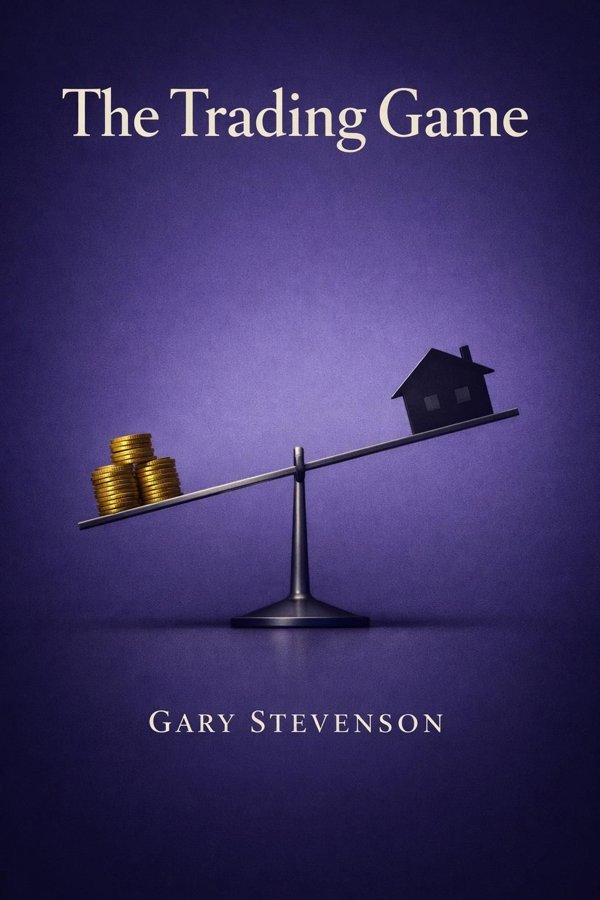
The Trading Game: A Confession: Summary & Key Insights
 10 min4 chaptersAudio available
What Is The Trading Game: A Confession About?
The Trading Game: A Confession by Gary Stevenson is a biographies book spanning 4 pages. In this memoir, former Citibank trader Gary Stevenson recounts his journey from a working-class upbringing in East London to becoming one of the youngest and most successful traders in the world. The book explores the psychological toll of extreme wealth, the moral conflicts of high finance, and the widening inequality that defines modern capitalism. Through candid storytelling, Stevenson reveals how the pursuit of profit can distort both markets and minds.
This FizzRead summary covers all 4 key chapters of The Trading Game: A Confession in approximately 10 minutes, distilling the most important ideas, arguments, and takeaways from Gary Stevenson's work. Also available as an audio summary and Key Quotes Podcast.
The Trading Game: A Confession
In this memoir, former Citibank trader Gary Stevenson recounts his journey from a working-class upbringing in East London to becoming one of the youngest and most successful traders in the world. The book explores the psychological toll of extreme wealth, the moral conflicts of high finance, and the widening inequality that defines modern capitalism. Through candid storytelling, Stevenson reveals how the pursuit of profit can distort both markets and minds.
Who Should Read The Trading Game: A Confession?
This book is perfect for anyone interested in biographies and looking to gain actionable insights in a short read. Whether you're a student, professional, or lifelong learner, the key ideas from The Trading Game: A Confession by Gary Stevenson will help you think differently.
- ✓Readers who enjoy biographies and want practical takeaways
- ✓Professionals looking to apply new ideas to their work and life
- ✓Anyone who wants the core insights of The Trading Game: A Confession in just 10 minutes
Want the full summary?
Get instant access to this book summary and 100K+ more with Fizz Moment.
Get Free SummaryAvailable on App Store • Free to download
Key Chapters
My childhood in East London shaped everything that would come later. I was the son of a working-class family where money was always tight, and comfort was something we glimpsed only through television. My parents worked hard, yet no matter how many hours they put in, there was always this sense that we were surviving rather than progressing. It was here, in the narrow streets and small flats, that I first began to feel the reality of inequality—not as an abstract theory, but as daily life.
At school, I learned quickly that intelligence could be a ticket out. I studied relentlessly, driven not just by curiosity but by hunger for change. My friends and I would joke about becoming rich one day, but beneath that laughter was a quiet desperation. We all wanted a way out of the grind that defined our parents’ lives.
When I got accepted into the London School of Economics, it felt as though the world had cracked open. Suddenly, I was surrounded by wealth, by students who had grown up in privilege, by conversations where people spoke casually of investment banking internships and property portfolios. I realized then that intelligence wasn’t enough—connections, background, and opportunity played a huge part. Still, I believed that if I could understand how money worked, I could learn to play the game on my own terms.
At LSE, I discovered the language of global finance. Numbers became stories, markets became mechanisms of power. Yet, even as I learned to decode the system, a question lingered: why did the rewards seem to go to those who already had the most? This question would follow me into the heart of the City itself.
When Citibank offered me a place on its trading floor, I was hooked. Imagine it: a vast, electric room filled with flashing prices, shouting voices, and the constant surge of adrenaline. The financial crisis was still fresh in everyone’s memory, yet to us young recruits, it was thrilling—we believed we were the new generation that would rebuild finance smarter, fairer, and more modern. How wrong we were.
My early trades were small at first, but success built quickly. I had a knack for reading markets and for understanding the subtleties of emotion beneath numbers. Before long, I was making millions in profit for the bank, and bonuses followed suit. To my friends back home, it looked like I had made it. Yet success in trading has little to do with understanding the economy as people live it; it’s about predicting how others with capital will behave. You’re not helping the world recover; you’re extracting value from its deepest imbalances.
During the aftermath of the 2008 crisis, I realized that inequality wasn’t just a background condition—it was the very engine of profit. As governments lowered interest rates to stimulate economies, the rich used cheap money to inflate asset prices, while ordinary families saw their wages stagnate. On the trading floor, we bet on those dynamics, making money when inequality widened. Every trade that made me richer also confirmed that the world was becoming less equal.
I began to see that the recovery was an illusion. The system was being propped up, not healed. And in that illusion, people like me thrived, while the rest were told to be patient.
+ 2 more chapters — available in the FizzRead app
All Chapters in The Trading Game: A Confession
About the Author
Gary Stevenson is a British economist, former interest rate trader, and social commentator. After leaving Citibank, where he was one of the bank’s most profitable traders, he became an advocate for economic equality and a critic of systemic inequality. He is known for his public commentary on wealth distribution and financial ethics.
Get This Summary in Your Preferred Format
Read or listen to the The Trading Game: A Confession summary by Gary Stevenson anytime, anywhere. FizzRead offers multiple formats so you can learn on your terms — all free.
Available formats: App · Audio · PDF · EPUB — All included free with FizzRead
Download The Trading Game: A Confession PDF and EPUB Summary
Key Quotes from The Trading Game: A Confession
“My childhood in East London shaped everything that would come later.”
“When Citibank offered me a place on its trading floor, I was hooked.”
Frequently Asked Questions about The Trading Game: A Confession
The Trading Game: A Confession by Gary Stevenson is a biographies book that explores key ideas across 4 chapters. In this memoir, former Citibank trader Gary Stevenson recounts his journey from a working-class upbringing in East London to becoming one of the youngest and most successful traders in the world. The book explores the psychological toll of extreme wealth, the moral conflicts of high finance, and the widening inequality that defines modern capitalism. Through candid storytelling, Stevenson reveals how the pursuit of profit can distort both markets and minds.
You Might Also Like

An American Marriage
Tayari Jones
10 min
Benjamin Franklin: An American Life
Walter Isaacson
10 min
I Know Why The Caged Bird Sings
Maya Angelou
10 min
Long Walk to Freedom
Nelson Mandela
10 min
Persepolis
Marjane Satrapi
10 min
Surely You're Joking, Mr. Feynman!
Richard P. Feynman
10 minBrowse by Category
Ready to read The Trading Game: A Confession?
Get the full summary and 100K+ more books with Fizz Moment.