
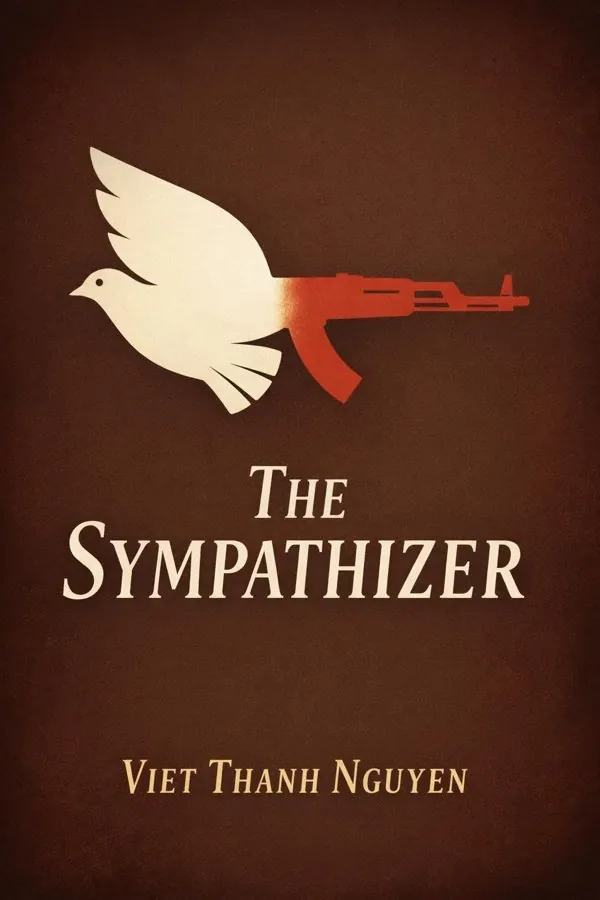
The Sympathizer: Summary & Key Insights
 10 min8 chaptersAudio available
Key Takeaways from The Sympathizer
The most dangerous divisions are often the ones hidden inside a single person.
Exile does not begin when you leave home; it begins when home becomes impossible to recover.
Who gets to tell the story of war often matters more than the facts of war itself.
A return home can become the final test of every belief you have carried in exile.
People become dangerous to rigid systems when they cannot be neatly categorized.
What Is The Sympathizer About?
The Sympathizer by Viet Thanh Nguyen is a war_military book spanning 4 pages. What happens to a person forced to live in two worlds at once, loyal to opposing causes and fully accepted by neither? Viet Thanh Nguyen’s The Sympathizer begins as the confession of a communist double agent embedded in the South Vietnamese military during the fall of Saigon, then grows into something larger: a fierce, darkly funny, and psychologically rich examination of war, exile, ideology, and identity. Told in a voice that is intimate, razor-sharp, and relentlessly self-questioning, the novel follows its unnamed narrator from Vietnam to the United States and back again, exposing the moral compromises hidden beneath every political certainty. More than a spy story, it is a study of divided consciousness: East and West, colonized and colonizer, victim and perpetrator, believer and skeptic. Nguyen writes with unusual authority as a Vietnamese American scholar and novelist whose work consistently challenges how wars are remembered and who gets to tell their stories. Winner of the Pulitzer Prize for Fiction, The Sympathizer matters because it refuses simple heroes and villains, showing instead how violence, memory, and power deform everyone they touch.
This FizzRead summary covers all 8 key chapters of The Sympathizer in approximately 10 minutes, distilling the most important ideas, arguments, and takeaways from Viet Thanh Nguyen's work. Also available as an audio summary and Key Quotes Podcast.
The Sympathizer
What happens to a person forced to live in two worlds at once, loyal to opposing causes and fully accepted by neither? Viet Thanh Nguyen’s The Sympathizer begins as the confession of a communist double agent embedded in the South Vietnamese military during the fall of Saigon, then grows into something larger: a fierce, darkly funny, and psychologically rich examination of war, exile, ideology, and identity. Told in a voice that is intimate, razor-sharp, and relentlessly self-questioning, the novel follows its unnamed narrator from Vietnam to the United States and back again, exposing the moral compromises hidden beneath every political certainty. More than a spy story, it is a study of divided consciousness: East and West, colonized and colonizer, victim and perpetrator, believer and skeptic. Nguyen writes with unusual authority as a Vietnamese American scholar and novelist whose work consistently challenges how wars are remembered and who gets to tell their stories. Winner of the Pulitzer Prize for Fiction, The Sympathizer matters because it refuses simple heroes and villains, showing instead how violence, memory, and power deform everyone they touch.
Who Should Read The Sympathizer?
This book is perfect for anyone interested in war_military and looking to gain actionable insights in a short read. Whether you're a student, professional, or lifelong learner, the key ideas from The Sympathizer by Viet Thanh Nguyen will help you think differently.
- ✓Readers who enjoy war_military and want practical takeaways
- ✓Professionals looking to apply new ideas to their work and life
- ✓Anyone who wants the core insights of The Sympathizer in just 10 minutes
Want the full summary?
Get instant access to this book summary and 100K+ more with Fizz Moment.
Get Free SummaryAvailable on App Store • Free to download
Key Chapters
The most dangerous divisions are often the ones hidden inside a single person. The narrator of The Sympathizer begins by confessing from imprisonment, writing under pressure from a Commandant who insists on total honesty. That framing device matters because the novel is not only about espionage in the external sense; it is about internal fracture. The narrator is a captain in the South Vietnamese army, aide to a General, and secret communist agent. He is also half-French and half-Vietnamese, educated in the United States yet shaped by colonial violence and revolutionary commitment. He survives by playing roles so convincingly that even he struggles to know where loyalty ends and performance begins.
Nguyen uses the spy plot to ask a deeper question: what does it do to the soul when every truth must be split in half? The narrator is able to see multiple sides of every conflict, which makes him insightful but also paralyzes him morally. He understands the corruption of the South, the brutality of the North, and the hypocrisies of American power. Yet this broad vision does not liberate him. Instead, it traps him in compromise, secrecy, and guilt.
In practical terms, the novel invites readers to think about modern double lives beyond espionage. Many people code-switch across workplaces, families, cultures, or political communities. Presenting one self in one setting and another elsewhere may be useful, but prolonged division can erode clarity and conviction. The narrator shows how intelligence without integration becomes a burden.
Actionable takeaway: identify one area of your life where you are performing conflicting identities, and ask what truth you have been postponing by keeping them separate.
Exile does not begin when you leave home; it begins when home becomes impossible to recover. After the fall of Saigon, the narrator escapes to the United States with the General and other South Vietnamese refugees. In California, they rebuild fragments of the world they lost: restaurants, social circles, military hierarchies, rumors of return, and nostalgia wrapped in anti-communist certainty. On the surface, this recreated community offers comfort and continuity. Beneath it lies denial, grief, and political fantasy.
Nguyen portrays exile as both material displacement and psychological suspension. The refugees are physically safe in America, but emotionally they remain trapped in the unfinished war. The General dreams of restoring the South through clandestine action. Others cling to old status symbols, old enemies, and old myths about who betrayed whom. The narrator, as usual, lives in two realities at once. He understands the pain of exile, yet he also sees how memory can become self-deception.
This idea extends beyond the refugee experience. Individuals and communities often build miniature versions of a lost past after upheaval, whether after migration, divorce, economic collapse, or political defeat. Such reconstruction can preserve dignity, but it can also become an illusion that prevents adaptation. The book shows that nostalgia is not always harmless sentiment; it can become a political force, one that distorts judgment and perpetuates resentment.
For readers today, this is especially relevant in any conversation about diaspora, migration, and belonging. Holding onto origins matters, but idealizing the past can imprison the present. Healthy remembrance requires honesty about what was beautiful and what was broken.
Actionable takeaway: when you find yourself longing for a lost version of life, write down both what you miss and what you may be selectively forgetting.
Who gets to tell the story of war often matters more than the facts of war itself. One of the novel’s most brilliant sections follows the narrator as a cultural consultant on an American film about Vietnam, a clear satire of Hollywood epics that turn Vietnamese people into scenery for American moral drama. He is hired to help with authenticity, but quickly discovers that authenticity is welcome only when it serves the existing script. The Vietnamese can appear in the film, but not fully speak. They can suffer, but not define the meaning of their suffering.
This episode works as comic set piece, political critique, and mirror held up to the reader. Nguyen exposes how representation operates through power. The problem is not simply inaccuracy; it is narrative ownership. Americans in the film industry want to process their trauma from the war, but they do so by recentralizing themselves. Even when trying to be sympathetic, they reduce Vietnamese lives to props in someone else’s journey.
The insight applies broadly to media, workplaces, and institutions. Marginalized groups are often invited into conversations as advisers rather than authors. Their role is to decorate, validate, or refine a story whose core assumptions have already been fixed by others. Inclusion without power is still exclusion.
The narrator’s frustration also reveals a personal challenge. He is skilled at observing systems critically, but less successful at transforming them. That too is familiar. Many people can diagnose tokenism or bias while still participating in it because they need access, income, or safety.
Actionable takeaway: the next time you encounter a story about a community, ask not only whether it seems accurate, but who created it, whose voice leads it, and who remains voiceless within it.
A return home can become the final test of every belief you have carried in exile. In the later part of The Sympathizer, the narrator becomes involved in a mission back to Vietnam alongside anti-communist exiles who still imagine a heroic restoration of the lost South. The mission is fueled by fantasy, wounded pride, and political delusion, yet also by genuine pain. For those who lost a nation, return is imagined as redemption. For the narrator, it becomes confrontation.
Nguyen uses this movement back toward Vietnam to strip away romantic narratives from all sides. The anti-communist dream of glorious reversal collapses under reality. The revolutionary cause the narrator served also reveals itself as capable of cruelty, coercion, and moral simplification. The novel refuses to let either side remain pure. Instead, return forces the narrator to face the cost of his own obedience, his complicity in violence, and the human lives abstract ideology has damaged.
This reckoning matters because many of us preserve identities by avoiding the places, people, or memories that would challenge our self-image. We prefer clean stories in which our side meant well and the other side betrayed humanity. The narrator’s experience shows that mature understanding often comes only when our cherished narratives fail.
In practical life, reckoning may not involve geography. It may mean revisiting family history, reexamining past political loyalties, or acknowledging harm done in the name of ambition or principle. Return, in this sense, is not nostalgia but accountability.
Actionable takeaway: revisit one important belief or decision from your past and ask what evidence you have ignored because it threatened the version of yourself you preferred.
People become dangerous to rigid systems when they cannot be neatly categorized. The narrator’s mixed heritage, Western education, and political doubleness make him an ideal spy, but they also make him intolerable to ideologies that demand purity. Throughout the novel, he is pressured to choose a single side, a single story, a single self. Yet he experiences reality as layered and contradictory. He belongs everywhere partially and nowhere completely.
Nguyen uses this instability to challenge binary thinking. The novel is set amid war, perhaps the context most likely to force divisions between friend and enemy, patriot and traitor, revolutionary and reactionary. Still, it insists that human beings exceed political labels. The narrator’s divided consciousness is painful, but it also grants him unusual moral perception. He can see that every camp contains vanity, fear, love, and cruelty. His problem is not that he sees too little; it is that he sees too much to be comfortable inside slogans.
This idea has clear relevance today. Public discourse often rewards certainty and punishes nuance. People are pushed to declare total allegiance to a side, even when reality is mixed. But moral seriousness usually begins where simplistic labels end. That does not mean refusing judgment altogether; it means grounding judgment in complexity rather than tribal reflex.
Readers can apply this insight in social, professional, and political life. Someone can love a country while criticizing its history. A person can emerge from a tradition while resisting its harmful practices. Complexity is not betrayal.
Actionable takeaway: the next time you are tempted to reduce a person or group to a single label, list two truths that complicate the story before forming your judgment.
Laughter can expose lies that solemn language leaves intact. One reason The Sympathizer feels so distinctive is its use of satire in the middle of trauma, imprisonment, displacement, and political violence. Nguyen does not treat humor as escape from seriousness. He uses it as a method of diagnosis. Through absurd military rituals, self-important exiles, Hollywood vanity, ideological hypocrisy, and bureaucratic cruelty, the novel reveals how power protects itself through performance.
Satire works especially well here because war is often wrapped in noble rhetoric. Governments speak of sacrifice, honor, liberation, destiny, and historical necessity. Satire punctures these abstractions by showing actual human behavior: vanity disguised as patriotism, revenge dressed up as principle, cowardice hidden behind hierarchy. The result is not cynicism for its own sake. Rather, it is a demand that language be accountable to reality.
For readers, this is a useful reminder that critical thinking sometimes requires attention to tone, exaggeration, and irony. When institutions become too self-serious, satire can reveal what they are trying to conceal. In everyday life, humor can help identify inflated claims, workplace absurdities, and public narratives that ask for obedience instead of thought.
At the same time, Nguyen’s satire never trivializes suffering. The joke often lands hardest because pain is real. That balance matters. Responsible satire aims upward at power, not downward at the powerless.
Actionable takeaway: when confronted with grand promises from leaders, institutions, or movements, ask what would look ridiculous if described plainly, and use that perspective to test whether the rhetoric matches reality.
War does not merely kill bodies; it reorganizes memory, language, and conscience. In The Sympathizer, violence appears not only in battle scenes or executions but in the psychological afterlife of conflict. Characters carry trauma into exile, into friendships, into love, and into political conviction. The narrator himself is both witness and participant, haunted by the people he has betrayed, the deaths he has enabled, and the ways ideology has numbed his empathy.
Nguyen refuses sentimental distinctions in which one side suffers while the other acts. Everyone is implicated in the machinery of violence, though not equally. The Americans carry imperial arrogance and historical amnesia. The South Vietnamese elite carry corruption and denial. The communist victors carry ruthless certainty and reeducation. Individuals survive by making compromises that later become unbearable to remember.
This idea is especially important because public memory often treats war as strategy, geopolitics, or national myth. The novel drags attention back to lived consequences: shame, displaced rage, survivor’s guilt, and broken trust. It suggests that even justified causes can produce dehumanizing habits if the means become cruel enough.
Outside wartime, the lesson still applies. Any high-pressure system that rewards dehumanization, whether in politics, institutions, or personal conflict, leaves residue in those who participate. Winning does not guarantee moral health. Being harmed does not automatically preserve innocence.
Actionable takeaway: after any serious conflict, ask not only what you lost or gained, but what habits of mind the struggle encouraged in you, and which of those habits you need to unlearn.
Telling the truth is necessary, but it does not erase what the truth contains. The entire novel is structured as a confession, written under surveillance and coercion. Yet as the narrator writes, confession becomes more than a forced political exercise. It turns into a painful excavation of motive, memory, and self-deception. He cannot simply list actions; he must confront why he acted, what he refused to see, and how he used ideals to justify betrayal.
Nguyen complicates the common belief that self-disclosure leads automatically to liberation. The narrator’s honesty does deepen understanding, but it also intensifies guilt. Memory does not arrive cleanly. It is fragmented, defensive, selective, and emotionally charged. To confess fully, he must admit not only what happened but how much he enjoyed power, how often he rationalized harm, and how identity itself became a hiding place.
This has broad human significance. In modern culture, confession is often public, immediate, and performative. People apologize, narrate trauma, or reveal mistakes in ways that seek closure. The novel suggests that real confession is slower and less flattering. It does not merely improve one’s image as honest or accountable. It risks dismantling that image altogether.
For anyone doing reflective work, whether journaling, therapy, mediation, or difficult conversation, this is a useful standard. The goal is not to produce a polished story of growth, but to get closer to the truths that convenience edits out.
Actionable takeaway: when reflecting on a mistake, write down not only what you did and why, but also what benefits you gained from not seeing the full moral cost at the time.
All Chapters in The Sympathizer
About the Author
Viet Thanh Nguyen is a Vietnamese American writer, critic, and professor whose work explores war, memory, displacement, and identity. Born in Vietnam, he came to the United States as a refugee after the fall of Saigon, an experience that deeply shapes his literary and scholarly voice. He is best known for The Sympathizer, his acclaimed debut novel, which won the 2016 Pulitzer Prize for Fiction. Nguyen is also the author of the story collection The Refugees, the nonfiction study Nothing Ever Dies: Vietnam and the Memory of War, and the sequel novel The Committed. In addition to fiction, he writes essays on politics, culture, and representation. Widely regarded as one of the most important contemporary voices on war and diaspora, Nguyen brings intellectual rigor and moral urgency to everything he writes.
Get This Summary in Your Preferred Format
Read or listen to the The Sympathizer summary by Viet Thanh Nguyen anytime, anywhere. FizzRead offers multiple formats so you can learn on your terms — all free.
Available formats: App · Audio · PDF · EPUB — All included free with FizzRead
Download The Sympathizer PDF and EPUB Summary
Key Quotes from The Sympathizer
“The most dangerous divisions are often the ones hidden inside a single person.”
“Exile does not begin when you leave home; it begins when home becomes impossible to recover.”
“Who gets to tell the story of war often matters more than the facts of war itself.”
“A return home can become the final test of every belief you have carried in exile.”
“People become dangerous to rigid systems when they cannot be neatly categorized.”
Frequently Asked Questions about The Sympathizer
The Sympathizer by Viet Thanh Nguyen is a war_military book that explores key ideas across 8 chapters. What happens to a person forced to live in two worlds at once, loyal to opposing causes and fully accepted by neither? Viet Thanh Nguyen’s The Sympathizer begins as the confession of a communist double agent embedded in the South Vietnamese military during the fall of Saigon, then grows into something larger: a fierce, darkly funny, and psychologically rich examination of war, exile, ideology, and identity. Told in a voice that is intimate, razor-sharp, and relentlessly self-questioning, the novel follows its unnamed narrator from Vietnam to the United States and back again, exposing the moral compromises hidden beneath every political certainty. More than a spy story, it is a study of divided consciousness: East and West, colonized and colonizer, victim and perpetrator, believer and skeptic. Nguyen writes with unusual authority as a Vietnamese American scholar and novelist whose work consistently challenges how wars are remembered and who gets to tell their stories. Winner of the Pulitzer Prize for Fiction, The Sympathizer matters because it refuses simple heroes and villains, showing instead how violence, memory, and power deform everyone they touch.
More by Viet Thanh Nguyen
You Might Also Like
Patriot
Andrew Britton
10 min
War
John Hersey
10 min
An Army at Dawn: The War in North Africa, 1942–1943
Rick Atkinson
10 min
Brave New War: The Next Stage of Terrorism and the End of Globalization
John Robb
10 min
Catch-22
Joseph Heller
10 min
Command and Control: Nuclear Weapons, the Damascus Accident, and the Illusion of Safety
Eric Schlosser
10 minBrowse by Category
Ready to read The Sympathizer?
Get the full summary and 100K+ more books with Fizz Moment.