
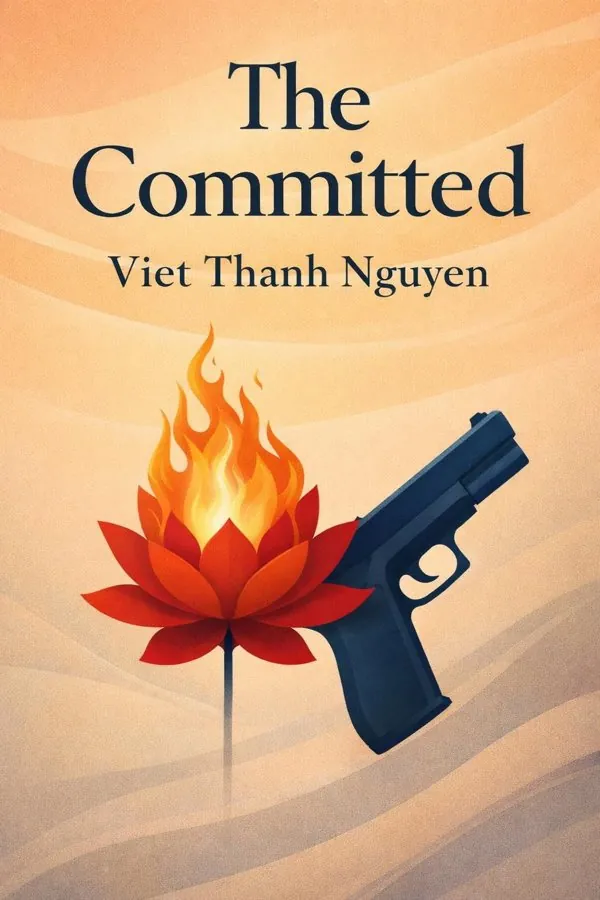
The Committed: Summary & Key Insights
 10 min9 chaptersAudio available
Key Takeaways from The Committed
Freedom can feel strangely similar to captivity when the self that survives is already fractured.
The people who save us can also become the people who trap us.
Intellectual sophistication is not the same as moral seriousness.
The body remembers what ideology tries to control.
Empire survives longest in the mind, in institutions, and in everyday habits that seem normal.
What Is The Committed About?
The Committed by Viet Thanh Nguyen is a bestsellers book spanning 6 pages. The Committed is Viet Thanh Nguyen’s fierce, intelligent, and darkly funny continuation of The Sympathizer, following its unnamed half-French, half-Vietnamese narrator into exile in 1980s Paris. Having survived war, imprisonment, and betrayal, he arrives in France expecting some version of freedom. Instead, he finds another system of hierarchy, hypocrisy, and violence waiting for him. In this new setting, Nguyen expands the story from the aftermath of the Vietnam War into a broader meditation on colonialism, capitalism, revolutionary politics, race, class, sex, and the psychological cost of divided loyalties. What makes the novel so powerful is that it refuses simple moral categories. Paris is not merely a refuge; it is a city haunted by empire, where intellectual elegance coexists with exploitation and where immigrants are welcomed in theory but marginalized in practice. Through crime, philosophical debate, erotic entanglements, and political disillusionment, the narrator confronts the same question that has always defined him: how can someone live when every identity is compromised? Nguyen, a Pulitzer Prize-winning novelist and one of the most important voices writing about war, memory, and diaspora, delivers a novel that is as entertaining as it is intellectually unsettling.
This FizzRead summary covers all 9 key chapters of The Committed in approximately 10 minutes, distilling the most important ideas, arguments, and takeaways from Viet Thanh Nguyen's work. Also available as an audio summary and Key Quotes Podcast.
The Committed
The Committed is Viet Thanh Nguyen’s fierce, intelligent, and darkly funny continuation of The Sympathizer, following its unnamed half-French, half-Vietnamese narrator into exile in 1980s Paris. Having survived war, imprisonment, and betrayal, he arrives in France expecting some version of freedom. Instead, he finds another system of hierarchy, hypocrisy, and violence waiting for him. In this new setting, Nguyen expands the story from the aftermath of the Vietnam War into a broader meditation on colonialism, capitalism, revolutionary politics, race, class, sex, and the psychological cost of divided loyalties.
What makes the novel so powerful is that it refuses simple moral categories. Paris is not merely a refuge; it is a city haunted by empire, where intellectual elegance coexists with exploitation and where immigrants are welcomed in theory but marginalized in practice. Through crime, philosophical debate, erotic entanglements, and political disillusionment, the narrator confronts the same question that has always defined him: how can someone live when every identity is compromised? Nguyen, a Pulitzer Prize-winning novelist and one of the most important voices writing about war, memory, and diaspora, delivers a novel that is as entertaining as it is intellectually unsettling.
Who Should Read The Committed?
This book is perfect for anyone interested in bestsellers and looking to gain actionable insights in a short read. Whether you're a student, professional, or lifelong learner, the key ideas from The Committed by Viet Thanh Nguyen will help you think differently.
- ✓Readers who enjoy bestsellers and want practical takeaways
- ✓Professionals looking to apply new ideas to their work and life
- ✓Anyone who wants the core insights of The Committed in just 10 minutes
Want the full summary?
Get instant access to this book summary and 100K+ more with Fizz Moment.
Get Free SummaryAvailable on App Store • Free to download
Key Chapters
Freedom can feel strangely similar to captivity when the self that survives is already fractured. That is the emotional starting point of The Committed. When the narrator arrives in Paris after the ordeals of war, espionage, and reeducation, he does not step into liberation so much as into another maze. Paris appears glamorous in the imagination: a city of art, philosophy, and political ideals. But Nguyen quickly strips away the fantasy. For a Vietnamese refugee, and especially one shaped by colonial history, Paris is also the former imperial capital, a place where elegance rests on domination.
The narrator’s first challenge is not simply finding a place to live or work. It is understanding what exile really means. He is physically removed from Vietnam, but psychologically trapped by memory, guilt, and ideological confusion. Even in a new country, he cannot escape the old voices inside him: the revolutionary, the anti-communist, the colonial subject, the lover, the betrayer. Paris does not heal these contradictions; it sharpens them.
Nguyen uses this disorienting arrival to show that migration is not just a movement across geography. It is a confrontation with the stories people tell about belonging. Many readers will recognize a broader truth here: changing environments does not automatically resolve internal conflict. A new job, new city, or new relationship can expose unresolved wounds rather than erase them.
A practical way to apply this insight is to question any fantasy of a “clean start.” Reinvention is real, but it requires facing the baggage you carry into every new chapter. The narrator’s experience reminds us that survival is only the beginning of the harder work of understanding oneself.
Actionable takeaway: when entering a new phase of life, identify the old beliefs and loyalties you are still carrying, because they will shape the future more than the new setting itself.
The people who save us can also become the people who trap us. In The Committed, Bon represents this painful paradox. He is the narrator’s blood brother, bound to him through shared suffering, shared history, and an oath of loyalty deeper than politics. Yet Bon’s fierce anti-communist conviction gives that bond a dangerous intensity. He believes in honor, vengeance, and ideological clarity with a purity the narrator cannot match.
Their relationship reveals one of the novel’s central tensions: survival often depends on solidarity, but solidarity can demand emotional and moral submission. Bon is admirable because he is unwavering. He has lost much and still refuses compromise. At the same time, his certainty exposes the narrator’s defining condition: divided allegiance. The narrator has always lived between positions, able to see multiple sides and therefore unable to surrender himself fully to any one cause. That doubleness gives him insight, but it also produces guilt. Around Bon, he feels both love and shame.
Nguyen does not reduce this brotherhood to a political argument. It is intimate, tender, masculine, and tragic. Bon is not just a symbol of anti-communism; he is a living reminder that ideas are carried in bodies and relationships. This is why the novel’s debates feel urgent. Ideology is never abstract when it is tied to the dead, the displaced, and the betrayed.
In ordinary life, many people experience a milder version of this dynamic. Family, friends, or communities can become moral anchors, but also sources of pressure to remain who we once were. Loyalty is valuable, yet unquestioned loyalty can keep us from honest change.
Actionable takeaway: honor the people who shaped you, but distinguish between loving them and inheriting all of their certainties.
Intellectual sophistication is not the same as moral seriousness. One of Nguyen’s sharpest achievements in The Committed is his portrait of the French intelligentsia, a world in which theory, radical language, and cultivated rebellion often coexist with detachment from real suffering. In Paris, the narrator encounters circles where Marxism, anti-imperialism, psychoanalysis, and revolutionary rhetoric are discussed with dazzling fluency. Yet these conversations are frequently haunted by vanity, performance, and privilege.
The novel does not dismiss ideas. On the contrary, Nguyen takes ideas very seriously. He shows how concepts about class, colonialism, race, and revolution shape institutions and people’s lives. What he criticizes is the ease with which intellectuals can consume political struggle as style. The narrator, who has lived through war and ideological violence, perceives the gap between those who theorize oppression and those who have inhabited it. For him, philosophy is not an elegant game. It is bound up with torture, betrayal, and exile.
This theme remains deeply relevant. In many modern settings, political language can become a form of status. People may speak brilliantly about justice while remaining insulated from the consequences of the systems they analyze. Nguyen asks readers to notice that contradiction without becoming anti-intellectual. The challenge is not to abandon theory, but to reconnect thought with accountability.
A practical application is to examine how we engage with political or moral ideas. Do we use them to understand reality more honestly, or to signal sophistication? Do our commitments cost us anything, or are they merely aesthetic preferences? The narrator’s discomfort in elite circles reminds us that truth often sounds less polished than performance.
Actionable takeaway: when evaluating any political argument, ask not only whether it is clever, but also who bears its consequences and what sacrifice it demands from the speaker.
The body remembers what ideology tries to control. In The Committed, sexuality and desire are never merely private matters. They are entangled with race, class, colonial fantasy, masculinity, and power. The narrator’s romantic and sexual encounters in Paris reveal how deeply political identity can shape intimacy. Love and lust do not free him from history; they pull history into the bedroom.
Nguyen explores how the narrator’s body is seen by others and by himself. As a mixed-race Vietnamese man in France, he is never just an individual. He is eroticized, categorized, and interpreted through inherited fantasies of East and West, colonizer and colonized, sophistication and otherness. This creates a tension between genuine desire and performed identity. Is he being loved, desired, or consumed as an idea? And how often does he himself participate in those distortions?
The novel also treats betrayal in intimate life as parallel to betrayal in political life. Just as ideologies promise purity and fail, desire promises connection but can expose domination, vanity, and self-deception. This is not cynicism for its own sake. It is Nguyen’s way of showing that power rarely stays confined to formal institutions. It enters touch, longing, pleasure, and shame.
Readers can apply this insight by recognizing how personal relationships are shaped by larger narratives. Attraction does not arise in a vacuum. Social hierarchies influence who feels visible, desirable, or disposable. Becoming more conscious of that can make relationships more honest and humane.
The narrator’s experiences suggest that self-knowledge requires asking uncomfortable questions about what we want and why. Intimacy becomes meaningful only when we can separate genuine connection from inherited scripts.
Actionable takeaway: reflect on how culture, status, and identity influence your desires, so that intimacy becomes a site of awareness rather than unconscious repetition.
Empire survives longest in the mind, in institutions, and in everyday habits that seem normal. The Committed makes this truth unavoidable. Although the narrator lives in postcolonial times, Paris remains saturated with colonial residues. The city’s wealth, taste, and self-image have been shaped by conquest, extraction, and the subordination of people like him. Nguyen refuses the comforting idea that colonialism belongs safely in the past.
This is one of the novel’s most important contributions. It shows that colonialism and ideology mirror each other in troubling ways. Both promise universal values while creating hierarchies. Both justify violence through abstract language. Both claim to civilize, liberate, or modernize while demanding obedience. The narrator, trained to think politically, recognizes these parallels. France may condemn certain forms of oppression while remaining blind to the systems that built its own power.
Nguyen’s insight applies far beyond French history. Many societies celebrate freedom, equality, or progress while quietly preserving structures that benefit from older forms of domination. Immigration policy, policing, education, language norms, and cultural prestige can all carry imperial afterlives. The narrator’s Paris is a useful lens through which to view the present: polished surfaces often conceal historical debts.
A practical way to engage this idea is to ask historical questions about the environments we inhabit. Who built the wealth of this city, institution, or tradition? Whose labor and suffering are missing from its official story? Such questions do not destroy appreciation; they deepen it by making memory more honest.
For the narrator, recognizing colonial continuity is painful but clarifying. It helps him see that his alienation is not merely personal failure. It is structurally produced.
Actionable takeaway: whenever a nation or institution presents itself as enlightened, look for the histories of exclusion and domination that made that self-image possible.
Sometimes the criminal underworld reveals society more clearly than respectable society does. In Paris, the narrator becomes entangled in drug dealing and illicit networks, and Nguyen uses this descent not only to generate tension but to expose capitalism’s moral logic. The illegal trade is not separate from the legitimate world. It is its distorted reflection, driven by the same hunger for profit, hierarchy, and control.
This is why the novel’s criminal plot matters intellectually. The narrator discovers that survival under exile often means entering economies that exploit the vulnerable while rewarding cunning. For immigrants and outsiders, the line between necessity and compromise can become dangerously thin. Crime offers money, belonging, and a form of power, but it also deepens alienation. The narrator participates in violence while trying to analyze it, which intensifies his inner split.
Nguyen suggests that respectable institutions often depend on forms of exploitation they prefer not to name. The underworld merely strips away the euphemisms. In this sense, crime becomes a social x-ray. It reveals how systems monetize desperation and how people rationalize harm when profit is involved.
Readers can draw a broader lesson here about modern work and ambition. Not all compromise is criminal, but many environments reward numbness, self-justification, and moral outsourcing. The narrator’s world exaggerates this dynamic, making it easier to see. We may not traffic drugs, but we can still participate in systems that ask us not to look too closely at who pays the price.
The novel does not offer purity as an easy alternative. Instead, it demands awareness. Once we see how power and profit operate, innocence is no longer available.
Actionable takeaway: examine the systems that provide your security or advancement, and ask what forms of invisible harm they may require you to ignore.
To see both sides is a gift until it becomes an inability to live. The narrator’s defining characteristic across Nguyen’s novels is divided consciousness. He is mixed in heritage, mixed in allegiance, intellectually agile, morally perceptive, and psychologically unstable because he can never stop noticing contradiction. In The Committed, this doubleness becomes even more painful. Exile removes the urgency of wartime action but leaves him alone with his fractured mind.
Nguyen portrays this condition with dark humor and philosophical intensity. The narrator can dissect ideologies, decode hypocrisy, and recognize the absurdity of nearly every social performance. Yet such insight does not produce wisdom or peace. It often produces paralysis, addiction to irony, and self-loathing. Knowing that all identities are constructed does not answer the practical question of how to inhabit one.
This is one reason the novel resonates beyond its historical setting. Many modern readers live with a version of split consciousness. We are trained to critique narratives, spot branding, analyze power, and question institutions. But constant critique can become emotionally exhausting. When every position has blind spots, commitment itself can feel naïve. The narrator embodies the cost of extreme awareness without grounding.
A practical application is to balance analysis with chosen responsibility. It is important to understand complexity, but at some point a person must still decide how to act, whom to protect, and what lines not to cross. The narrator struggles because he confuses total comprehension with ethical direction. They are not the same.
Nguyen does not mock intelligence; he warns that intelligence alone cannot organize a life. Insight must be joined to discipline, care, and action.
Actionable takeaway: allow complexity to deepen your judgment, but do not let endless ambivalence become an excuse for avoiding moral commitment.
Laughter can be one of the most honest responses to a world built on absurd violence. The Committed is a serious novel full of trauma, politics, and moral ruin, yet it is also wickedly funny. Nguyen’s dark humor is not ornamental. It is essential to how the novel thinks. Comedy becomes a way to expose hypocrisy, puncture prestige, and keep despair from becoming sentimental.
The narrator’s voice is central here. He is sardonic, hyperaware, and capable of describing terrifying or degrading situations with a wit that unsettles the reader. This tonal complexity matters because it mirrors the refugee and immigrant experience more accurately than solemnity alone could. People who have endured catastrophe do not live in a single emotional register. They joke, perform, seduce, mock, and improvise. Humor becomes both defense mechanism and diagnostic tool.
Nguyen also uses comedy to challenge authority. French intellectuals, political dogmatists, gangsters, revolutionaries, and romantics all become vulnerable to satire. By making them ridiculous, he reveals how fragile their claims to certainty really are. Humor, then, is not evasion. It is critique sharpened by style.
In everyday life, this insight is useful because it reminds us that seriousness and playfulness are not opposites. A well-placed joke can uncover a truth that formal analysis misses. Humor can create distance from fear and expose the vanity hidden inside institutions or identities.
Of course, the novel also shows the limits of irony. Wit can protect the self, but it cannot substitute for healing or accountability. The narrator’s intelligence and humor do not save him from consequences.
Actionable takeaway: use humor to reveal truth and endure difficulty, but do not let irony become a shield that prevents genuine feeling or responsibility.
Some stories end with forgiveness; this one insists that reckoning is messier. The Committed moves toward confrontation, violence, and self-recognition, but it refuses the neat arc of moral purification. Nguyen is too honest a novelist to pretend that trauma, complicity, and historical violence can be resolved by a single confession or heroic act. The narrator wants understanding, perhaps even absolution, yet what he receives is a harsher education in consequence.
This matters because many narratives about refugees, survivors, or political exiles are shaped by redemptive expectations. Readers often want suffering to produce wisdom and moral clarity. Nguyen resists that desire. His narrator remains compromised. He learns, but he does not become pure. He gains perspective, but perspective does not erase damage. This refusal is one of the book’s greatest strengths because it respects both history and psychology.
At the same time, the novel is not nihilistic. It suggests that redemption, if it exists at all, is not innocence restored but honesty earned. The narrator’s progress lies in becoming less enchanted by ideological fantasies, less willing to lie to himself about power, desire, and violence. That may sound modest, but in Nguyen’s moral universe it is significant. Clear-eyed self-knowledge is a difficult achievement.
Readers can apply this lesson by rejecting perfectionist models of change. Growth rarely means becoming flawless. More often it means seeing one’s patterns clearly, accepting responsibility, and making less destructive choices going forward. The narrator’s journey is valuable precisely because it does not flatter us with simplicity.
Actionable takeaway: pursue accountability over purity, because real transformation begins not with feeling redeemed but with refusing self-deception.
All Chapters in The Committed
About the Author
Viet Thanh Nguyen is a Vietnamese-American author, critic, and professor whose work explores war, memory, refugees, identity, and empire. Born in Vietnam in 1971, he came to the United States as a refugee after the end of the Vietnam War, an experience that deeply informs his writing. He is best known for his debut novel, The Sympathizer, which won the 2016 Pulitzer Prize for Fiction and was widely praised for its blend of political insight, dark humor, and psychological complexity. Nguyen has also written influential essays and nonfiction on displacement, representation, and the ethics of remembrance. As both a novelist and public intellectual, he is regarded as one of the most important contemporary voices examining the Vietnamese diaspora and the lasting consequences of war and colonialism.
Get This Summary in Your Preferred Format
Read or listen to the The Committed summary by Viet Thanh Nguyen anytime, anywhere. FizzRead offers multiple formats so you can learn on your terms — all free.
Available formats: App · Audio · PDF · EPUB — All included free with FizzRead
Download The Committed PDF and EPUB Summary
Key Quotes from The Committed
“Freedom can feel strangely similar to captivity when the self that survives is already fractured.”
“The people who save us can also become the people who trap us.”
“Intellectual sophistication is not the same as moral seriousness.”
“The body remembers what ideology tries to control.”
“Empire survives longest in the mind, in institutions, and in everyday habits that seem normal.”
Frequently Asked Questions about The Committed
The Committed by Viet Thanh Nguyen is a bestsellers book that explores key ideas across 9 chapters. The Committed is Viet Thanh Nguyen’s fierce, intelligent, and darkly funny continuation of The Sympathizer, following its unnamed half-French, half-Vietnamese narrator into exile in 1980s Paris. Having survived war, imprisonment, and betrayal, he arrives in France expecting some version of freedom. Instead, he finds another system of hierarchy, hypocrisy, and violence waiting for him. In this new setting, Nguyen expands the story from the aftermath of the Vietnam War into a broader meditation on colonialism, capitalism, revolutionary politics, race, class, sex, and the psychological cost of divided loyalties. What makes the novel so powerful is that it refuses simple moral categories. Paris is not merely a refuge; it is a city haunted by empire, where intellectual elegance coexists with exploitation and where immigrants are welcomed in theory but marginalized in practice. Through crime, philosophical debate, erotic entanglements, and political disillusionment, the narrator confronts the same question that has always defined him: how can someone live when every identity is compromised? Nguyen, a Pulitzer Prize-winning novelist and one of the most important voices writing about war, memory, and diaspora, delivers a novel that is as entertaining as it is intellectually unsettling.
More by Viet Thanh Nguyen
You Might Also Like
The Godfather
Mario Puzo
10 min
The Handmaid's Tale
Margaret Atwood
10 min
The Hunger Games
Suzanne Collins
10 min
The Nightingale
Kristin Hannah
10 min
The Seven Husbands of Evelyn Hugo
Taylor Jenkins Reid
10 min
Backwater Justice
Fern Michaels
10 minBrowse by Category
Ready to read The Committed?
Get the full summary and 100K+ more books with Fizz Moment.