
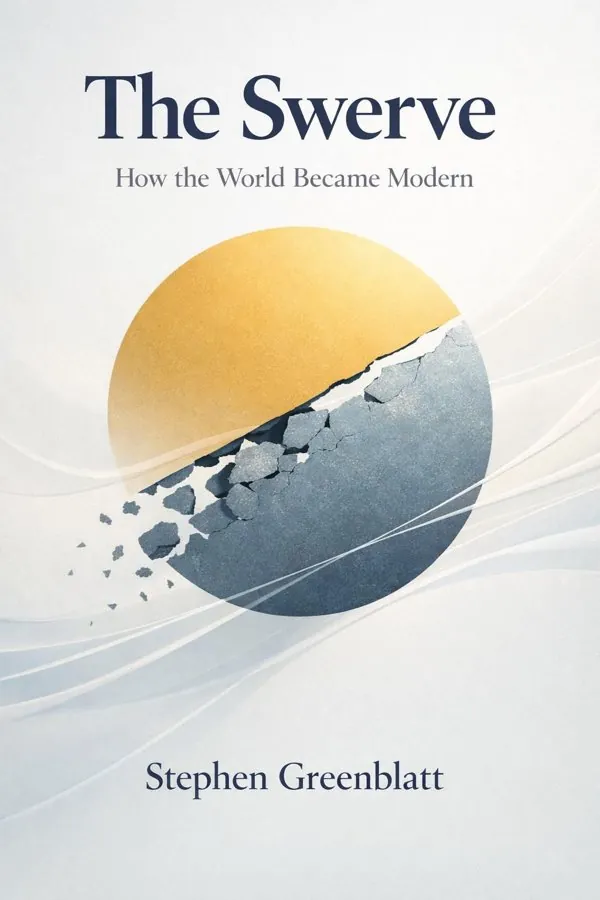
The Swerve: How the World Became Modern: Summary & Key Insights
 10 min10 chaptersAudio available
What Is The Swerve: How the World Became Modern About?
The Swerve: How the World Became Modern by Stephen Greenblatt is a civilization book spanning 10 pages. In this Pulitzer Prize–winning work, Stephen Greenblatt traces how the rediscovery of Lucretius’s ancient Roman poem 'De Rerum Natura' in the 15th century helped ignite the Renaissance and transform Western thought. The book explores how this classical text’s ideas about atomism, pleasure, and the nature of the universe challenged medieval orthodoxy and laid the groundwork for modern secularism, science, and humanism.
This FizzRead summary covers all 10 key chapters of The Swerve: How the World Became Modern in approximately 10 minutes, distilling the most important ideas, arguments, and takeaways from Stephen Greenblatt's work. Also available as an audio summary and Key Quotes Podcast.
The Swerve: How the World Became Modern
In this Pulitzer Prize–winning work, Stephen Greenblatt traces how the rediscovery of Lucretius’s ancient Roman poem 'De Rerum Natura' in the 15th century helped ignite the Renaissance and transform Western thought. The book explores how this classical text’s ideas about atomism, pleasure, and the nature of the universe challenged medieval orthodoxy and laid the groundwork for modern secularism, science, and humanism.
Who Should Read The Swerve: How the World Became Modern?
This book is perfect for anyone interested in civilization and looking to gain actionable insights in a short read. Whether you're a student, professional, or lifelong learner, the key ideas from The Swerve: How the World Became Modern by Stephen Greenblatt will help you think differently.
- ✓Readers who enjoy civilization and want practical takeaways
- ✓Professionals looking to apply new ideas to their work and life
- ✓Anyone who wants the core insights of The Swerve: How the World Became Modern in just 10 minutes
Want the full summary?
Get instant access to this book summary and 100K+ more with Fizz Moment.
Get Free SummaryAvailable on App Store • Free to download
Key Chapters
When Poggio Bracciolini was born, the world he entered was defined by hierarchy and theological certainty. The medieval imagination was ordered around God—every natural phenomenon explained through divine will, every text interpreted in service to religious truth. Universities taught not discovery but defense of doctrine. Scholasticism reigned: a system of inquiry that revered Aristotle but reshaped him into a lens compatible with the Church’s view of creation.
It is crucial to understand how tightly controlled the intellectual atmosphere was. Knowledge did not belong to everyone—it belonged to institutions, particularly the Church. Monasteries were the great custodians of learning, but also its gatekeepers. Classical texts—especially those that spoke of materialism, sensuality, or skepticism—were often suppressed or allowed to decay. Pagan philosophers who measured the world through observation rather than revelation were treated as dangerous or irrelevant.
Yet even in this climate, whispers of the lost ancient world persisted. A few scholars mourned what was gone—the vibrant voices of Cicero, Virgil, and the poet Lucretius. For centuries, their works existed only in fragments or memory. What struck me most in examining this period was not only the absence of classical thought but the hunger for it—an unspoken yearning beneath the rigid piety. Poggio and his circle found themselves increasingly disenchanted with the corruption of church politics and enamored of a broader idea: to recover the intellectual liberty of the ancients. That yearning would become the heartbeat of humanism.
The medieval world was thus not merely the backdrop to Poggio’s story; it was the cage that defined his rebellion. The rediscovery of Lucretius did not arise from institutional permission—it was an act of resistance. Poggio’s intellectual quest was a quiet defiance against centuries of silence imposed on free inquiry.
To appreciate how the recovery of an ancient poem could alter history, we must first know the man who found it. Poggio Bracciolini was born near Florence in 1380—a child of the early Renaissance, raised amid the resurgence of Italian art and learning but still bound by the papal bureaucracy he served. He became a secretary at the papal court in Rome, a position that demanded diplomacy, linguistic refinement, and loyalty. Yet beneath that official façade, Poggio was a restless soul. He loved words as others loved gold.
In his letters and notes, Poggio emerges as a man fascinated by the beauty of Latin, obsessed with manuscripts, and weary of ecclesiastical corruption. The papal court was rife with intrigue, and Poggio’s talents earned him privilege, but not fulfillment. His true religion was the written word—the idea that ancient texts contained not only literary elegance but truths forgotten by his own age.
He joined the growing movement known as humanism—the revival of classical learning—and found in it a moral purpose. Humanists believed that the study of antiquity could ennoble modern life, reconnecting man to the dignity of reason and eloquence. But unlike some of his contemporaries who pursued texts merely for their rhetorical grace, Poggio sought their substance. He wanted to resurrect ideas buried for a thousand years.
What makes Poggio so compelling is his transformation from bureaucrat to adventurer. He turned his back on the comfort of Rome’s courts and followed his passion into the remotest corners of Europe, hunting manuscripts in monasteries where few thought to look. His letters describe the physical thrill of discovery—the smell of parchment, the weight of a codex bound in fading leather. In that moment, the intellectual and the sensual merged. Poggio treated each text as an artifact of human freedom.
He embodied the idea that the Renaissance was not born in palaces but in libraries, not through invention but through recovery. His life demonstrates that history’s great turning points often depend on stubborn individuals who refuse to let the past die.
+ 8 more chapters — available in the FizzRead app
All Chapters in The Swerve: How the World Became Modern
About the Author
Stephen Greenblatt is an American literary historian, critic, and scholar, best known for his work on Renaissance literature and for pioneering the field of New Historicism. He is the John Cogan University Professor of the Humanities at Harvard University and the author of several acclaimed books, including 'Will in the World' and 'Tyrant: Shakespeare on Politics.'
Get This Summary in Your Preferred Format
Read or listen to the The Swerve: How the World Became Modern summary by Stephen Greenblatt anytime, anywhere. FizzRead offers multiple formats so you can learn on your terms — all free.
Available formats: App · Audio · PDF · EPUB — All included free with FizzRead
Download The Swerve: How the World Became Modern PDF and EPUB Summary
Key Quotes from The Swerve: How the World Became Modern
“When Poggio Bracciolini was born, the world he entered was defined by hierarchy and theological certainty.”
“To appreciate how the recovery of an ancient poem could alter history, we must first know the man who found it.”
Frequently Asked Questions about The Swerve: How the World Became Modern
The Swerve: How the World Became Modern by Stephen Greenblatt is a civilization book that explores key ideas across 10 chapters. In this Pulitzer Prize–winning work, Stephen Greenblatt traces how the rediscovery of Lucretius’s ancient Roman poem 'De Rerum Natura' in the 15th century helped ignite the Renaissance and transform Western thought. The book explores how this classical text’s ideas about atomism, pleasure, and the nature of the universe challenged medieval orthodoxy and laid the groundwork for modern secularism, science, and humanism.
You Might Also Like
The Structure of Scientific Revolutions
Thomas S. Kuhn
10 min
Genius
Harold Bloom
10 min
A Cultural History of the Medieval Age
Various Editors
10 min
A History of God: The 4,000-Year Quest of Judaism, Christianity and Islam
Karen Armstrong
10 min
A History of the World in 10½ Chapters
Julian Barnes
10 min
A Short History of Progress
Ronald Wright
10 minBrowse by Category
Ready to read The Swerve: How the World Became Modern?
Get the full summary and 100K+ more books with Fizz Moment.