
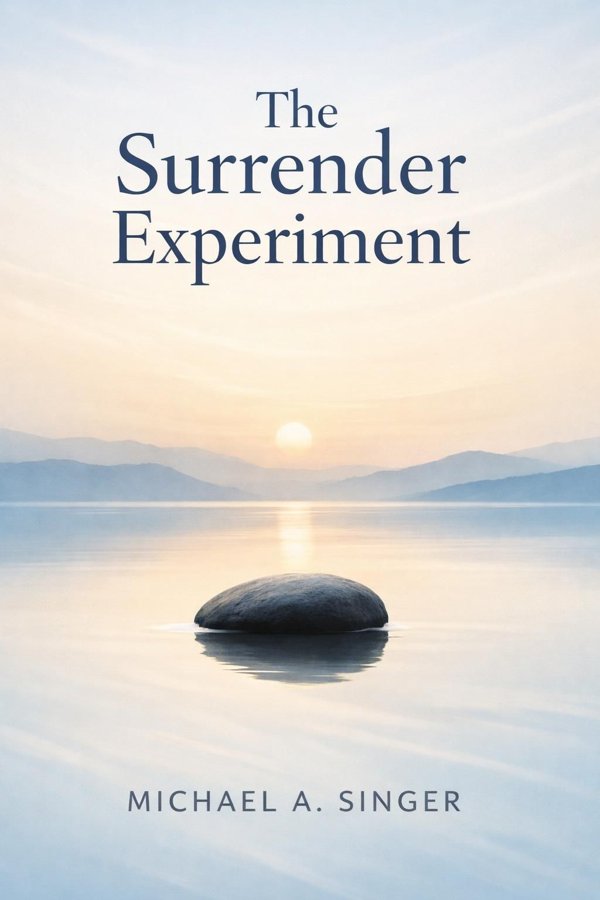
The Surrender Experiment: Summary & Key Insights
 10 min9 chaptersAudio available
Key Takeaways from The Surrender Experiment
He noticed that his mind was endlessly commenting, judging, fearing, preferring, and resisting.
Retreating into stillness does not instantly create peace; often, it reveals how restless we already are.
A meaningful life does not always arrive through a master plan; sometimes it grows from repeatedly saying yes to what naturally appears.
One of the book’s most refreshing challenges to conventional thinking is that deep spirituality and major worldly achievement do not have to be enemies.
It is easy to feel surrendered when life is quiet and simple; the true test comes when responsibilities multiply.
What Is The Surrender Experiment About?
The Surrender Experiment by Michael Singer is a self-help book published in 2015 spanning 8 pages. What if the life you are trying so hard to build is smaller than the life that would unfold if you stopped fighting reality? In The Surrender Experiment, Michael A. Singer tells the remarkable true story of what happened when he made one radical decision: instead of arranging life around his personal preferences, fears, and ambitions, he would say yes to what life placed in front of him. What follows is not a quiet spiritual memoir in the usual sense, but an astonishing journey from isolated meditation in the Florida woods to founding a spiritual community, building a major medical software company, and facing severe legal turmoil he never could have predicted. The book matters because it offers more than inspiration; it presents a lived test of surrender as a practical way of engaging with uncertainty, success, pain, and purpose. Singer writes with unusual authority because he did not arrive at these insights through theory alone. As a longtime meditation practitioner, founder of Temple of the Universe, and author of The Untethered Soul, he combines spiritual depth with firsthand experience in both inner work and worldly achievement.
This FizzRead summary covers all 9 key chapters of The Surrender Experiment in approximately 10 minutes, distilling the most important ideas, arguments, and takeaways from Michael Singer's work. Also available as an audio summary and Key Quotes Podcast.
The Surrender Experiment
What if the life you are trying so hard to build is smaller than the life that would unfold if you stopped fighting reality? In The Surrender Experiment, Michael A. Singer tells the remarkable true story of what happened when he made one radical decision: instead of arranging life around his personal preferences, fears, and ambitions, he would say yes to what life placed in front of him. What follows is not a quiet spiritual memoir in the usual sense, but an astonishing journey from isolated meditation in the Florida woods to founding a spiritual community, building a major medical software company, and facing severe legal turmoil he never could have predicted. The book matters because it offers more than inspiration; it presents a lived test of surrender as a practical way of engaging with uncertainty, success, pain, and purpose. Singer writes with unusual authority because he did not arrive at these insights through theory alone. As a longtime meditation practitioner, founder of Temple of the Universe, and author of The Untethered Soul, he combines spiritual depth with firsthand experience in both inner work and worldly achievement.
Who Should Read The Surrender Experiment?
This book is perfect for anyone interested in self-help and looking to gain actionable insights in a short read. Whether you're a student, professional, or lifelong learner, the key ideas from The Surrender Experiment by Michael Singer will help you think differently.
- ✓Readers who enjoy self-help and want practical takeaways
- ✓Professionals looking to apply new ideas to their work and life
- ✓Anyone who wants the core insights of The Surrender Experiment in just 10 minutes
Want the full summary?
Get instant access to this book summary and 100K+ more with Fizz Moment.
Get Free SummaryAvailable on App Store • Free to download
Key Chapters
Most people assume life is difficult because of what happens to them, but Singer’s deepest realization is that suffering is often intensified by the constant inner argument against reality. He noticed that his mind was endlessly commenting, judging, fearing, preferring, and resisting. The real noise was not outside him but inside. This insight became the seed of his surrender experiment: instead of insisting that life match his personal comfort and plans, he would let go of the compulsion to control every outcome.
This is not passivity or laziness. Singer does not suggest that we abandon responsibility or stop making decisions. He points to something subtler: the habit of mentally fighting what is already happening. We suffer twice when we do this. First, there is the event itself. Then there is our psychological resistance to it. By dropping the second layer, we free up energy, clarity, and openness.
In everyday life, this might mean noticing your reaction when a project changes direction, a relationship becomes uncomfortable, or an opportunity appears in a form you did not expect. Instead of immediately saying, “I don’t want this,” you can pause and ask, “What if this moment is part of a larger unfolding?” That simple shift turns resistance into curiosity.
Singer’s life changes because he treats each moment as a doorway rather than an obstacle. The experiment begins with one inner choice: stop making your happiness dependent on conditions.
Actionable takeaway: The next time something unwanted happens, notice your inner protest and consciously relax around it before responding.
Retreating into stillness does not instantly create peace; often, it reveals how restless we already are. When Singer moved into the woods of Florida and began living simply, meditating for long periods, he discovered that solitude did not eliminate inner disturbance. It exposed it. In silence, the machinery of the mind became obvious: repetitive thoughts, emotional habits, old fears, and the endless voice trying to manage experience.
This is one of the book’s most important lessons. Many people think peace comes from finding the perfect external environment. Singer’s early spiritual practice showed him that peace comes from relating differently to the mind. He built a simple shelter, surrounded himself with nature, and devoted himself to meditation not as an escape from life, but as a way to study consciousness directly. The woods became his laboratory.
For modern readers, this does not require abandoning society or moving into a cabin. It means creating regular space to observe yourself. Ten minutes of meditation, a silent walk, journaling before checking your phone, or simply sitting without distraction can reveal how quickly the mind clings, judges, and grasps for control. Once seen, these patterns become less powerful.
Singer’s practice gave him the stability to surrender when life became larger, busier, and more unpredictable. He did not wait until conditions were perfect to start inner work. He built that foundation early.
Actionable takeaway: Establish a daily period of silence, even brief, and use it to observe your thoughts rather than automatically believing them.
A meaningful life does not always arrive through a master plan; sometimes it grows from repeatedly saying yes to what naturally appears. One of the most striking aspects of Singer’s story is that he did not set out to become a public teacher, community founder, or business leader. He simply kept accepting the next thing life placed before him, even when it disrupted his preferences.
This attitude led to the creation of the Temple of the Universe. What began as private spiritual practice gradually expanded because people were drawn to the peace and sincerity they felt around him. Opportunities emerged organically: gatherings, teachings, land, a growing community. Instead of clutching to the identity of a solitary meditator, Singer surrendered to the form life wanted to take through him.
There is a valuable distinction here between forced ambition and responsive participation. Many of us either over-control our future or drift without intention. Singer models a third option: stay rooted inwardly, then engage wholeheartedly with the opportunities that genuinely arise. For example, if someone asks for your help, if a project keeps returning, or if a role opens unexpectedly, you can explore it without needing to map out your entire life in advance.
This way of living requires trust. It also requires flexibility, because your ego may prefer a cleaner, safer, more self-designed story. But surrender often leads beyond the narrow self-concept we defend.
Actionable takeaway: For one week, pay attention to recurring invitations in your life and ask whether one of them deserves a sincere yes.
One of the book’s most refreshing challenges to conventional thinking is that deep spirituality and major worldly achievement do not have to be enemies. Singer did not abandon meditation when business opportunities appeared, nor did he assume that entering commerce would corrupt his inner path. Instead, he treated work itself as part of the surrender experiment.
His unexpected career path into software and business growth did not come from a long-standing corporate ambition. It came through a series of life events he had not planned. Rather than refusing because it did not fit his image of a spiritual person, he accepted the responsibilities before him. This willingness eventually led to the creation and growth of a successful medical software company.
The deeper principle is that no outer role is inherently unspiritual. What matters is the consciousness you bring to it. You can run a company from ego, fear, and domination, or you can approach work as service, stewardship, discipline, and participation in a larger unfolding. Singer’s example suggests that success becomes dangerous mainly when identity attaches to it. If you can work intensely without making your self-worth depend on outcomes, success becomes another arena for practice.
For readers, this is liberating. You do not need to choose between ambition and awakening. You can pursue excellence while staying committed to inner freedom. The challenge is to succeed without becoming psychologically possessed by success.
Actionable takeaway: Reframe your current work as a spiritual practice by focusing on service, presence, and integrity instead of image or status.
It is easy to feel surrendered when life is quiet and simple; the true test comes when responsibilities multiply. As Singer’s business expanded and the Temple of the Universe grew, his life became increasingly complex. He had employees, leadership demands, financial pressures, community obligations, and large-scale decisions to make. This stage of his journey reveals that surrender is not just a retreat practice. It must survive deadlines, conflict, visibility, and power.
Growth exposes hidden attachments. We may discover we like influence, fear failure, crave recognition, or become stressed by uncertainty. Singer’s experiment required him to stay open even as life intensified. Rather than shrinking back into a more controlled existence, he tried to remain aligned with the same principle that guided him in the woods: let go of personal preference and serve what is unfolding.
For many readers, this lesson applies directly to career advancement, family expansion, or leadership. The promotion you wanted may bring chaos. The dream project may create pressure. The role of parenting, teaching, managing, or building something meaningful will challenge your nervous system and your ego. Growth itself is not the problem; resistance to the demands of growth creates much of the suffering.
Surrender during expansion means continuing to show up fully while releasing the need to emotionally control every variable. It means acting decisively but not obsessively. It means allowing life to become larger than your comfort zone.
Actionable takeaway: When your responsibilities increase, ask not only “How do I manage this?” but also “What attachment in me is this growth exposing?”
A powerful thread running through The Surrender Experiment is that life keeps offering situations perfectly designed to free us from ourselves. Singer did not divide experience into spiritual moments and ordinary moments. Teaching, managing, negotiating, listening, dealing with conflict, and handling setbacks all became material for awakening. Every role was an opportunity to release fear, ego, and preference.
This perspective changes how we interpret difficulty. Instead of asking, “Why is this happening to me?” we can ask, “What part of me is being asked to let go?” A difficult employee might expose your impatience. An uncertain decision may reveal your fear of making mistakes. An uncomfortable conversation may confront your need to be liked. Seen this way, life becomes an ongoing training ground.
The practical value is enormous. You do not need to wait for retreats, peak experiences, or ideal conditions to grow. Your family life, workplace, friendships, and body are already giving you the curriculum. Singer demonstrates that surrender is not a single dramatic event but a repeated willingness to stop defending the small self.
This does not mean becoming passive in relationships or ignoring real problems. It means engaging them from consciousness rather than compulsion. You still set boundaries, make choices, and solve issues, but you do so while watching your inner reactions rather than being run by them.
Actionable takeaway: Pick one recurring challenge in your life and treat it as a spiritual assignment designed to reveal and soften a specific attachment.
One of the book’s most sobering lessons is that surrender is not a bargain that guarantees a pain-free life. Despite years of spiritual practice, personal discipline, and remarkable success, Singer eventually faced severe legal and ethical challenges that threatened his reputation, freedom, and stability. This section of the memoir is crucial because it prevents readers from romanticizing surrender as a technique for getting only pleasant outcomes.
Real surrender includes the willingness to remain open when life becomes frightening, unfair, and incomprehensible. Singer’s ordeal tested whether his philosophy held under pressure. Could he continue trusting the unfolding of life when events looked disastrous? Could he maintain integrity without collapsing into bitterness, panic, or self-pity? This is where the experiment moves from inspiring to profound.
In ordinary life, crisis may not look like a federal investigation, but it can take the form of illness, divorce, job loss, betrayal, or public failure. These moments strip away spiritual fantasy. They reveal whether our peace depends on favorable conditions. Singer’s example does not suggest we should like suffering. It shows that we can meet suffering without adding mental warfare, identity collapse, and endless resistance.
This idea is deeply practical. In crisis, we still need lawyers, doctors, plans, and support. But inwardly, we can stop amplifying pain by demanding that reality be different before we allow ourselves to remain centered.
Actionable takeaway: In your next major setback, separate the facts of the situation from the dramatic story your mind is creating, and work with the facts first.
At the heart of Singer’s memoir is a radical proposition: life may be wiser than the limited mind trying to control it. Our personal plans are shaped by fear, habit, and narrow perception. We usually want what feels safe, familiar, or flattering. But the larger unfolding of life often moves us toward experiences that grow us far beyond what our preferences would choose.
Singer repeatedly finds that when he relaxes control and trusts the unfolding, life arranges circumstances more intelligently than his own agenda would have. This does not mean every event is pleasant or immediately understandable. It means that reality is not always an enemy to conquer. There is often a larger order at work, one that becomes visible only in hindsight.
For readers, trust can sound abstract until it becomes behavioral. Trust means accepting an invitation you did not expect. It means staying present through uncertainty rather than rushing to force closure. It means acting responsibly while admitting you do not control all variables. It means allowing your life to be informed by reality, not just by your anxieties.
This is especially relevant in a culture obsessed with optimization and personal branding. We are taught to engineer every outcome. Singer offers a counterpoint: the deepest fulfillment may come not from dominating life, but from cooperating with it.
Actionable takeaway: Identify one area where you are over-controlling the future, and experiment with loosening your grip while still taking the next responsible step.
The ultimate contribution of The Surrender Experiment is not its unusual plot but its definition of freedom. Singer shows that freedom is not merely doing what you want, avoiding discomfort, or arranging ideal circumstances. True freedom is inner nondependence: the capacity to remain open, present, and unconfined by your own preferences, fears, and mental patterns.
This is why the memoir resonates as more than autobiography. The external events are dramatic, but the core teaching is universal. Every person knows the tension between what is happening and what the mind insists should be happening instead. Every person feels the pull to contract, resist, defend, and control. Singer’s life becomes evidence that another way is possible.
Importantly, this freedom is built through practice. It develops each time you relax instead of clench, listen instead of react, participate instead of withdraw, and release instead of grasp. Over time, these moments create a different inner structure. You stop being pushed around by every preference and fear. You become available to life.
Readers may never follow Singer’s exact path, and that is not the point. The point is to test the principle in your own circumstances. What happens if you stop organizing life around avoiding discomfort? What opens if you allow each moment to teach, stretch, and move you?
Actionable takeaway: Define one comfort-based pattern that limits your life, and practice choosing openness over avoidance the next time it appears.
All Chapters in The Surrender Experiment
About the Author
Michael A. Singer is an American author, spiritual teacher, and entrepreneur whose work focuses on meditation, consciousness, and the practice of letting go. After a profound inner awakening in his twenties, he devoted himself to deep meditation and spiritual inquiry, eventually founding Temple of the Universe in Florida, a long-standing center for yoga, meditation, and contemplation. Singer is widely known for his bestselling books The Untethered Soul and The Surrender Experiment, both of which explore how inner freedom emerges when we stop identifying with the mind’s fears and preferences. Unusually, his life has also included major success in the business world through his role in developing a medical software company. That combination of spiritual depth and practical experience gives his writing a rare credibility and broad appeal.
Get This Summary in Your Preferred Format
Read or listen to the The Surrender Experiment summary by Michael Singer anytime, anywhere. FizzRead offers multiple formats so you can learn on your terms — all free.
Available formats: App · Audio · PDF · EPUB — All included free with FizzRead
Download The Surrender Experiment PDF and EPUB Summary
Key Quotes from The Surrender Experiment
“Most people assume life is difficult because of what happens to them, but Singer’s deepest realization is that suffering is often intensified by the constant inner argument against reality.”
“Retreating into stillness does not instantly create peace; often, it reveals how restless we already are.”
“A meaningful life does not always arrive through a master plan; sometimes it grows from repeatedly saying yes to what naturally appears.”
“One of the book’s most refreshing challenges to conventional thinking is that deep spirituality and major worldly achievement do not have to be enemies.”
“It is easy to feel surrendered when life is quiet and simple; the true test comes when responsibilities multiply.”
Frequently Asked Questions about The Surrender Experiment
The Surrender Experiment by Michael Singer is a self-help book that explores key ideas across 9 chapters. What if the life you are trying so hard to build is smaller than the life that would unfold if you stopped fighting reality? In The Surrender Experiment, Michael A. Singer tells the remarkable true story of what happened when he made one radical decision: instead of arranging life around his personal preferences, fears, and ambitions, he would say yes to what life placed in front of him. What follows is not a quiet spiritual memoir in the usual sense, but an astonishing journey from isolated meditation in the Florida woods to founding a spiritual community, building a major medical software company, and facing severe legal turmoil he never could have predicted. The book matters because it offers more than inspiration; it presents a lived test of surrender as a practical way of engaging with uncertainty, success, pain, and purpose. Singer writes with unusual authority because he did not arrive at these insights through theory alone. As a longtime meditation practitioner, founder of Temple of the Universe, and author of The Untethered Soul, he combines spiritual depth with firsthand experience in both inner work and worldly achievement.
You Might Also Like



Featured In
Browse by Category
Ready to read The Surrender Experiment?
Get the full summary and 100K+ more books with Fizz Moment.