
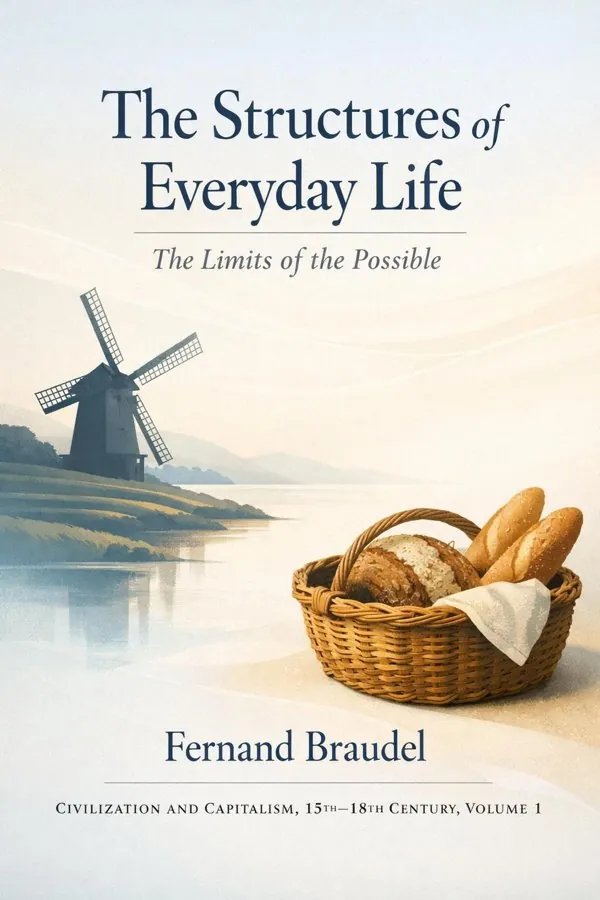
The Structures of Everyday Life: The Limits of the Possible: Civilization and Capitalism, 15th–18th Century, Volume 1: Summary & Key Insights
 10 min12 chaptersAudio available
What Is The Structures of Everyday Life: The Limits of the Possible: Civilization and Capitalism, 15th–18th Century, Volume 1 About?
The Structures of Everyday Life: The Limits of the Possible: Civilization and Capitalism, 15th–18th Century, Volume 1 by Fernand Braudel is a civilization book spanning 12 pages. The first volume of Fernand Braudel’s monumental trilogy, this book explores the material life and economic structures of the world between the 15th and 18th centuries. Braudel examines the slow rhythms of daily civilization—food, housing, clothing, and technology—and shows how these elements shaped societies before the rise of modern capitalism.
This FizzRead summary covers all 12 key chapters of The Structures of Everyday Life: The Limits of the Possible: Civilization and Capitalism, 15th–18th Century, Volume 1 in approximately 10 minutes, distilling the most important ideas, arguments, and takeaways from Fernand Braudel's work. Also available as an audio summary and Key Quotes Podcast.
The Structures of Everyday Life: The Limits of the Possible: Civilization and Capitalism, 15th–18th Century, Volume 1
The first volume of Fernand Braudel’s monumental trilogy, this book explores the material life and economic structures of the world between the 15th and 18th centuries. Braudel examines the slow rhythms of daily civilization—food, housing, clothing, and technology—and shows how these elements shaped societies before the rise of modern capitalism.
Who Should Read The Structures of Everyday Life: The Limits of the Possible: Civilization and Capitalism, 15th–18th Century, Volume 1?
This book is perfect for anyone interested in civilization and looking to gain actionable insights in a short read. Whether you're a student, professional, or lifelong learner, the key ideas from The Structures of Everyday Life: The Limits of the Possible: Civilization and Capitalism, 15th–18th Century, Volume 1 by Fernand Braudel will help you think differently.
- ✓Readers who enjoy civilization and want practical takeaways
- ✓Professionals looking to apply new ideas to their work and life
- ✓Anyone who wants the core insights of The Structures of Everyday Life: The Limits of the Possible: Civilization and Capitalism, 15th–18th Century, Volume 1 in just 10 minutes
Want the full summary?
Get instant access to this book summary and 100K+ more with Fizz Moment.
Get Free SummaryAvailable on App Store • Free to download
Key Chapters
To understand material life, one must first confront the Earth itself. Geography and climate imposed the primary rhythms of existence. From the Mediterranean basin to the cold plains of northern Europe, from the monsoon-fed rice fields of Asia to the drought-stricken zones of Africa, humanity’s material existence was never detached from nature’s discipline. In my view, the physical environment acted not simply as decor but as the most enduring actor in history.
The variability of climates defined the possibilities of agriculture, settlement, and even mobility. The modest technological means available before industrialization left humans in close subservience to weather cycles. A bad harvest meant famine; an unexpectedly mild winter could bring reprieve. In the fifteenth and sixteenth centuries, recurring climatic fluctuations—what we might now call the 'Little Ice Age'—lowered average temperatures and reshaped entire economies. Northern populations struggled against shorter growing seasons, grain became more precious, and migration patterns subtly adjusted. In these slow oscillations, one reads not chaos but pattern—a rhythm determining how societies moved within the boundaries of their environments.
Natural resources also dictated human destiny. Forests provided wood, the universal energy source; rivers formed arteries for communication; soil fertility separated prosperous regions from those condemned to scarcity. Where coal or metals were accessible, technology found its first impulsions. Yet, as I insist, these were local phenomena at best. The world economy of the early modern period was stitched together not by industrial capital but by the steady pulse of geography—a geography whose limits few dared to challenge.
This environmental determinism, however, was never absolute. Human ingenuity learned to adapt and modify surroundings. Terraced agriculture in mountainous regions, canals in the Netherlands, irrigation systems in Asia—all testify to man’s stubborn resistance to natural bounds. Such adaptations, while profound, were slow. The landscape you see in a sixteenth-century painting remained largely similar even two centuries later.
Thus the world of my narrative is one where the horizon of possibility was drawn by the Earth itself. Every subsequent form of productivity, exchange, and social organization rested upon this enduring stage. Civilization, before dreams of progress, was a negotiation with nature’s unrelenting constraints.
Within these natural limits, humanity itself moved in long rhythms—waves of birth, growth, and decline that shaped economies more profoundly than any policy could. Between the fifteenth and eighteenth centuries, Europe and many parts of the world experienced alternating phases of demographic expansion and contraction. Epidemics, nutrition, and marriage practices regulated these cycles. I treat population as one of history’s slowest variables—its ups and downs forming a background hum against which economic and cultural transformations occurred.
In Europe, the late Middle Ages had seen decline following the Black Death; then, from the sixteenth century onward, rebirth took place as populations gradually recovered. Yet this recovery was uneven. Rural regions, limited by food supply, often reached Malthusian pressures: too many mouths for the available plots of land. Urban centers, though vibrant, were unhealthy and reliant on constant rural immigration. Mortality rates remained severe; birth rates correspondingly high. The result was not steady growth, but oscillation—the rhythm of plenty and crisis that characterized what I call demographic life within a closed material system.
These population dynamics fundamentally influenced economic behavior. A surplus of labor kept wages low and productivity traditional. Family structures dictated how work was divided, how property circulated, and how innovation was constrained. Large households in agrarian societies were not mere social units—they were economic institutions, repositories of manpower and skill across generations.
Migration, whether within countries or across oceans, became the great moderator of population pressure. The period saw Portugal, Spain, and later England dispatching settlers and slaves across continents. Yet these movements were never large enough to alter the overall structure of old societies. Even in the era of exploration, most people lived and died within fifty kilometers of their birthplace. The demographic landscape remained local, cyclical, and cautious.
To grasp material life, then, one must imagine this demographic pulse beating slowly under every transaction and every social habit. The rhythms of birth and death set the tempo for how civilization adjusted to scarcity or abundance. Such cycles reveal not fragility but endurance. Humanity, though perpetually threatened by disease and hunger, continued to multiply its possibilities within constraints that seemed eternal.
+ 10 more chapters — available in the FizzRead app
All Chapters in The Structures of Everyday Life: The Limits of the Possible: Civilization and Capitalism, 15th–18th Century, Volume 1
About the Author
Fernand Braudel (1902–1985) was a major French historian associated with the Annales School. His works on the Mediterranean and on world economic history profoundly reshaped the understanding of long-term historical structures.
Get This Summary in Your Preferred Format
Read or listen to the The Structures of Everyday Life: The Limits of the Possible: Civilization and Capitalism, 15th–18th Century, Volume 1 summary by Fernand Braudel anytime, anywhere. FizzRead offers multiple formats so you can learn on your terms — all free.
Available formats: App · Audio · PDF · EPUB — All included free with FizzRead
Download The Structures of Everyday Life: The Limits of the Possible: Civilization and Capitalism, 15th–18th Century, Volume 1 PDF and EPUB Summary
Key Quotes from The Structures of Everyday Life: The Limits of the Possible: Civilization and Capitalism, 15th–18th Century, Volume 1
“To understand material life, one must first confront the Earth itself.”
“Within these natural limits, humanity itself moved in long rhythms—waves of birth, growth, and decline that shaped economies more profoundly than any policy could.”
Frequently Asked Questions about The Structures of Everyday Life: The Limits of the Possible: Civilization and Capitalism, 15th–18th Century, Volume 1
The Structures of Everyday Life: The Limits of the Possible: Civilization and Capitalism, 15th–18th Century, Volume 1 by Fernand Braudel is a civilization book that explores key ideas across 12 chapters. The first volume of Fernand Braudel’s monumental trilogy, this book explores the material life and economic structures of the world between the 15th and 18th centuries. Braudel examines the slow rhythms of daily civilization—food, housing, clothing, and technology—and shows how these elements shaped societies before the rise of modern capitalism.
More by Fernand Braudel



You Might Also Like

The Structure of Scientific Revolutions
Thomas S. Kuhn
10 min
Genius
Harold Bloom
10 min
A Cultural History of the Medieval Age
Various Editors
10 min
A History of God: The 4,000-Year Quest of Judaism, Christianity and Islam
Karen Armstrong
10 min
A History of the World in 10½ Chapters
Julian Barnes
10 min
A Short History of Progress
Ronald Wright
10 minBrowse by Category
Ready to read The Structures of Everyday Life: The Limits of the Possible: Civilization and Capitalism, 15th–18th Century, Volume 1?
Get the full summary and 100K+ more books with Fizz Moment.