
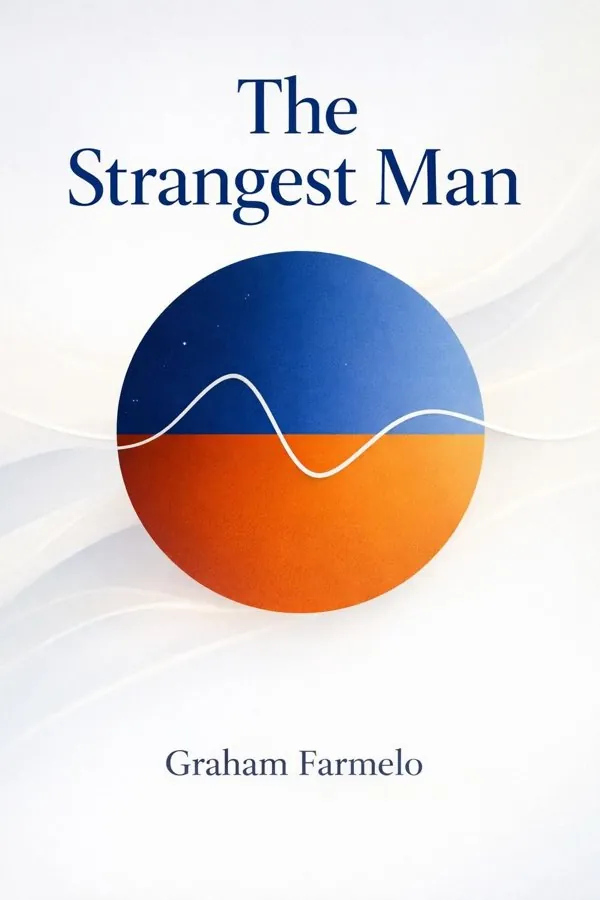
The Strangest Man: The Hidden Life of Paul Dirac, Mystic of the Atom: Summary & Key Insights
 10 min10 chaptersAudio available
Key Takeaways from The Strangest Man: The Hidden Life of Paul Dirac, Mystic of the Atom
Great scientific revolutions often begin in private emotional worlds, and Paul Dirac’s story is a striking example.
Breakthrough thinkers rarely emerge from a straight path, and Dirac’s early education shows why detours can be powerful.
Sometimes a place does not merely educate a person; it reveals who they were meant to become.
The most powerful ideas often begin by accepting that reality is stranger than common sense.
One of Dirac’s most radical beliefs was that beauty in equations is not decorative but revealing.
What Is The Strangest Man: The Hidden Life of Paul Dirac, Mystic of the Atom About?
The Strangest Man: The Hidden Life of Paul Dirac, Mystic of the Atom by Graham Farmelo is a biographies book spanning 10 pages. The Strangest Man is far more than a scientific biography. In Graham Farmelo’s hands, the life of Paul Dirac becomes a gripping story about genius, silence, beauty, and the strange ways great discoveries are made. Dirac helped build the foundations of quantum mechanics, predicted the existence of antimatter, and reshaped modern physics with a style of thought so pure and economical that even his peers found him astonishing. Yet he was also deeply private, emotionally distant, and famously difficult to know. That tension lies at the heart of this book. Farmelo shows how Dirac’s austere personality, traumatic family life, and uncompromising devotion to mathematical elegance all influenced his scientific breakthroughs. The result is both an intimate portrait and a history of one of the most revolutionary periods in science. Farmelo writes with unusual authority: trained in physics and celebrated as a historian of science, he translates difficult ideas into vivid narrative without losing precision. This makes the book valuable not only for science enthusiasts, but for anyone interested in creativity, character, and the hidden costs of brilliance.
This FizzRead summary covers all 10 key chapters of The Strangest Man: The Hidden Life of Paul Dirac, Mystic of the Atom in approximately 10 minutes, distilling the most important ideas, arguments, and takeaways from Graham Farmelo's work. Also available as an audio summary and Key Quotes Podcast.
The Strangest Man: The Hidden Life of Paul Dirac, Mystic of the Atom
The Strangest Man is far more than a scientific biography. In Graham Farmelo’s hands, the life of Paul Dirac becomes a gripping story about genius, silence, beauty, and the strange ways great discoveries are made. Dirac helped build the foundations of quantum mechanics, predicted the existence of antimatter, and reshaped modern physics with a style of thought so pure and economical that even his peers found him astonishing. Yet he was also deeply private, emotionally distant, and famously difficult to know. That tension lies at the heart of this book. Farmelo shows how Dirac’s austere personality, traumatic family life, and uncompromising devotion to mathematical elegance all influenced his scientific breakthroughs. The result is both an intimate portrait and a history of one of the most revolutionary periods in science. Farmelo writes with unusual authority: trained in physics and celebrated as a historian of science, he translates difficult ideas into vivid narrative without losing precision. This makes the book valuable not only for science enthusiasts, but for anyone interested in creativity, character, and the hidden costs of brilliance.
Who Should Read The Strangest Man: The Hidden Life of Paul Dirac, Mystic of the Atom?
This book is perfect for anyone interested in biographies and looking to gain actionable insights in a short read. Whether you're a student, professional, or lifelong learner, the key ideas from The Strangest Man: The Hidden Life of Paul Dirac, Mystic of the Atom by Graham Farmelo will help you think differently.
- ✓Readers who enjoy biographies and want practical takeaways
- ✓Professionals looking to apply new ideas to their work and life
- ✓Anyone who wants the core insights of The Strangest Man: The Hidden Life of Paul Dirac, Mystic of the Atom in just 10 minutes
Want the full summary?
Get instant access to this book summary and 100K+ more with Fizz Moment.
Get Free SummaryAvailable on App Store • Free to download
Key Chapters
Great scientific revolutions often begin in private emotional worlds, and Paul Dirac’s story is a striking example. Born in Bristol in 1902, Dirac grew up in a home dominated by his father Charles, a strict Swiss schoolmaster who imposed discipline with unusual severity. Family life was marked by tension, control, and emotional coldness. Charles insisted that Paul speak French at the dinner table, turning ordinary conversation into a test of performance rather than a source of warmth. Dirac’s mother, Florence, offered gentleness, but she could not counterbalance the atmosphere of constraint. The result was a boy who learned to hide his feelings, measure his words, and retreat into thought.
Farmelo does not reduce Dirac’s genius to childhood trauma, but he shows convincingly how early experience shaped the adult scientist. Dirac’s extreme reserve, his preference for exact statements, and his discomfort with emotional complexity all seem connected to his upbringing. Silence became both defense and discipline. What looked like strangeness to others was, in part, a survival strategy.
This matters because it reminds us that intellectual style is not separate from personal history. Dirac’s later obsession with precision and economy in physics mirrored habits formed long before he entered a laboratory or lecture hall. In modern life, we often separate achievement from biography, but Farmelo argues that the two are intertwined.
A practical lesson follows: pay attention to how your environment shapes the way you think. Constraints can wound, but they can also cultivate unusual strengths. The actionable takeaway is to examine one habit from your past—such as silence, caution, or perfectionism—and ask how it might be redirected into focused work rather than merely endured.
Breakthrough thinkers rarely emerge from a straight path, and Dirac’s early education shows why detours can be powerful. Before becoming one of the architects of quantum mechanics, he studied electrical engineering at the University of Bristol. At first glance, this may seem like a mismatch for a future theoretical physicist. Yet the training gave him something invaluable: a respect for structure, systems, and practical logic. Engineering taught him to think in terms of constraints, formal relationships, and elegant solutions—habits that later informed his theoretical work.
When job prospects proved limited, Dirac continued with mathematics, eventually moving toward the abstract frontiers of physics. This shift was crucial. He brought to mathematical physics an unusual combination of rigor and technical sobriety. He was not dazzled by speculation for its own sake. He wanted equations that worked, fit together cleanly, and expressed something fundamental. Farmelo presents this transition as one of the hidden keys to Dirac’s originality: he was abstract, but never careless.
For readers outside science, the broader lesson is that foundational skills from one domain can become transformative in another. A disciplined training in one field may provide exactly the mental tools needed to innovate elsewhere. In business, design, coding, or writing, people often underestimate the creative value of technical apprenticeship.
The practical application is simple: do not dismiss earlier training just because it does not match your current ambition. Ask what methods, habits, or standards from a previous field could sharpen your present work. The actionable takeaway is to identify one overlooked skill from your background and deliberately apply it to a problem in your current domain this week.
Sometimes a place does not merely educate a person; it reveals who they were meant to become. Dirac’s arrival at Cambridge, especially at St John’s College and within the orbit of the Cavendish Laboratory, placed him at the center of a scientific transformation. Physics in the 1920s was in crisis. Classical ideas could no longer explain atomic behavior, and young theorists were searching for a new language. Dirac entered this world with traits that were both limiting and liberating: social awkwardness, emotional remoteness, and near-superhuman concentration.
At Cambridge he found what had been missing from his earlier life: an intellectual environment where silence, intensity, and abstraction were assets rather than liabilities. He absorbed the emerging work of Niels Bohr, Werner Heisenberg, and others, but he did not merely imitate them. Farmelo shows how Dirac rapidly developed a style of his own—lean, formal, and almost ascetic. He was less interested in philosophical debate than in discovering the mathematical form that nature seemed to prefer.
Cambridge also brought him into contact with a generation of brilliant contemporaries. In such company, many minds shone brightly, but Dirac’s stood out for its peculiar purity. He was not the most charismatic, nor the most verbally expansive, but he often saw farther because he demanded more internal consistency from a theory than others did.
The wider lesson is that talent needs the right environment to fully emerge. A person who seems out of place in one setting may become exceptional in another. The actionable takeaway is to assess whether your current environment rewards your strongest mode of thinking. If it does not, seek a community, workplace, or discipline where your natural style is not merely tolerated but amplified.
The most powerful ideas often begin by accepting that reality is stranger than common sense. Dirac’s role in the creation of quantum mechanics was not simply that of a contributor; he was one of the thinkers who gave the field its deepest mathematical form. Building on Heisenberg’s matrix mechanics and Schrödinger’s wave mechanics, Dirac helped show that these seemingly different approaches were connected expressions of a new physical order. His work on transformation theory became one of the conceptual bridges that unified the field.
Farmelo explains that Dirac’s genius lay in abstraction without vagueness. He stripped problems to their essence and searched for the symbolic structure beneath the apparent confusion. This allowed him to formulate principles that outlasted specific interpretations. Quantum mechanics, in his hands, became not just a patchwork of results, but a coherent language for describing the atomic world.
This was more than technical achievement. It changed how science understands matter, energy, and certainty itself. Electrons no longer behaved like tiny billiard balls; they belonged to a probabilistic, mathematically encoded universe. Today, everything from semiconductors to lasers to modern computing rests on this conceptual revolution.
For non-specialists, Dirac’s work offers a practical model of problem-solving. When a system looks contradictory, the answer may not be choosing one side over another, but finding a framework that contains both. In organizations, this can mean reconciling speed and quality, creativity and discipline, or vision and execution.
The actionable takeaway is to identify one conflict you currently see as either-or and ask whether a deeper framework could integrate both sides. Often the next breakthrough begins there.
One of Dirac’s most radical beliefs was that beauty in equations is not decorative but revealing. He trusted mathematical elegance with unusual intensity, convinced that nature at its deepest level is expressed through forms of great simplicity and symmetry. This was not aesthetic snobbery. For Dirac, beauty meant internal coherence, economy, and inevitability—the feeling that an equation could scarcely be otherwise. Farmelo shows that this sensibility guided some of his most important scientific decisions.
This approach reached its peak in Dirac’s relativistic equation for the electron, which united quantum mechanics with Einstein’s special relativity. He was searching not merely for a working formula, but for one that possessed the right kind of mathematical grace. That equation not only described electron spin naturally, but also implied something extraordinary: the possible existence of particles identical to electrons but carrying opposite charge.
The idea sounded bizarre, yet it proved correct. The positron was soon discovered experimentally, confirming one of the most famous theoretical predictions in science. Dirac’s commitment to beauty had helped him see beyond known facts toward hidden structure.
The practical application is not that beauty always guarantees truth, but that elegance can be a useful test of depth. In writing, software, strategy, and design, clumsy solutions often signal unresolved confusion. Simplicity that preserves power is usually hard-won and meaningful.
The actionable takeaway is to review one complex solution you have created—a document, workflow, presentation, or process—and ask whether it can be made simpler without losing function. Pursuing elegance is not vanity; it is often a path to clarity.
Few moments in science are more thrilling than when a mathematical idea turns out to describe something real that no one has yet seen. Dirac’s prediction of antimatter is one of the clearest examples. While refining his equation for the electron, he encountered solutions that seemed physically awkward: they implied states with negative energy. Rather than dismissing the mathematics as nonsense, he took it seriously. This intellectual courage led him to propose that the equation pointed to an entirely new type of particle.
Eventually this became the idea of the positron, the electron’s positively charged counterpart. When Carl Anderson detected the positron experimentally in 1932, Dirac’s theory was spectacularly vindicated. What had begun as a mathematical puzzle became evidence that the universe contains mirror versions of matter. This discovery opened the way to particle physics as we know it and deepened the sense that theoretical physics could reveal realities long before instruments confirmed them.
Farmelo uses this episode to show Dirac at his best: patient, severe, and unwilling to compromise with untidy reasoning. He did not reach the result through rhetorical brilliance or experimental intuition, but through disciplined fidelity to formal structure.
In everyday work, the lesson is to respect anomalies instead of forcing them to fit old assumptions. Unexpected outputs, awkward data, or strange customer behavior can signal error—but sometimes they reveal a deeper truth.
The actionable takeaway is to revisit one puzzling inconsistency you have recently ignored. Instead of correcting it immediately, spend time asking what it might be trying to tell you. Innovation often begins where expectations fail.
History often remembers scientific revolutions as a parade of famous names, but Farmelo reveals how much they also depend on difficult human relationships. Dirac worked alongside and against some of the greatest minds of his era: Bohr, Heisenberg, Pauli, Schrödinger, Einstein, Oppenheimer, and Feynman. He commanded enormous respect, yet remained emotionally distant from nearly all of them. His interactions could be awkward, literal-minded, and sometimes unintentionally severe. Stories of his silences became legendary.
And yet this social remoteness had a paradoxical effect. It insulated him from intellectual fashion. Dirac was less likely than others to be swept away by personality, reputation, or institutional pressure. He listened to ideas through the filter of logic rather than charm. This made him both difficult and extraordinarily independent.
Farmelo also shows that these relationships mattered profoundly to the development of physics. Bohr’s philosophical depth challenged Dirac’s austerity. Heisenberg’s boldness helped create the atmosphere in which Dirac could operate. Pauli’s criticism sharpened standards. Einstein admired Dirac’s gifts, even while diverging from him on the interpretation of quantum theory. Science, in other words, advanced through a mix of solitude and exchange.
The practical lesson is that creative work requires both independent judgment and serious peers. Too much isolation leads to blindness; too much social conformity leads to imitation. Productive tension matters.
The actionable takeaway is to build a deliberate intellectual circle: seek at least one person who encourages your originality and one who challenges your weak reasoning. Growth comes not from comfort, but from well-chosen friction.
Genius does not erase the need for human connection, and one of the most revealing parts of Farmelo’s biography is the way Dirac’s personal life slowly changed over time. For years he seemed almost unreachable: formal, emotionally guarded, and baffling in conversation. Many people assumed he was simply incapable of intimacy. Yet his marriage to Margit Wigner, sister of physicist Eugene Wigner, brought a different dimension to his life. Margit was socially skilled, energetic, and emotionally perceptive—the opposite of Dirac in many respects.
Their marriage did not transform him into a warm extrovert, but it did create a more stable domestic world. Dirac became a stepfather and later a father, and those relationships drew him, however imperfectly, into forms of everyday life he had long kept at a distance. Farmelo treats this carefully: the point is not that marriage "fixed" Dirac, but that even an unusually reserved person can change through companionship.
This section of the book broadens the portrait beyond the stereotype of the isolated genius. Dirac remained strange, but he was not static. His later life suggests that character is durable without being immovable.
The practical application is encouraging. Many people assume their emotional style is permanent: the shy stay shy, the rigid stay rigid, the lonely stay alone. Dirac’s life suggests otherwise. Meaningful relationships may not rewrite personality, but they can expand it.
The actionable takeaway is to identify one relational habit—withdrawal, bluntness, overcontrol, avoidance—and practice a small counter-move. Change in private life begins not with dramatic reinvention, but with repeated acts of openness.
Not all great careers unfold as a steady climb. After his early triumphs, Dirac continued to work in physics for decades, but the later chapters of his life were more complicated. During World War II and after, physics became increasingly collective, institutional, and tied to military power. Dirac never fit comfortably into this new world. He contributed important work, especially in quantum electrodynamics and related areas, but he was less central than during the revolutionary 1920s and early 1930s.
Farmelo presents this not as decline in a simplistic sense, but as a revealing mismatch between a particular kind of mind and a changing scientific culture. Dirac preferred purity over politics, solitary thought over bureaucracy, and foundational questions over large-team problem solving. As physics moved toward big projects and more elaborate collaboration, his style became harder to place. He also remained willing to pursue unfashionable ideas if he found them mathematically compelling, even when others considered them marginal.
Later in life, he moved to Florida State University, where he continued to think, teach, and embody a standard of intellectual integrity that younger physicists still admired. He was no longer the revolutionary center of the field, but he remained a moral and conceptual reference point.
The practical lesson is that excellence is not always rewarded equally across different eras or institutions. A changing environment can alter how talent is recognized. The actionable takeaway is to distinguish between losing ability and losing fit. If your strengths are undervalued, consider whether the context has changed—and whether a new setting would better honor your way of working.
Some figures matter not only because of what they discovered, but because of the standard they set for thinking itself. Dirac’s legacy reaches far beyond a handful of equations. He helped create the framework of quantum mechanics, predicted antimatter, influenced quantum field theory, and inspired generations of physicists with his ruthless commitment to clarity. Yet Farmelo’s deeper claim is that Dirac endures because he embodied a rare intellectual ethic: say only what can be defended, prefer elegance to clutter, and trust that reality may be stranger than intuition allows.
His influence can be seen in modern particle physics, cosmology, and the culture of theoretical science. Even when later theories moved beyond his formulations, physicists continued to admire his style—a severe beauty of thought. At the same time, Farmelo avoids turning Dirac into a saint of reason. His limitations were real. He could be socially inaccessible, emotionally narrow, and resistant to ideas that lacked formal neatness. The power of the biography lies in holding both truths together.
For readers in any field, Dirac’s life poses a lasting question: what does it mean to pursue truth without compromise, and what might that cost? His example suggests that originality often requires indifference to convention, but also that brilliance does not exempt anyone from the need for human understanding.
The actionable takeaway is to define your own intellectual standard. Write down the two or three principles you want your work to embody—clarity, honesty, elegance, rigor, usefulness—and use them as a filter for major decisions. A life of substance is built around such commitments.
All Chapters in The Strangest Man: The Hidden Life of Paul Dirac, Mystic of the Atom
About the Author
Graham Farmelo is a British author, science communicator, and historian of physics known for writing accessible, deeply researched works about modern science. Trained in physics, he has combined technical knowledge with a gift for narrative, helping general readers engage with difficult scientific ideas without oversimplifying them. Farmelo has worked at the Science Museum in London and has been a fellow of Churchill College, University of Cambridge. His writing often focuses on the development of twentieth-century physics and the personalities who shaped it. In The Strangest Man, he brings together biography, intellectual history, and clear scientific explanation to portray Paul Dirac as both a towering thinker and a profoundly unusual human being. His work is widely respected for its rigor, readability, and insight.
Get This Summary in Your Preferred Format
Read or listen to the The Strangest Man: The Hidden Life of Paul Dirac, Mystic of the Atom summary by Graham Farmelo anytime, anywhere. FizzRead offers multiple formats so you can learn on your terms — all free.
Available formats: App · Audio · PDF · EPUB — All included free with FizzRead
Download The Strangest Man: The Hidden Life of Paul Dirac, Mystic of the Atom PDF and EPUB Summary
Key Quotes from The Strangest Man: The Hidden Life of Paul Dirac, Mystic of the Atom
“Great scientific revolutions often begin in private emotional worlds, and Paul Dirac’s story is a striking example.”
“Breakthrough thinkers rarely emerge from a straight path, and Dirac’s early education shows why detours can be powerful.”
“Sometimes a place does not merely educate a person; it reveals who they were meant to become.”
“The most powerful ideas often begin by accepting that reality is stranger than common sense.”
“One of Dirac’s most radical beliefs was that beauty in equations is not decorative but revealing.”
Frequently Asked Questions about The Strangest Man: The Hidden Life of Paul Dirac, Mystic of the Atom
The Strangest Man: The Hidden Life of Paul Dirac, Mystic of the Atom by Graham Farmelo is a biographies book that explores key ideas across 10 chapters. The Strangest Man is far more than a scientific biography. In Graham Farmelo’s hands, the life of Paul Dirac becomes a gripping story about genius, silence, beauty, and the strange ways great discoveries are made. Dirac helped build the foundations of quantum mechanics, predicted the existence of antimatter, and reshaped modern physics with a style of thought so pure and economical that even his peers found him astonishing. Yet he was also deeply private, emotionally distant, and famously difficult to know. That tension lies at the heart of this book. Farmelo shows how Dirac’s austere personality, traumatic family life, and uncompromising devotion to mathematical elegance all influenced his scientific breakthroughs. The result is both an intimate portrait and a history of one of the most revolutionary periods in science. Farmelo writes with unusual authority: trained in physics and celebrated as a historian of science, he translates difficult ideas into vivid narrative without losing precision. This makes the book valuable not only for science enthusiasts, but for anyone interested in creativity, character, and the hidden costs of brilliance.
You Might Also Like

An American Marriage
Tayari Jones
10 min
Benjamin Franklin: An American Life
Walter Isaacson
10 min
I Know Why The Caged Bird Sings
Maya Angelou
10 min
Long Walk to Freedom
Nelson Mandela
10 min
Persepolis
Marjane Satrapi
10 min
Surely You're Joking, Mr. Feynman!
Richard P. Feynman
10 minBrowse by Category
Ready to read The Strangest Man: The Hidden Life of Paul Dirac, Mystic of the Atom?
Get the full summary and 100K+ more books with Fizz Moment.