
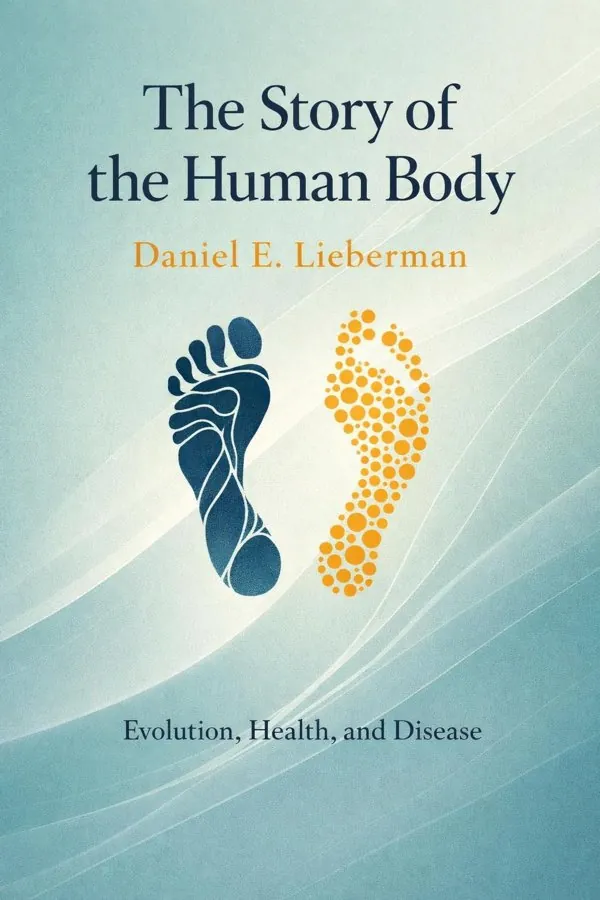
The Story of the Human Body: Evolution, Health, and Disease: Summary & Key Insights
 10 min11 chaptersAudio available
What Is The Story of the Human Body: Evolution, Health, and Disease About?
The Story of the Human Body: Evolution, Health, and Disease by Daniel E. Lieberman is a life_science book spanning 11 pages. In this groundbreaking work, evolutionary biologist Daniel E. Lieberman explores how the human body evolved over millions of years and how modern lifestyles have created a mismatch between our biology and environment. He explains how evolutionary adaptations that once ensured survival now contribute to chronic diseases such as obesity, diabetes, and heart disease, offering insights into how understanding our evolutionary past can help improve health today.
This FizzRead summary covers all 11 key chapters of The Story of the Human Body: Evolution, Health, and Disease in approximately 10 minutes, distilling the most important ideas, arguments, and takeaways from Daniel E. Lieberman's work. Also available as an audio summary and Key Quotes Podcast.
The Story of the Human Body: Evolution, Health, and Disease
In this groundbreaking work, evolutionary biologist Daniel E. Lieberman explores how the human body evolved over millions of years and how modern lifestyles have created a mismatch between our biology and environment. He explains how evolutionary adaptations that once ensured survival now contribute to chronic diseases such as obesity, diabetes, and heart disease, offering insights into how understanding our evolutionary past can help improve health today.
Who Should Read The Story of the Human Body: Evolution, Health, and Disease?
This book is perfect for anyone interested in life_science and looking to gain actionable insights in a short read. Whether you're a student, professional, or lifelong learner, the key ideas from The Story of the Human Body: Evolution, Health, and Disease by Daniel E. Lieberman will help you think differently.
- ✓Readers who enjoy life_science and want practical takeaways
- ✓Professionals looking to apply new ideas to their work and life
- ✓Anyone who wants the core insights of The Story of the Human Body: Evolution, Health, and Disease in just 10 minutes
Want the full summary?
Get instant access to this book summary and 100K+ more with Fizz Moment.
Get Free SummaryAvailable on App Store • Free to download
Key Chapters
Let us begin where the story truly starts: with our divergence from the other primates several million years ago. This ancient split was not a single event but a long evolutionary experiment, played out across Africa’s changing landscapes. Our distant ancestors lived among trees, foraging for fruit, moving on all fours. Yet as climates oscillated between wet and dry periods, these proto-humans ventured into open habitats. Natural selection began to favor traits that allowed survival on the ground—upright walking, greater endurance, and hands free to carry tools.
In tracing this period, scientists rely on fossils like *Australopithecus afarensis*, epitomized by the famous Lucy specimen, which demonstrate a transitional anatomy: hips and knees optimized for bipedal motion, but arms and shoulders still suited for climbing. Behavioral changes accompanied these anatomical ones. Cooperation, food sharing, and rudimentary tool use began to appear. These adaptations were not isolated; they formed a tight feedback loop in which social behaviors supported survival advantages and physical traits reinforced the social ones.
From my perspective as an evolutionary biologist, these early transformations reveal something profound: human evolution was never just about survival, it was about flexibility—our species’ unique ability to adapt through both biology and culture. That flexibility would later become our greatest asset, and occasionally, our greatest vulnerability.
Walking upright was the defining moment of our lineage. It reorganized the entire body, from the skull to the feet. The spine developed its characteristic S-curve to maintain balance; the pelvis shortened and broadened; and the foot became a marvel of engineering, with arches designed to absorb stress and store elastic energy. These changes brought immense benefits. Bipedalism allowed us to travel long distances efficiently, carry food and offspring, and keep cool under the savanna sun by reducing surface exposure.
What fascinates me most as a researcher is how bipedalism shaped our metabolism. The energy cost of walking on two legs is far lower than that of quadrupedal movement over long distances. This efficiency opened new ecological strategies: endurance hunting, migration, and exploration. Yet, it also introduced new vulnerabilities—back pain, knee arthritis, and flat feet—that arise when modern lifestyles diverge from the evolutionary context of constant movement.
Understanding this helps make sense of a great irony: we evolved to be active, yet we live sedentary lives. Our painful backs and tired knees are not signs of poor design but of mismatch—systems honed for endurance now trapped in chairs.
+ 9 more chapters — available in the FizzRead app
All Chapters in The Story of the Human Body: Evolution, Health, and Disease
About the Author
Daniel E. Lieberman is a professor of human evolutionary biology at Harvard University. His research focuses on the evolution of the human head, the biomechanics of running, and the evolutionary origins of physical activity. He is known for his contributions to the study of human evolution and health.
Get This Summary in Your Preferred Format
Read or listen to the The Story of the Human Body: Evolution, Health, and Disease summary by Daniel E. Lieberman anytime, anywhere. FizzRead offers multiple formats so you can learn on your terms — all free.
Available formats: App · Audio · PDF · EPUB — All included free with FizzRead
Download The Story of the Human Body: Evolution, Health, and Disease PDF and EPUB Summary
Key Quotes from The Story of the Human Body: Evolution, Health, and Disease
“Let us begin where the story truly starts: with our divergence from the other primates several million years ago.”
“Walking upright was the defining moment of our lineage.”
Frequently Asked Questions about The Story of the Human Body: Evolution, Health, and Disease
The Story of the Human Body: Evolution, Health, and Disease by Daniel E. Lieberman is a life_science book that explores key ideas across 11 chapters. In this groundbreaking work, evolutionary biologist Daniel E. Lieberman explores how the human body evolved over millions of years and how modern lifestyles have created a mismatch between our biology and environment. He explains how evolutionary adaptations that once ensured survival now contribute to chronic diseases such as obesity, diabetes, and heart disease, offering insights into how understanding our evolutionary past can help improve health today.
More by Daniel E. Lieberman
You Might Also Like
The Selfish Gene
Richard Dawkins
10 min
Awakenings
Oliver Sacks
10 min
Parasite Rex: Inside the Bizarre World of Nature's Most Dangerous Creatures
Carl Zimmer
10 min
The Atlas of Life on Earth
Various
10 min
The Book of Humans: The Story of How We Became Us
Adam Rutherford
10 min
The Horse
Wendy Williams
10 minBrowse by Category
Ready to read The Story of the Human Body: Evolution, Health, and Disease?
Get the full summary and 100K+ more books with Fizz Moment.