
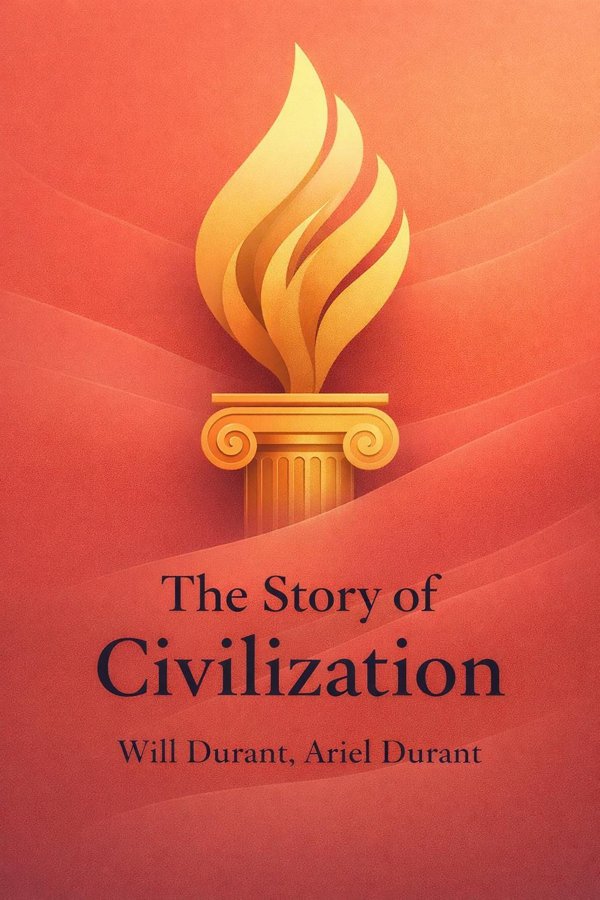
The Story of Civilization: Summary & Key Insights
 10 min9 chaptersAudio available
Key Takeaways from The Story of Civilization
Civilization begins when survival is no longer humanity’s only occupation.
A civilization rises higher when it learns to admire excellence in many forms.
Civilization matures when energy is converted into law.
History changes not only through armies and laws, but through new definitions of what a human being is worth.
Periods often dismissed as dark are frequently busy laying foundations.
What Is The Story of Civilization About?
The Story of Civilization by Will Durant, Ariel Durant is a civilization book spanning 11 pages. The Story of Civilization is one of the most ambitious historical works ever written: an eleven-volume journey through human history from the ancient Near East to the age of Napoleon. Written by Will and Ariel Durant, it does far more than recount wars, rulers, and dates. It explores how religion, philosophy, politics, science, economics, literature, and art combine to create what we call civilization. The Durants ask a deeper question than most historians: how do human beings, despite violence, ignorance, and instability, repeatedly build order, meaning, beauty, and culture? What makes this work enduring is its scale and its spirit. The Durants wrote with extraordinary scholarship, but also with warmth, clarity, and moral seriousness. They treat history not as a dry archive but as a living drama of ambition, belief, suffering, genius, and renewal. Their great achievement is showing that civilizations are fragile yet resilient, always shaped by the tension between power and ideals. For readers who want a sweeping, human-centered understanding of the past—and what it can teach us about the present—The Story of Civilization remains a landmark achievement.
This FizzRead summary covers all 9 key chapters of The Story of Civilization in approximately 10 minutes, distilling the most important ideas, arguments, and takeaways from Will Durant, Ariel Durant's work. Also available as an audio summary and Key Quotes Podcast.
The Story of Civilization
The Story of Civilization is one of the most ambitious historical works ever written: an eleven-volume journey through human history from the ancient Near East to the age of Napoleon. Written by Will and Ariel Durant, it does far more than recount wars, rulers, and dates. It explores how religion, philosophy, politics, science, economics, literature, and art combine to create what we call civilization. The Durants ask a deeper question than most historians: how do human beings, despite violence, ignorance, and instability, repeatedly build order, meaning, beauty, and culture?
What makes this work enduring is its scale and its spirit. The Durants wrote with extraordinary scholarship, but also with warmth, clarity, and moral seriousness. They treat history not as a dry archive but as a living drama of ambition, belief, suffering, genius, and renewal. Their great achievement is showing that civilizations are fragile yet resilient, always shaped by the tension between power and ideals. For readers who want a sweeping, human-centered understanding of the past—and what it can teach us about the present—The Story of Civilization remains a landmark achievement.
Who Should Read The Story of Civilization?
This book is perfect for anyone interested in civilization and looking to gain actionable insights in a short read. Whether you're a student, professional, or lifelong learner, the key ideas from The Story of Civilization by Will Durant, Ariel Durant will help you think differently.
- ✓Readers who enjoy civilization and want practical takeaways
- ✓Professionals looking to apply new ideas to their work and life
- ✓Anyone who wants the core insights of The Story of Civilization in just 10 minutes
Want the full summary?
Get instant access to this book summary and 100K+ more with Fizz Moment.
Get Free SummaryAvailable on App Store • Free to download
Key Chapters
Civilization begins when survival is no longer humanity’s only occupation. The Durants open their vast history in Mesopotamia, Egypt, and the ancient Near East because these regions reveal the first durable answers to chaos: agriculture, law, writing, priesthood, taxation, architecture, and organized government. In the valleys of the Tigris, Euphrates, and Nile, human communities learned to store grain, divide labor, regulate trade, and coordinate large populations. What emerged was not simply wealth or power, but memory. Writing allowed societies to record debts, laws, myths, prayers, and achievements, making knowledge cumulative instead of fragile.
The Durants emphasize that early civilization was never purely rational or purely material. Temples stood beside markets; kings relied on priests; law borrowed authority from religion. In Egypt, stability and hierarchy produced astonishing continuity. In Mesopotamia, competition among city-states stimulated innovation. In both worlds, order rested on institutions strong enough to survive individual lives.
This insight still matters. Modern societies also depend on invisible systems: infrastructure, trusted records, shared norms, and institutions people believe in. A city collapses not only when food or money runs out, but when cooperation fails. Consider how banks, schools, courts, and digital networks play a role today similar to granaries, scribes, and temples in the ancient world.
The practical lesson is simple: civilization is built less by isolated genius than by stable systems that allow ordinary life to function. If you want to understand any society—ancient or modern—look first at how it feeds people, stores knowledge, enforces rules, and creates shared meaning. Actionable takeaway: study the institutions behind prosperity, because durable progress always starts with organized cooperation.
A civilization rises higher when it learns to admire excellence in many forms. For the Durants, Greece represents one of history’s most luminous moments because it transformed human aspiration into philosophy, drama, politics, science, and art. The Greeks did not invent thought, beauty, or government, but they gave these pursuits a self-conscious intensity. In Athens especially, argument became a civic act. Citizens debated justice, poets explored tragedy, sculptors sought ideal form, and philosophers asked what it means to live well.
The greatness of Greece lay not in perfection but in creative restlessness. Socrates questioned accepted wisdom. Plato imagined a realm of ideals beyond political corruption. Aristotle brought disciplined observation to ethics, biology, logic, and politics. The Greek city-state fostered participation and pride, but also rivalry, exclusion, and instability. The Durants admire Greece because it embodied the idea that civilization flourishes when minds are free enough to inquire and ambitious enough to refine human capacities.
That Greek legacy remains practical today. A healthy workplace, school, or democracy depends on the willingness to debate ideas without destroying social cohesion. Excellence in any field grows where standards exist, where criticism is allowed, and where beauty and truth are treated as public goods rather than private luxuries. Think of modern research institutions, constitutional debate, or even design culture: all are indebted to the Greek conviction that human life can be consciously improved.
The Greek story also warns us that brilliance alone cannot sustain a civilization. Culture must be matched by discipline and political resilience. Actionable takeaway: cultivate excellence through inquiry, dialogue, and standards, but remember that freedom survives only when joined to responsibility.
Civilization matures when energy is converted into law. If Greece symbolizes the flowering of mind and form, Rome represents the organization of power on an unprecedented scale. The Durants portray Rome not merely as a military empire but as a master builder of institutions: roads, legal systems, citizenship, administration, engineering, and imperial governance. Rome’s genius was practical. It absorbed, standardized, and extended. It turned conquest into structure.
Roman civilization endured because it created rules that could outlive rulers. Law became one of its greatest achievements, offering a framework for property, contracts, family, and public order. Roman engineering connected distant lands, making trade and military response faster and more reliable. Even its empire, harsh as it often was, established conditions for exchange and relative peace across vast territories.
Yet the Durants are equally attentive to decline. Rome was weakened by corruption, inequality, overexpansion, militarization, demographic pressures, and the erosion of civic virtue. Wealth concentrated. Citizenship lost some of its moral weight. Political life became more theatrical and more violent. The lesson is not that empires simply fall from external attack, but that institutions decay when they stop serving the common good.
Modern parallels are obvious. Large organizations, nations, and companies can appear invincible while their culture quietly deteriorates. When bureaucracy becomes self-serving, when public trust fades, when elites detach from ordinary people, decline begins long before collapse is visible.
Rome teaches that strength is not only about winning, but about administering fairly and renewing legitimacy. Actionable takeaway: wherever you lead or participate, strengthen systems that promote trust, accountability, and long-term thinking, because durable power depends more on institutional integrity than raw force.
History changes not only through armies and laws, but through new definitions of what a human being is worth. The Durants treat the rise of Christianity as one of civilization’s great turning points because it redirected moral attention toward the poor, the suffering, the meek, and the soul. Emerging within the Roman world, Christianity offered not merely theology but a new emotional and ethical framework. It gave meaning to sacrifice, transformed suffering into a path of redemption, and built communities rooted in shared belief rather than blood or citizenship alone.
The church became both spiritual refuge and institutional power. Monasticism preserved learning, disciplined desire, and created centers of charity and scholarship. Bishops and theologians helped shape doctrine, law, and social order. Christianity gave Europe a common moral vocabulary, but it also generated conflict: struggles over authority, persecution of dissent, and tension between faith and reason. The Durants refuse simplification. They show Christianity as both a civilizing force and a source of dogmatic rigidity.
The enduring insight is that civilizations need moral narratives powerful enough to restrain selfishness and bind strangers together. Even secular societies rely on inherited ideas of dignity, compassion, and conscience. Hospitals, philanthropy, human rights language, and social reform often draw, directly or indirectly, from this moral tradition.
For modern readers, the Christian transformation raises a practical question: what beliefs in your own world create solidarity and moral seriousness? Efficiency alone cannot sustain a society. People need purpose, shared ethics, and rituals of belonging.
Actionable takeaway: identify the values that shape your decisions and communities, and strengthen those that enlarge compassion without surrendering intellectual honesty.
Periods often dismissed as dark are frequently busy laying foundations. The Durants treat the Middle Ages not as a mere pause between classical glory and Renaissance brilliance, but as a long era of adaptation, preservation, and gradual construction. After Rome’s fragmentation, Europe had to rebuild order under difficult conditions. Feudalism, local loyalties, monastic communities, guilds, and the medieval church together formed a social fabric capable of surviving insecurity.
This was an age of faith, hierarchy, and limited mobility, but also one of serious achievement. Monasteries copied manuscripts, cultivated land, and preserved intellectual traditions. Universities emerged, creating institutional homes for disciplined learning. Cathedrals united theology, engineering, civic identity, and artistic ambition. Scholastic thinkers attempted something profound: to reconcile inherited faith with reasoned analysis. The medieval world was constrained, but it was not empty.
The Durants’ broader point is that civilization rarely advances in a straight line. What looks stagnant from one angle may be quietly productive from another. Medieval institutions prepared Europe for later commercial expansion, urban growth, legal refinement, and intellectual awakening.
This insight applies far beyond history. In personal life or organizational life, some phases are not glamorous but necessary. Training, maintenance, preservation, and habit-building may feel less exciting than innovation, yet they make renewal possible. A company’s documentation, a family’s rituals, or a school’s traditions can seem ordinary until crisis reveals their value.
The Middle Ages remind us that continuity is itself an achievement. Actionable takeaway: do not underestimate the importance of preserving knowledge, building durable habits, and maintaining communities during uncertain times, because renewal usually depends on what patient people protected earlier.
Civilization renews itself when it rediscovers what human beings are capable of becoming. The Durants present the Renaissance as far more than a revival of classical texts. It was a reawakening of confidence in human talent, perception, individuality, and worldly achievement. In the cities of Italy especially, commerce, patronage, urban rivalry, and recovered learning combined to produce extraordinary creative energy. Artists, scholars, architects, and statesmen began to see the human person not only as a sinner seeking salvation, but as a maker, thinker, and creator.
Leonardo embodied curiosity without boundaries. Michelangelo turned stone into moral drama. Machiavelli examined politics as it is rather than as it ought to be. Humanists returned to Greek and Roman sources not out of nostalgia alone, but to refine language, ethics, education, and civic life. The Renaissance broadened the imagination of what education and culture could accomplish.
The Durants also note the complexity beneath the splendor. Renaissance courts could be ruthless; patronage often depended on inequality and power. Yet this does not diminish its significance. The era demonstrated that material prosperity can be converted into artistic and intellectual achievement when societies choose to value excellence.
Modern readers can apply this lesson directly. Creativity rarely flourishes in a vacuum. It needs funding, mentorship, institutions, and ambitious standards. Whether in science, design, writing, or business, breakthroughs often occur where people combine technical skill with wide cultural curiosity.
The Renaissance asks us to resist narrowness. Actionable takeaway: invest in broad learning, support the arts and ideas, and cultivate environments where talent can stretch beyond utility toward mastery and beauty.
When institutions stop listening, reform arrives with disruption. The Durants describe the Reformation and Counter-Reformation as a seismic struggle over authority, salvation, scripture, and the structure of Christian life. Martin Luther’s challenge to ecclesiastical power was not merely theological; it exposed accumulated resentment against corruption, hierarchy, and mediation. Soon reform spread through multiple channels: Calvin’s disciplined communities, radical sects, political rulers seeking autonomy, and ordinary believers newly empowered by print and vernacular scripture.
The result was not simple liberation. Europe entered generations of conflict, persecution, polarization, and war. Yet the Reformation permanently altered the relationship between the individual and authority. Conscience gained new force. Religious uniformity weakened. Literacy expanded as people read sacred texts for themselves. States and churches had to redefine their boundaries.
The Counter-Reformation showed that institutions can respond to crisis with renewal as well as repression. Through reforming councils, new religious orders, educational initiatives, and artistic patronage, Catholicism revitalized itself and regained intellectual and spiritual vigor. The Durants are careful to show that both sides contained courage, excess, devotion, and violence.
The practical importance of this era is enormous. Any system—religious, political, educational, corporate—must eventually face criticism from within. Suppressing reform may delay change, but often makes the eventual rupture more severe. At the same time, revolt without structure can produce chaos.
For modern life, the balance is clear: honor conscience, but pair conviction with discipline, study, and institutional reform. Actionable takeaway: when you encounter failing systems, seek principled change early, because honest self-correction is less destructive than delayed upheaval.
A civilization becomes self-aware when it begins to examine its own beliefs as if they were hypotheses. For the Durants, the Enlightenment was a defining moment because reason was elevated into a tool for social reform, scientific advance, and criticism of inherited authority. Thinkers such as Voltaire, Montesquieu, Diderot, Rousseau, and many others challenged superstition, censorship, arbitrary power, and legal inequality. They believed that knowledge could be organized, institutions could be redesigned, and public life could be made more humane.
This confidence in reason did not emerge in isolation. It drew strength from scientific discoveries, global exploration, rising literacy, salons, printing, and the growth of commercial society. The Encyclopedists tried to gather and systematize knowledge itself, reflecting the era’s belief that understanding should be accessible and useful. The Durants admire the Enlightenment’s courage while also recognizing its limits. Reason can expose error, but it does not automatically erase selfishness, passion, or tribal loyalty.
The Enlightenment remains intensely relevant. Much of modern liberal society—constitutionalism, free inquiry, religious tolerance, evidence-based thinking, education reform, and skepticism toward concentrated power—owes a debt to this period. In everyday life, its spirit appears whenever we test assumptions, compare evidence, revise policies, or ask whether traditions still serve human flourishing.
But the Durants also suggest a warning: reason detached from moral depth or historical humility can become arrogant. Data does not replace wisdom.
Actionable takeaway: practice disciplined skepticism and evidence-based thinking, but anchor reason in empathy, ethical reflection, and respect for the complexity of human nature.
When reform is delayed too long, history accelerates violently. The Durants culminate their narrative with the age of revolution and Napoleon, showing how the ideas of liberty, equality, rights, and popular sovereignty burst from philosophy into mass politics. The French Revolution exposed the fragility of old regimes built on privilege and inertia. It also revealed how quickly noble ideals can be overtaken by fear, faction, and coercion.
The Revolution was at once emancipatory and destructive. Feudal structures were challenged, citizenship broadened, and political legitimacy redefined. Yet terror, instability, and war followed. Into this turbulence stepped Napoleon, a figure the Durants treat with fascination and ambivalence. He was both child and conqueror of the Revolution: a military genius who preserved some of its reforms while centralizing power around himself. Through legal codification, administrative restructuring, and battlefield domination, he spread modernizing forces across Europe even as he pursued imperial ambition.
The larger lesson is that historical progress is rarely clean. Transformative change often mixes principle with opportunism, justice with violence, liberation with control. This pattern continues in modern revolutions, institutional overhauls, and political movements. Change can solve long-standing problems while creating new ones if passion outruns prudence.
For readers today, the age of revolution urges a sober realism. Political enthusiasm must be matched by institutional design, leadership character, and respect for human unpredictability. Bold visions matter, but execution determines whether renewal becomes reform or chaos.
Actionable takeaway: whenever you support major change, ask not only what should be overthrown, but what stable and humane order will replace it.
All Chapters in The Story of Civilization
About the Authors
Will Durant (1885-1981) was an American historian, philosopher, and master popularizer of ideas who became famous for making complex intellectual history accessible to general readers. His early success with The Story of Philosophy established his reputation as a brilliant synthesizer of knowledge. Ariel Durant (1898-1981), his wife and close intellectual partner, played a vital role in the research, writing, and shaping of their joint works. Together, they spent decades creating The Story of Civilization, an extraordinary multi-volume history that combined scholarship, narrative elegance, and philosophical reflection. Their collaboration produced one of the most widely read historical series of the twentieth century. The Durants were awarded the Pulitzer Prize and the Presidential Medal of Freedom, and they remain celebrated for their humanistic vision of history and culture.
Get This Summary in Your Preferred Format
Read or listen to the The Story of Civilization summary by Will Durant, Ariel Durant anytime, anywhere. FizzRead offers multiple formats so you can learn on your terms — all free.
Available formats: App · Audio · PDF · EPUB — All included free with FizzRead
Download The Story of Civilization PDF and EPUB Summary
Key Quotes from The Story of Civilization
“Civilization begins when survival is no longer humanity’s only occupation.”
“A civilization rises higher when it learns to admire excellence in many forms.”
“Civilization matures when energy is converted into law.”
“History changes not only through armies and laws, but through new definitions of what a human being is worth.”
“Periods often dismissed as dark are frequently busy laying foundations.”
Frequently Asked Questions about The Story of Civilization
The Story of Civilization by Will Durant, Ariel Durant is a civilization book that explores key ideas across 9 chapters. The Story of Civilization is one of the most ambitious historical works ever written: an eleven-volume journey through human history from the ancient Near East to the age of Napoleon. Written by Will and Ariel Durant, it does far more than recount wars, rulers, and dates. It explores how religion, philosophy, politics, science, economics, literature, and art combine to create what we call civilization. The Durants ask a deeper question than most historians: how do human beings, despite violence, ignorance, and instability, repeatedly build order, meaning, beauty, and culture? What makes this work enduring is its scale and its spirit. The Durants wrote with extraordinary scholarship, but also with warmth, clarity, and moral seriousness. They treat history not as a dry archive but as a living drama of ambition, belief, suffering, genius, and renewal. Their great achievement is showing that civilizations are fragile yet resilient, always shaped by the tension between power and ideals. For readers who want a sweeping, human-centered understanding of the past—and what it can teach us about the present—The Story of Civilization remains a landmark achievement.
You Might Also Like
The Structure of Scientific Revolutions
Thomas S. Kuhn
10 min
Genius
Harold Bloom
10 min
A Cultural History of the Medieval Age
Various Editors
10 min
A History of God: The 4,000-Year Quest of Judaism, Christianity and Islam
Karen Armstrong
10 min
A History of the World in 10½ Chapters
Julian Barnes
10 min
A Short History of Progress
Ronald Wright
10 minBrowse by Category
Ready to read The Story of Civilization?
Get the full summary and 100K+ more books with Fizz Moment.