
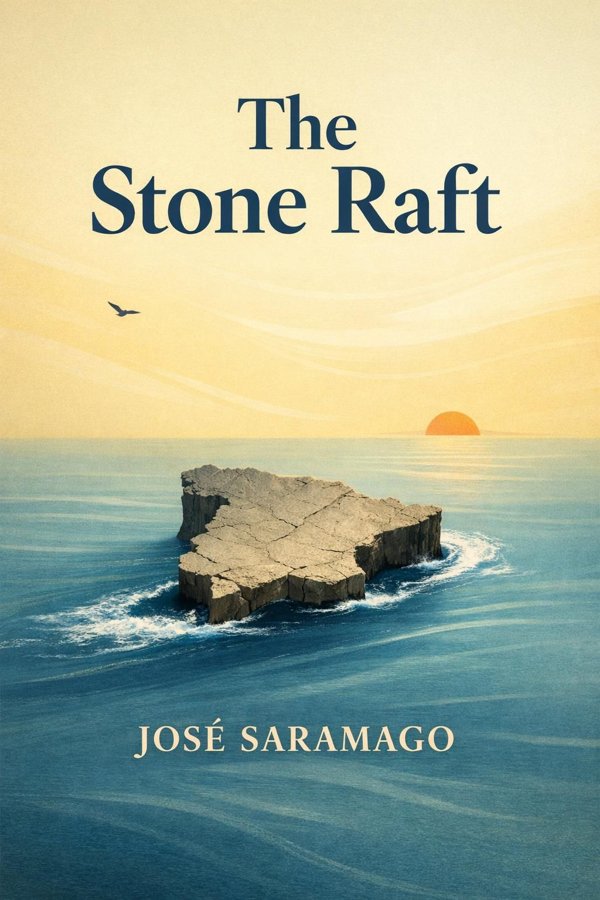
The Stone Raft: Summary & Key Insights
 10 min9 chaptersAudio available
Key Takeaways from The Stone Raft
Sometimes the best way to reveal the fragility of reality is to alter a single fact and watch everything else tremble.
A strange world often announces itself through small, inexplicable signs before it reveals its full meaning.
Movement changes people not only because it alters their location, but because it loosens the identities tied to fixed places.
The most honest stories about destiny do not provide certainty; they show how meaning remains unfinished even when events feel fated.
We tend to speak of nations as if they were eternal, but Saramago reminds us that every border is a story made solid by repetition.
What Is The Stone Raft About?
The Stone Raft by José Saramago is a classics book spanning 4 pages. What if a continent could simply decide to leave? In The Stone Raft, José Saramago begins with an impossible event and treats it with unnerving seriousness: the Iberian Peninsula breaks away from Europe and drifts into the Atlantic like an enormous raft of stone. From that startling premise, the novel becomes far more than a geopolitical fantasy. It is a searching meditation on identity, borders, community, and the mysterious forces that bind people to one another. As Portugal and Spain literally detach from the rest of Europe, five ordinary individuals—each marked by strange, symbolic signs—are drawn together on a journey that feels at once accidental and fated. Their travels across a moving landscape transform the novel into a study of companionship, uncertainty, and shared destiny. Saramago, one of the most important European novelists of the twentieth century and winner of the 1998 Nobel Prize in Literature, is known for blending allegory, irony, and philosophical depth. In The Stone Raft, he uses a fantastical rupture to ask enduring questions: Who are we when the ground beneath us shifts? What remains when familiar political and cultural maps stop making sense?
This FizzRead summary covers all 9 key chapters of The Stone Raft in approximately 10 minutes, distilling the most important ideas, arguments, and takeaways from José Saramago's work. Also available as an audio summary and Key Quotes Podcast.
The Stone Raft
What if a continent could simply decide to leave? In The Stone Raft, José Saramago begins with an impossible event and treats it with unnerving seriousness: the Iberian Peninsula breaks away from Europe and drifts into the Atlantic like an enormous raft of stone. From that startling premise, the novel becomes far more than a geopolitical fantasy. It is a searching meditation on identity, borders, community, and the mysterious forces that bind people to one another. As Portugal and Spain literally detach from the rest of Europe, five ordinary individuals—each marked by strange, symbolic signs—are drawn together on a journey that feels at once accidental and fated. Their travels across a moving landscape transform the novel into a study of companionship, uncertainty, and shared destiny. Saramago, one of the most important European novelists of the twentieth century and winner of the 1998 Nobel Prize in Literature, is known for blending allegory, irony, and philosophical depth. In The Stone Raft, he uses a fantastical rupture to ask enduring questions: Who are we when the ground beneath us shifts? What remains when familiar political and cultural maps stop making sense?
Who Should Read The Stone Raft?
This book is perfect for anyone interested in classics and looking to gain actionable insights in a short read. Whether you're a student, professional, or lifelong learner, the key ideas from The Stone Raft by José Saramago will help you think differently.
- ✓Readers who enjoy classics and want practical takeaways
- ✓Professionals looking to apply new ideas to their work and life
- ✓Anyone who wants the core insights of The Stone Raft in just 10 minutes
Want the full summary?
Get instant access to this book summary and 100K+ more with Fizz Moment.
Get Free SummaryAvailable on App Store • Free to download
Key Chapters
Sometimes the best way to reveal the fragility of reality is to alter a single fact and watch everything else tremble. That is the brilliant opening move of The Stone Raft. Without warning, the Iberian Peninsula separates from the rest of Europe along the Pyrenees and begins to drift into the Atlantic. Saramago presents this impossible event not as spectacle alone, but as a test of how societies react when the ground of certainty disappears. Governments panic, experts issue theories, the media interprets every tremor, and ordinary citizens struggle to understand what this rupture means for daily life. The event is geological in form but existential in meaning.
What matters is not whether such a separation could happen scientifically. What matters is what the break exposes. Borders that once seemed permanent are shown to be temporary arrangements. Political identities that felt stable are suddenly open to revision. Europe, Iberia, nationality, alliance, and belonging all become negotiable once the land itself moves. Saramago turns geography into metaphor: when a nation shifts physically, it also shifts psychologically.
In practical terms, the novel mirrors moments in real life when institutions we trust cease to feel reliable—economic crises, political fractures, migrations, or personal upheavals like divorce or displacement. When the familiar order cracks, people search for explanations, scapegoats, or new sources of solidarity. Saramago reminds us that uncertainty is not merely a condition to endure; it can also become a chance to rethink inherited assumptions.
Actionable takeaway: When your own “map” changes—whether socially, professionally, or personally—pause before rushing to restore the old order, and ask what new identity or possibility the rupture makes visible.
A strange world often announces itself through small, inexplicable signs before it reveals its full meaning. In The Stone Raft, five individuals become linked to the peninsula’s separation through uncanny events that seem trivial at first but gradually acquire symbolic force. Joana Carda scratches the ground with an elm branch and triggers a crack in the earth. José Anaiço finds himself followed by a cloud of starlings. Pedro Orce, an aging pharmacist, senses the ground trembling beneath his feet when others feel nothing. Joaquim Sassa hurls an impossibly heavy stone into the sea. Maria Guavaira begins unravelling an endless thread from an old wool sock. Alongside them travels a dog, Constant, whose loyalty and instinctive presence deepen the novel’s sense of mystery and companionship.
These signs do not function like neat clues in a detective story. Saramago never fully explains them, and that is precisely the point. Human lives are often shaped by events we recognize only after the fact as meaningful. The characters are not heroes because they understand their calling; they become significant because they respond to something they cannot fully explain. The signs push them out of ordinary routines and into relationship.
This idea has practical resonance. In real life, major turning points rarely arrive with certainty or clear instructions. They appear as recurring patterns, unshakable intuitions, unusual encounters, or small disturbances in habit. We may not know what they mean, but ignoring them can keep us trapped in narratives that no longer fit.
Saramago invites us to treat mystery not as a problem to eliminate but as a condition of being alive. The companions are united less by answers than by openness to the unknown.
Actionable takeaway: Pay attention to recurring signs in your own life—persistent questions, chance meetings, instincts, or disruptions—and consider whether they are inviting you toward a meaningful change.
Movement changes people not only because it alters their location, but because it loosens the identities tied to fixed places. Once the peninsula is adrift, The Stone Raft becomes a road novel of unusual scope. The five companions travel together across Portugal and Spain, moving through a landscape that is itself moving. Their journey unfolds against social confusion, political anxiety, and a collective reimagining of what Iberia might become now that it is no longer attached to Europe.
The travel itself matters as much as the destination. Saramago is less interested in plot mechanics than in what shared movement does to strangers. The group begins as a cluster of solitary people drawn together by bizarre circumstances. Over time, the road turns them into a temporary family. They learn one another’s habits, insecurities, strengths, and emotional rhythms. Romance, irritation, tenderness, humor, and mutual dependence emerge naturally. The drifting peninsula becomes a stage on which human connection is tested and deepened.
The journey also reframes the land. Places previously understood through national borders become part of a larger, fluid space. The characters are no longer simply Portuguese or Spanish individuals crossing familiar terrain. They are inhabitants of a new condition, trying to inhabit uncertainty without surrendering to fear.
In everyday life, journeys—literal or metaphorical—often create similar transformations. A new job, a relocation, a season of caregiving, or a collaborative project can reveal that identity is less fixed than we imagined. Shared motion creates solidarity because it strips away some of the illusion of self-sufficiency.
Saramago suggests that we often discover who we are not in stability but in transit, not alone but in company.
Actionable takeaway: If you are in a period of transition, focus less on controlling the final destination and more on building trust, patience, and attentiveness with the people traveling alongside you.
The most honest stories about destiny do not provide certainty; they show how meaning remains unfinished even when events feel fated. In The Stone Raft, the companions’ strange signs and converging paths suggest a larger design, yet Saramago refuses to offer a final, tidy explanation. The drifting peninsula changes course, public speculation multiplies, and personal relationships evolve, but the novel never collapses mystery into doctrine. Instead, it leaves readers with a fertile tension between destiny and freedom, pattern and improvisation.
This openness is central to the book’s power. The characters seem chosen, but not in a way that removes agency. They must still decide how to relate to one another, how to interpret what is happening, and how to live inside uncertainty. Renewal, then, does not come from solving the mystery. It comes from accepting that life’s largest transformations often resist total interpretation. Meaning is not handed down complete; it is lived into gradually.
That idea can be practical and liberating. Many people delay action until they feel they understand everything—why a relationship ended, why a career path no longer fits, why a social order has become unstable. Saramago suggests that waiting for perfect clarity can become another form of paralysis. Renewal often begins when we act responsibly within ambiguity.
The novel’s unfinished quality also mirrors history itself. Nations, communities, and identities are never once-and-for-all complete. They are always being revised by events, migrations, desires, and crises. Iberia’s drifting becomes a symbol of the open-endedness of collective life.
Actionable takeaway: Do not treat uncertainty as proof that you must stand still; instead, make the best humane and thoughtful choices you can while allowing larger meaning to unfold over time.
We tend to speak of nations as if they were eternal, but Saramago reminds us that every border is a story made solid by repetition. The Stone Raft takes the political map of Europe and turns it into something unstable, forcing readers to reconsider what national identity really means. If Portugal and Spain can physically detach from Europe, then their relationship to Europe was never merely geographic. It was historical, cultural, economic, and ideological. By breaking the land away, Saramago exposes how identities are constructed through narratives of belonging and exclusion.
The novel is especially rich in its treatment of Iberian identity. Portugal and Spain are not merged into sameness, yet their shared drift encourages a broader imagination of solidarity across internal differences. This is not a simplistic celebration of unity. Tensions remain. But the floating peninsula invites the possibility that peripheral peoples can understand themselves outside the frameworks imposed by dominant centers.
Readers can connect this theme to current questions about regional alliances, nationalism, migration, and cultural hybridity. In a globalized world, many people live between identities rather than inside one stable category. Saramago does not argue that roots do not matter. Rather, he shows that roots themselves are dynamic. Belonging can be revised without being erased.
On a personal level, the same insight applies to family identity, professional identity, or social role. We often inherit labels that shape us deeply, but moments of rupture can reveal that those labels are not destiny. Reinvented identity need not mean betrayal; it can mean maturation.
Actionable takeaway: Examine one identity label you rely on—national, professional, familial, or ideological—and ask whether it still describes your deepest loyalties or whether it needs to be reimagined.
History is often narrated through leaders, institutions, and official decisions, yet upheaval is mostly lived by ordinary people improvising through confusion. One of the quiet achievements of The Stone Raft is its refusal to center traditional heroes. The five companions are not generals, presidents, or renowned intellectuals. They are everyday individuals whose strange experiences push them into a world-changing event. Saramago suggests that when reality shifts dramatically, the moral substance of the moment is often found in how ordinary people respond.
Each character carries vulnerabilities, habits, and limitations. They are not idealized symbols. Their significance comes from their willingness to continue, observe, care, and adapt. In this way, the novel resists the fantasy that only exceptional people matter during exceptional times. It shows instead that endurance, companionship, and responsiveness are forms of courage.
This idea applies strongly to modern crises. During pandemics, economic downturns, displacement, or political instability, social life is sustained not only by policy but by teachers, neighbors, caregivers, pharmacists, drivers, and strangers who act decently under pressure. Saramago grants this ordinary decency narrative importance.
The drifting peninsula may be fantastic, but the emotional logic is realistic. Most people do not choose the age they live in. They inherit conditions they did not create and must still decide whether to become cynical, passive, or generous. The companions demonstrate that significance can emerge from participation rather than status.
By focusing on ordinary figures, Saramago democratizes meaning. The extraordinary does not descend only upon the powerful; it reorganizes the lives of everyone.
Actionable takeaway: In times of disruption, do not underestimate the impact of steady, humane actions—showing up, helping others, staying curious, and building small structures of trust where you can.
A novel can be politically serious without becoming heavy-handed, and Saramago achieves this through irony. The Stone Raft contains a clear political imagination, but it does not lecture. Instead, it exposes institutional absurdity by showing how authorities, experts, media systems, and public discourse respond to the impossible. Bureaucratic language strains to contain the event. Political actors seek control over narratives they barely understand. Official explanations proliferate even as certainty disappears.
This satirical edge gives the novel much of its energy. Saramago recognizes that modern systems often confuse naming with understanding. Once an event is categorized, measured, televised, or debated, institutions behave as though they have mastered it. But the drifting peninsula exceeds every framework placed upon it. Satire here is not decorative humor; it is a method of revealing the limits of technocratic confidence and political self-importance.
Readers can easily connect this to contemporary life. In many crises, public conversation becomes cluttered with premature certainty, opportunistic commentary, and symbolic posturing. Saramago’s irony teaches readers to remain alert to how language can obscure reality as much as clarify it. It also encourages skepticism without despair. Institutions may falter, but human intelligence can still survive through observation, humility, and wit.
Politically, the novel imagines the possibility that peripheral regions might rethink their relationship to dominant centers. That vision is not presented as a manifesto, but as a provocative invitation to reconsider who gets to define cultural and political importance.
Actionable takeaway: When public explanations seem too quick or too confident, practice critical reading—notice who benefits from a given narrative, what remains unexplained, and where lived reality exceeds official language.
Sometimes a novel reveals its deepest ethics through how it treats a nonhuman creature. In The Stone Raft, the dog Constant is more than a charming companion. His presence brings tenderness, instinct, and groundedness to a story full of symbolism and political upheaval. Animals in literature often serve as mirrors of human behavior, and Constant does this subtly: he embodies loyalty without ideology, attentiveness without abstraction, and companionship without rhetorical complexity.
In a novel concerned with ruptured borders and uncertain destinies, the dog provides a different measure of reality. He responds not to theories or national identities but to presence, movement, danger, trust, and affection. This matters because Saramago’s world is saturated with interpretation. Everyone wants to explain the drifting peninsula, decode the signs, or map political consequences. Constant reminds readers that life is also made of simpler truths: who stays close, who can be trusted, where warmth and danger are found, and how bodies share space.
This is not sentimental. Rather, it sharpens the novel’s moral focus. The treatment of vulnerable beings—animals included—often reveals more about a community than its grand principles do. In times of upheaval, the human measure is found in concrete care, not lofty declarations.
Practically, this theme invites reflection on how we stay anchored when events become overwhelming. Attention to the immediate, embodied world—walking, caring for pets, preparing food, noticing weather, tending to another creature—can protect us from being swallowed by abstraction.
Actionable takeaway: When large uncertainties make life feel unreal, return to concrete acts of care for living beings around you; such acts can restore perspective, responsibility, and emotional steadiness.
All Chapters in The Stone Raft
About the Author
José Saramago (1922–2010) was a Portuguese novelist, essayist, and public intellectual whose work reshaped modern European literature. Born into a poor rural family in Azinhaga, Portugal, he worked in a range of jobs before becoming internationally recognized as a writer. Saramago developed a distinctive prose style marked by long, flowing sentences, minimal punctuation, irony, and philosophical depth. His novels often begin with an improbable premise that opens into moral, political, and existential inquiry. Among his best-known works are Blindness, Baltasar and Blimunda, The Gospel According to Jesus Christ, All the Names, and The Stone Raft. In 1998 he received the Nobel Prize in Literature for fiction that, in the words of the Swedish Academy, continually makes reality appear newly illuminated. He remains one of Portugal’s most influential literary figures.
Get This Summary in Your Preferred Format
Read or listen to the The Stone Raft summary by José Saramago anytime, anywhere. FizzRead offers multiple formats so you can learn on your terms — all free.
Available formats: App · Audio · PDF · EPUB — All included free with FizzRead
Download The Stone Raft PDF and EPUB Summary
Key Quotes from The Stone Raft
“Sometimes the best way to reveal the fragility of reality is to alter a single fact and watch everything else tremble.”
“A strange world often announces itself through small, inexplicable signs before it reveals its full meaning.”
“Movement changes people not only because it alters their location, but because it loosens the identities tied to fixed places.”
“The most honest stories about destiny do not provide certainty; they show how meaning remains unfinished even when events feel fated.”
“We tend to speak of nations as if they were eternal, but Saramago reminds us that every border is a story made solid by repetition.”
Frequently Asked Questions about The Stone Raft
The Stone Raft by José Saramago is a classics book that explores key ideas across 9 chapters. What if a continent could simply decide to leave? In The Stone Raft, José Saramago begins with an impossible event and treats it with unnerving seriousness: the Iberian Peninsula breaks away from Europe and drifts into the Atlantic like an enormous raft of stone. From that startling premise, the novel becomes far more than a geopolitical fantasy. It is a searching meditation on identity, borders, community, and the mysterious forces that bind people to one another. As Portugal and Spain literally detach from the rest of Europe, five ordinary individuals—each marked by strange, symbolic signs—are drawn together on a journey that feels at once accidental and fated. Their travels across a moving landscape transform the novel into a study of companionship, uncertainty, and shared destiny. Saramago, one of the most important European novelists of the twentieth century and winner of the 1998 Nobel Prize in Literature, is known for blending allegory, irony, and philosophical depth. In The Stone Raft, he uses a fantastical rupture to ask enduring questions: Who are we when the ground beneath us shifts? What remains when familiar political and cultural maps stop making sense?
More by José Saramago
You Might Also Like






Browse by Category
Ready to read The Stone Raft?
Get the full summary and 100K+ more books with Fizz Moment.