
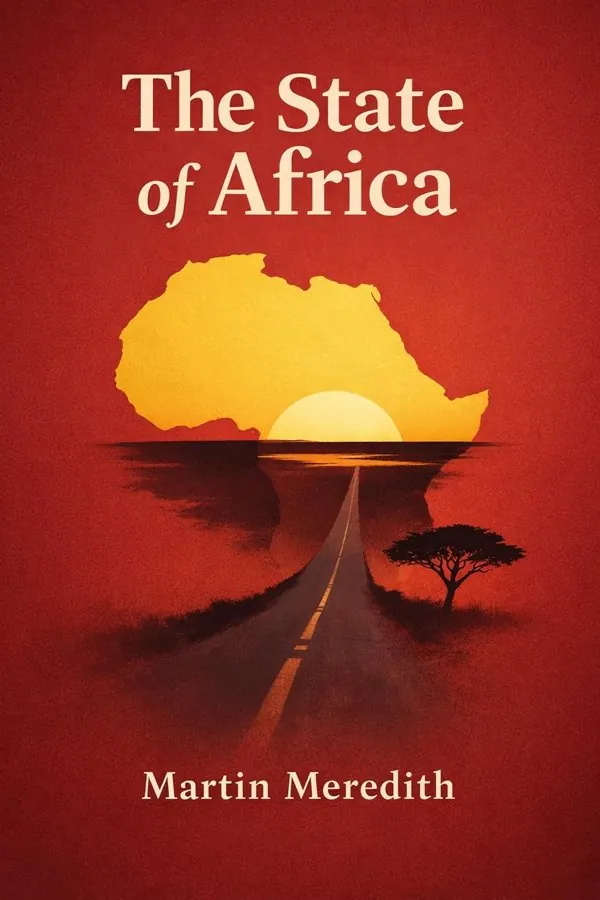
The State of Africa: A History of the Continent Since Independence: Summary & Key Insights
 10 min9 chaptersAudio available
Key Takeaways from The State of Africa: A History of the Continent Since Independence
Few political moments in modern history have carried as much emotional force as Africa’s wave of independence.
A stirring speech can inspire a country, but it cannot by itself hold one together.
Many African states did not lose democracy all at once; they slid away from it as leaders treated opposition as a threat to national survival.
Political independence did not automatically produce economic independence.
Africa’s postcolonial struggles were never shaped by domestic forces alone.
What Is The State of Africa: A History of the Continent Since Independence About?
The State of Africa: A History of the Continent Since Independence by Martin Meredith is a world_history book spanning 6 pages. Martin Meredith’s The State of Africa is a sweeping, deeply researched history of what happened after the flags of empire came down across Africa. Beginning with the exhilarating independence movements of the 1950s and 1960s, the book follows the continent through nation-building experiments, military coups, civil wars, economic crises, foreign intervention, apartheid, reform, and democratic renewal. Rather than treating Africa as a single story, Meredith shows how dozens of countries faced similar inherited problems—artificial borders, weak institutions, dependent economies, and divided societies—yet experienced them in different ways. What makes this book matter is its refusal to romanticize either colonial rule or postcolonial leadership. Meredith documents both the extraordinary courage of African liberation movements and the devastating failures of many rulers who replaced colonial power with autocracy, corruption, and violence. At the same time, he captures the resilience of ordinary Africans and the ongoing search for accountable government and stability. As a veteran journalist and historian of African affairs, Meredith brings decades of reporting and scholarship to a narrative that is authoritative, vivid, and indispensable for understanding modern Africa.
This FizzRead summary covers all 9 key chapters of The State of Africa: A History of the Continent Since Independence in approximately 10 minutes, distilling the most important ideas, arguments, and takeaways from Martin Meredith's work. Also available as an audio summary and Key Quotes Podcast.
The State of Africa: A History of the Continent Since Independence
Martin Meredith’s The State of Africa is a sweeping, deeply researched history of what happened after the flags of empire came down across Africa. Beginning with the exhilarating independence movements of the 1950s and 1960s, the book follows the continent through nation-building experiments, military coups, civil wars, economic crises, foreign intervention, apartheid, reform, and democratic renewal. Rather than treating Africa as a single story, Meredith shows how dozens of countries faced similar inherited problems—artificial borders, weak institutions, dependent economies, and divided societies—yet experienced them in different ways.
What makes this book matter is its refusal to romanticize either colonial rule or postcolonial leadership. Meredith documents both the extraordinary courage of African liberation movements and the devastating failures of many rulers who replaced colonial power with autocracy, corruption, and violence. At the same time, he captures the resilience of ordinary Africans and the ongoing search for accountable government and stability. As a veteran journalist and historian of African affairs, Meredith brings decades of reporting and scholarship to a narrative that is authoritative, vivid, and indispensable for understanding modern Africa.
Who Should Read The State of Africa: A History of the Continent Since Independence?
This book is perfect for anyone interested in world_history and looking to gain actionable insights in a short read. Whether you're a student, professional, or lifelong learner, the key ideas from The State of Africa: A History of the Continent Since Independence by Martin Meredith will help you think differently.
- ✓Readers who enjoy world_history and want practical takeaways
- ✓Professionals looking to apply new ideas to their work and life
- ✓Anyone who wants the core insights of The State of Africa: A History of the Continent Since Independence in just 10 minutes
Want the full summary?
Get instant access to this book summary and 100K+ more with Fizz Moment.
Get Free SummaryAvailable on App Store • Free to download
Key Chapters
Few political moments in modern history have carried as much emotional force as Africa’s wave of independence. In the late 1950s and 1960s, colonial rule began to collapse across the continent, and millions believed a new era of dignity, prosperity, and self-determination had arrived. Ghana’s independence in 1957 under Kwame Nkrumah became a beacon for the rest of Africa, signaling that European empires were no longer invincible. Similar momentum spread through Nigeria, Kenya, Tanzania, Senegal, Congo, and many others.
Meredith shows that independence was not simply a legal transfer of power. It was a psychological revolution. African leaders and citizens imagined that freedom would quickly translate into development, unity, and international respect. But the expectations placed on new governments were enormous. Colonial administrations had often left behind weak institutions, economies geared toward exporting raw materials, and borders that grouped rival communities into fragile states. New rulers inherited sovereignty without necessarily inheriting the administrative capacity needed to govern effectively.
The contrast between symbolic liberation and practical governance is one of the book’s central themes. Nkrumah, for instance, spoke in grand continental terms about African unity, yet his government soon faced the hard realities of managing a modern state. Congo’s chaotic post-independence collapse demonstrated even more starkly how quickly celebrations could turn to crisis when institutions were absent.
A practical lesson emerges here for anyone studying political transition: winning freedom is not the same as building a functioning state. Moments of liberation create momentum, but they can also create unrealistic hopes if institutions, economic planning, and political inclusion do not keep pace. The actionable takeaway is to judge political transformation not only by the achievement of independence or revolution, but by whether durable systems are built to sustain that victory.
A stirring speech can inspire a country, but it cannot by itself hold one together. In the first years after independence, many African leaders believed they could mold unified nations out of territories that colonial powers had drawn with little regard for history, ethnicity, or local political realities. Figures such as Julius Nyerere in Tanzania, Jomo Kenyatta in Kenya, Léopold Sédar Senghor in Senegal, and Nkrumah in Ghana each offered distinct visions of national purpose, often centered on unity, modernization, and social justice.
Meredith explains that nation-building was the central challenge of postcolonial Africa. Many states were mosaics of languages, religions, regions, and ethnic communities with limited shared political identity. In some countries, leaders tried to solve this through inclusive citizenship and national service. Nyerere’s project in Tanzania, for example, emphasized Swahili as a common language and promoted a broad sense of national belonging. In other places, ruling elites relied more on patronage networks, rewarding allies and sidelining rivals. That approach often deepened division rather than reducing it.
The book makes clear that early optimism frequently underestimated the difficulty of forging legitimacy. Institutions such as civil services, courts, professional armies, and functioning local administrations mattered more than personal prestige. Where governments built systems that outlasted personalities, states gained resilience. Where power revolved around one leader or one ethnic coalition, instability increased.
This is not only a historical insight; it applies to any society emerging from conflict, colonialism, or authoritarian rule. Shared identity must be cultivated through education, law, fairness, and participation—not merely proclaimed from the top. The actionable takeaway is to look beyond heroic founders and ask whether a country is investing in institutions, inclusive citizenship, and habits of cooperation that can survive leadership change.
Political independence did not automatically produce economic independence. Meredith shows that many African countries inherited economies designed for colonial extraction rather than balanced national development. Railways, ports, and commercial systems were often built to move cocoa, copper, coffee, cotton, oil, or minerals abroad—not to connect domestic markets, encourage industry, or support broad-based prosperity. After independence, governments found themselves dependent on a narrow range of exports whose prices they could not control.
This dependence created repeated crises. When commodity prices fell, government revenues collapsed. States that had expanded spending during boom years suddenly faced debt, inflation, and austerity. Zambia’s vulnerability to copper prices is one of the clearest examples. Nigeria’s oil wealth generated huge expectations, but also encouraged waste, corruption, and neglect of other sectors. In many countries, development plans were ambitious on paper yet undermined by weak administration, patronage, and external shocks.
Meredith also examines the role of foreign lenders and international financial institutions. By the 1970s and 1980s, debt burdens and fiscal crises pushed many African governments into structural adjustment programs. These often demanded cuts in public spending, currency devaluation, and market reforms. Some reforms addressed genuine inefficiencies, but they also imposed severe social costs, especially on the poor, while leaving deeper questions of economic diversification unresolved.
The book’s insight is that underdevelopment was not merely a matter of poor leadership, though leadership mattered greatly. It was also the result of inherited structures that made sovereignty economically fragile. For modern readers, this raises an enduring policy question: how can countries move from resource dependence to resilient growth? The actionable takeaway is to evaluate development not by short-term windfalls, but by whether economies are diversifying, strengthening institutions, and building capacity beyond a single export or external donor relationship.
Africa’s postcolonial struggles were never shaped by domestic forces alone. Meredith makes clear that the Cold War turned many African disputes into international battlegrounds. Newly independent states became arenas where the United States, Soviet Union, Cuba, China, and former colonial powers competed for influence, allies, and strategic advantage. Local tensions that might have remained limited were often magnified by foreign money, weapons, and ideological pressure.
Angola is one of the strongest examples. Competing liberation movements did not simply negotiate a national future after Portuguese rule ended; they became proxies in a wider geopolitical contest. South Africa, Cuba, the Soviet bloc, and the United States all played roles in extending and intensifying the war. Mozambique, Ethiopia, Somalia, and Congo were similarly affected by superpower calculations. In many cases, outside powers spoke the language of liberation, anti-communism, or socialist solidarity while fueling devastation on the ground.
Meredith’s treatment of Patrice Lumumba’s Congo and later conflicts shows how dangerous foreign intervention could be when institutions were weak and leadership contested. External actors often preferred pliable clients to legitimate governments. The human cost was enormous: prolonged wars, displaced populations, militarized politics, and regimes sustained not by consent but by external backing.
The broader insight is that African history after independence cannot be understood if viewed only through national borders. International systems shaped domestic possibilities, sometimes decisively. This matters today whenever major powers intervene in fragile states under strategic or ideological banners. The actionable takeaway is to ask, in any conflict, not only who the local players are, but also which outside actors benefit from prolonging instability and how external dependence affects the prospects for peace.
A state can appear sovereign on a map while barely holding together in reality. One of Meredith’s most powerful contributions is his account of how civil wars revealed the underlying weakness of many postcolonial governments. These conflicts were rarely caused by a single grievance. Instead, they grew from combinations of ethnic exclusion, regional inequality, contested resources, abusive leadership, foreign interference, and collapsed institutions.
Nigeria’s Biafran war illustrated the explosive consequences of mistrust in a newly independent federation. The Congo crisis showed how quickly a state could fragment when the army mutinied, provinces seceded, and outside powers intervened. Later tragedies in Liberia, Sierra Leone, Sudan, and Rwanda demonstrated that when governments lose legitimacy and coercive force is privatized, violence can become self-sustaining. Militias, warlords, and predatory elites profit from disorder even as civilians endure famine, displacement, and massacre.
Meredith avoids simplistic explanations. He does not portray these conflicts as ancient tribal hatreds. Instead, he shows how colonial legacies, manipulative politicians, and competition for state power turned social differences into deadly fault lines. Resource wealth could worsen matters, as diamonds, oil, and minerals financed armed movements and corrupted peace efforts.
For readers, the practical value of this analysis lies in understanding warning signs. States are most vulnerable when political competition becomes winner-take-all, security forces lose professionalism, and excluded groups no longer believe peaceful participation is possible. Peace agreements alone are not enough if they leave predatory structures untouched. The actionable takeaway is to think of peacebuilding as institution-building: fair representation, accountable security forces, local reconciliation, and economic inclusion are not secondary issues but the real foundations of lasting stability.
The fall of apartheid was not only a South African milestone; it transformed the political landscape of the entire region. Meredith places South Africa within a larger southern African story that includes colonial wars, liberation movements, regional destabilization, and the long struggle against white minority rule. For decades, apartheid South Africa had projected military and economic power across its borders, influencing events in Angola, Mozambique, Namibia, Zimbabwe, and beyond.
The end of apartheid therefore carried significance far beyond the election of Nelson Mandela in 1994. It marked the collapse of one of the most visible systems of racial domination in the modern world and opened the possibility of a more cooperative regional order. Yet Meredith does not present this transition as a miracle detached from hard politics. It was achieved through years of internal resistance, international pressure, economic strain, negotiation, and strategic compromise.
He also shows that political liberation did not erase structural inequality. South Africa entered democracy with extraordinary moral authority but also with deep social divisions, spatial segregation, unemployment, and economic concentration. Across southern Africa more broadly, the legacy of war and authoritarian liberation movements continued to shape governance. Zimbabwe’s later trajectory under Robert Mugabe became a cautionary example of how liberation credentials could be used to justify repression and economic ruin.
The lesson here is twofold. First, entrenched systems can end through a mix of resistance and negotiation. Second, transition is not completion. Symbols matter, but institutions and socioeconomic reforms determine whether freedom deepens. The actionable takeaway is to distinguish between political breakthrough and long-term transformation, and to judge post-conflict settlements by how well they reduce exclusion, not just by how successfully they end formal oppression.
History does not move in only one direction, and Meredith shows that the late twentieth century brought important signs of recovery across parts of Africa. After decades of coups, one-party states, and economic crisis, new generations of leaders emerged promising reform, accountability, and economic stabilization. In countries such as Uganda, Ethiopia, Ghana, and later elsewhere, governments sought to rebuild state capacity, attract investment, and restore order after periods of severe dysfunction.
Some of these efforts achieved real progress. Ghana, after years of instability, developed into one of West Africa’s more durable electoral democracies. Uganda under Yoweri Museveni initially restored a measure of stability after the catastrophes of Idi Amin and Milton Obote. In several countries, pressure from civil society, churches, professional groups, students, and international donors helped reopen political space and push rulers toward multiparty elections.
Yet Meredith remains cautious. New leadership often repeated old patterns once power was consolidated. Reformers who began as liberators sometimes restricted opposition, manipulated constitutions, or built patronage systems of their own. Economic growth did not always translate into broad social gains, and donor-backed reform could become superficial if domestic accountability remained weak.
The key insight is that renewal is possible, but it is fragile when tied too closely to individuals. Celebrated leaders may improve matters without fundamentally changing the political culture that enables abuse. This is a useful lesson for citizens, analysts, and policymakers alike. Hope should not depend solely on charismatic reformers. The actionable takeaway is to evaluate “new leadership” by concrete institutional markers—credible elections, peaceful transfers of power, independent courts, reduced corruption, and improved public services—rather than by rhetoric or international praise alone.
To focus only on coups, famines, and dictatorships is to miss a crucial truth: African societies repeatedly endured, adapted, and rebuilt under immense pressure. Meredith’s narrative is unsparing about failure, but it also reveals the persistence of civic life, local initiative, and popular resistance. Across the continent, ordinary people confronted collapsing states, predatory rulers, and economic hardship without surrendering the search for dignity and order.
This resilience took many forms. Independent newspapers challenged censorship. Churches and mosques offered social support where states failed. Market women, farmers, teachers, and labor organizers sustained communities through inflation, shortages, and war. Human rights activists and pro-democracy movements forced openings in places where authoritarian rule once seemed permanent. In countries from Benin to South Africa to Ghana, public pressure helped create transitions that elites alone would not have chosen.
Meredith’s broader achievement is to restore agency to Africans themselves. The continent’s history since independence is not merely a record of victimhood or elite betrayal; it is also a history of social energy pressing upward from below. Even where institutions faltered, societies did not become empty spaces. Informal economies, local peace arrangements, and civic networks often kept life going when official structures disintegrated.
For readers, this is an important corrective to fatalism. Structural problems are real, but they do not erase human capacity for adaptation and reform. Any serious understanding of Africa must hold tragedy and resilience together. The actionable takeaway is to avoid narratives that treat countries only through their crises; instead, ask what local institutions, civic actors, and social networks are already solving problems and deserve support.
All Chapters in The State of Africa: A History of the Continent Since Independence
About the Author
Martin Meredith is a British journalist, historian, and biographer best known for his writing on Africa’s political history. Over the course of a long career, he reported extensively on African affairs and developed a strong reputation for turning complex historical and political developments into clear, compelling narrative history. His work often examines the legacies of colonial rule, the ambitions and failures of post-independence leadership, and the broader forces that have shaped modern African states. Meredith has written on subjects ranging from African leaders and liberation movements to the continent’s economic and political transformations. His combination of journalistic experience, historical research, and continental scope makes him one of the most widely read interpreters of modern African history for general audiences.
Get This Summary in Your Preferred Format
Read or listen to the The State of Africa: A History of the Continent Since Independence summary by Martin Meredith anytime, anywhere. FizzRead offers multiple formats so you can learn on your terms — all free.
Available formats: App · Audio · PDF · EPUB — All included free with FizzRead
Download The State of Africa: A History of the Continent Since Independence PDF and EPUB Summary
Key Quotes from The State of Africa: A History of the Continent Since Independence
“Few political moments in modern history have carried as much emotional force as Africa’s wave of independence.”
“A stirring speech can inspire a country, but it cannot by itself hold one together.”
“Many African states did not lose democracy all at once; they slid away from it as leaders treated opposition as a threat to national survival.”
“Political independence did not automatically produce economic independence.”
“Africa’s postcolonial struggles were never shaped by domestic forces alone.”
Frequently Asked Questions about The State of Africa: A History of the Continent Since Independence
The State of Africa: A History of the Continent Since Independence by Martin Meredith is a world_history book that explores key ideas across 9 chapters. Martin Meredith’s The State of Africa is a sweeping, deeply researched history of what happened after the flags of empire came down across Africa. Beginning with the exhilarating independence movements of the 1950s and 1960s, the book follows the continent through nation-building experiments, military coups, civil wars, economic crises, foreign intervention, apartheid, reform, and democratic renewal. Rather than treating Africa as a single story, Meredith shows how dozens of countries faced similar inherited problems—artificial borders, weak institutions, dependent economies, and divided societies—yet experienced them in different ways. What makes this book matter is its refusal to romanticize either colonial rule or postcolonial leadership. Meredith documents both the extraordinary courage of African liberation movements and the devastating failures of many rulers who replaced colonial power with autocracy, corruption, and violence. At the same time, he captures the resilience of ordinary Africans and the ongoing search for accountable government and stability. As a veteran journalist and historian of African affairs, Meredith brings decades of reporting and scholarship to a narrative that is authoritative, vivid, and indispensable for understanding modern Africa.
More by Martin Meredith
You Might Also Like
The Age of Capital
Eric Hobsbawm
10 min
The Gulag Archipelago
Aleksandr Solzhenitsyn
10 min
Jerusalem: The Biography
Simon Sebag Montefiore
10 min
The Anglo-Saxons
James Campbell
10 min
The Boer War
Thomas Pakenham
10 min
The Industrial Revolutionaries: The Making of the Modern World 1776–1914
Gavin Weightman
10 minBrowse by Category
Ready to read The State of Africa: A History of the Continent Since Independence?
Get the full summary and 100K+ more books with Fizz Moment.