
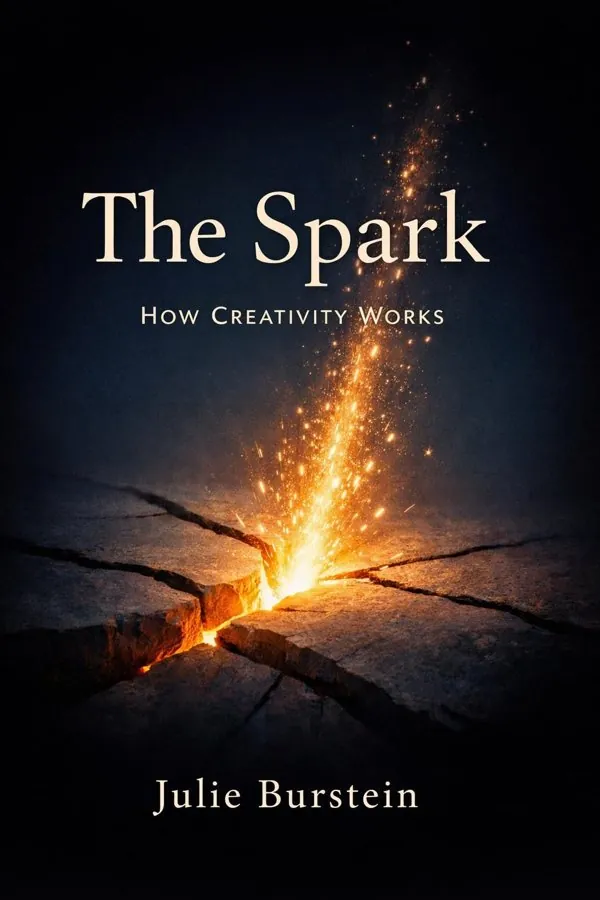
The Spark: How Creativity Works: Summary & Key Insights
 10 min9 chaptersAudio available
What Is The Spark: How Creativity Works About?
The Spark: How Creativity Works by Julie Burstein is a creativity book spanning 9 pages. In this book, Julie Burstein explores the creative process through interviews and stories from artists, writers, filmmakers, and musicians. Drawing from her experience as the creator of the public radio program 'Studio 360', she reveals how challenges, limitations, and even heartbreak can fuel creativity. The book offers insights into how individuals harness their experiences to produce meaningful art and innovation.
This FizzRead summary covers all 9 key chapters of The Spark: How Creativity Works in approximately 10 minutes, distilling the most important ideas, arguments, and takeaways from Julie Burstein's work. Also available as an audio summary and Key Quotes Podcast.
The Spark: How Creativity Works
In this book, Julie Burstein explores the creative process through interviews and stories from artists, writers, filmmakers, and musicians. Drawing from her experience as the creator of the public radio program 'Studio 360', she reveals how challenges, limitations, and even heartbreak can fuel creativity. The book offers insights into how individuals harness their experiences to produce meaningful art and innovation.
Who Should Read The Spark: How Creativity Works?
This book is perfect for anyone interested in creativity and looking to gain actionable insights in a short read. Whether you're a student, professional, or lifelong learner, the key ideas from The Spark: How Creativity Works by Julie Burstein will help you think differently.
- ✓Readers who enjoy creativity and want practical takeaways
- ✓Professionals looking to apply new ideas to their work and life
- ✓Anyone who wants the core insights of The Spark: How Creativity Works in just 10 minutes
Want the full summary?
Get instant access to this book summary and 100K+ more with Fizz Moment.
Get Free SummaryAvailable on App Store • Free to download
Key Chapters
Every work of art begins in experience. What we live through—our past, our emotional landscape—becomes the raw material for creativity. In conversations with artists like Richard Serra or Isabel Allende, I’ve heard again and again how personal history seeps into creation, often unconsciously. Serra speaks of the physicality of his childhood in working-class San Francisco—his father’s job in shipyards taught him the power of metal and motion, influences that later shaped his monumental steel sculptures. Allende, in turn, transforms family stories and historical events into sweeping worlds of magic and memory, as if every grief and joy were a thread in her imaginative tapestry.
Experience doesn’t merely provide content; it provides the emotional resonance that makes art alive. When a filmmaker draws on childhood memory, a composer recalls cultural rhythms, or a photographer channels moments of intimacy, they tap into something universal through something deeply personal. Yet there’s another side to this relationship. Sometimes experience wounds. Sometimes it pierces us so deeply that we’d rather turn away. But it is in facing those experiences, rather than fleeing, that creativity finds depth. The act of making becomes both a response and a resolution, allowing us to shape chaos into coherence. For me, the most moving creative stories are those in which the artist transforms the weight of experience into meaning—a sculpture emerging from loss, a song from longing, a film from the fragments of history. When we learn to honor our experience without denying its complexity, we begin to understand creativity not as escape, but as engagement—a dialogue between what happens to us and what we choose to make of it.
We tend to imagine creativity as a pursuit of perfection, a polishing of ideas until they gleam. But artists know that real breakthroughs often come through mistakes. The brush slips, the clay cracks, the melody veers off-key—and suddenly, something unexpected appears. In my interviews, photographer Joel Meyerowitz once told me how he learned that imperfection can be a portal to discovery. Early in his career, he tried to control every frame, but it was only when he allowed chance and error—a fleeting reflection, a blur of color—that his work came alive with spontaneity.
Japanese potters speak of *wabi-sabi*, the beauty of the imperfect. I’ve heard musicians repeat the same truth: a dissonant note can create deeper emotional texture than a perfect one. Imperfection is not failure; it’s evidence of vitality. To embrace it requires courage—the courage to relinquish control and let the process lead you instead of the other way around.
In making art, as in living, our flaws can become the source of our originality. When we stop demanding flawlessness, we open ourselves to genuine exploration. The work expands, surprises us, and in that surprise we touch something authentic. Perfection closes; imperfection enlarges. To create is to make peace with the parts that don’t fit neatly, to love the rough edges that remind us we’re human.
+ 7 more chapters — available in the FizzRead app
All Chapters in The Spark: How Creativity Works
About the Author
Julie Burstein is an American producer, author, and public radio host best known for creating and producing 'Studio 360' with Kurt Andersen. She has spent her career exploring creativity across disciplines, interviewing artists and thinkers about their work and inspiration.
Get This Summary in Your Preferred Format
Read or listen to the The Spark: How Creativity Works summary by Julie Burstein anytime, anywhere. FizzRead offers multiple formats so you can learn on your terms — all free.
Available formats: App · Audio · PDF · EPUB — All included free with FizzRead
Download The Spark: How Creativity Works PDF and EPUB Summary
Key Quotes from The Spark: How Creativity Works
“What we live through—our past, our emotional landscape—becomes the raw material for creativity.”
“We tend to imagine creativity as a pursuit of perfection, a polishing of ideas until they gleam.”
Frequently Asked Questions about The Spark: How Creativity Works
The Spark: How Creativity Works by Julie Burstein is a creativity book that explores key ideas across 9 chapters. In this book, Julie Burstein explores the creative process through interviews and stories from artists, writers, filmmakers, and musicians. Drawing from her experience as the creator of the public radio program 'Studio 360', she reveals how challenges, limitations, and even heartbreak can fuel creativity. The book offers insights into how individuals harness their experiences to produce meaningful art and innovation.
You Might Also Like
Dimensions Of Creativity
Margaret A. Boden
10 min
How to Fly a Horse: The Secret History of Creation, Invention, and Discovery
Kevin Ashton
10 min
Imagine: How Creativity Works
Jonah Lehrer
10 min
The Accidental Creative: How to Be Brilliant at a Moment's Notice
Todd Henry
10 min
The Origins of Creativity
Edward O. Wilson
10 min
Wired to Create: Unraveling the Mysteries of the Creative Mind
Scott Barry Kaufman, Carolyn Gregoire
10 minBrowse by Category
Ready to read The Spark: How Creativity Works?
Get the full summary and 100K+ more books with Fizz Moment.