
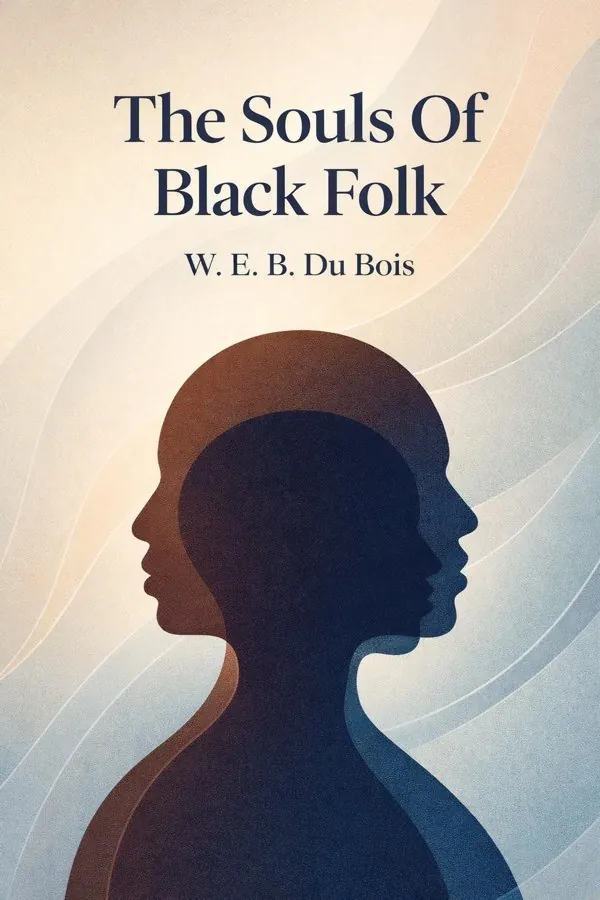
The Souls Of Black Folk: Summary & Key Insights
 10 min5 chaptersAudio available
What Is The Souls Of Black Folk About?
The Souls Of Black Folk by W. E. B. Du Bois is a civilization book spanning 5 pages. A landmark work in African American literature, this collection of essays by W. E. B. Du Bois explores the social, political, and spiritual struggles of Black Americans in the post-Reconstruction era. It introduces the concept of 'double consciousness' and examines the enduring effects of racism and inequality in the United States.
This FizzRead summary covers all 5 key chapters of The Souls Of Black Folk in approximately 10 minutes, distilling the most important ideas, arguments, and takeaways from W. E. B. Du Bois's work. Also available as an audio summary and Key Quotes Podcast.
The Souls Of Black Folk
A landmark work in African American literature, this collection of essays by W. E. B. Du Bois explores the social, political, and spiritual struggles of Black Americans in the post-Reconstruction era. It introduces the concept of 'double consciousness' and examines the enduring effects of racism and inequality in the United States.
Who Should Read The Souls Of Black Folk?
This book is perfect for anyone interested in civilization and looking to gain actionable insights in a short read. Whether you're a student, professional, or lifelong learner, the key ideas from The Souls Of Black Folk by W. E. B. Du Bois will help you think differently.
- ✓Readers who enjoy civilization and want practical takeaways
- ✓Professionals looking to apply new ideas to their work and life
- ✓Anyone who wants the core insights of The Souls Of Black Folk in just 10 minutes
Want the full summary?
Get instant access to this book summary and 100K+ more with Fizz Moment.
Get Free SummaryAvailable on App Store • Free to download
Key Chapters
I begin with the question that has haunted my people since emancipation: What does it mean to be free in a land that denies your humanity? In this opening essay, I introduce what I call the 'double consciousness' — that peculiar condition in which the Negro is always looking at himself through the eyes of others, measuring his soul by the tape of a world that regards him with amused contempt and pity. It is the psychological wound of being both American and Negro, two souls, two thoughts, two unreconciled strivings.
This inner conflict is not just personal; it is existential. For the Black man, to think, to act, to aspire, is to navigate two contradictory worlds — one that professes equality, and another that degrades him. Yet out of this tension arises a unique spiritual strength. The Negro does not seek to tear down America; he seeks to make her true to herself. He wants to merge his double self into a better and truer self, wherein neither self is lost.
I write of the spiritual striving of men who, denied political equality, seek moral recognition; of women who, amidst social scorn, cultivate dignity. And I tell of faith — a faith that persists even when the body is crushed. This essay lays the foundation for what follows: the portrayal of a people who, through every obstacle, continue to sing, to build, to learn, and to assert their humanity. The struggle of the double consciousness, I say, is the gift and burden of all oppressed souls.
Here I turn to the history of the Freedmen’s Bureau — that noble yet flawed attempt to reconstruct the South and uplift the newly freed Black men after the Civil War. The Bureau was conceived as an agent of justice, education, and land reform. It was the dawn of freedom: a moment when possibilities trembled at the horizon. Yet, as I show, the Bureau’s failure lay in the nation’s refusal to commit fully to equality. Political compromise, corruption, and racial prejudice undermined its mission until it became a shell of reform rather than a living arm of justice.
Through this account, I do not write as a detached historian but as one who understands that every policy touches living souls. The Freedmen needed guidance in literacy, labor, and law, but above all, they needed respect — something the American system was not ready to give. The Bureau’s agents, like General O. O. Howard, often worked with heroic intention, yet their efforts collided with entrenched hatred and systemic neglect.
This chapter is a meditation on the meaning of progress itself. I argue that emancipation without education, freedom without empathy, are hollow victories. The dawn of freedom was brilliant yet brief; the sunlight faded into the gray of institutional failure. But even in that failure, I see seeds of future struggle and reform. The Bureau taught us a vital truth: freedom must be nurtured through justice, not merely proclaimed.
+ 3 more chapters — available in the FizzRead app
All Chapters in The Souls Of Black Folk
About the Author
W. E. B. Du Bois (1868–1963) was an American sociologist, historian, and civil rights activist. He was one of the founders of the NAACP and a leading intellectual voice for racial equality and Pan-Africanism.
Get This Summary in Your Preferred Format
Read or listen to the The Souls Of Black Folk summary by W. E. B. Du Bois anytime, anywhere. FizzRead offers multiple formats so you can learn on your terms — all free.
Available formats: App · Audio · PDF · EPUB — All included free with FizzRead
Download The Souls Of Black Folk PDF and EPUB Summary
Key Quotes from The Souls Of Black Folk
“I begin with the question that has haunted my people since emancipation: What does it mean to be free in a land that denies your humanity?”
“Here I turn to the history of the Freedmen’s Bureau — that noble yet flawed attempt to reconstruct the South and uplift the newly freed Black men after the Civil War.”
Frequently Asked Questions about The Souls Of Black Folk
The Souls Of Black Folk by W. E. B. Du Bois is a civilization book that explores key ideas across 5 chapters. A landmark work in African American literature, this collection of essays by W. E. B. Du Bois explores the social, political, and spiritual struggles of Black Americans in the post-Reconstruction era. It introduces the concept of 'double consciousness' and examines the enduring effects of racism and inequality in the United States.
You Might Also Like
The Structure of Scientific Revolutions
Thomas S. Kuhn
10 min
Genius
Harold Bloom
10 min
A Cultural History of the Medieval Age
Various Editors
10 min
A History of God: The 4,000-Year Quest of Judaism, Christianity and Islam
Karen Armstrong
10 min
A History of the World in 10½ Chapters
Julian Barnes
10 min
A Short History of Progress
Ronald Wright
10 minBrowse by Category
Ready to read The Souls Of Black Folk?
Get the full summary and 100K+ more books with Fizz Moment.