
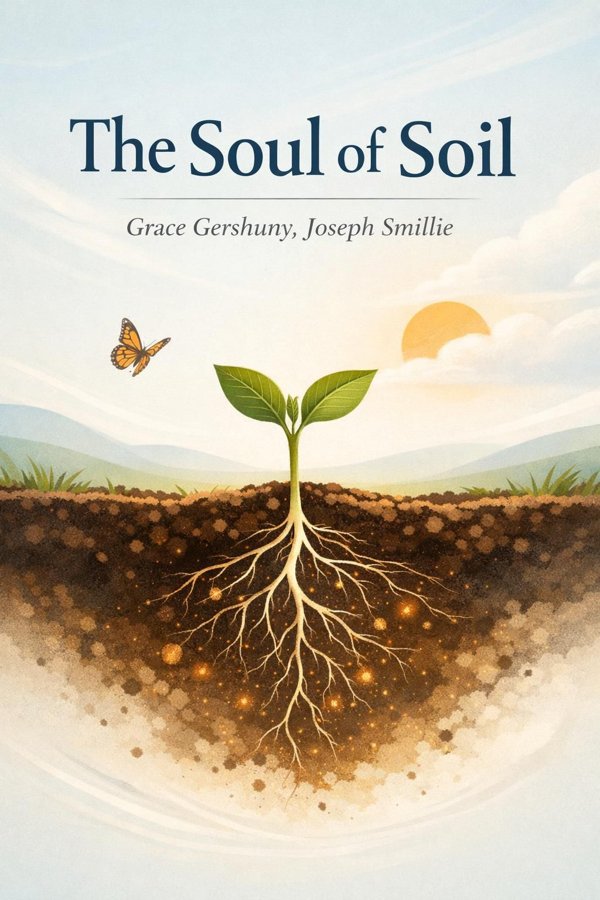
The Soul of Soil: A Soil-Building Guide for Master Gardeners and Farmers: Summary & Key Insights
by Grace Gershuny, Joseph Smillie
 10 min9 chaptersAudio available
Key Takeaways from The Soul of Soil: A Soil-Building Guide for Master Gardeners and Farmers
The most important shift this book asks us to make is surprisingly simple: stop thinking of soil as dirt.
Good soil management begins with a clear understanding of what soil actually contains.
One teaspoon of healthy soil can contain more living organisms than there are people on Earth, and that astonishing fact captures the spirit of this book.
The book’s central argument is that true soil fertility is a process, not a stockpile.
If soil health had a savings account, organic matter would be the principal.
What Is The Soul of Soil: A Soil-Building Guide for Master Gardeners and Farmers About?
The Soul of Soil: A Soil-Building Guide for Master Gardeners and Farmers by Grace Gershuny, Joseph Smillie is a environment book spanning 9 pages. Healthy soil is easy to overlook because its most important work happens out of sight. In The Soul of Soil, Grace Gershuny and Joseph Smillie bring that hidden world into focus, showing that soil is not merely a growing medium but a living ecosystem that drives plant health, farm productivity, and long-term ecological balance. The book explains how minerals, organic matter, moisture, air, microbes, insects, fungi, and roots interact to cycle nutrients and build fertility naturally. Rather than treating soil as something to be corrected with quick chemical inputs, the authors advocate a biological, systems-based approach grounded in observation, stewardship, and regeneration. What makes this guide enduringly valuable is its blend of scientific clarity and practical application. Gershuny, a respected educator in organic agriculture, and Smillie, an experienced advocate for ecological soil management, translate complex soil processes into usable strategies for gardeners and farmers alike. For anyone who wants to grow healthier crops while protecting the land, this book offers both a philosophy and a field manual.
This FizzRead summary covers all 9 key chapters of The Soul of Soil: A Soil-Building Guide for Master Gardeners and Farmers in approximately 10 minutes, distilling the most important ideas, arguments, and takeaways from Grace Gershuny, Joseph Smillie's work. Also available as an audio summary and Key Quotes Podcast.
The Soul of Soil: A Soil-Building Guide for Master Gardeners and Farmers
Healthy soil is easy to overlook because its most important work happens out of sight. In The Soul of Soil, Grace Gershuny and Joseph Smillie bring that hidden world into focus, showing that soil is not merely a growing medium but a living ecosystem that drives plant health, farm productivity, and long-term ecological balance. The book explains how minerals, organic matter, moisture, air, microbes, insects, fungi, and roots interact to cycle nutrients and build fertility naturally. Rather than treating soil as something to be corrected with quick chemical inputs, the authors advocate a biological, systems-based approach grounded in observation, stewardship, and regeneration. What makes this guide enduringly valuable is its blend of scientific clarity and practical application. Gershuny, a respected educator in organic agriculture, and Smillie, an experienced advocate for ecological soil management, translate complex soil processes into usable strategies for gardeners and farmers alike. For anyone who wants to grow healthier crops while protecting the land, this book offers both a philosophy and a field manual.
Who Should Read The Soul of Soil: A Soil-Building Guide for Master Gardeners and Farmers?
This book is perfect for anyone interested in environment and looking to gain actionable insights in a short read. Whether you're a student, professional, or lifelong learner, the key ideas from The Soul of Soil: A Soil-Building Guide for Master Gardeners and Farmers by Grace Gershuny, Joseph Smillie will help you think differently.
- ✓Readers who enjoy environment and want practical takeaways
- ✓Professionals looking to apply new ideas to their work and life
- ✓Anyone who wants the core insights of The Soul of Soil: A Soil-Building Guide for Master Gardeners and Farmers in just 10 minutes
Want the full summary?
Get instant access to this book summary and 100K+ more with Fizz Moment.
Get Free SummaryAvailable on App Store • Free to download
Key Chapters
The most important shift this book asks us to make is surprisingly simple: stop thinking of soil as dirt. Soil is a living community, and once you see it that way, every gardening or farming decision changes. Beneath the surface, bacteria, fungi, earthworms, arthropods, nematodes, roots, and countless microscopic organisms are continuously breaking down organic matter, exchanging nutrients, creating structure, and regulating moisture. Plants do not thrive because they stand in an inert medium; they thrive because they are embedded in a dynamic biological partnership.
Gershuny and Smillie argue that many modern fertility problems come from ignoring this living dimension. When soil is compacted, left bare, overtilled, or saturated with harsh synthetic inputs, biological activity declines. The result is often weaker crops, reduced nutrient availability, poor water infiltration, and greater dependence on external fertilizers. In contrast, when growers feed the soil food web with compost, mulch, crop residues, and diversified plantings, the soil begins to regulate itself more effectively.
A practical example is the difference between two vegetable beds: one repeatedly tilled and left exposed, and one protected with compost and cover crops. The second will usually hold moisture longer, resist crusting, and support steadier plant growth because the biology remains active.
The authors’ deeper point is that fertility is not a product you buy but a relationship you build. Actionable takeaway: treat soil as a habitat first by minimizing disturbance, keeping it covered, and regularly adding organic matter that nourishes its living community.
Good soil management begins with a clear understanding of what soil actually contains. Soil is not a uniform substance. It is a carefully balanced mixture of mineral particles, organic matter, water, and air, and each part influences how well plants can grow. The mineral portion comes from weathered rock and includes sand, silt, and clay. Their relative proportions determine texture, which shapes drainage, nutrient-holding capacity, and workability. Organic matter, though often a small percentage by volume, has an outsized effect on fertility, moisture retention, and biological life.
The authors show that healthy soil also depends on pore space. Air-filled pores supply oxygen to roots and microorganisms, while water-filled pores help transport nutrients. If soil is compacted, this balance collapses. Roots struggle to penetrate, microbes lose oxygen, and water either runs off or stagnates. This is why two soils with similar nutrient levels can perform very differently in the field.
Consider a sandy garden bed and a heavy clay plot. Sandy soil drains quickly and warms early but loses nutrients easily. Clay holds nutrients better but may become dense and waterlogged. The solution is not to fight texture with unrealistic expectations but to manage each soil according to its strengths and limitations, often by increasing organic matter.
The practical wisdom here is to observe before intervening. Test texture by feel, note drainage after rain, and look at how roots develop. Actionable takeaway: learn your soil’s basic composition and adjust your practices to improve structure and balance rather than relying on one-size-fits-all fertility fixes.
The book’s central argument is that true soil fertility is a process, not a stockpile. Nutrients are constantly moving through cycles of growth, decay, transformation, and reabsorption. Nitrogen, phosphorus, potassium, sulfur, calcium, and trace minerals do not simply sit in the ground waiting to be taken up. They are released, immobilized, stored, leached, or exchanged depending on biological activity, moisture, temperature, pH, and organic matter content. Understanding these cycles helps growers make wiser and more economical decisions.
Gershuny and Smillie challenge the idea that fertility is best managed by repeatedly applying soluble inputs. Quick-release fertilizers can produce visible growth, but they often bypass the slower, more resilient processes that create long-term soil health. In contrast, composts, manures, crop residues, and cover crops feed a gradual cycle in which nutrients are held in organic forms and released over time. This reduces waste and aligns fertility with plant demand.
A practical example is nitrogen management. A gardener who incorporates a legume cover crop before planting can add biologically fixed nitrogen while also improving soil structure and organic matter. A farmer who returns crop residues to the field rather than removing or burning them preserves nutrient capital and supports microbial turnover.
The broader lesson is patience. Fertility built through ecological cycling becomes more stable over time and less vulnerable to weather extremes or price shocks in agricultural inputs. Actionable takeaway: design your soil program around nutrient cycling by recycling organic materials, using cover crops, and treating every residue as a future source of fertility.
If soil health had a savings account, organic matter would be the principal. The authors return repeatedly to this point because organic matter influences nearly every desirable soil trait at once. It feeds microorganisms, helps form stable aggregates, improves water-holding capacity, buffers pH swings, increases cation exchange capacity, and stores nutrients in a slow-release form. In degraded soils, rebuilding organic matter is often the single most transformative step a grower can take.
The book distinguishes between fresh residues and more stable humus, showing that both matter. Leaves, cover crop residues, and manures provide food for the biological community, while decomposed organic matter contributes long-term structure and nutrient retention. Building organic matter is not a one-time amendment but a continuous process of returning carbon to the soil system.
Examples abound in practice. Mulching around vegetables reduces evaporation, moderates temperature, and eventually decomposes into the upper soil layer. Compost additions to exhausted beds can revive microbial activity and improve tilth within a season. On larger farms, sod rotations, green manures, and residue retention can gradually restore land that has become hard, crusted, or erosion-prone.
The authors also imply a warning: any practice that accelerates organic matter loss, especially repeated intensive tillage or leaving fields bare, spends down soil capital. The gains of one compost application can be undone by poor management.
Actionable takeaway: make organic matter building a central annual goal by composting, mulching, growing cover crops, and reducing practices that expose soil and speed decomposition.
A fertile soil that roots cannot enter is fertile only on paper. Soil structure, the arrangement of particles into aggregates and pores, determines whether water infiltrates or runs off, whether roots explore deeply or stall near the surface, and whether the land resists erosion or slowly washes away. Gershuny and Smillie show that structure is shaped not only by texture but by organic matter, biological activity, moisture management, and physical disturbance.
Good structure creates a balance of large and small pores. Larger pores allow air exchange and drainage, while smaller pores hold water against gravity. Aggregated soil also resists crusting and compaction better than lifeless, pulverized soil. Earthworms, fungal hyphae, root exudates, and decomposing organic matter all help bind particles into stable crumbs.
In practical terms, this means timing and traffic matter. Working wet soil can smear and compact it, especially in clay-rich fields. Repeated passes by machinery or even foot traffic in the same area can compress pore space and limit root growth. Raised beds, permanent paths, reduced tillage, and the use of deep-rooted cover crops such as tillage radish can all improve structure over time.
Erosion prevention is another structural issue. Bare, sloping ground is vulnerable to rain impact and runoff. Cover crops, mulches, contour planting, and maintaining living roots can slow water and protect topsoil, which is the most biologically active and valuable layer.
Actionable takeaway: protect soil structure by avoiding unnecessary compaction, keeping soil covered, and using organic matter and living roots to build stable aggregates that hold both water and life.
Not all organic inputs work the same way, and one of the book’s strengths is its insistence on informed amendment rather than vague enthusiasm. Compost, manure, rock powders, lime, crop residues, seaweed, and other organic materials each affect the soil differently. Some release nutrients quickly, others slowly. Some primarily feed microbes, while others help correct mineral imbalances or pH. Effective ecological management depends on matching the amendment to the soil’s real condition.
The authors encourage growers to use soil testing and careful observation rather than assumptions. For example, adding manure to a soil already rich in phosphorus may worsen nutrient imbalance, even if the practice seems traditionally sound. Likewise, applying high-carbon residues without considering nitrogen availability can temporarily tie up nutrients and slow crop growth. Timing, material quality, and decomposition state all matter.
A practical scenario might involve a market gardener using finished compost before planting heavy feeders such as tomatoes, while using a less mature compost or residue mulch in pathways or fall beds. A farmer with acidic soil may need lime to improve nutrient availability and microbial function, but should apply it based on soil analysis rather than guesswork. The point is not to reject inputs, but to understand them as tools within a living system.
This idea bridges science and stewardship. Ecological farming is not random or purely intuitive; it requires disciplined management. Actionable takeaway: choose amendments based on soil tests, crop needs, and decomposition characteristics so that every input supports long-term balance instead of creating hidden excesses or deficiencies.
Monoculture simplifies management in the short term but weakens the biological richness that healthy soil depends on. Gershuny and Smillie make a strong case for crop rotation and plant diversity as foundational tools for soil building. Different plants draw on different nutrients, produce different root structures, and feed different microbial communities through their root exudates and residues. Diversity above ground stimulates resilience below ground.
Crop rotation helps break pest and disease cycles, but the authors show that its value goes far beyond pest control. Deep-rooted crops can open channels and recover nutrients from lower layers. Legumes can contribute nitrogen. Dense cover crops can protect against erosion and suppress weeds. Perennial phases or sod crops can rebuild structure and organic matter in worn-out fields. When these functions are intentionally sequenced, fertility becomes more self-renewing.
For a home gardener, rotation might mean not planting tomatoes and peppers in the same bed year after year, alternating them with legumes, leafy crops, or cover crops. For a farmer, it may involve a multi-year pattern that includes grain, forage, and green manure phases. Even integrating flowering borders or mixed-species cover crops can increase biological complexity and soil benefits.
The deeper insight is that resilient soils are shaped by variety, not repetition. Repeatedly asking the same thing from the land narrows its biological capacity. Actionable takeaway: create a rotation plan that alternates crop families, root types, and fertility demands while regularly including cover crops or restorative phases that feed the soil instead of only extracting from it.
One of the book’s most powerful contributions is its quiet challenge to conventional agriculture’s dependency mindset. If soil problems are always met with external fixes, growers become trapped in a cycle of correction without restoration. Gershuny and Smillie propose an ecological alternative: build a system in which the soil increasingly supplies its own structure, fertility, and resilience through biological processes. This is not a rejection of science or management; it is a more integrated use of both.
Conventional systems often separate fertility from biology, treating nutrients as chemical units that can be delivered regardless of the condition of the soil ecosystem. But this approach can produce hidden costs: declining organic matter, compaction, erosion, nutrient runoff, and rising input needs. Ecological soil management asks a different question: what conditions allow the land to function well on its own?
In practice, this may mean reducing excessive tillage, replacing some purchased fertility with compost and cover crops, increasing monitoring of soil organic matter, and managing water more carefully. A farmer transitioning away from heavy synthetic dependence may not see immediate perfection, but over time can gain improved tilth, more stable yields, and lower vulnerability to fertilizer price spikes or drought stress.
The authors are realistic. Ecological management requires knowledge, observation, and patience. Yet it offers something conventional shortcuts rarely provide: cumulative improvement. Actionable takeaway: evaluate every soil practice by one standard: does it increase the land’s biological capacity and long-term self-renewal, or does it deepen dependence on repeated external correction?
All Chapters in The Soul of Soil: A Soil-Building Guide for Master Gardeners and Farmers
About the Authors
Grace Gershuny is an American writer, educator, and influential voice in organic agriculture and sustainable land stewardship. She is widely known for making complex topics such as soil fertility, composting, and ecological farming accessible to practical growers. Her work has helped gardeners and farmers understand that soil health is central to productive and responsible agriculture. Joseph Smillie is an ecological soil management expert whose contributions focus on the biological and environmental foundations of long-term fertility. Together, Gershuny and Smillie combine scientific understanding with field-level practicality. Their collaboration in The Soul of Soil reflects a shared commitment to organic methods, regenerative thinking, and teaching growers how to build resilient soils through observation, organic matter management, biodiversity, and respect for natural nutrient cycles.
Get This Summary in Your Preferred Format
Read or listen to the The Soul of Soil: A Soil-Building Guide for Master Gardeners and Farmers summary by Grace Gershuny, Joseph Smillie anytime, anywhere. FizzRead offers multiple formats so you can learn on your terms — all free.
Available formats: App · Audio · PDF · EPUB — All included free with FizzRead
Download The Soul of Soil: A Soil-Building Guide for Master Gardeners and Farmers PDF and EPUB Summary
Key Quotes from The Soul of Soil: A Soil-Building Guide for Master Gardeners and Farmers
“The most important shift this book asks us to make is surprisingly simple: stop thinking of soil as dirt.”
“Good soil management begins with a clear understanding of what soil actually contains.”
“One teaspoon of healthy soil can contain more living organisms than there are people on Earth, and that astonishing fact captures the spirit of this book.”
“The book’s central argument is that true soil fertility is a process, not a stockpile.”
“If soil health had a savings account, organic matter would be the principal.”
Frequently Asked Questions about The Soul of Soil: A Soil-Building Guide for Master Gardeners and Farmers
The Soul of Soil: A Soil-Building Guide for Master Gardeners and Farmers by Grace Gershuny, Joseph Smillie is a environment book that explores key ideas across 9 chapters. Healthy soil is easy to overlook because its most important work happens out of sight. In The Soul of Soil, Grace Gershuny and Joseph Smillie bring that hidden world into focus, showing that soil is not merely a growing medium but a living ecosystem that drives plant health, farm productivity, and long-term ecological balance. The book explains how minerals, organic matter, moisture, air, microbes, insects, fungi, and roots interact to cycle nutrients and build fertility naturally. Rather than treating soil as something to be corrected with quick chemical inputs, the authors advocate a biological, systems-based approach grounded in observation, stewardship, and regeneration. What makes this guide enduringly valuable is its blend of scientific clarity and practical application. Gershuny, a respected educator in organic agriculture, and Smillie, an experienced advocate for ecological soil management, translate complex soil processes into usable strategies for gardeners and farmers alike. For anyone who wants to grow healthier crops while protecting the land, this book offers both a philosophy and a field manual.
You Might Also Like

A Life on Our Planet: My Witness Statement and a Vision for the Future
David Attenborough
10 min
A Sky Full Of Birds
Matt Merritt
10 min
Carbon Zero: Imagining Cities That Can Save the Planet
Alex Steffen
10 min
Eaarth: Making a Life on a Tough New Planet
Bill McKibben
10 min
The Social Contract and Environmental Governance
Various Editors
10 min
The Wild Places
Robert Macfarlane
10 minBrowse by Category
Ready to read The Soul of Soil: A Soil-Building Guide for Master Gardeners and Farmers?
Get the full summary and 100K+ more books with Fizz Moment.