
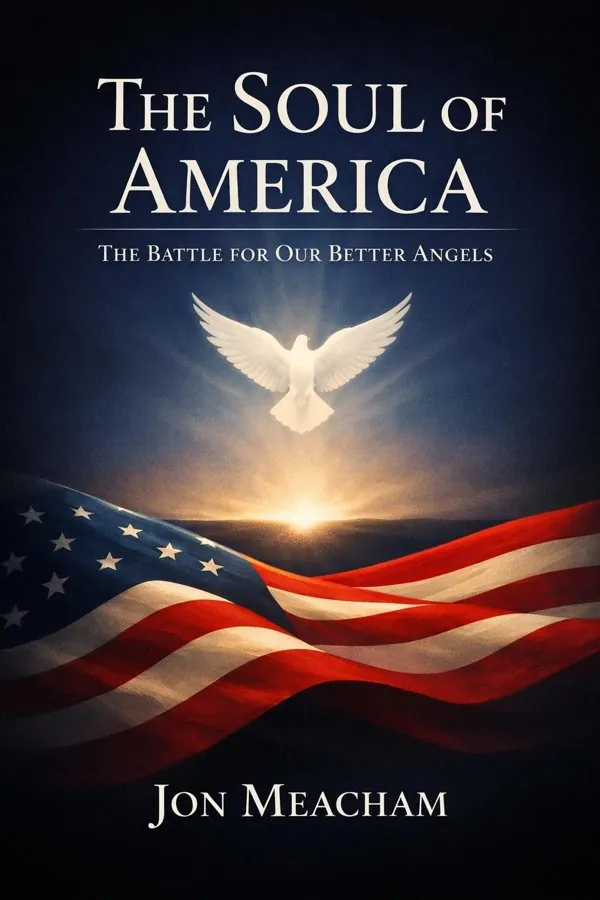
The Soul of America: The Battle for Our Better Angels: Summary & Key Insights
by Jon Meacham
 10 min10 chaptersAudio available
What Is The Soul of America: The Battle for Our Better Angels About?
The Soul of America: The Battle for Our Better Angels by Jon Meacham is a politics book spanning 10 pages. In this illuminating work, Pulitzer Prize–winning historian Jon Meacham explores pivotal moments in U.S. history when the nation's 'better angels' triumphed over fear and division. Through portraits of presidents and movements that shaped democracy—from Lincoln and Roosevelt to civil rights leaders—Meacham reminds readers that the American soul has always been a struggle between hope and fear, and that understanding this history can guide the present.
This FizzRead summary covers all 10 key chapters of The Soul of America: The Battle for Our Better Angels in approximately 10 minutes, distilling the most important ideas, arguments, and takeaways from Jon Meacham's work. Also available as an audio summary and Key Quotes Podcast.
The Soul of America: The Battle for Our Better Angels
In this illuminating work, Pulitzer Prize–winning historian Jon Meacham explores pivotal moments in U.S. history when the nation's 'better angels' triumphed over fear and division. Through portraits of presidents and movements that shaped democracy—from Lincoln and Roosevelt to civil rights leaders—Meacham reminds readers that the American soul has always been a struggle between hope and fear, and that understanding this history can guide the present.
Who Should Read The Soul of America: The Battle for Our Better Angels?
This book is perfect for anyone interested in politics and looking to gain actionable insights in a short read. Whether you're a student, professional, or lifelong learner, the key ideas from The Soul of America: The Battle for Our Better Angels by Jon Meacham will help you think differently.
- ✓Readers who enjoy politics and want practical takeaways
- ✓Professionals looking to apply new ideas to their work and life
- ✓Anyone who wants the core insights of The Soul of America: The Battle for Our Better Angels in just 10 minutes
Want the full summary?
Get instant access to this book summary and 100K+ more with Fizz Moment.
Get Free SummaryAvailable on App Store • Free to download
Key Chapters
The American story begins with idealists who imagined freedom yet tolerated bondage, who proclaimed equality while practicing exclusion. Our founders lived within that tension. They understood liberty as a radical experiment but restricted it to property-owning white men. When Jefferson wrote that 'all men are created equal,' he penned an aspiration more than a reality. In the founding era, America’s soul was forming—a combination of noble intent and profound contradiction.
What made the founding remarkable was not moral consistency but moral striving. The Revolution compelled Americans to ask what freedom meant, and its aftermath forced them to reckon with who deserved it. Beneath every debate—the Constitution’s compromises, the fight between Federalists and Anti-Federalists—lay a common anxiety: could a democracy built on human imperfection sustain itself? The founders believed it could if citizens upheld virtue. Yet they also feared mob rule and tyranny. Thus, they designed checks not only on power but on passion.
In this period, America’s better angels appeared in the belief that free governance required informed compassion, a sense of common good. Even amid the hypocrisy of slavery, some recognized the contradiction as untenable. Washington, Jefferson, and Madison all expressed unease at the institution but could not overcome it politically. Their failure framed the moral struggle that would define subsequent centuries. Still, the founding faith—that reason and moral conscience could guide the Republic—laid the groundwork for later awakenings. The American soul began as a promise rather than an achievement, a covenant between principle and progress destined to face relentless tests.
Lincoln’s era was the crucible of the American soul. When the Republic fractured over slavery, he stepped forward not merely as a political leader but as a moral guide. In war’s chaos, Lincoln appealed to what he called 'the better angels of our nature,' urging reconciliation amid bloodshed. For him, the choice was existential: whether America would fulfill the founding promise or collapse under its hypocrisy.
Lincoln understood fear’s seductive pull—the fear of losing privilege, culture, or identity. He faced a nation where millions refused to imagine equality as compatible with liberty. But he also knew hope’s power. In his vision, preservation of the Union was inseparable from the expansion of its moral boundaries. His Emancipation Proclamation was both pragmatic and prophetic, a recognition that freedom could not remain partial.
I have always seen Lincoln as the moral fulcrum of our history. His leadership was not about perfection but empathy—a willingness to hold together rival truths until a higher one emerged. When he called for 'malice toward none, charity for all,' he was suggesting something revolutionary: that reconciliation must be moral before it can be political. His assassination froze that dream, yet his spirit redirected the nation’s conscience. Lincoln’s appeal to humanity’s better nature became America’s enduring call in subsequent crises. His life and words proved that the soul’s redemption requires compassion even in conflict, and faith even when progress falters.
+ 8 more chapters — available in the FizzRead app
All Chapters in The Soul of America: The Battle for Our Better Angels
About the Author
Jon Meacham is an American historian, biographer, and Pulitzer Prize–winning author known for his works on American political and cultural history. He has written acclaimed biographies of Thomas Jefferson, Andrew Jackson, and George H. W. Bush, and served as a contributing writer for Time and The New York Times Book Review.
Get This Summary in Your Preferred Format
Read or listen to the The Soul of America: The Battle for Our Better Angels summary by Jon Meacham anytime, anywhere. FizzRead offers multiple formats so you can learn on your terms — all free.
Available formats: App · Audio · PDF · EPUB — All included free with FizzRead
Download The Soul of America: The Battle for Our Better Angels PDF and EPUB Summary
Key Quotes from The Soul of America: The Battle for Our Better Angels
“The American story begins with idealists who imagined freedom yet tolerated bondage, who proclaimed equality while practicing exclusion.”
“Lincoln’s era was the crucible of the American soul.”
Frequently Asked Questions about The Soul of America: The Battle for Our Better Angels
The Soul of America: The Battle for Our Better Angels by Jon Meacham is a politics book that explores key ideas across 10 chapters. In this illuminating work, Pulitzer Prize–winning historian Jon Meacham explores pivotal moments in U.S. history when the nation's 'better angels' triumphed over fear and division. Through portraits of presidents and movements that shaped democracy—from Lincoln and Roosevelt to civil rights leaders—Meacham reminds readers that the American soul has always been a struggle between hope and fear, and that understanding this history can guide the present.
More by Jon Meacham
You Might Also Like
Antifa: The Anti-Fascist Handbook
Mark Bray
10 min
Attack from Within: How Disinformation Is Sabotaging America
Barbara McQuade
10 min
Coercion, Capital, and European States, AD 990–1992
Charles Tilly
10 min
Digital Democracy: Concepts, Methodologies, Tools, and Applications
Various Authors
10 min
Fascism
Stanley G. Payne
10 min
Fire And Fury: Inside The Trump White House
Michael Wolff
10 minBrowse by Category
Ready to read The Soul of America: The Battle for Our Better Angels?
Get the full summary and 100K+ more books with Fizz Moment.