
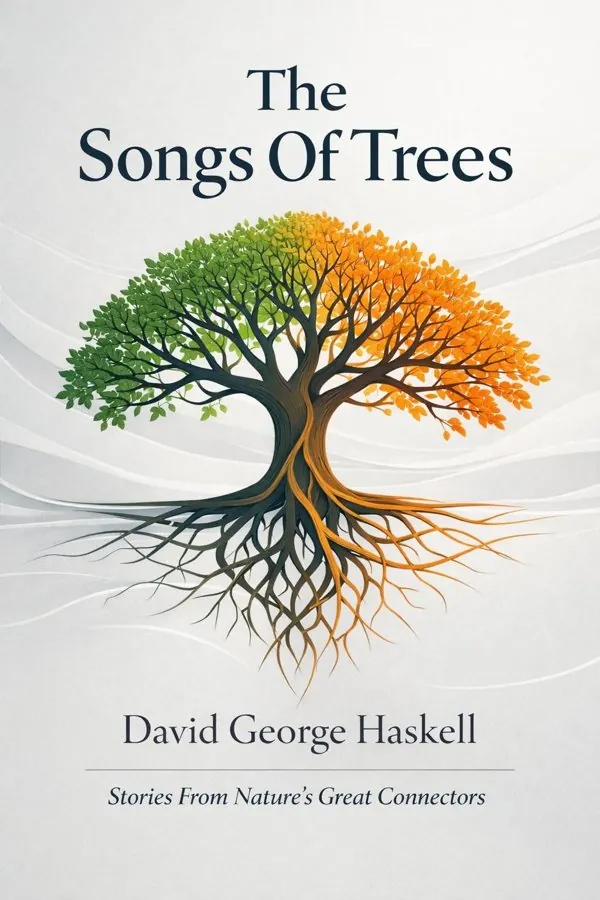
The Songs Of Trees: Stories From Nature's Great Connectors: Summary & Key Insights
 10 min10 chaptersAudio available
What Is The Songs Of Trees: Stories From Nature's Great Connectors About?
The Songs Of Trees: Stories From Nature's Great Connectors by David George Haskell is a environment book spanning 10 pages. A lyrical and scientific exploration of the biological and cultural connections that trees create across the world. David George Haskell listens to a dozen trees in different ecosystems—from the Amazon rainforest to the streets of Manhattan—revealing how they connect and sustain life. The book blends ecology, philosophy, and storytelling to show how trees embody the interdependence of all living things.
This FizzRead summary covers all 10 key chapters of The Songs Of Trees: Stories From Nature's Great Connectors in approximately 10 minutes, distilling the most important ideas, arguments, and takeaways from David George Haskell's work. Also available as an audio summary and Key Quotes Podcast.
The Songs Of Trees: Stories From Nature's Great Connectors
A lyrical and scientific exploration of the biological and cultural connections that trees create across the world. David George Haskell listens to a dozen trees in different ecosystems—from the Amazon rainforest to the streets of Manhattan—revealing how they connect and sustain life. The book blends ecology, philosophy, and storytelling to show how trees embody the interdependence of all living things.
Who Should Read The Songs Of Trees: Stories From Nature's Great Connectors?
This book is perfect for anyone interested in environment and looking to gain actionable insights in a short read. Whether you're a student, professional, or lifelong learner, the key ideas from The Songs Of Trees: Stories From Nature's Great Connectors by David George Haskell will help you think differently.
- ✓Readers who enjoy environment and want practical takeaways
- ✓Professionals looking to apply new ideas to their work and life
- ✓Anyone who wants the core insights of The Songs Of Trees: Stories From Nature's Great Connectors in just 10 minutes
Want the full summary?
Get instant access to this book summary and 100K+ more with Fizz Moment.
Get Free SummaryAvailable on App Store • Free to download
Key Chapters
In the heart of the Ecuadorian rainforest stands the ceibo tree — a giant whose roots stretch deep into both the soil and the culture of the region. To stand beneath its branches is to stand within a living cathedral, moist with life and layered with sound. The ceibo’s enormous trunk is more than a physical support; it is an intersection point for thousands of species, from ants nested in its bark to orchids that cling to its limbs. Indigenous communities here see the ceibo not as an object, but as kin — a guardian that shelters and sustains.
When I listened by the ceibo, the rainforest murmured like a conversation carried through time. Each breath of air passing through its branches stirred countless other beings, insects and birds reacting in subtle symphony. Scientifically, the ceibo’s wide canopy creates microclimates that nurture biodiversity. Culturally, it anchors stories and rituals, reminding those who dwell here that human life is braided into the forest’s rhythms.
In the intertwining roots and the humming canopy, one can sense a lesson about interdependence. Biodiversity is the rainforest’s language; every living being is a syllable that contributes to meaning. The ceibo shows us that to safeguard life, we must honor connection. To cut such a tree for profit or convenience is to silence a part of the world’s voice.
Moving northward, I came to the white pine — a tree that once covered the eastern landscapes of North America, shaping human and ecological history alike. The white pine’s needles whisper in the wind, carrying echoes of centuries of logging, resistance, and regeneration. In its relationships with fungi below and warblers above, the tree embodies balance and resilience.
Historically, white pines built ships and cities, linking human enterprise to forest vitality. As I listened, the air held both nostalgia and renewal. The remaining old-growth stands hum with underground stories: roots communicating distress, nutrients shared among neighbors through mycorrhizal networks. In these networks, individuality dissolves — one tree’s growth depends on another’s wisdom, carried chemically and electrically through soil.
The pine’s song is one of perseverance amid exploitation. It reminds us that restoration is possible, that forests can regrow when humans learn humility. Every pine needle vibrating in the wind is a testament: connection over isolation, regeneration over depletion.
+ 8 more chapters — available in the FizzRead app
All Chapters in The Songs Of Trees: Stories From Nature's Great Connectors
About the Author
David George Haskell is a biologist and writer whose work integrates scientific observation with literary narrative. He is a professor of biology at the University of the South in Sewanee, Tennessee, and a Pulitzer Prize finalist for his earlier book, The Forest Unseen. His writing explores the relationships between humans and the natural world.
Get This Summary in Your Preferred Format
Read or listen to the The Songs Of Trees: Stories From Nature's Great Connectors summary by David George Haskell anytime, anywhere. FizzRead offers multiple formats so you can learn on your terms — all free.
Available formats: App · Audio · PDF · EPUB — All included free with FizzRead
Download The Songs Of Trees: Stories From Nature's Great Connectors PDF and EPUB Summary
Key Quotes from The Songs Of Trees: Stories From Nature's Great Connectors
“In the heart of the Ecuadorian rainforest stands the ceibo tree — a giant whose roots stretch deep into both the soil and the culture of the region.”
“Moving northward, I came to the white pine — a tree that once covered the eastern landscapes of North America, shaping human and ecological history alike.”
Frequently Asked Questions about The Songs Of Trees: Stories From Nature's Great Connectors
The Songs Of Trees: Stories From Nature's Great Connectors by David George Haskell is a environment book that explores key ideas across 10 chapters. A lyrical and scientific exploration of the biological and cultural connections that trees create across the world. David George Haskell listens to a dozen trees in different ecosystems—from the Amazon rainforest to the streets of Manhattan—revealing how they connect and sustain life. The book blends ecology, philosophy, and storytelling to show how trees embody the interdependence of all living things.
More by David George Haskell
You Might Also Like

A Life on Our Planet: My Witness Statement and a Vision for the Future
David Attenborough
10 min
A Sky Full Of Birds
Matt Merritt
10 min
Carbon Zero: Imagining Cities That Can Save the Planet
Alex Steffen
10 min
Eaarth: Making a Life on a Tough New Planet
Bill McKibben
10 min
The Social Contract and Environmental Governance
Various Editors
10 min
The Wild Places
Robert Macfarlane
10 minBrowse by Category
Ready to read The Songs Of Trees: Stories From Nature's Great Connectors?
Get the full summary and 100K+ more books with Fizz Moment.