
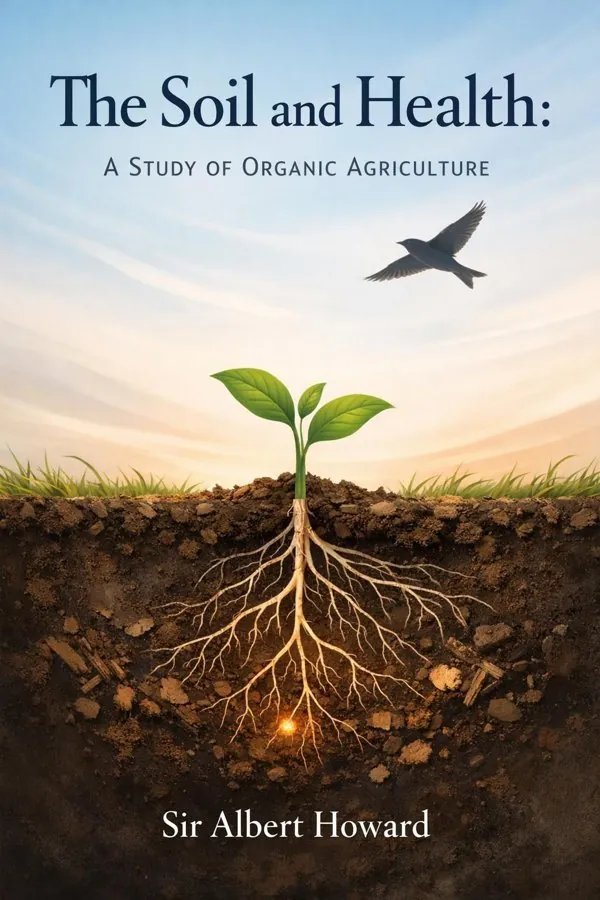
The Soil and Health: A Study of Organic Agriculture: Summary & Key Insights
 10 min11 chaptersAudio available
What Is The Soil and Health: A Study of Organic Agriculture About?
The Soil and Health: A Study of Organic Agriculture by Sir Albert Howard is a environment book spanning 11 pages. In this seminal work, Sir Albert Howard presents his philosophy of organic agriculture, emphasizing the interdependence of soil health, plant vitality, animal well-being, and human nutrition. Drawing on his extensive agricultural research in India, Howard critiques industrial farming practices and advocates for composting and natural soil fertility as the foundation of sustainable farming.
This FizzRead summary covers all 11 key chapters of The Soil and Health: A Study of Organic Agriculture in approximately 10 minutes, distilling the most important ideas, arguments, and takeaways from Sir Albert Howard's work. Also available as an audio summary and Key Quotes Podcast.
The Soil and Health: A Study of Organic Agriculture
In this seminal work, Sir Albert Howard presents his philosophy of organic agriculture, emphasizing the interdependence of soil health, plant vitality, animal well-being, and human nutrition. Drawing on his extensive agricultural research in India, Howard critiques industrial farming practices and advocates for composting and natural soil fertility as the foundation of sustainable farming.
Who Should Read The Soil and Health: A Study of Organic Agriculture?
This book is perfect for anyone interested in environment and looking to gain actionable insights in a short read. Whether you're a student, professional, or lifelong learner, the key ideas from The Soil and Health: A Study of Organic Agriculture by Sir Albert Howard will help you think differently.
- ✓Readers who enjoy environment and want practical takeaways
- ✓Professionals looking to apply new ideas to their work and life
- ✓Anyone who wants the core insights of The Soil and Health: A Study of Organic Agriculture in just 10 minutes
Want the full summary?
Get instant access to this book summary and 100K+ more with Fizz Moment.
Get Free SummaryAvailable on App Store • Free to download
Key Chapters
As I traveled through India and later studied conditions across the globe, a grievous pattern emerged everywhere. Our soils—the very skin of the Earth—were bleeding away. It was not merely a local misfortune; it was the consequence of a universal recklessness. Industrial and colonial farming, driven by immediate profit and heedless extraction, had stripped the soil of its protective cover, its humus, its life. Where the forests had been cleared for plantations, where the rotation of crops had been abandoned, the humus disappeared, and the land collapsed into dust.
I saw fields that once yielded bounty reduced to sterile wasteland. Erosion was more than the movement of earth—it was the physical sign of a broken relationship. Without organic matter continually returning, the structure of the soil disintegrated. Rain no longer sank into the ground but tore it apart, carrying away its most fertile fractions. The farmer, deprived of living soil, turned increasingly to chemical crutches, perpetuating the cycle of decay.
This chapter warns that soil erosion is not simply technical—it is moral and ecological. The health of civilizations depends upon the conservation of the soil. Whenever men forget this, history records their downfall. The only enduring remedy is to restore humus, to return all organic refuse to the land, and to treat every farm not as a factory but as a living organism that must be nourished from within.
During my years in India, I sought a practical way to restore fertility—not through imported chemicals but through harnessing natural processes. The Indore Process was born out of this quest. At its core lies the art of composting: converting the waste of life into the raw material of future growth. I learned from local peasants, forest, and garden practice that nature never wastes. Leaves fall, animals die, and all is returned to the soil. I refined this process to suit farm scale—systematic, predictable, and as scientifically elegant as it is natural.
By mixing plant residues, animal manure, and a touch of soil in controlled heaps and allowing aerobic decomposition, we watch transformation occur. The result is humus—a stable, friable, and astonishingly fertile substance, rich with microbial life. The Indore Process proved that any farm can be self-contained in fertility. It removes dependence on artificial fertilizers and transforms what we once called waste into wealth.
Through detailed experiments and years of observation, I found that fields treated with Indore compost produced plants with deeper roots, higher resistance to disease, and better yields over time. When the Law of Return is embodied through composting, fertility becomes an unending cycle, not a resource to be mined and exhausted.
+ 9 more chapters — available in the FizzRead app
All Chapters in The Soil and Health: A Study of Organic Agriculture
About the Author
Sir Albert Howard (1873–1947) was a British botanist and agricultural scientist, widely regarded as one of the founders of the organic farming movement. His research in India and his advocacy for soil fertility and natural farming methods profoundly influenced modern sustainable agriculture.
Get This Summary in Your Preferred Format
Read or listen to the The Soil and Health: A Study of Organic Agriculture summary by Sir Albert Howard anytime, anywhere. FizzRead offers multiple formats so you can learn on your terms — all free.
Available formats: App · Audio · PDF · EPUB — All included free with FizzRead
Download The Soil and Health: A Study of Organic Agriculture PDF and EPUB Summary
Key Quotes from The Soil and Health: A Study of Organic Agriculture
“As I traveled through India and later studied conditions across the globe, a grievous pattern emerged everywhere.”
“During my years in India, I sought a practical way to restore fertility—not through imported chemicals but through harnessing natural processes.”
Frequently Asked Questions about The Soil and Health: A Study of Organic Agriculture
The Soil and Health: A Study of Organic Agriculture by Sir Albert Howard is a environment book that explores key ideas across 11 chapters. In this seminal work, Sir Albert Howard presents his philosophy of organic agriculture, emphasizing the interdependence of soil health, plant vitality, animal well-being, and human nutrition. Drawing on his extensive agricultural research in India, Howard critiques industrial farming practices and advocates for composting and natural soil fertility as the foundation of sustainable farming.
You Might Also Like

A Life on Our Planet: My Witness Statement and a Vision for the Future
David Attenborough
10 min
A Sky Full Of Birds
Matt Merritt
10 min
Carbon Zero: Imagining Cities That Can Save the Planet
Alex Steffen
10 min
Eaarth: Making a Life on a Tough New Planet
Bill McKibben
10 min
The Social Contract and Environmental Governance
Various Editors
10 min
The Wild Places
Robert Macfarlane
10 minBrowse by Category
Ready to read The Soil and Health: A Study of Organic Agriculture?
Get the full summary and 100K+ more books with Fizz Moment.