
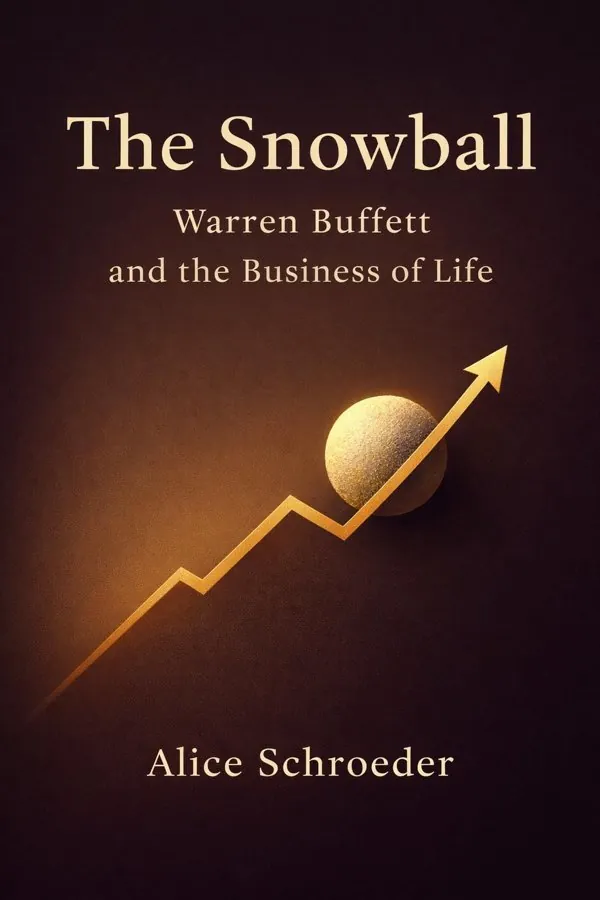
The Snowball: Warren Buffett and the Business of Life: Summary & Key Insights
 10 min9 chaptersAudio available
Key Takeaways from The Snowball: Warren Buffett and the Business of Life
Great fortunes often begin long before money appears.
Education creates the most value when it gives you a framework for thinking, not merely a certificate.
Big empires often begin with modest structures and disciplined execution.
The most important edge in investing is often emotional, not mathematical.
Public success and private wholeness are not always the same achievement.
What Is The Snowball: Warren Buffett and the Business of Life About?
The Snowball: Warren Buffett and the Business of Life by Alice Schroeder is a biographies book spanning 6 pages. The Snowball: Warren Buffett and the Business of Life is far more than a business biography. It is a detailed portrait of how one of the world’s greatest investors built his fortune, shaped his principles, and navigated the emotional contradictions of an extraordinary life. Alice Schroeder traces Warren Buffett from his childhood in Omaha to his rise as the leader of Berkshire Hathaway, showing how curiosity, discipline, emotional restraint, and relentless learning combined into one of the most remarkable careers in modern capitalism. But the book also goes beyond balance sheets. It examines Buffett’s family relationships, his partnership with Susan Buffett, his intellectual bond with Charlie Munger, and his evolving views on philanthropy and purpose. What makes the book especially valuable is Schroeder’s authority. A former top financial analyst, she was given unusual access to Buffett, his family, friends, and personal archives. The result is an intimate, richly reported account that explains not just what Buffett did, but how he thought. For readers interested in investing, decision-making, leadership, or the hidden tradeoffs behind success, this book is both instructive and unforgettable.
This FizzRead summary covers all 9 key chapters of The Snowball: Warren Buffett and the Business of Life in approximately 10 minutes, distilling the most important ideas, arguments, and takeaways from Alice Schroeder's work. Also available as an audio summary and Key Quotes Podcast.
The Snowball: Warren Buffett and the Business of Life
The Snowball: Warren Buffett and the Business of Life is far more than a business biography. It is a detailed portrait of how one of the world’s greatest investors built his fortune, shaped his principles, and navigated the emotional contradictions of an extraordinary life. Alice Schroeder traces Warren Buffett from his childhood in Omaha to his rise as the leader of Berkshire Hathaway, showing how curiosity, discipline, emotional restraint, and relentless learning combined into one of the most remarkable careers in modern capitalism. But the book also goes beyond balance sheets. It examines Buffett’s family relationships, his partnership with Susan Buffett, his intellectual bond with Charlie Munger, and his evolving views on philanthropy and purpose. What makes the book especially valuable is Schroeder’s authority. A former top financial analyst, she was given unusual access to Buffett, his family, friends, and personal archives. The result is an intimate, richly reported account that explains not just what Buffett did, but how he thought. For readers interested in investing, decision-making, leadership, or the hidden tradeoffs behind success, this book is both instructive and unforgettable.
Who Should Read The Snowball: Warren Buffett and the Business of Life?
This book is perfect for anyone interested in biographies and looking to gain actionable insights in a short read. Whether you're a student, professional, or lifelong learner, the key ideas from The Snowball: Warren Buffett and the Business of Life by Alice Schroeder will help you think differently.
- ✓Readers who enjoy biographies and want practical takeaways
- ✓Professionals looking to apply new ideas to their work and life
- ✓Anyone who wants the core insights of The Snowball: Warren Buffett and the Business of Life in just 10 minutes
Want the full summary?
Get instant access to this book summary and 100K+ more with Fizz Moment.
Get Free SummaryAvailable on App Store • Free to download
Key Chapters
Great fortunes often begin long before money appears. In Warren Buffett’s case, the foundation was laid in Omaha during a childhood shaped by numbers, routine, and a deep respect for integrity. Alice Schroeder shows that Buffett was not simply born with a talent for investing; he was formed by an environment that rewarded thrift, observation, and independent thinking. His father, Howard Buffett, a stockbroker and later congressman, modeled honesty and principle. His mother, Leila, brought emotional complexity to the household, giving Buffett an early education in both insecurity and self-reliance.
As a child, Buffett displayed an unusual fascination with making money. He sold chewing gum, Coca-Cola, and magazines, tracked statistics obsessively, and treated small enterprises as experiments. What stands out is not just that he earned money young, but that he loved measuring results. Profit became less a symbol of luxury and more a scoreboard of rational judgment. Omaha’s Midwestern practicality reinforced this attitude. Buffett learned to value plain dealing over appearance and long-term consistency over dramatic gestures.
This early period also helps explain one of Buffett’s most enduring traits: emotional distance paired with intellectual intensity. He often found safety in systems, patterns, and numbers. That made him exceptionally suited to investing, where calm analysis can outperform emotional reaction.
For modern readers, the lesson is powerful. Lasting success is usually built on early habits, not sudden breakthroughs. You do not need Buffett’s childhood, but you can imitate his habits: track what matters, start small, stay curious, and protect your integrity as if it were capital. Actionable takeaway: identify one repeated habit in your life that compounds over time, and strengthen it deliberately this week.
Education creates the most value when it gives you a framework for thinking, not merely a certificate. Buffett’s academic path illustrates this clearly. He attended the Wharton School briefly, then transferred to the University of Nebraska, and eventually studied at Columbia Business School, where he met Benjamin Graham. That encounter changed the trajectory of his life because Graham gave Buffett something more important than information: a disciplined method.
Graham’s value investing philosophy taught Buffett to view stocks not as tickers moving across a screen, but as ownership shares in real businesses. The famous ideas of intrinsic value, margin of safety, and market irrationality gave Buffett a rational structure for making decisions. Rather than chasing excitement or guessing short-term trends, he learned to compare price with underlying business value. This became his intellectual anchor.
Schroeder makes clear, however, that Buffett did not become great simply by adopting Graham’s rules. He internalized them, tested them, and later evolved them. That is the deeper lesson. Real learning happens when you absorb a principle deeply enough to adapt it without abandoning its core.
This applies far beyond finance. In careers, relationships, and strategy, most people look for hacks. Buffett looked for enduring truths. He wanted a model that would still work after emotions, fads, and market noise passed.
If you are building expertise in any field, focus less on collecting credentials and more on mastering foundational ideas. Ask yourself: what are the core principles that explain success in my domain? Then study them until they become second nature. Actionable takeaway: choose one foundational concept in your field and spend the next week applying it consciously in real decisions.
Big empires often begin with modest structures and disciplined execution. Before Berkshire Hathaway became a legendary conglomerate, Buffett built his reputation through investment partnerships that demonstrated his ability to allocate capital better than almost anyone else. Schroeder shows how these early partnerships were not glamorous. They were practical vehicles that allowed Buffett to apply his ideas, earn trust, and prove that rational discipline could produce extraordinary returns over time.
Buffett’s early method was classic Graham: buy undervalued securities, special situations, and statistically cheap assets. He was intensely analytical and willing to go where others were not looking. Yet the real turning point came with Berkshire Hathaway. Originally a struggling textile company, Berkshire was not acquired because it was a wonderful business. It was a cheap one. Buffett later described buying it as a mistake in strategic terms, but he transformed that mistake into a platform. By using Berkshire as a capital allocation vehicle, he created an engine that could redeploy cash into far better businesses.
This chapter of Buffett’s life illustrates an essential truth: success does not require a perfect beginning. It requires the ability to redirect imperfect opportunities toward better outcomes. Berkshire’s evolution from textile mill to capital compounding machine shows Buffett’s gift was not merely picking stocks. It was structuring systems that multiplied the effect of sound decisions over decades.
Professionals can apply the same thinking to their own work. A job, business, or project may not be ideal at first. But if it gives you control over capital, skills, relationships, or reputation, it can become the base for something much larger.
Actionable takeaway: evaluate one underwhelming asset in your life or career and ask how it could be repurposed into a platform for future growth instead of discarded as a disappointment.
The most important edge in investing is often emotional, not mathematical. One of Schroeder’s clearest insights is that Buffett’s genius lies as much in temperament as in intellect. He is undoubtedly brilliant, but his rare advantage is his ability to remain rational when others are fearful, greedy, impatient, or distracted. In markets, emotional control is a competitive advantage because panic and euphoria constantly distort price.
Buffett’s famous calm is not passive. It is trained restraint. He developed habits that protected his thinking from noise: reading constantly, working independently, avoiding unnecessary complexity, and refusing to let social pressure dictate decisions. He understood that investment success often comes from doing nothing while others overreact. This ability to wait is one of the central themes of The Snowball. The market rewards not those who act most often, but those who act most wisely.
This principle extends beyond investing. In negotiation, leadership, and personal decision-making, people often damage outcomes by seeking immediate relief from uncertainty. They confuse activity with progress. Buffett demonstrates the opposite. He waits for conditions he understands, then acts decisively.
A practical example is hiring or career moves. Many people accept the first respectable opportunity because waiting feels uncomfortable. A more Buffett-like approach is to define what truly matters, remain patient, and move only when the odds are in your favor.
Emotional discipline can be built. Reduce exposure to noise, write down your decision criteria before acting, and review results objectively rather than defensively. Actionable takeaway: before your next important decision, pause and ask whether you are responding to facts or to discomfort. Delay action until the answer is clear.
Public success and private wholeness are not always the same achievement. One of the most revealing dimensions of The Snowball is its exploration of Buffett’s personal life, especially his relationship with Susan Thompson Buffett. Susan was not merely Buffett’s wife; she was a stabilizing, socially expansive, emotionally intelligent force who helped compensate for qualities he lacked. Where Buffett was guarded and intensely focused, Susan was warm, empathetic, and outward-looking. Their marriage contained love, strain, distance, and unconventional arrangements, making it one of the most human parts of the biography.
Schroeder uses this relationship to illuminate Buffett’s idea of the “inner scorecard,” the notion that what matters most is not external applause but whether you are living by standards you respect. Yet the book also complicates that idea. Buffett excelled at measuring business outcomes, but emotional life proved harder to quantify. His devotion to work sometimes came at personal cost. This tension is one reason the biography feels richer than a simple success story.
For readers, this is a crucial lesson. Competence in one domain does not guarantee wisdom in others. A person can be world-class in business and still struggle with intimacy, communication, or emotional reciprocity. That does not diminish accomplishment, but it should deepen our understanding of what a full life requires.
In practical terms, many ambitious people overinvest in visible performance and underinvest in relationships that sustain them. The inner scorecard should include character, loyalty, and presence, not just financial or professional milestones.
Actionable takeaway: define three standards by which you want to judge your life privately, then compare them with the metrics you currently spend most of your time optimizing.
Sometimes the most important partnership in life is the one that improves how you think. Charlie Munger’s influence on Buffett is one of the book’s central intellectual stories. Buffett began as a classic Graham investor, focused on buying assets cheaply. Munger helped him evolve toward buying wonderful businesses at fair prices rather than merely fair businesses at wonderful prices. That shift may sound subtle, but it changed Berkshire Hathaway permanently.
Munger broadened Buffett’s lens from balance-sheet bargains to durable economics. Instead of focusing only on undervaluation, the two increasingly emphasized quality: strong brands, pricing power, trustworthy management, and business models capable of compounding over long periods. Companies like See’s Candies became proof that a great business could be worth far more than traditional value formulas suggested.
Schroeder also highlights the nature of their partnership. It was grounded in intellectual honesty, low ego, and mutual trust. They disagreed productively, shared a common ethical framework, and pursued truth over pride. This is rare. Many partnerships fail because people seek validation rather than correction.
Readers can apply this lesson by seeking collaborators who do not merely support their strengths but challenge their limitations. A great thinking partner increases the quality of your decisions by widening the map, not by cheering louder.
This idea works in business, creative work, and personal development. If you are naturally analytical, find someone with stronger judgment about people. If you are visionary, find someone who sees structural risks. The goal is not comfort but complementarity.
Actionable takeaway: identify one area where your current decision-making is one-dimensional, and seek out a person or perspective that consistently improves your blind spot.
In Buffett’s world, ethics are not decorative ideals; they are practical assets with enormous long-term value. Throughout The Snowball, Schroeder emphasizes Buffett’s belief that trust compounds just as capital does. A reputation for honesty attracts better partners, better deals, better managers, and greater resilience during hard times. Conversely, ethical shortcuts may produce short-term gains but eventually destroy the very system that creates wealth.
Buffett’s management philosophy reflects this view. He often acquired companies run by strong managers and then gave them autonomy, trusting them to operate responsibly. He preferred simple arrangements, direct communication, and moral clarity. One of his well-known principles was that he could tolerate mistakes of judgment, but not lapses in integrity. This standard helped shape Berkshire’s distinctive culture.
The practical lesson is that ethical behavior is not separate from performance. In many fields, reliability is a multiplier. A person who can be trusted lowers friction, speeds decisions, and attracts repeat opportunities. This is true for executives, freelancers, investors, and team leaders alike.
Consider how this applies in ordinary work. A manager who gives honest feedback early prevents expensive confusion later. A founder who treats investors transparently builds flexibility when results disappoint. A professional who refuses to manipulate metrics may lose a short-term advantage but gains credibility that compounds for years.
The challenge is that ethical returns are rarely immediate. They often arrive quietly, through trust accumulated over time. Buffett’s life demonstrates that this delayed payoff is still one of the best investments available.
Actionable takeaway: choose one area where convenience tempts you to blur standards, and replace ambiguity with a clear rule that protects your reputation before it is tested.
Buffett is often described as an investor, but Schroeder’s deeper point is that he is an extraordinary allocator. He decides where money, attention, time, and trust should go for the highest long-term return. That skill is not limited to billion-dollar acquisitions. It is a universal principle that applies to anyone trying to build a meaningful life.
At Berkshire Hathaway, Buffett allocated capital toward opportunities with attractive economics and trustworthy leadership. He resisted pressure to diversify mindlessly or pursue growth for its own sake. He concentrated resources where odds and understanding aligned. This same logic appeared in his personal habits. He guarded his time, read constantly, and designed his life to reduce distraction.
Most people think poor outcomes come from lack of effort. Often they come from poor allocation. We spend premium energy on low-value tasks, attention on trivial conflicts, and money on status purchases rather than durable assets. Buffett’s example invites a different question: not “Am I working hard?” but “Am I putting resources where they compound?”
This can be applied immediately. In a career, capital allocation means choosing projects that build scarce skills or strong networks. In personal finance, it means buying productive assets before indulgences. In health, it means prioritizing habits with outsized returns, such as sleep, exercise, and consistency.
The beauty of this idea is that it scales. Whether you manage billions or a monthly budget, the principle is the same: allocate scarce resources to high-quality opportunities and avoid unnecessary leakage.
Actionable takeaway: review your calendar and spending from the past two weeks, then eliminate or reduce one recurring commitment that consumes resources without offering meaningful long-term return.
The final measure of wealth is not how much you accumulate, but what you choose to do with the power it creates. In later life, Buffett’s views on philanthropy became a defining part of his legacy. Schroeder shows that his decision to give away the vast majority of his fortune was not a sudden gesture of generosity, but the extension of a deeply held belief: capital should be allocated where it can do the most good.
Buffett rejected the idea of dynastic wealth as an automatic virtue. He believed massive inherited fortunes could distort incentives and that society benefits when resources are directed toward capable institutions addressing large-scale problems. His commitment to donate most of his wealth, particularly through the Gates Foundation and family foundations, reflected a practical, results-oriented philosophy. Even in philanthropy, he thought like an allocator.
This perspective matters because it reframes success. The point of compounding is not merely accumulation for its own sake. At some stage, the question becomes one of stewardship. What responsibilities accompany extraordinary advantage? Buffett’s answer was to treat wealth as a tool, not a trophy.
Readers do not need billions to apply this lesson. Philanthropy can begin with money, but it also includes time, mentoring, and institutional support. The broader idea is to think deliberately about surplus. Once your basic needs and prudent security are covered, what is the highest use of what remains?
Actionable takeaway: choose one cause or institution you genuinely trust and commit a defined amount of money, time, or expertise to it on a recurring basis rather than waiting for a perfect future moment to give.
All Chapters in The Snowball: Warren Buffett and the Business of Life
About the Author
Alice Schroeder is an American author, journalist, and former financial analyst best known for writing The Snowball: Warren Buffett and the Business of Life. Before turning to writing, she built a distinguished career on Wall Street, including serving as a highly regarded insurance analyst at Morgan Stanley. Her strong background in finance gave her the technical knowledge needed to understand complex business and investment decisions, while her reporting skills helped her translate that expertise into accessible, engaging prose. Schroeder gained rare access to Warren Buffett, his personal papers, and the people closest to him, allowing her to produce one of the most detailed and authoritative biographies ever written about a business leader. Her work is valued for combining analytical precision with psychological depth and narrative clarity.
Get This Summary in Your Preferred Format
Read or listen to the The Snowball: Warren Buffett and the Business of Life summary by Alice Schroeder anytime, anywhere. FizzRead offers multiple formats so you can learn on your terms — all free.
Available formats: App · Audio · PDF · EPUB — All included free with FizzRead
Download The Snowball: Warren Buffett and the Business of Life PDF and EPUB Summary
Key Quotes from The Snowball: Warren Buffett and the Business of Life
“Great fortunes often begin long before money appears.”
“Education creates the most value when it gives you a framework for thinking, not merely a certificate.”
“Big empires often begin with modest structures and disciplined execution.”
“The most important edge in investing is often emotional, not mathematical.”
“Public success and private wholeness are not always the same achievement.”
Frequently Asked Questions about The Snowball: Warren Buffett and the Business of Life
The Snowball: Warren Buffett and the Business of Life by Alice Schroeder is a biographies book that explores key ideas across 9 chapters. The Snowball: Warren Buffett and the Business of Life is far more than a business biography. It is a detailed portrait of how one of the world’s greatest investors built his fortune, shaped his principles, and navigated the emotional contradictions of an extraordinary life. Alice Schroeder traces Warren Buffett from his childhood in Omaha to his rise as the leader of Berkshire Hathaway, showing how curiosity, discipline, emotional restraint, and relentless learning combined into one of the most remarkable careers in modern capitalism. But the book also goes beyond balance sheets. It examines Buffett’s family relationships, his partnership with Susan Buffett, his intellectual bond with Charlie Munger, and his evolving views on philanthropy and purpose. What makes the book especially valuable is Schroeder’s authority. A former top financial analyst, she was given unusual access to Buffett, his family, friends, and personal archives. The result is an intimate, richly reported account that explains not just what Buffett did, but how he thought. For readers interested in investing, decision-making, leadership, or the hidden tradeoffs behind success, this book is both instructive and unforgettable.
You Might Also Like

An American Marriage
Tayari Jones
10 min
Benjamin Franklin: An American Life
Walter Isaacson
10 min
I Know Why The Caged Bird Sings
Maya Angelou
10 min
Long Walk to Freedom
Nelson Mandela
10 min
Persepolis
Marjane Satrapi
10 min
Surely You're Joking, Mr. Feynman!
Richard P. Feynman
10 minBrowse by Category
Ready to read The Snowball: Warren Buffett and the Business of Life?
Get the full summary and 100K+ more books with Fizz Moment.