
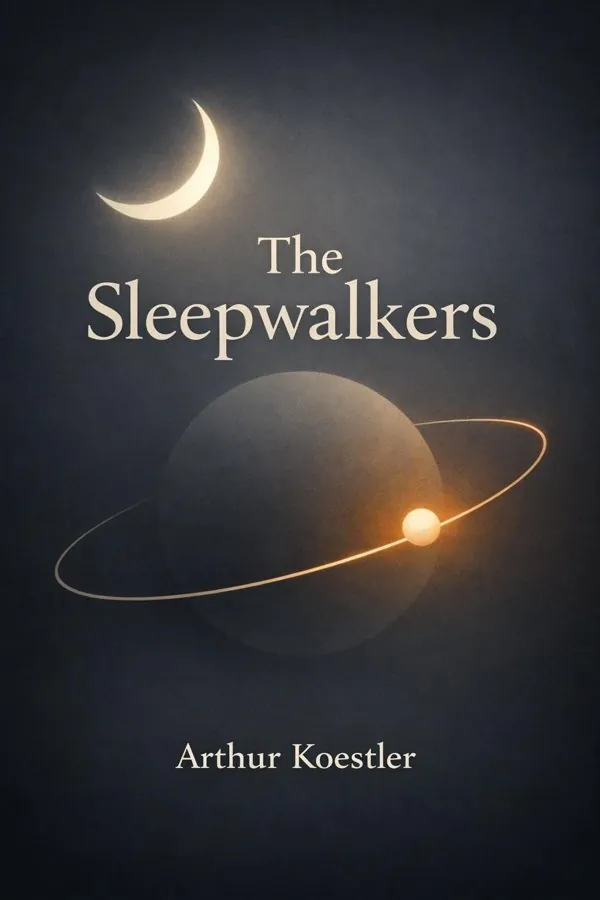
The Sleepwalkers: A History of Man’s Changing Vision of the Universe: Summary & Key Insights
 10 min10 chaptersAudio available
Key Takeaways from The Sleepwalkers: A History of Man’s Changing Vision of the Universe
Before people tried to calculate the heavens, they told stories about them.
A civilization changes when it starts asking not only what the world means, but how it works.
Some systems survive not because they are true in the deepest sense, but because they are useful enough.
An age remains stable when it can join knowledge, morality, and social order into one convincing picture.
Revolutions in thought often begin quietly.
What Is The Sleepwalkers: A History of Man’s Changing Vision of the Universe About?
The Sleepwalkers: A History of Man’s Changing Vision of the Universe by Arthur Koestler is a civilization book spanning 9 pages. Arthur Koestler’s The Sleepwalkers is a sweeping history of how Western humanity learned to imagine the universe differently. Moving from ancient myth and Greek philosophy through Ptolemy, Copernicus, Kepler, Galileo, and Newton, Koestler argues that scientific progress did not unfold as a calm ascent of pure reason. Instead, it advanced through confusion, obsession, intuition, theological compromise, and flashes of visionary insight. His famous image of the great scientific pioneers as “sleepwalkers” challenges the comforting myth that modern science was built only by cold logic. These thinkers often moved forward without fully grasping where their own ideas would lead. What makes the book enduring is not just its history of astronomy, but its portrait of discovery itself. Koestler shows that revolutions in knowledge are deeply human events shaped by ambition, imagination, error, and cultural pressure. A novelist, historian, and essayist with unusual range, he brings scientific ideas to life as drama rather than abstraction. The result is a rich, provocative account of how our picture of the cosmos changed—and how every major intellectual breakthrough carries both reason and mystery within it.
This FizzRead summary covers all 10 key chapters of The Sleepwalkers: A History of Man’s Changing Vision of the Universe in approximately 10 minutes, distilling the most important ideas, arguments, and takeaways from Arthur Koestler's work. Also available as an audio summary and Key Quotes Podcast.
The Sleepwalkers: A History of Man’s Changing Vision of the Universe
Arthur Koestler’s The Sleepwalkers is a sweeping history of how Western humanity learned to imagine the universe differently. Moving from ancient myth and Greek philosophy through Ptolemy, Copernicus, Kepler, Galileo, and Newton, Koestler argues that scientific progress did not unfold as a calm ascent of pure reason. Instead, it advanced through confusion, obsession, intuition, theological compromise, and flashes of visionary insight. His famous image of the great scientific pioneers as “sleepwalkers” challenges the comforting myth that modern science was built only by cold logic. These thinkers often moved forward without fully grasping where their own ideas would lead.
What makes the book enduring is not just its history of astronomy, but its portrait of discovery itself. Koestler shows that revolutions in knowledge are deeply human events shaped by ambition, imagination, error, and cultural pressure. A novelist, historian, and essayist with unusual range, he brings scientific ideas to life as drama rather than abstraction. The result is a rich, provocative account of how our picture of the cosmos changed—and how every major intellectual breakthrough carries both reason and mystery within it.
Who Should Read The Sleepwalkers: A History of Man’s Changing Vision of the Universe?
This book is perfect for anyone interested in civilization and looking to gain actionable insights in a short read. Whether you're a student, professional, or lifelong learner, the key ideas from The Sleepwalkers: A History of Man’s Changing Vision of the Universe by Arthur Koestler will help you think differently.
- ✓Readers who enjoy civilization and want practical takeaways
- ✓Professionals looking to apply new ideas to their work and life
- ✓Anyone who wants the core insights of The Sleepwalkers: A History of Man’s Changing Vision of the Universe in just 10 minutes
Want the full summary?
Get instant access to this book summary and 100K+ more with Fizz Moment.
Get Free SummaryAvailable on App Store • Free to download
Key Chapters
Before people tried to calculate the heavens, they told stories about them. Koestler begins by reminding us that the earliest human responses to the sky were not scientific but mythological. The stars were not distant physical bodies governed by laws; they were divine presences, omens, ancestors, or parts of sacred dramas. In Babylon, Egypt, and other ancient civilizations, celestial observation served religion, kingship, agriculture, and ritual. This was not ignorance in a simple sense. It was a different way of organizing reality, one in which meaning came before mechanism.
Koestler’s point is crucial because it undermines the idea that science emerged from a vacuum. Rational astronomy did not replace an empty superstition; it evolved out of deeply rooted symbolic systems that gave people orientation and psychological order. Even as observation became more exact, the longing for cosmic meaning did not disappear. In fact, later astronomers often carried traces of this older worldview into their supposedly scientific work.
A practical lesson follows from this. In any field—business, politics, technology, or education—people rarely begin with data alone. They begin with stories, assumptions, metaphors, and inherited beliefs. Organizations do the same. A company may say it is driven by analytics, yet often its real decisions are shaped by founding myths about what success means or who the customer is.
Koestler asks us to see knowledge historically: what seems obvious now once served a different emotional and cultural purpose. Actionable takeaway: before judging old ideas as irrational, ask what human need they once fulfilled—and examine the myths still hiding inside your own worldview.
A civilization changes when it starts asking not only what the world means, but how it works. For Koestler, the Greek achievement lies in this shift. The pre-Socratic philosophers—Thales, Anaximander, Heraclitus, Pythagoras, and others—began seeking natural explanations for cosmic order. They speculated boldly, often wrongly, but they introduced something revolutionary: the belief that the universe could be understood through rational inquiry.
This Greek legacy was not a straight march toward truth. It mixed philosophy, mathematics, metaphysics, and aesthetic preference. The Greeks loved harmony and symmetry, and those preferences shaped their cosmology. Spheres, circles, and ordered structures appeared intellectually satisfying before they were empirically proven. Plato elevated perfect geometric order; Aristotle built a powerful system that explained motion, change, and the layered structure of the cosmos. These frameworks endured not merely because they were accurate, but because they were intellectually beautiful and socially authoritative.
Koestler emphasizes that reason itself is never free of imagination. Greek thought gave Europe the tools of logic and abstraction, but it also created dogmas that later generations struggled to escape. This is a pattern worth noticing today. Elegant theories in economics, psychology, or management can dominate for centuries because they feel coherent, not because they fully fit reality.
In practical terms, the Greek moment teaches two complementary habits: think in principles, but distrust excessive elegance. A strategy, model, or explanation that seems too perfect may be concealing weak contact with facts. Actionable takeaway: when evaluating a compelling theory, ask two questions—Is it logically beautiful? And does it survive contact with messy reality?
Some systems survive not because they are true in the deepest sense, but because they are useful enough. Koestler treats the Ptolemaic system as one of history’s great intellectual constructions: a geocentric cosmos centered on Earth, equipped with deferents, epicycles, and mathematical adjustments that could predict planetary motion with impressive practical success. It was cumbersome, but it worked. That made it powerful.
Ptolemy’s achievement illustrates a paradox central to the history of ideas. A false model can still generate real results. Sailors, priests, calendar-makers, and scholars could use this Earth-centered framework for centuries. Its resilience came from both technical adaptability and cultural fit. It aligned with common sense—after all, the Earth feels stationary—and with religious and philosophical assumptions that placed humanity near the center of creation.
Koestler uses Ptolemy to show that intellectual revolutions rarely occur just because a better idea exists. Old systems often endure because they are institutionally embedded. Schools teach them, authorities defend them, and practical routines depend on them. We see the same dynamic now in outdated corporate processes, legacy software, and policy frameworks that persist because replacing them is costly and disruptive.
This is why “wrong” ideas can be extraordinarily durable. They become scaffolding for entire ways of life. To dislodge them, a new model must do more than criticize; it must solve problems, fit emerging evidence, and provide a usable alternative.
Actionable takeaway: in your own work, do not ask only whether a system is flawed. Ask why it still functions, who depends on it, and what practical replacement would make change genuinely possible.
An age remains stable when it can join knowledge, morality, and social order into one convincing picture. Koestler presents the medieval synthesis as exactly that: a civilization in which Aristotelian philosophy, Christian theology, and Ptolemaic astronomy formed a coherent universe. Earth stood at the center, the heavens were ordered and purposeful, and every level of existence had its designated place. This cosmos was not only a map of stars; it was a map of meaning.
Modern readers often caricature the Middle Ages as hostile to inquiry, but Koestler is subtler. The medieval worldview supported scholarship within boundaries. It offered intellectual security, institutional continuity, and spiritual orientation. The problem was not that it lacked intelligence, but that its assumptions became too tightly interlocked to be easily revised. If astronomy changed, theology, anthropology, and ethics seemed threatened as well.
That helps explain why later discoveries caused so much disturbance. A challenge to cosmic structure felt like a challenge to human significance. The same pattern appears whenever a society ties factual claims too closely to moral identity. Scientific debates about evolution, climate, genetics, or artificial intelligence often provoke such intensity because they seem to unsettle deeper stories about purpose and control.
Koestler’s account invites humility. People do not resist new ideas only out of stupidity; they resist because entire structures of value may be at stake. If you want to persuade others, attacking their conclusions is often less effective than understanding the framework those conclusions protect.
Actionable takeaway: when confronting resistance to change, identify the larger meaning-system involved. Address not just the facts, but the fears about identity, order, and purpose that those facts may disrupt.
Revolutions in thought often begin quietly. Copernicus did not launch modernity with a dramatic manifesto; he cautiously proposed that the Sun, not the Earth, occupies the center of the planetary system. Koestler shows that this heliocentric shift was radical in implication but conservative in style. Copernicus still clung to circular motion, mathematical harmony, and ancient ideals of cosmic perfection. His innovation was therefore partial: he displaced Earth physically without fully dismantling inherited assumptions.
This is one of Koestler’s most important insights. Breakthroughs are often hybrids. They combine bold vision with old habits. Copernicus did not think like a complete modern scientist; he thought like a Renaissance scholar trying to repair an unsatisfactory tradition using a more elegant geometry. Yet that limited change had enormous consequences. It altered humanity’s symbolic position in the universe and opened space for later thinkers to ask deeper questions about motion, evidence, and natural law.
In practical life, this pattern is common. Real transformation often starts as reframing rather than total destruction. A company may not reinvent its entire business overnight, but changing one core assumption—who the customer is, how value is created, what problem is being solved—can trigger cascading effects.
Koestler also reminds us that revolutionary ideas are often first defended on aesthetic or intuitive grounds before they are fully proven. People sense a new order before they can demonstrate it conclusively. That does not excuse carelessness, but it warns us against believing that all innovation begins with airtight certainty.
Actionable takeaway: if a system seems stuck, search for the one foundational assumption that everyone takes for granted. Changing that assumption may matter more than improving dozens of surface details.
History often celebrates visionaries, but revolutions also depend on those who collect stubborn facts. Tycho Brahe occupies this vital middle ground in Koestler’s story. He did not embrace full Copernican heliocentrism, and he proposed his own compromise model in which planets orbited the Sun while the Sun orbited the Earth. Yet his true greatness lay elsewhere: he gathered astronomical observations of unmatched precision, creating the empirical foundation on which others would build.
Koestler uses Tycho to reveal that progress is rarely made by pure theorists alone. In periods of transition, evidence accumulates before interpretation catches up. Tycho lived in the tension between old and new cosmologies, and his work reflects that ambiguity. He was aristocratic, eccentric, proud, and methodical. He also recognized that the sky had to be observed with greater accuracy than inherited books allowed. His measurements of planetary positions, as well as phenomena like comets and novae, weakened the old image of incorruptible celestial spheres.
This has clear modern parallels. In medicine, policy, or business, data collection often exposes the limitations of reigning theories before a better theory exists. Teams may know their current model is failing long before they agree on a replacement. The disciplined gathering of evidence in such moments is not secondary work; it is the bridge between eras.
Tycho’s example also warns against dismissing imperfect intermediaries. A person may hold outdated beliefs and still make indispensable contributions. Actionable takeaway: when navigating uncertainty, invest in high-quality observation. Better data will not solve every problem immediately, but without it, the next breakthrough has nothing solid to stand on.
The path to truth is not always walked by people who look conventionally rational. Koestler’s portrait of Johannes Kepler is the emotional center of The Sleepwalkers. Kepler was a brilliant mathematician, but also a mystical thinker obsessed with divine harmony, geometric archetypes, and hidden correspondences. Far from disqualifying him, these passions drove his relentless search for order in planetary motion. Out of this mixture of numerology, theology, intuition, and calculation came one of science’s great breakthroughs: the laws of planetary motion.
Kepler’s real triumph was not simply replacing circles with ellipses. It was accepting that the universe might obey lawful patterns that violated aesthetic expectations inherited from antiquity. That required unusual courage. For centuries, circular motion had been considered perfect; ellipses seemed inelegant. Yet Kepler followed the evidence in Tycho’s data until he could no longer deny what the planets were actually doing.
Koestler uses Kepler to dissolve the simplistic contrast between reason and imagination. Discovery often begins in obsession, analogy, and metaphysical longing. The danger lies not in having intuitions, but in refusing to test them. Kepler succeeded because he combined visionary boldness with mathematical honesty.
This lesson applies broadly. Entrepreneurs, researchers, writers, and leaders often begin with hunches that cannot yet be fully justified. The crucial discipline is to refine or abandon those hunches when reality resists them. Creative conviction must remain accountable to evidence.
Actionable takeaway: honor your intuitions, but make them earn survival. Let imagination generate possibilities, then submit those possibilities to rigorous testing without sentimentality.
A new instrument can change not only what people see, but what counts as proof. Koestler presents Galileo as both scientist and strategist: a gifted observer, polemicist, and public performer who used the telescope to challenge traditional cosmology. Mountains on the Moon, the phases of Venus, and the moons of Jupiter all weakened the old Aristotelian-Ptolemaic picture. The heavens no longer looked smooth, perfect, and immutable. Observation itself had become revolutionary.
Yet Koestler does not reduce Galileo to a hero of pure reason battling blind authority. He stresses Galileo’s ambition, rhetorical sharpness, and tendency toward conflict. The famous struggle with the Church was not merely science versus religion in the abstract; it was also a clash of institutions, personalities, political sensitivities, and competing claims to interpretive authority. Galileo’s evidence mattered, but so did the way he presented it.
This makes the episode deeply relevant today. Facts rarely enter society naked. They arrive through media, narrative, personality, and power structures. In public health, climate science, or technological risk, evidence is filtered through trust and communication. A strong case can fail if delivered with contempt; weak arguments can spread if attached to charismatic confidence.
Galileo shows that discovery and persuasion are different skills, both necessary. He also demonstrates that institutions often resist not only being proven wrong, but losing control over who gets to define reality.
Actionable takeaway: if you want people to accept a new truth, do more than gather evidence. Think carefully about medium, credibility, timing, and tone. Being right is essential, but it is not always enough to be effective.
The greatest syntheses do two things at once: they solve old problems and create a new mental prison. Koestler sees Newton as the figure who unified the cosmic revolution. With the laws of motion and universal gravitation, Newton joined terrestrial and celestial physics into one grand framework. The apple and the moon obeyed the same laws. What had once seemed a fractured universe of separate realms became a coherent mathematical order.
This was a triumph of astonishing power. Newton gave modern science its confidence that nature is lawful, intelligible, and expressible through precise relations. He helped establish the model of the universe as a vast mechanism. For generations, this image inspired progress across physics, engineering, and philosophy. Yet Koestler also notes the cost. The world became more explainable, but also more impersonal. The enchanted cosmos of symbols and meanings gave way to a machine-like reality that many later thinkers found spiritually thinning.
The broader insight is that every successful framework simplifies reality in productive ways while obscuring something else. Mechanistic thinking has generated immense achievements, but when applied carelessly to human life it can reduce persons to functions, societies to systems, and values to variables. The challenge is to use powerful models without mistaking them for the whole of existence.
Newton’s success therefore represents both culmination and warning. Intellectual closure feels satisfying, but no synthesis should become immune to revision. Actionable takeaway: use strong models boldly, yet hold them lightly. Whenever a framework explains everything, ask what dimensions of life it may be leaving out.
Koestler’s deepest argument is not really about astronomy. It is about how human beings discover. By calling great innovators “sleepwalkers,” he does not insult them; he reveals that history advances through imperfect minds moving beyond their own full awareness. Scientists, philosophers, and reformers rarely know the ultimate meaning of what they are doing. They proceed through partial insight, error, stubbornness, faith, and imaginative leaps. Reason matters enormously, but it never acts alone.
This challenges the tidy myth of linear progress. We like stories in which truth steadily defeats superstition through neutral method. Koestler offers a far more dramatic and realistic picture. Old ideas survive because they serve real needs. New ideas emerge from strange mixtures of logic and longing. Breakthroughs depend on temperament as much as technique. And each new worldview carries fresh blind spots.
The practical relevance of this insight extends far beyond science history. In careers, institutions, and societies, change rarely unfolds according to plan. Teams often improvise their way into discovery, understanding only afterward what they were actually building. Leaders make decisions under uncertainty, guided by instinct as well as analysis. Creative work in particular often feels like moving in the dark until a pattern becomes visible.
Koestler’s message is not anti-rational. It is anti-naive. He asks us to respect method without worshipping certainty, and to recognize that the search for truth is inseparable from the human drama of fear, ambition, hope, and imagination.
Actionable takeaway: when pursuing any breakthrough, expect ambiguity. Think rigorously, test relentlessly, but accept that important advances often begin before complete clarity arrives.
All Chapters in The Sleepwalkers: A History of Man’s Changing Vision of the Universe
About the Author
Arthur Koestler (1905–1983) was a Hungarian-British author, journalist, and public intellectual whose work ranged across fiction, politics, science, psychology, and philosophy. Born in Budapest, he studied in Vienna, worked as a journalist, and later became known for his sharp reflections on ideology, freedom, and the limits of reason. His most famous novel, Darkness at Noon, is a classic exploration of totalitarianism and moral conscience. In nonfiction, Koestler often examined creativity, scientific discovery, and the relationship between rational thought and deeper human impulses. The Sleepwalkers remains one of his most influential books because it combines historical scholarship with literary energy and philosophical ambition. Koestler’s writing is distinguished by its curiosity, bold argument, and determination to show that ideas are never separate from the people who create them.
Get This Summary in Your Preferred Format
Read or listen to the The Sleepwalkers: A History of Man’s Changing Vision of the Universe summary by Arthur Koestler anytime, anywhere. FizzRead offers multiple formats so you can learn on your terms — all free.
Available formats: App · Audio · PDF · EPUB — All included free with FizzRead
Download The Sleepwalkers: A History of Man’s Changing Vision of the Universe PDF and EPUB Summary
Key Quotes from The Sleepwalkers: A History of Man’s Changing Vision of the Universe
“Before people tried to calculate the heavens, they told stories about them.”
“A civilization changes when it starts asking not only what the world means, but how it works.”
“Some systems survive not because they are true in the deepest sense, but because they are useful enough.”
“An age remains stable when it can join knowledge, morality, and social order into one convincing picture.”
“Revolutions in thought often begin quietly.”
Frequently Asked Questions about The Sleepwalkers: A History of Man’s Changing Vision of the Universe
The Sleepwalkers: A History of Man’s Changing Vision of the Universe by Arthur Koestler is a civilization book that explores key ideas across 10 chapters. Arthur Koestler’s The Sleepwalkers is a sweeping history of how Western humanity learned to imagine the universe differently. Moving from ancient myth and Greek philosophy through Ptolemy, Copernicus, Kepler, Galileo, and Newton, Koestler argues that scientific progress did not unfold as a calm ascent of pure reason. Instead, it advanced through confusion, obsession, intuition, theological compromise, and flashes of visionary insight. His famous image of the great scientific pioneers as “sleepwalkers” challenges the comforting myth that modern science was built only by cold logic. These thinkers often moved forward without fully grasping where their own ideas would lead. What makes the book enduring is not just its history of astronomy, but its portrait of discovery itself. Koestler shows that revolutions in knowledge are deeply human events shaped by ambition, imagination, error, and cultural pressure. A novelist, historian, and essayist with unusual range, he brings scientific ideas to life as drama rather than abstraction. The result is a rich, provocative account of how our picture of the cosmos changed—and how every major intellectual breakthrough carries both reason and mystery within it.
You Might Also Like

The Structure of Scientific Revolutions
Thomas S. Kuhn
10 min
Genius
Harold Bloom
10 min
A Cultural History of the Medieval Age
Various Editors
10 min
A History of God: The 4,000-Year Quest of Judaism, Christianity and Islam
Karen Armstrong
10 min
A History of the World in 10½ Chapters
Julian Barnes
10 min
A Short History of Progress
Ronald Wright
10 minBrowse by Category
Ready to read The Sleepwalkers: A History of Man’s Changing Vision of the Universe?
Get the full summary and 100K+ more books with Fizz Moment.