
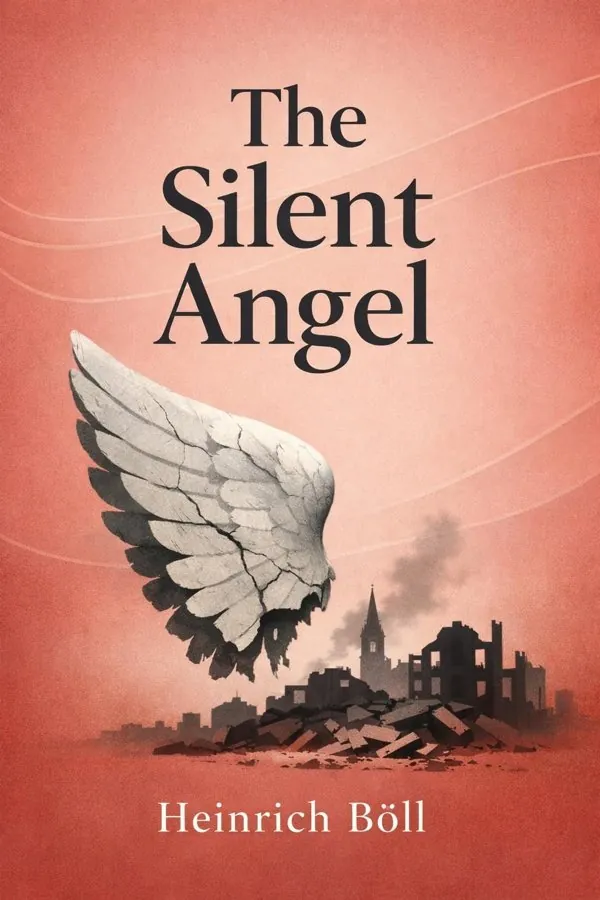
The Silent Angel: Summary & Key Insights
 10 min8 chaptersAudio available
Key Takeaways from The Silent Angel
Sometimes the deepest crisis begins after the fighting ends.
In extreme situations, survival often demands choices that blur the line between necessity and wrongdoing.
Human beings do not recover alone; they recover in damaged, provisional shelters.
Hope becomes most meaningful when it appears where there is every reason to abandon it.
Belief becomes most revealing when it can no longer hide behind institutions.
What Is The Silent Angel About?
The Silent Angel by Heinrich Böll is a classics book spanning 7 pages. The Silent Angel is Heinrich Böll’s haunting early novel about what remains of a human being after war has stripped away certainty, dignity, and belonging. Written in 1949, just a few years after the end of World War II, and published only decades later, the book follows Hans Schnitzler, a former soldier moving through the wreckage of a German city as he searches for food, shelter, and some reason to keep living. Yet Böll’s subject is far larger than one man’s survival. He is asking how people continue after moral collapse, how love can arise in devastation, and whether redemption is possible when guilt hangs over everything. What makes the novel so powerful is its immediacy. Böll was not reconstructing the war from a comfortable distance; he was writing out of the psychological and physical ruins of postwar Germany itself. That gives the story an unusual moral authority. The Silent Angel is not merely an antiwar novel or a portrait of destruction. It is a deeply humane exploration of conscience, faith, identity, and fragile hope. For readers of literary fiction and postwar classics, it offers an unforgettable vision of survival without sentimentality.
This FizzRead summary covers all 8 key chapters of The Silent Angel in approximately 10 minutes, distilling the most important ideas, arguments, and takeaways from Heinrich Böll's work. Also available as an audio summary and Key Quotes Podcast.
The Silent Angel
The Silent Angel is Heinrich Böll’s haunting early novel about what remains of a human being after war has stripped away certainty, dignity, and belonging. Written in 1949, just a few years after the end of World War II, and published only decades later, the book follows Hans Schnitzler, a former soldier moving through the wreckage of a German city as he searches for food, shelter, and some reason to keep living. Yet Böll’s subject is far larger than one man’s survival. He is asking how people continue after moral collapse, how love can arise in devastation, and whether redemption is possible when guilt hangs over everything.
What makes the novel so powerful is its immediacy. Böll was not reconstructing the war from a comfortable distance; he was writing out of the psychological and physical ruins of postwar Germany itself. That gives the story an unusual moral authority. The Silent Angel is not merely an antiwar novel or a portrait of destruction. It is a deeply humane exploration of conscience, faith, identity, and fragile hope. For readers of literary fiction and postwar classics, it offers an unforgettable vision of survival without sentimentality.
Who Should Read The Silent Angel?
This book is perfect for anyone interested in classics and looking to gain actionable insights in a short read. Whether you're a student, professional, or lifelong learner, the key ideas from The Silent Angel by Heinrich Böll will help you think differently.
- ✓Readers who enjoy classics and want practical takeaways
- ✓Professionals looking to apply new ideas to their work and life
- ✓Anyone who wants the core insights of The Silent Angel in just 10 minutes
Want the full summary?
Get instant access to this book summary and 100K+ more with Fizz Moment.
Get Free SummaryAvailable on App Store • Free to download
Key Chapters
Sometimes the deepest crisis begins after the fighting ends. In The Silent Angel, Hans Schnitzler returns not to peace but to emptiness. The city around him has been shattered by bombing, and its broken buildings mirror his own fractured inner life. He walks through streets filled with rubble, displaced people, hunger, and exhaustion, yet what disturbs him most is not only material ruin. It is the collapse of meaning. The old structures that once gave life shape—nation, duty, religion, social order—have all been discredited or weakened.
Böll uses Hans’s wandering as more than plot movement. It becomes a moral condition. Hans is physically adrift because he is spiritually unmoored. He has survived, but survival alone offers no direction. This is one of the novel’s central insights: after collective catastrophe, the problem is not simply rebuilding walls but rebuilding reasons to live.
This idea remains relevant far beyond war literature. People often experience smaller versions of Hans’s crisis after layoffs, divorce, illness, migration, or other life disruptions. External stability disappears, and the question becomes not just “How do I continue?” but “What am I continuing for?” Böll suggests that clarity rarely arrives in one dramatic revelation. Instead, it emerges through encounters, choices, and moments of honesty.
The ruins in the novel therefore represent both devastation and possibility. In a destroyed landscape, illusions have been stripped away. That is painful, but it also creates the chance to start from truth rather than slogans. Hans’s journey asks readers to examine what remains when comforting lies are gone.
Actionable takeaway: When your life feels unsettled, resist the urge to seek instant certainty. Start by naming what has truly collapsed, what still endures, and what values you want to rebuild from the ground up.
In extreme situations, survival often demands choices that blur the line between necessity and wrongdoing. One of the novel’s most unsettling turning points comes when Hans takes the papers of a dying comrade and assumes another identity. The act is practical: documents mean access, protection, movement, and a chance to go on living. But Böll refuses to treat it as a simple survival tactic. It becomes a moral wound.
By taking another man’s name, Hans is forced to confront a frightening truth: war has reduced identity to paperwork, improvisation, and chance. A person can be erased, replaced, or reinvented by a few documents in the right pocket. Yet the ethical burden remains. Hans survives by stepping into a space created by another man’s death, and that fact shadows his conscience.
Böll’s treatment of this moment is nuanced. He does not present Hans as villainous, nor does he absolve him with easy sympathy. Instead, he explores moral ambiguity in a damaged world. Under ordinary conditions, taking another person’s identity would be clear theft. In a destroyed society, categories become unstable. This is one of the book’s great strengths: it shows how war deforms ethics without eliminating them. Conscience survives even when rules collapse.
In modern life, most readers will never face such a dramatic choice, but the underlying issue is familiar. People reshape themselves to fit institutions, expectations, and crises. They perform versions of themselves to get hired, accepted, or protected. The question is always how much adaptation is survival and how much becomes self-betrayal.
Actionable takeaway: In moments of pressure, ask not only “What helps me survive?” but also “What cost will this choice leave on my conscience, and how will I account for it later?”
Human beings do not recover alone; they recover in damaged, provisional shelters. In The Silent Angel, the hospital and the spaces around it function as fragile sanctuaries amid chaos. These places are far from ideal. They are overcrowded, strained, and marked by scarcity. Yet they offer something the ruined streets cannot: temporary structure, care, and the possibility of human recognition.
Böll is especially interested in what happens when formal institutions have lost much of their power but still retain a residual moral function. The hospital does not erase suffering. It cannot reverse death, poverty, or trauma. What it can do is interrupt total abandonment. In such spaces, people become visible to one another again. The sick are tended to, the desperate are spoken to, and the anonymous can briefly become persons instead of casualties.
This matters because the novel repeatedly shows how war destroys not only bodies and buildings but also the social habits that make compassion possible. In normal times, care may seem routine. In postwar collapse, it becomes radical. A bed, a meal, a conversation, or a small act of patience becomes a defense against dehumanization.
The hospital scenes also reveal that sanctuary is never pure. It is mixed with bureaucracy, fatigue, and compromise. That realism is essential. Böll does not romanticize care; he shows how difficult it is to sustain. Yet even imperfect refuge has moral significance. It keeps the possibility of humanity alive.
Readers can apply this insight to everyday life by thinking differently about institutions and relationships that provide stability during crisis. A clinic, school, community center, or even one reliable household can become a place where dignity is restored.
Actionable takeaway: If you cannot solve a crisis, create or support one small space of steadiness where someone else can feel safe, seen, and less alone.
Hope becomes most meaningful when it appears where there is every reason to abandon it. Regina enters The Silent Angel not as a sentimental rescue figure but as a living challenge to Hans’s despair. Their connection introduces tenderness into a world organized by loss, and Böll uses that relationship to ask whether love can still be honest after historical catastrophe.
Regina matters because she is not simply an object of comfort. She represents the possibility of mutual recognition. Hans has been drifting through the city as someone inwardly numbed, morally burdened, and uncertain of his own identity. In Regina’s presence, he is drawn back toward emotional life. This does not mean that love solves his guilt or erases the past. Instead, it creates a fragile reason to imagine a future.
Böll’s portrayal of love is deliberately restrained. There is no grand romantic illusion that private feeling can cancel collective devastation. Rather, affection becomes one of the few forces that can resist spiritual deadness. Love matters here because it restores relational responsibility. To care for another person means that one’s choices are no longer purely about endurance; they become tied to protection, honesty, and commitment.
This is a useful corrective to simplistic ideas about healing. Recovery is often described as an individual achievement, but Böll suggests it is also relational. People emerge from numbness when they encounter someone who calls them back into ethical and emotional presence.
In everyday life, hope often begins in similarly modest ways: through one trusted conversation, a new friendship, a shared act of care, or a relationship that helps us imagine tomorrow differently than yesterday.
Actionable takeaway: When life feels emotionally exhausted, do not dismiss small bonds as insignificant. Invest in one relationship that invites you to become more truthful, more responsible, and more alive.
Belief becomes most revealing when it can no longer hide behind institutions. Through the figure of the priest and the religious atmosphere surrounding parts of the novel, Böll explores what faith looks like after a civilization has committed enormous crimes and then fallen into ruin. The question is not whether religion exists, but whether it still has moral credibility.
Böll does not offer an easy answer. The priest stands within a tradition meant to provide consolation, judgment, and meaning, yet he operates in a world where official language often feels hollow. This tension is crucial. Postwar Germany is full of inherited words—sin, grace, sacrifice, duty—that can sound compromised by history. The challenge is whether faith can become truthful again rather than ceremonial.
For Hans, religious questions are inseparable from guilt and survival. Faith is not an abstract doctrine but a confrontation with conscience. If there is forgiveness, what would it require? If there is God, where was moral clarity during the war? If prayer remains possible, can it coexist with complicity and horror? Böll treats these questions with seriousness rather than dogmatism.
The novel’s spiritual power lies in its refusal to separate religion from ethics. Genuine faith, if it survives, must stand with the vulnerable, reject self-deception, and make room for repentance. It cannot merely bless endurance or decorate suffering with pious language.
This resonates today for anyone wrestling with disillusionment toward institutions—religious or secular. When systems fail, people must decide whether to abandon belief entirely or to recover its deepest principles from beneath hypocrisy.
Actionable takeaway: If an institution has shaken your trust, return to first principles. Ask what values were meant to be protected, where they were betrayed, and how you can live them honestly in practice.
What is left unspoken often governs a life more powerfully than what is confessed. In The Silent Angel, silence is everywhere: in ruined streets, in exhausted people, in interrupted prayers, and above all in the inner world of guilt. Hans carries burdens that cannot easily be explained or resolved. His silence is partly protective, partly shameful, and partly a sign that language itself has been damaged by war.
Böll understands that guilt after collective violence is rarely simple. There is personal guilt for actions taken or not taken, survivor’s guilt for living while others die, and historical guilt that attaches to belonging to a nation or system that committed atrocities. Silence becomes a way to endure these layers without collapsing under them. But it also traps people in moral isolation.
The novel suggests that redemption cannot begin in denial. Silence may preserve a person temporarily, yet healing requires some movement toward truth. That truth may not arrive as dramatic confession. It can emerge through acts of care, acknowledgment of responsibility, refusal of lies, and willingness to remember honestly. Böll’s point is not that speech magically cleanses guilt. Rather, speaking truthfully is one condition for moral recovery.
This idea is highly practical. In families, workplaces, and societies, unacknowledged harm tends to harden into bitterness, repetition, or numbness. People often hope that time alone will dissolve guilt, but hidden wounds usually deepen when ignored.
The novel therefore encourages readers to see silence critically. Some silences protect dignity; others protect evasion. Wisdom lies in distinguishing them.
Actionable takeaway: Identify one uncomfortable truth you have been avoiding—whether with yourself or someone else—and take one honest, proportionate step toward naming it without self-justification.
Rebuilding a society is not only an economic or political task; it is a discipline of attention. The Silent Angel repeatedly shows that postwar recovery depends on whether people can learn to see one another again as moral beings rather than as categories, obstacles, or remnants. In a devastated city, it is easy to become numb. Hunger, fatigue, and fear encourage emotional self-protection. Yet Böll insists that indifference is one of the most dangerous aftereffects of violence.
Hans’s encounters with others—wounded civilians, caretakers, officials, priests, and Regina—gradually press him toward moral attention. This means noticing suffering without turning it into spectacle, recognizing vulnerability without exploiting it, and accepting that every person carries a history not visible on the surface. Such attention is demanding because it interrupts self-absorption. It asks, in effect, not only “How do I get through this?” but “What do I owe the people who are getting through it with me?”
Böll’s insight applies strongly to the modern world. In times of crisis, people often focus on large solutions and abstract debates, while everyday moral attention declines. Yet the health of any community depends on ordinary acts of seeing and responding: listening carefully, treating strangers with patience, resisting contempt, and honoring human complexity.
The novel suggests that moral repair starts before formal justice is complete. It begins whenever people refuse to treat others as debris left behind by history. That is the seed from which more durable recovery can grow.
Actionable takeaway: Practice deliberate moral attention today by slowing down in one interaction, noticing what someone may be carrying, and responding with more care than convenience would normally allow.
Great historical disasters are often remembered through dates, battles, and political outcomes, but novels remind us that history is also lived in kitchens, hospital rooms, side streets, and interrupted conversations. One of Böll’s major achievements in The Silent Angel is his focus on the intimate scale of postwar existence. He brings the vast catastrophe of World War II down to the level of hunger, paperwork, fatigue, tenderness, and fear.
This approach matters because it resists abstraction. When destruction is discussed only in geopolitical terms, people disappear inside statistics. Böll restores the small textures of life: where someone sleeps, how they speak, what they hide, whom they love, and how they carry memory. These details are not incidental. They are where moral reality lives.
Hans is not a symbolic figure floating above history. He is trapped inside its consequences in concrete ways. His choices are shaped by practical pressures, damaged institutions, and emotional deprivation. Through him, Böll shows how public catastrophe reorganizes private life. Love becomes riskier, trust becomes rarer, identity becomes unstable, and even ordinary decency requires effort.
Readers can draw an important lesson from this. Whenever we think about social crisis—war, displacement, economic collapse, or political upheaval—we should ask not only what systems are failing but how daily human life is being altered. Literature trains this kind of perception especially well.
Actionable takeaway: When considering any large public issue, look for the human-scale story inside it. Ask how policies, conflicts, or crises reshape ordinary relationships, choices, and dignity.
All Chapters in The Silent Angel
About the Author
Heinrich Böll (1917–1985) was a German novelist, short story writer, and essayist widely regarded as one of the defining literary voices of postwar Germany. Born in Cologne, he served in the German army during World War II, an experience that profoundly shaped his writing. His fiction consistently examined war’s aftermath, moral responsibility, social hypocrisy, and the struggle to preserve human dignity in damaged societies. Böll wrote with clarity, compassion, and a strong ethical concern for ordinary people caught in historical upheaval. In 1972, he was awarded the Nobel Prize in Literature for work that combined a broad view of his times with a sensitive skill in characterization. The Silent Angel, though published posthumously, reveals the early power of themes that would define his career.
Get This Summary in Your Preferred Format
Read or listen to the The Silent Angel summary by Heinrich Böll anytime, anywhere. FizzRead offers multiple formats so you can learn on your terms — all free.
Available formats: App · Audio · PDF · EPUB — All included free with FizzRead
Download The Silent Angel PDF and EPUB Summary
Key Quotes from The Silent Angel
“Sometimes the deepest crisis begins after the fighting ends.”
“In extreme situations, survival often demands choices that blur the line between necessity and wrongdoing.”
“Human beings do not recover alone; they recover in damaged, provisional shelters.”
“Hope becomes most meaningful when it appears where there is every reason to abandon it.”
“Belief becomes most revealing when it can no longer hide behind institutions.”
Frequently Asked Questions about The Silent Angel
The Silent Angel by Heinrich Böll is a classics book that explores key ideas across 8 chapters. The Silent Angel is Heinrich Böll’s haunting early novel about what remains of a human being after war has stripped away certainty, dignity, and belonging. Written in 1949, just a few years after the end of World War II, and published only decades later, the book follows Hans Schnitzler, a former soldier moving through the wreckage of a German city as he searches for food, shelter, and some reason to keep living. Yet Böll’s subject is far larger than one man’s survival. He is asking how people continue after moral collapse, how love can arise in devastation, and whether redemption is possible when guilt hangs over everything. What makes the novel so powerful is its immediacy. Böll was not reconstructing the war from a comfortable distance; he was writing out of the psychological and physical ruins of postwar Germany itself. That gives the story an unusual moral authority. The Silent Angel is not merely an antiwar novel or a portrait of destruction. It is a deeply humane exploration of conscience, faith, identity, and fragile hope. For readers of literary fiction and postwar classics, it offers an unforgettable vision of survival without sentimentality.
More by Heinrich Böll


You Might Also Like





Browse by Category
Ready to read The Silent Angel?
Get the full summary and 100K+ more books with Fizz Moment.