
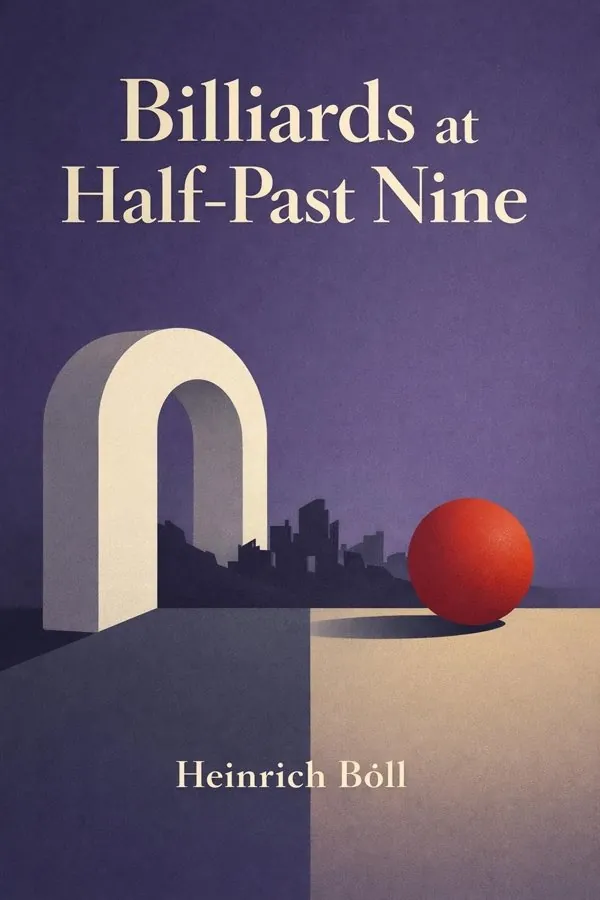
Billiards at Half-Past Nine: Summary & Key Insights
 10 min9 chaptersAudio available
Key Takeaways from Billiards at Half-Past Nine
A single day can contain an entire century when memory refuses to stay buried.
What we build often reveals what we worship.
Routine is often less about order than about survival.
The most morally lucid people are often the ones society labels difficult, unstable, or inconvenient.
Societies rarely forget by accident; they often forget because forgetting is useful.
What Is Billiards at Half-Past Nine About?
Billiards at Half-Past Nine by Heinrich Böll is a classics book spanning 5 pages. Billiards at Half-Past Nine is Heinrich Böll’s profound 1959 novel about memory, guilt, and moral survival in postwar Germany. Set across a single day—September 6, 1958, the eightieth birthday of architect Heinrich Fähmel—the book unfolds through shifting voices, recollections, and private rituals, revealing the hidden history of three generations of one family. What begins as an apparently quiet family occasion becomes an excavation of the German twentieth century: imperial confidence, war, Nazism, destruction, and uneasy reconstruction. Böll uses the Fähmels not simply as characters but as moral witnesses, asking how people live with what they have built, obeyed, destroyed, or silently tolerated. What makes the novel enduring is its refusal to offer easy absolution. Böll is less interested in dramatic courtroom guilt than in the subtler forms of compromise, conformity, and integrity that shape ordinary lives. With unusual tenderness and precision, he shows how public history enters kitchens, churches, marriages, and habits of speech. As one of postwar Germany’s most important writers and later a Nobel Prize winner, Böll brings both literary mastery and moral seriousness to this story. The result is a classic that still speaks powerfully to any society trying to rebuild without forgetting.
This FizzRead summary covers all 9 key chapters of Billiards at Half-Past Nine in approximately 10 minutes, distilling the most important ideas, arguments, and takeaways from Heinrich Böll's work. Also available as an audio summary and Key Quotes Podcast.
Billiards at Half-Past Nine
Billiards at Half-Past Nine is Heinrich Böll’s profound 1959 novel about memory, guilt, and moral survival in postwar Germany. Set across a single day—September 6, 1958, the eightieth birthday of architect Heinrich Fähmel—the book unfolds through shifting voices, recollections, and private rituals, revealing the hidden history of three generations of one family. What begins as an apparently quiet family occasion becomes an excavation of the German twentieth century: imperial confidence, war, Nazism, destruction, and uneasy reconstruction. Böll uses the Fähmels not simply as characters but as moral witnesses, asking how people live with what they have built, obeyed, destroyed, or silently tolerated.
What makes the novel enduring is its refusal to offer easy absolution. Böll is less interested in dramatic courtroom guilt than in the subtler forms of compromise, conformity, and integrity that shape ordinary lives. With unusual tenderness and precision, he shows how public history enters kitchens, churches, marriages, and habits of speech. As one of postwar Germany’s most important writers and later a Nobel Prize winner, Böll brings both literary mastery and moral seriousness to this story. The result is a classic that still speaks powerfully to any society trying to rebuild without forgetting.
Who Should Read Billiards at Half-Past Nine?
This book is perfect for anyone interested in classics and looking to gain actionable insights in a short read. Whether you're a student, professional, or lifelong learner, the key ideas from Billiards at Half-Past Nine by Heinrich Böll will help you think differently.
- ✓Readers who enjoy classics and want practical takeaways
- ✓Professionals looking to apply new ideas to their work and life
- ✓Anyone who wants the core insights of Billiards at Half-Past Nine in just 10 minutes
Want the full summary?
Get instant access to this book summary and 100K+ more with Fizz Moment.
Get Free SummaryAvailable on App Store • Free to download
Key Chapters
A single day can contain an entire century when memory refuses to stay buried. Böll structures Billiards at Half-Past Nine around September 6, 1958, the eightieth birthday of Heinrich Fähmel. On paper, almost nothing extraordinary happens: appointments are kept, family members move through the city, conversations occur, and routines continue. Yet beneath that ordinary surface lies the emotional weight of wars, betrayals, loyalties, and losses stretching across decades. The novel’s brilliance lies in showing that history is not safely locked in the past; it lives inside gestures, habits, and silences.
This structure matters because it mirrors the way people actually experience memory. We do not remember our lives in neat chronological order. A building, a familiar street, a church bell, or a birthday can suddenly collapse years into a single moment. Böll uses shifting perspectives to reveal how each member of the Fähmel family carries a different version of the same past. Time becomes layered rather than linear, and the reader gradually understands that the present cannot be interpreted without the accumulated moral residue of earlier choices.
This has a practical relevance beyond literature. Families, institutions, and even nations often tell themselves that the past is over once the visible damage is repaired. But unresolved history tends to reappear in rituals, resentments, and evasions. Think of organizations that celebrate anniversaries without confronting how they treated employees, minorities, or dissenters in earlier decades. The celebration may look complete, but the story is not.
Böll invites us to read the present as a compressed archive. Everyday life is never merely everyday; it is shaped by what people remember, avoid, and repeat. Actionable takeaway: when trying to understand a person, family, or institution, do not ask only what is happening today—ask what earlier history today is quietly carrying.
What we build often reveals what we worship. Heinrich Fähmel, the family patriarch, is an architect whose life is bound to St. Anthony’s Abbey, the building that symbolizes both artistic achievement and moral burden. For Heinrich, architecture once represented order, discipline, permanence, and perhaps even spiritual clarity. A well-designed building could seem to promise that human life itself might be made coherent. But Böll complicates that ideal by showing that structures do not remain innocent once history passes through them.
Heinrich belongs to an older generation that believed in craftsmanship and continuity, yet his work becomes entangled with a century that repeatedly destroys what it creates. The abbey is not merely a setting; it becomes a measure of German history itself. What does it mean to devote oneself to creation in a society capable of monumental ruin? Can beauty remain morally neutral when political violence surrounds it? Through Heinrich, Böll explores the painful possibility that creative work can be meaningful and compromised at the same time.
This idea applies far beyond architecture. Professionals often imagine that technical excellence alone is enough—that if they do their work well, the moral context will somehow take care of itself. But engineers, lawyers, teachers, and designers all work inside political and social systems. A brilliant structure, policy, or product may still serve destructive ends or become implicated in them. The novel asks us to examine not only whether something was skillfully made, but what world it helped sustain.
Heinrich is not portrayed as a villain or saint. He is a man whose dignity is shadowed by the historical uses and meanings of what he has made. Actionable takeaway: take pride in your craft, but regularly ask where your work fits ethically—creation is never separate from context.
Routine is often less about order than about survival. Robert Fähmel, Heinrich’s son, is one of the novel’s most compelling figures precisely because he appears so controlled. His daily ritual of playing billiards at half-past nine is not a quirky habit but a shield—a carefully maintained space in which he can regulate memory, emotion, and contact with a compromised world. Böll understands that after political catastrophe, people often cling to rituals not because life is calm, but because it is not.
Robert’s inner life is shaped by war, resistance, and the terrible moral choices forced by his era. His famous act of blowing up St. Anthony’s Abbey during the war gives his character its central paradox: he destroys what his father built. Yet this is not simple rebellion or nihilism. In Böll’s moral universe, destruction can become an act of refusal when institutions have been claimed by barbarism. Robert’s restraint, then, is not emptiness; it is the residue of having acted decisively in a world where action always leaves scars.
The billiards game symbolizes something larger: the human need to create zones of predictability when history has made trust difficult. Many people today do something similar. They rely on repetitive exercise, work habits, coffee routines, inbox rituals, or gaming sessions to preserve emotional balance after grief, burnout, or political disillusionment. Such patterns can be healthy forms of self-management, but they can also become emotional fortresses that prevent genuine reckoning.
Böll neither mocks nor romanticizes Robert’s distance. He shows how discipline can preserve integrity while also isolating the person who practices it. Actionable takeaway: pay attention to the routines that stabilize you, and ask whether they are helping you heal—or merely helping you avoid what still needs to be faced.
The most morally lucid people are often the ones society labels difficult, unstable, or inconvenient. In Billiards at Half-Past Nine, Johanna Fähmel and the outsider Schrella embody forms of resistance that refuse the comforting language of forgetting. Johanna, especially, is one of Böll’s sharpest moral presences. Her apparent instability is inseparable from a deeper clarity: she cannot make peace with the crimes and hypocrisies that others have normalized. In a society eager to resume respectability, her refusal to act as though everything is fine becomes a form of truth-telling.
Schrella, too, represents moral persistence. Marked by persecution and exile, he returns as someone who remembers what many would rather bury. He stands outside the comfortable circles of restored postwar life, and that outsider status gives him a distinctive authority. Together, Johanna and Schrella reveal a crucial theme in the novel: those who preserve memory are often treated as socially disruptive because memory itself threatens convenient narratives of innocence.
This dynamic remains recognizable today. Whistleblowers, survivors, dissidents, and outspoken family members are frequently dismissed as bitter or excessive, especially when they challenge institutions invested in moving on quickly. Yet social health depends not only on reconciliation but on the willingness to hear disturbing truths. Böll suggests that emotional discomfort may be the price of moral honesty.
Johanna and Schrella are not simply symbols of protest. They show that resistance can take many forms: refusal to flatter, refusal to forget, refusal to adopt the official language of normality. Their presence makes the novel ethically alive. Actionable takeaway: when someone’s testimony feels inconvenient, resist the urge to dismiss them—sometimes the most unsettling voices are the ones preserving reality.
Societies rarely forget by accident; they often forget because forgetting is useful. One of Böll’s central insights is that postwar reconstruction does not automatically produce moral reconstruction. Roads can be repaired, churches rebuilt, businesses reopened, and family routines resumed while deeper questions of guilt, complicity, and cowardice remain unresolved. In the world of the novel, memory is not merely personal recollection but a contested moral territory. Different characters preserve, distort, suppress, or stylize the past according to what they can bear.
Böll is especially interested in the respectable forms of forgetting. These are not crude denials but subtle maneuvers: changing the subject, emphasizing suffering without discussing responsibility, praising order while ignoring what order served, and treating victims and perpetrators as though time has flattened all distinctions. Such forgetting allows individuals and nations to function, but it comes at a cost. It prevents genuine renewal because renewal requires truthful naming.
This theme has broad application. Modern institutions often prefer narratives of resilience over accountability. A company after scandal, a political movement after abuse, or a family after long secrecy may focus on “healing” before clarity has been achieved. But healing built on evasion is fragile. The suppressed truth tends to return in distrust, repetition, and moral confusion.
The novel does not suggest that people should live in perpetual self-condemnation. Rather, it argues that memory is the condition of integrity. Remembering honestly is what allows ethical distinctions to survive. Without it, reconstruction becomes cosmetic. Actionable takeaway: when you hear a story of recovery—whether personal or collective—ask what has been remembered, what has been omitted, and whether reconciliation has been earned or merely declared.
History is easiest to misunderstand when it is told only in slogans, dates, and official events. Böll counters that abstraction by embedding Germany’s twentieth-century crises within family life. The Fähmels are not political leaders or military strategists. They are a family of professionals, spouses, parents, children, and acquaintances whose lives are shaped by choices that feel intimate and local. That is exactly why the novel is so powerful. It shows how national catastrophe enters ordinary existence—through marriage, education, work, religion, friendship, and inheritance.
By narrowing the lens to one family, Böll avoids turning history into spectacle. Instead, he reveals how moral decisions are distributed across daily life. One person complies, another resists, another stays silent, another rationalizes, another suffers the consequences, and another attempts to start over without looking back. No grand speech is needed; domestic interactions themselves become historical evidence.
Readers can apply this insight to the way they understand any era of upheaval. Public events are never only public. Economic collapse changes dinner-table anxieties. War alters career paths, romances, and concepts of duty. Authoritarianism transforms language inside schools and workplaces long before its full violence is acknowledged. If we want to understand history responsibly, we must look not only at governments and headlines but at family systems, institutional habits, and moral atmospheres.
Böll’s method also encourages empathy. Rather than dividing the world into pure monsters and pure innocents, he traces gradations of weakness, courage, blindness, and endurance. This makes the moral landscape more uncomfortable but also more true. Actionable takeaway: when trying to understand a historical moment, examine how it shaped ordinary relationships—private life often reveals what official narratives hide.
Some novels explain themselves through argument; Böll often works through symbols that quietly organize moral meaning. Billiards, the abbey, food, animals, rituals, and recurring images all help structure the book’s ethical landscape. Most famous is the contrast sometimes described through the language of the “sacrament of the buffalo” and the “sacrament of the lamb,” a symbolic shorthand for brutality versus innocence, domination versus vulnerability, predatory power versus humane conscience. Böll uses such imagery not to simplify history but to expose the moral instincts hiding beneath respectable appearances.
These symbols matter because the novel deals with realities that are difficult to capture through factual narration alone. How do you portray a society in which cruelty becomes normalized and gentleness appears weak? How do you show that some people align themselves with force almost religiously, while others protect human dignity at great cost? Symbolic language gives Böll a way to dramatize ethical allegiance without turning the novel into a lecture.
In practical terms, this reminds readers to pay attention to the metaphors and rituals governing real communities. Every workplace, family, school, or political movement has a symbolic vocabulary. Some celebrate toughness, conquest, and loyalty at any price. Others reward truth, care, and restraint. These values are not always stated directly; they appear in jokes, slogans, heroes, and habits of admiration.
Böll’s symbols invite slow reading because they reveal what characters may not say openly. They also show that moral worlds are built not only by laws and actions but by imagination. Actionable takeaway: listen closely to the symbols and metaphors people live by—they often reveal their deepest loyalties before their actions fully do.
Moral integrity in Böll’s fiction is rarely clean, triumphant, or socially rewarded. One of the novel’s most important lessons is that decency often appears as refusal rather than purity. Characters preserve their humanity not by remaining untouched by history—that is impossible—but by refusing certain forms of participation, obedience, or self-deception. In a corrupted society, integrity may look negative: not joining, not praising, not forgetting, not pretending.
This is why Billiards at Half-Past Nine resists sentimental redemption. Böll knows that under dictatorship and war, even the decent are wounded, compromised, or forced into impossible choices. The question is not who stayed immaculate, but who continued to recognize moral boundaries when those boundaries were under assault. Robert’s act of destruction, Johanna’s refusal of normalizing language, and Schrella’s persistence as a witness all illustrate this difficult ethic. Their resistance is costly and incomplete, but it matters.
This concept has contemporary relevance because modern culture often treats integrity as personal branding—an image of flawless consistency. Böll offers a tougher, more realistic standard. Integrity may involve silence at one moment, confrontation at another, withdrawal from corrupt systems, or costly acts that outsiders misunderstand. It is less about appearing righteous than about preserving the ability to distinguish human dignity from organized brutality.
That lesson is especially valuable in workplaces and public life where people are pressured to “go along” for the sake of harmony or advancement. Sometimes the most ethical act is simply to refuse false language or illegitimate demands. Actionable takeaway: do not wait to feel morally pure before acting—integrity often begins with one clear refusal to cooperate with what you know is wrong.
Hope in this novel is quiet, fragile, and conditional. Böll does not believe that nations, families, or individuals can simply decide to start fresh. Renewal becomes possible only when the past is neither glorified nor erased. This is the novel’s final moral achievement: despite all its sorrow, it is not a book of despair. It suggests that honesty, however painful, creates the groundwork for a more humane future.
The possibility of renewal appears not in grand political programs but in recovered relationships, truthful speech, and the reassertion of moral distinctions. For Böll, reconstruction is meaningful only if it includes conscience. Otherwise, postwar normality becomes another mask. The younger and older generations of the Fähmel family are bound together by damage, yet they are also given moments in which recognition becomes possible. Such recognition does not cancel loss, but it can interrupt repetition.
This is a useful insight for readers facing inherited wounds of any kind—family trauma, institutional failure, community violence, or social division. People often want closure quickly, but closure imposed too early tends to protect appearances rather than heal reality. Truthful conversation, acknowledgment of harm, and acceptance of complexity are slower, less dramatic paths, yet they create stronger foundations.
Böll’s hope is therefore demanding. It asks readers to reject both cynicism and easy consolation. The world may not be repaired completely, but it can be made less false. That itself is a moral victory. Actionable takeaway: if you want genuine renewal in any damaged relationship or system, begin with honest acknowledgment—repair that skips truth is only another form of denial.
All Chapters in Billiards at Half-Past Nine
About the Author
Heinrich Böll (1917–1985) was a major German novelist, essayist, and public intellectual whose work helped define postwar German literature. Born in Cologne, he experienced the upheavals of Nazism and served in World War II, experiences that deeply shaped his fiction. His novels and stories often focus on ordinary people caught in systems of power, hypocrisy, and historical trauma, and he became known for his moral seriousness, compassion, and sharp criticism of postwar complacency. Böll’s writing consistently explores guilt, memory, religion, violence, and the struggle to preserve human dignity in damaged societies. In 1972, he was awarded the Nobel Prize in Literature for his wide-ranging contribution to contemporary letters. Today, he remains one of the essential voices for understanding Germany’s moral and cultural reconstruction after the war.
Get This Summary in Your Preferred Format
Read or listen to the Billiards at Half-Past Nine summary by Heinrich Böll anytime, anywhere. FizzRead offers multiple formats so you can learn on your terms — all free.
Available formats: App · Audio · PDF · EPUB — All included free with FizzRead
Download Billiards at Half-Past Nine PDF and EPUB Summary
Key Quotes from Billiards at Half-Past Nine
“A single day can contain an entire century when memory refuses to stay buried.”
“What we build often reveals what we worship.”
“Routine is often less about order than about survival.”
“The most morally lucid people are often the ones society labels difficult, unstable, or inconvenient.”
“Societies rarely forget by accident; they often forget because forgetting is useful.”
Frequently Asked Questions about Billiards at Half-Past Nine
Billiards at Half-Past Nine by Heinrich Böll is a classics book that explores key ideas across 9 chapters. Billiards at Half-Past Nine is Heinrich Böll’s profound 1959 novel about memory, guilt, and moral survival in postwar Germany. Set across a single day—September 6, 1958, the eightieth birthday of architect Heinrich Fähmel—the book unfolds through shifting voices, recollections, and private rituals, revealing the hidden history of three generations of one family. What begins as an apparently quiet family occasion becomes an excavation of the German twentieth century: imperial confidence, war, Nazism, destruction, and uneasy reconstruction. Böll uses the Fähmels not simply as characters but as moral witnesses, asking how people live with what they have built, obeyed, destroyed, or silently tolerated. What makes the novel enduring is its refusal to offer easy absolution. Böll is less interested in dramatic courtroom guilt than in the subtler forms of compromise, conformity, and integrity that shape ordinary lives. With unusual tenderness and precision, he shows how public history enters kitchens, churches, marriages, and habits of speech. As one of postwar Germany’s most important writers and later a Nobel Prize winner, Böll brings both literary mastery and moral seriousness to this story. The result is a classic that still speaks powerfully to any society trying to rebuild without forgetting.
More by Heinrich Böll


You Might Also Like






Browse by Category
Ready to read Billiards at Half-Past Nine?
Get the full summary and 100K+ more books with Fizz Moment.