
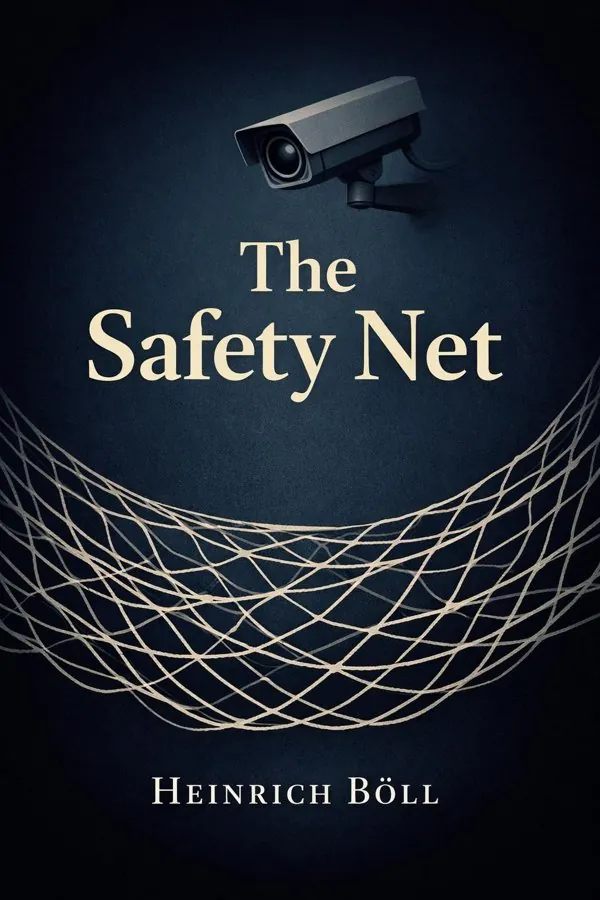
The Safety Net: Summary & Key Insights
 10 min5 chaptersAudio available
What Is The Safety Net About?
The Safety Net by Heinrich Böll is a classics book spanning 5 pages. The Safety Net is a novel by Nobel Prize-winning author Heinrich Böll, first published in English in 1979. It explores the pervasive atmosphere of surveillance and control in modern society, focusing on an industrialist’s family whose lives are increasingly dominated by media scrutiny, police oversight, and political manipulation. Through this narrative, Böll offers a sharp critique of the obsession with security and the erosion of personal freedom in postwar West Germany.
This FizzRead summary covers all 5 key chapters of The Safety Net in approximately 10 minutes, distilling the most important ideas, arguments, and takeaways from Heinrich Böll's work. Also available as an audio summary and Key Quotes Podcast.
The Safety Net
The Safety Net is a novel by Nobel Prize-winning author Heinrich Böll, first published in English in 1979. It explores the pervasive atmosphere of surveillance and control in modern society, focusing on an industrialist’s family whose lives are increasingly dominated by media scrutiny, police oversight, and political manipulation. Through this narrative, Böll offers a sharp critique of the obsession with security and the erosion of personal freedom in postwar West Germany.
Who Should Read The Safety Net?
This book is perfect for anyone interested in classics and looking to gain actionable insights in a short read. Whether you're a student, professional, or lifelong learner, the key ideas from The Safety Net by Heinrich Böll will help you think differently.
- ✓Readers who enjoy classics and want practical takeaways
- ✓Professionals looking to apply new ideas to their work and life
- ✓Anyone who wants the core insights of The Safety Net in just 10 minutes
Want the full summary?
Get instant access to this book summary and 100K+ more with Fizz Moment.
Get Free SummaryAvailable on App Store • Free to download
Key Chapters
In the world I depict, everything begins with the illusion of safety. The affluent families like the Tolms or their friends the Schrellas live under continuous police surveillance, guarded against political extremists and potential kidnappers. West Germany in the 1970s was reeling from the era of the Red Army Faction, a time when terrorism blurred the boundaries between dissent and fear. For people like Fritz Tolm, the newly elected head of the industrial association, this atmosphere produces an architecture of control. Policemen camp outside the gates, communication devices hum in every corner, and every gesture is classified, logged, and reported up through anonymous hierarchies of bureaucrats.
Within these walls, the Tolm household ceases to be a home. Its inhabitants are suspended between privilege and imprisonment: they possess everything, yet own nothing of their own movements. Visiting a friend or stepping outside without notification triggers alarm. The children grow accustomed to a life mediated by guards. The servants and officers occupy the house like ghosts; everyone watches everyone, no one trusts anyone completely. This is what I wanted to capture—the transformation of private existence into a monitored performance.
Beneath the surface stillness lies a silent revolt. Käthe Tolm, graceful and dignified, feels her life fragment under the constant exposure. The security personnel treat her as a potential liability; even intimacy becomes procedural. Conversations are whispered or left unfinished, for they might be overheard. What interests me here is how fear changes people’s language: they stop speaking freely, learn to self-censor without command. That is the true success of any surveillance regime—not the control it exerts, but the obedience it breeds.
The Tolm and Schrella families epitomize the crisis of a society that cannot distinguish protection from coercion. They are not villains but victims of their own status, trapped in a collective paranoia where trust is exchanged for order, and love is domesticated by the logic of regulation.
I chose Fritz Tolm to embody the contradiction at the heart of postwar German prosperity: a man who sincerely believes in civic responsibility but who also profits from the machinery of fear. As an industrialist and public figure, he represents both moral legitimacy and moral compromise. The state relies on him to stabilize the economy, and in return, grants him the illusion of control. Yet, in his private moments—when he examines the cameras that line his hallways or listens to the hum of his monitored telephone—he feels the weight of something irreversible.
Tolm’s discomfort grows as he realizes that the institutions meant to protect him are now defining his life. His house resembles an administrative office more than a residence. He talks to officials more than to his wife; he observes his children as if they were part of a case file. The logic of efficiency, security, and reputation drives out spontaneity, generosity, and joy. I designed Tolm’s growing anxiety not as melodrama, but as an emblem of how systems absorb individuality.
The tragedy of Fritz Tolm is not that he is hunted, but that he consents. There is no dictator forcing him into submission; there is only the seductive logic of safety. He cooperates with the police chief, he allows the media to construct his image, he rationalizes every intrusion as necessary. But little by little, he begins to see that his compliance sustains the very structure that humiliates him. He becomes both beneficiary and prisoner, master and subject—a symbol of the modern citizen who mistakes surveillance for responsibility.
Through Tolm I ask: how much freedom can a man surrender before losing the ability to notice its absence? His journey is not about rebellion but awakening—a slow recognition that safety purchased at the price of humanity is a deceitful bargain.
+ 3 more chapters — available in the FizzRead app
All Chapters in The Safety Net
About the Author
Heinrich Böll (1917–1985) was a German writer and one of the most significant authors of the postwar period. He received the Nobel Prize in Literature in 1972. His works often examine German society, morality, and politics with a humanistic and satirical lens.
Get This Summary in Your Preferred Format
Read or listen to the The Safety Net summary by Heinrich Böll anytime, anywhere. FizzRead offers multiple formats so you can learn on your terms — all free.
Available formats: App · Audio · PDF · EPUB — All included free with FizzRead
Download The Safety Net PDF and EPUB Summary
Key Quotes from The Safety Net
“In the world I depict, everything begins with the illusion of safety.”
“I chose Fritz Tolm to embody the contradiction at the heart of postwar German prosperity: a man who sincerely believes in civic responsibility but who also profits from the machinery of fear.”
Frequently Asked Questions about The Safety Net
The Safety Net by Heinrich Böll is a classics book that explores key ideas across 5 chapters. The Safety Net is a novel by Nobel Prize-winning author Heinrich Böll, first published in English in 1979. It explores the pervasive atmosphere of surveillance and control in modern society, focusing on an industrialist’s family whose lives are increasingly dominated by media scrutiny, police oversight, and political manipulation. Through this narrative, Böll offers a sharp critique of the obsession with security and the erosion of personal freedom in postwar West Germany.
More by Heinrich Böll

You Might Also Like





Browse by Category
Ready to read The Safety Net?
Get the full summary and 100K+ more books with Fizz Moment.