
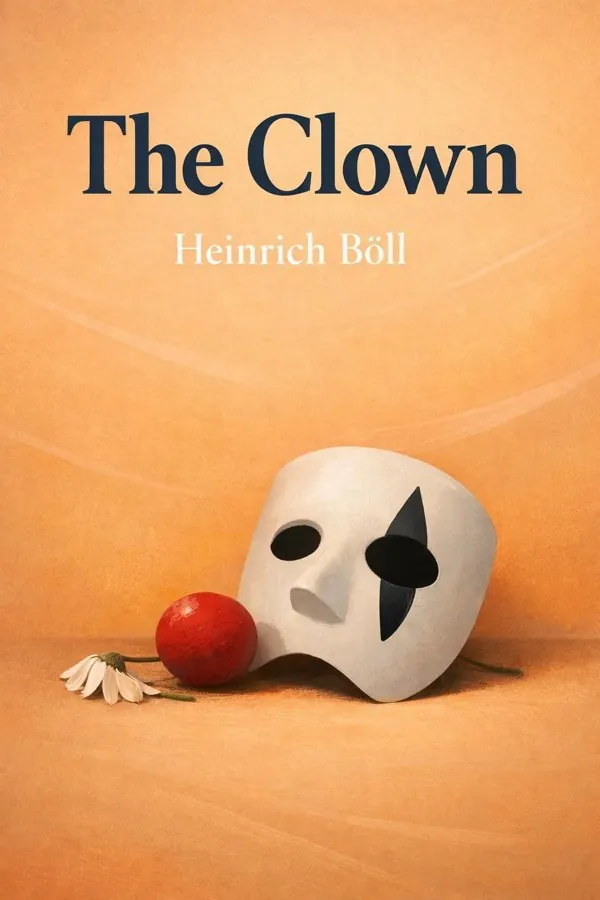
The Clown: Summary & Key Insights
 10 min9 chaptersAudio available
Key Takeaways from The Clown
A person’s deepest crisis often becomes visible in the smallest details: a limp, an empty room, an unanswered call.
Love becomes fragile when two people share affection but cannot inhabit the same moral world.
Some of the harshest moral judgments come from people most invested in appearing decent.
Nothing reveals social truth faster than asking for help and hearing hesitation on the other end of the line.
Societies often rebuild their cities faster than they rebuild their conscience.
What Is The Clown About?
The Clown by Heinrich Böll is a classics book spanning 8 pages. Heinrich Böll’s The Clown is a sharp, intimate, and unsettling portrait of a man collapsing under the pressure of love, memory, and social hypocrisy. The novel follows Hans Schnier, a professional clown who returns to Bonn physically injured, emotionally shattered, and financially unstable after losing Marie, the woman he loves. Over the course of a single evening, through phone calls, recollections, and bitter reflections, Hans revisits his failed relationship, his fractured family, and the moral landscape of postwar West Germany. What begins as the story of one man’s misery becomes a devastating critique of a society eager to restore respectability while ignoring its own compromises and moral evasions. Böll writes with unusual authority because he was not only one of Germany’s greatest postwar novelists but also one of its clearest moral witnesses. Awarded the Nobel Prize in Literature in 1972, he repeatedly confronted the gap between public virtue and private guilt. The Clown remains powerful because it asks timeless questions: What happens when love collides with ideology? What does integrity cost in a conformist world? And how does a society hide from its own conscience?
This FizzRead summary covers all 9 key chapters of The Clown in approximately 10 minutes, distilling the most important ideas, arguments, and takeaways from Heinrich Böll's work. Also available as an audio summary and Key Quotes Podcast.
The Clown
Heinrich Böll’s The Clown is a sharp, intimate, and unsettling portrait of a man collapsing under the pressure of love, memory, and social hypocrisy. The novel follows Hans Schnier, a professional clown who returns to Bonn physically injured, emotionally shattered, and financially unstable after losing Marie, the woman he loves. Over the course of a single evening, through phone calls, recollections, and bitter reflections, Hans revisits his failed relationship, his fractured family, and the moral landscape of postwar West Germany. What begins as the story of one man’s misery becomes a devastating critique of a society eager to restore respectability while ignoring its own compromises and moral evasions. Böll writes with unusual authority because he was not only one of Germany’s greatest postwar novelists but also one of its clearest moral witnesses. Awarded the Nobel Prize in Literature in 1972, he repeatedly confronted the gap between public virtue and private guilt. The Clown remains powerful because it asks timeless questions: What happens when love collides with ideology? What does integrity cost in a conformist world? And how does a society hide from its own conscience?
Who Should Read The Clown?
This book is perfect for anyone interested in classics and looking to gain actionable insights in a short read. Whether you're a student, professional, or lifelong learner, the key ideas from The Clown by Heinrich Böll will help you think differently.
- ✓Readers who enjoy classics and want practical takeaways
- ✓Professionals looking to apply new ideas to their work and life
- ✓Anyone who wants the core insights of The Clown in just 10 minutes
Want the full summary?
Get instant access to this book summary and 100K+ more with Fizz Moment.
Get Free SummaryAvailable on App Store • Free to download
Key Chapters
A person’s deepest crisis often becomes visible in the smallest details: a limp, an empty room, an unanswered call. That is how The Clown begins. Hans Schnier returns to Bonn after a failed performance, physically injured and emotionally wrecked. He is a clown by profession, but the irony is immediate: the man meant to entertain others can no longer hold himself together. His apartment becomes a chamber of pain, memory, and self-examination, and from this confined space Böll builds a sweeping moral drama.
Hans’s decline is not presented as a sudden breakdown but as the result of accumulated losses. He has lost Marie, the woman he loves. He is losing his career because his emotional state is affecting his performances. He is alienated from his wealthy family, who stand for a polished, respectable social order he distrusts. Bonn, the political center of West Germany, becomes more than a city; it becomes the setting of a society whose outward stability contrasts with Hans’s inward collapse.
This opening matters because it establishes Böll’s method. Instead of giving readers a broad historical lecture, he shows postwar Germany through one suffering consciousness. Hans’s body and finances are in bad shape, but so is his faith in the people around him. His pain becomes a lens through which we see the false comfort of social respectability.
In modern life, people often hide crisis behind routine. A missed meeting, a curt reply, or chronic fatigue may signal larger emotional wounds. Böll reminds us that collapse usually has a history.
Actionable takeaway: When someone seems merely difficult or withdrawn, pause before judging. Ask what hidden losses or pressures may lie beneath the surface.
Love becomes fragile when two people share affection but cannot inhabit the same moral world. Hans’s relationship with Marie is the emotional center of The Clown. She is not simply a lost lover; she represents the possibility of tenderness, loyalty, and shared life. Yet their bond is strained by a conflict larger than personality: religion, especially Catholic expectations around marriage, sexuality, and respectability.
Hans is secular, skeptical, and resistant to institutions that demand obedience without honesty. Marie is devout and deeply shaped by Catholic values. Their life together contains real intimacy, but it is shadowed by the unresolved question of legitimacy. Hans does not want to submit to a religious marriage he does not believe in. Marie, increasingly drawn toward Catholic social circles, feels the weight of spiritual duty and communal approval. In the end, she leaves him for a more socially and religiously acceptable future.
Böll does not reduce this conflict to a simple attack on faith. Instead, he examines how belief can become entangled with social pressure. Marie’s departure hurts not only because Hans loses her, but because he sees how powerful organized morality can be when it aligns with conformity. Love, in this world, is not judged on sincerity alone; it must also fit the approved pattern.
This dynamic still feels current. Couples today may be divided not only by religion, but by class expectations, political identity, family traditions, or career ambitions. Deep feeling does not erase structural tension. If fundamental values remain unspoken, intimacy slowly becomes a battleground.
Actionable takeaway: In close relationships, discuss core beliefs early and honestly. Love can survive difference, but not endless avoidance of what matters most.
Some of the harshest moral judgments come from people most invested in appearing decent. Hans’s family embodies one of Böll’s central themes: the hypocrisy of postwar respectability. The Schniers are wealthy, influential, and outwardly proper, but Hans remembers them as emotionally cold and morally compromised. His mother in particular becomes a symbol of how postwar Germany reinvented itself without adequately confronting its past.
Böll uses family memory to expose the continuity between old and new forms of moral blindness. During the Nazi era, many people justified cruelty through ideology, duty, or silence. After the war, some of these same people adapted smoothly to new public roles, speaking the language of renewal while preserving habits of self-justification. Hans cannot forget this. His bitterness toward his family is not only personal resentment; it is ethical outrage at a world that rewards those who perform virtue instead of practicing it.
The novel shows how family systems can train people to distrust their own perceptions. Hans, sensitive and unwilling to play along, becomes the outsider. He does not fit the script of success, discipline, and polite reconciliation. His clowning, often seen as unserious, actually makes him more truthful than those who hide behind status and etiquette.
This idea remains relevant wherever institutions or families rewrite uncomfortable history. A household may avoid discussing betrayal, addiction, prejudice, or abuse and instead preserve an image of normality. But what is buried continues to shape every interaction.
Actionable takeaway: Question polished narratives, especially in families or institutions. Honest reckoning with the past is painful, but it is healthier than building identity on denial.
Societies often rebuild their cities faster than they rebuild their conscience. Through Hans’s observations, The Clown becomes a fierce satire of postwar West Germany. Böll is not interested in easy denunciation; he is interested in the subtler forms of moral decay that flourish once a nation begins congratulating itself on recovery. Economic growth, political order, and religious participation may signal renewal, but they can also become masks.
In the novel, Catholic circles, bourgeois households, and public institutions frequently appear less concerned with truth than with propriety. Böll exposes a culture eager to define itself as decent while avoiding serious examination of complicity, class privilege, and emotional cruelty. Hans’s refusal to fit in gives him a strange authority. Because he is socially marginal, he sees what respectable people cannot admit: much of what passes for morality is theatrical performance.
This is why the image of the clown is so important. A clown is visibly artificial, yet paradoxically closer to honesty than the supposedly authentic citizens around him. Hans’s profession allows Böll to invert social hierarchy. The entertainer, often dismissed as trivial, becomes the witness. The respectable classes, who claim seriousness, become performers in a larger cultural lie.
The book’s critique extends beyond Germany. Any era of national self-congratulation risks moral amnesia. Whenever public discourse praises unity, civility, or tradition without examining who is excluded or silenced, Böll’s warning applies.
Actionable takeaway: Be skeptical of moral language that emphasizes appearance, order, or respectability while neglecting truth, accountability, and compassion.
Physical pain often tells the truth before the mind is ready to speak it. Hans’s decline is not only emotional or philosophical; it is bodily. He is injured, tired, and increasingly unable to perform his work effectively. Böll links artistic collapse to spiritual exhaustion, showing that despair is rarely confined to thought alone. The body absorbs grief, loneliness, humiliation, and anxiety until even ordinary tasks become difficult.
Hans’s profession deepens this theme. As a clown, he depends on gesture, timing, voice, and presence. His body is his instrument. When he is emotionally broken, his art suffers. This is not just a career problem; it becomes a metaphor for a person who can no longer mediate between inner truth and public performance. The world still expects him to entertain, but he no longer possesses the psychic energy to transform pain into spectacle.
Böll anticipates modern discussions of burnout and psychosomatic distress. People under sustained emotional pressure often experience headaches, fatigue, chronic tension, or reduced performance. In creative professions especially, audiences may consume the output without seeing the cost. Hans reveals the cruelty of expecting emotional labor from someone whose own inner life is in fragments.
At the same time, the novel respects art as a serious vocation. Hans is not a failed clown because clowning is frivolous. He is tragic because art demands a kind of wholeness the world around him helps destroy.
Actionable takeaway: Treat emotional suffering as a whole-person issue. If your body is signaling collapse, do not dismiss it as weakness; it may be asking for rest, support, and honest change.
The most painful guilt is often not about breaking rules, but about failing to live truthfully. The Clown continually returns to guilt, but Böll complicates the idea. Hans is surrounded by people who speak in moral and religious language, yet he often appears more ethically serious than they are. He may reject conventional piety, but he is obsessed with sincerity. He wants words, love, and commitments to mean what they claim to mean.
This creates one of the novel’s deepest tensions. Religious institutions in the book often present themselves as guardians of morality, yet they can also become instruments of pressure and exclusion. Hans resists their authority not because he believes nothing matters, but because he believes too much in authenticity to accept empty formulas. His anger at Marie’s departure is partly romantic heartbreak, but it is also outrage at a system that rewards compliance over truth.
Böll asks whether faith without compassion becomes merely social control. He also asks whether unbelief can still carry profound moral seriousness. Hans is flawed, self-pitying, and at times cruel in judgment, but his suffering stems from an unwillingness to fake conviction. In that sense, he is one of literature’s unlikely moralists.
This question remains alive wherever people use ethical vocabulary for status rather than transformation. In workplaces, communities, and politics, slogans about values can obscure fear, vanity, or opportunism.
Actionable takeaway: Measure moral seriousness not by labels or affiliations alone, but by whether actions align with professed beliefs, especially under pressure.
Sometimes the person dismissed as marginal sees society most clearly. Hans’s role as a clown is not a decorative detail; it is the novel’s central symbol. He lives by performance, disguise, and public reaction, yet he is unusually alert to the performances of others. Because he stands outside respectable professional and religious structures, he notices their rituals, scripts, and self-deceptions with painful clarity.
Böll uses the outsider figure to challenge assumptions about seriousness and dignity. Hans may seem unstable, unproductive, and socially embarrassing, but his very exclusion sharpens his perception. He understands that the people who condemn him are often acting parts themselves: the dutiful Catholic, the responsible parent, the cultivated citizen, the reformed public figure. Their identities are maintained through repetition and approval, much like stage roles.
The clown is therefore both vulnerable and revelatory. He depends on audiences yet cannot truly belong to them. He exposes truths through awkwardness, irony, and visible failure. In a society built on polished surfaces, the clown’s cracked voice becomes a kind of testimony. His inability to function smoothly is not merely weakness; it is evidence of misfit with a damaged moral order.
In everyday life, whistleblowers, artists, comedians, and dissenters often play a similar role. They may appear disruptive, but they reveal contradictions that institutions prefer to keep hidden. Marginality can carry knowledge that comfort does not.
Actionable takeaway: Listen carefully to outsiders and inconvenient voices. Social belonging is not always a sign of wisdom, and discomfort can be a path to truth.
A human being can be devastated without being entirely defeated. The ending of The Clown is haunting because it refuses easy resolution. Hans reaches a point of near-total emotional and material collapse, and yet the novel does not convert his suffering into neat redemption or complete annihilation. Instead, Böll leaves readers with an image of exposure: a man stripped of illusion, dignity, and support, still existing in public space.
This final movement matters because it captures the novel’s ethical realism. Hans is not rewarded for his honesty, nor is he transformed into a heroic martyr. He remains compromised, wounded, and lonely. But in his refusal to adopt the false language of reconciliation, he preserves a remnant of integrity. The ending suggests that endurance can itself be meaningful, especially in a society where survival often depends on role-playing.
Böll’s conclusion also honors the ambiguity of despair. Crisis does not always produce insight that immediately heals. Sometimes it produces only exposure: you see the world, your losses, and yourself more clearly, but must still continue somehow. That is why the final image lingers. Hans’s condition is bleak, yet his continued presence becomes a challenge to the society that would rather not see him.
Readers today may recognize this form of endurance in people navigating depression, grief, unemployment, or social disgrace. Recovery is rarely dramatic. Often it begins with remaining visible, speaking honestly, and refusing to disappear.
Actionable takeaway: Do not underestimate the courage required simply to continue without illusion. In hard seasons, survival with honesty is already a significant act.
All Chapters in The Clown
About the Author
Heinrich Böll (1917–1985) was a German novelist, essayist, and one of the most significant literary voices of postwar Europe. Born in Cologne, he served in World War II, and the experience deeply shaped his writing. Much of his work examines the moral consequences of war, the pressures of conformity, and the gap between public respectability and private guilt in modern Germany. Böll wrote with unusual clarity and compassion, often focusing on outsiders, ordinary citizens, and people wounded by institutions that claimed moral authority. His major works include The Clown, Billiards at Half-Past Nine, and Group Portrait with Lady. In 1972, he received the Nobel Prize in Literature for writing that combined broad historical vision with sensitive characterization. He remains widely admired for his ethical seriousness and sharp social criticism.
Get This Summary in Your Preferred Format
Read or listen to the The Clown summary by Heinrich Böll anytime, anywhere. FizzRead offers multiple formats so you can learn on your terms — all free.
Available formats: App · Audio · PDF · EPUB — All included free with FizzRead
Download The Clown PDF and EPUB Summary
Key Quotes from The Clown
“A person’s deepest crisis often becomes visible in the smallest details: a limp, an empty room, an unanswered call.”
“Love becomes fragile when two people share affection but cannot inhabit the same moral world.”
“Some of the harshest moral judgments come from people most invested in appearing decent.”
“Nothing reveals social truth faster than asking for help and hearing hesitation on the other end of the line.”
“Societies often rebuild their cities faster than they rebuild their conscience.”
Frequently Asked Questions about The Clown
The Clown by Heinrich Böll is a classics book that explores key ideas across 9 chapters. Heinrich Böll’s The Clown is a sharp, intimate, and unsettling portrait of a man collapsing under the pressure of love, memory, and social hypocrisy. The novel follows Hans Schnier, a professional clown who returns to Bonn physically injured, emotionally shattered, and financially unstable after losing Marie, the woman he loves. Over the course of a single evening, through phone calls, recollections, and bitter reflections, Hans revisits his failed relationship, his fractured family, and the moral landscape of postwar West Germany. What begins as the story of one man’s misery becomes a devastating critique of a society eager to restore respectability while ignoring its own compromises and moral evasions. Böll writes with unusual authority because he was not only one of Germany’s greatest postwar novelists but also one of its clearest moral witnesses. Awarded the Nobel Prize in Literature in 1972, he repeatedly confronted the gap between public virtue and private guilt. The Clown remains powerful because it asks timeless questions: What happens when love collides with ideology? What does integrity cost in a conformist world? And how does a society hide from its own conscience?
More by Heinrich Böll

You Might Also Like






Browse by Category
Ready to read The Clown?
Get the full summary and 100K+ more books with Fizz Moment.