
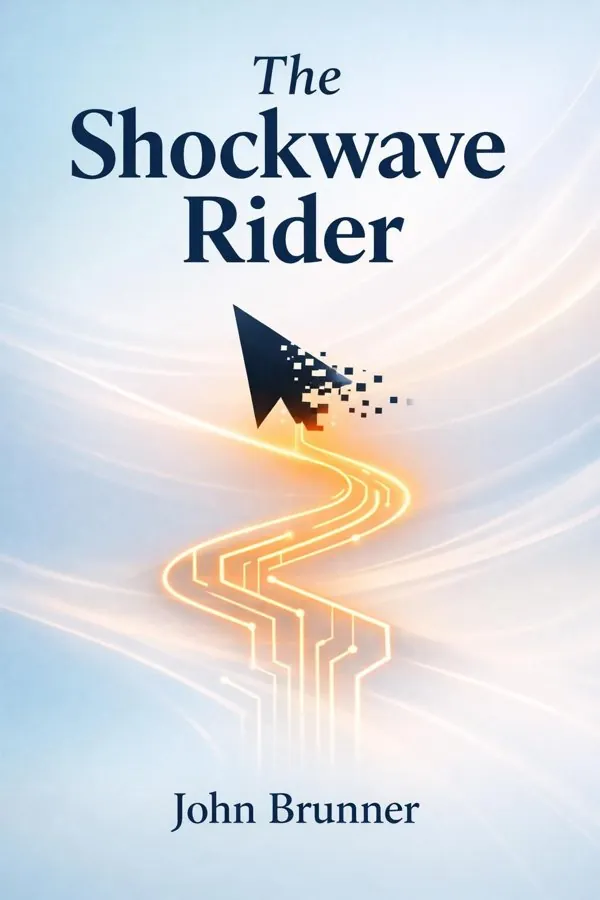
The Shockwave Rider: Summary & Key Insights
by John Brunner
 10 min9 chaptersAudio available
Key Takeaways from The Shockwave Rider
A society does not need visible chains to become unfree; sometimes it only needs perfect records.
The most dangerous person in a controlled system is often the one it trained too well.
When the future arrives unevenly, social order starts to splinter.
Systems often justify secrecy by claiming to protect the public, but secrecy can also hide the public’s betrayal.
Sometimes the most radical tool is not a bomb, but a message that cannot be stopped.
What Is The Shockwave Rider About?
The Shockwave Rider by John Brunner is a scifi_fantasy book spanning 7 pages. The Shockwave Rider is John Brunner’s startlingly prophetic 1975 science fiction novel about life inside a society ruled by information. Set in a near-future America where giant data networks track identities, behavior, and social risk, the story follows Nick Haflinger, a brilliant fugitive raised by a government program to become an elite systems mind. Rather than serve the machine that made him, Nick turns against it, using his knowledge of code, surveillance, and institutional secrecy to fight for personal freedom. His most famous weapon is a self-replicating program—what Brunner memorably imagined as a “worm”—deployed not for profit, but to expose corruption and force truth into the open. What makes the novel endure is not just its fast-moving plot, but its eerie accuracy. Decades before the internet became central to everyday life, Brunner envisioned data profiling, digital identity manipulation, online harassment, predictive social systems, and the political power of leaked information. He wrote speculative fiction with the urgency of social criticism, blending thriller pacing with deep concern about technology’s effect on democracy and privacy. The Shockwave Rider matters because it asks a question that feels even more urgent today: when information systems shape reality, who controls the truth?
This FizzRead summary covers all 9 key chapters of The Shockwave Rider in approximately 10 minutes, distilling the most important ideas, arguments, and takeaways from John Brunner's work. Also available as an audio summary and Key Quotes Podcast.
The Shockwave Rider
The Shockwave Rider is John Brunner’s startlingly prophetic 1975 science fiction novel about life inside a society ruled by information. Set in a near-future America where giant data networks track identities, behavior, and social risk, the story follows Nick Haflinger, a brilliant fugitive raised by a government program to become an elite systems mind. Rather than serve the machine that made him, Nick turns against it, using his knowledge of code, surveillance, and institutional secrecy to fight for personal freedom. His most famous weapon is a self-replicating program—what Brunner memorably imagined as a “worm”—deployed not for profit, but to expose corruption and force truth into the open.
What makes the novel endure is not just its fast-moving plot, but its eerie accuracy. Decades before the internet became central to everyday life, Brunner envisioned data profiling, digital identity manipulation, online harassment, predictive social systems, and the political power of leaked information. He wrote speculative fiction with the urgency of social criticism, blending thriller pacing with deep concern about technology’s effect on democracy and privacy. The Shockwave Rider matters because it asks a question that feels even more urgent today: when information systems shape reality, who controls the truth?
Who Should Read The Shockwave Rider?
This book is perfect for anyone interested in scifi_fantasy and looking to gain actionable insights in a short read. Whether you're a student, professional, or lifelong learner, the key ideas from The Shockwave Rider by John Brunner will help you think differently.
- ✓Readers who enjoy scifi_fantasy and want practical takeaways
- ✓Professionals looking to apply new ideas to their work and life
- ✓Anyone who wants the core insights of The Shockwave Rider in just 10 minutes
Want the full summary?
Get instant access to this book summary and 100K+ more with Fizz Moment.
Get Free SummaryAvailable on App Store • Free to download
Key Chapters
A society does not need visible chains to become unfree; sometimes it only needs perfect records. The Shockwave Rider opens in a near-future America where computerized databanks, linked systems, and institutional profiling have become the hidden architecture of daily life. Every person leaves a trail of information—education, employment, consumption, health, political risk, even psychological disposition—and that trail determines access to opportunity. Brunner’s world is not ruled by a single dictator in the traditional sense. Instead, it is governed by systems: sprawling bureaucracies, corporations, and state agencies that make decisions through data.
This is what makes the novel so powerful. It imagines control not as dramatic oppression, but as administrative convenience. A citizen may change jobs, move cities, or reinvent a name, yet the network seeks to reduce that complexity into a manageable file. In Brunner’s vision, the danger is not only surveillance itself, but the belief that enough information can produce a fully knowable human being. Once institutions accept that idea, they begin to sort people into categories, predict behavior, and justify intervention in the name of efficiency or safety.
The contemporary parallel is easy to see. Credit scores, algorithmic hiring, recommendation systems, predictive policing, targeted advertising, and digital reputations all turn messy human lives into machine-readable signals. The issue is not that data is useless; it is that data gains moral authority when we forget who collected it, how it was interpreted, and whose interests it serves.
Brunner invites readers to recognize that convenience can become compliance. When systems know us better than we know how they work, freedom shrinks quietly. Actionable takeaway: audit the digital systems that shape your own life—what they collect, what they infer, and where you can reclaim privacy, consent, and transparency.
The most dangerous person in a controlled system is often the one it trained too well. Nick Haflinger begins as a creation of Project Delphi, a government experiment designed to identify and cultivate extraordinary intelligence for strategic ends. Raised in an environment of psychological conditioning, advanced training, and institutional manipulation, he is groomed to become a tool of the state’s information machinery. But Nick’s genius gives him something the planners did not fully anticipate: the ability to understand the system as a whole, including its lies.
His escape is therefore more than a physical flight. It is an act of intellectual rebellion. Nick survives by changing identities, reading people and systems with equal skill, and staying one step ahead of the vast network built to classify and retrieve him. He embodies a central paradox of modern technocratic society: institutions want highly capable individuals, but they also want obedience. The moment competence produces independent judgment, the asset becomes a threat.
Brunner uses Nick’s story to explore how environments shape people without fully determining them. Project Delphi tried to engineer a predictable outcome, but human beings remain morally unstable in the best sense—they can choose against their programming. This makes Nick a compelling protagonist not because he is simply smarter than everyone else, but because he transforms intelligence into conscience.
The idea has real-world relevance. Many people are trained within systems—elite schools, major firms, government programs, platform companies—that reward technical excellence while discouraging ethical dissent. The question becomes: what do you do when your expertise reveals harms your institution prefers not to see? Nick’s answer is risky but clear: refusal matters.
Actionable takeaway: if your skills give you privileged insight into how a system works, use that knowledge not only to advance within it, but to question what it normalizes and what it hides.
When the future arrives unevenly, social order starts to splinter. One of Brunner’s sharpest achievements in The Shockwave Rider is his depiction of a society under chronic pressure from rapid technological and cultural change. America in the novel is not a cleanly advanced utopia. It is restless, unstable, and psychologically strained. Communities fracture, institutions lose legitimacy, and ordinary people live with persistent dislocation. Brunner captures the feeling of a civilization that has gained immense technical power without the moral coordination to use it well.
This fractured society appears in many forms: temporary identities, unstable relationships, social violence, elite enclaves insulated from consequence, and citizens who feel overwhelmed by complexity. Brunner suggests that information saturation does not automatically produce wisdom. Instead, too much unmanaged change can make people more vulnerable to manipulation, fear, and dependency. When everything shifts at once—jobs, norms, technologies, authorities—individuals seek stability anywhere they can find it, even in systems that exploit them.
The idea feels current because modern life also produces fragmentation. Gig work, endless digital feeds, geographic mobility, weakening social trust, and online tribalism can leave people informed yet unmoored. The problem is not simply that society changes. It is that institutions often innovate faster than they build humane structures of support. Brunner’s future warns that a networked civilization can remain emotionally primitive, treating people as units to process rather than citizens to protect.
This key idea broadens the novel beyond a story of one hacker against one regime. Nick moves through a culture already destabilized, and that instability is what makes centralized information control seem attractive in the first place. Disorder becomes the excuse for surveillance.
Actionable takeaway: in periods of rapid change, invest deliberately in human-scale anchors—trusted relationships, local community, shared norms, and media discipline—so you are less likely to trade freedom for the promise of technological order.
Systems often justify secrecy by claiming to protect the public, but secrecy can also hide the public’s betrayal. As Nick moves deeper into the machinery of the state and its allied institutions, he discovers that the real rot in Brunner’s world is not accidental malfunction. It is deliberate concealment. Powerful actors manipulate information, bury wrongdoing, and maintain control by deciding what may be known and by whom. The network does not merely store facts; it becomes a weapon for managing perception.
This is a crucial turn in the novel. Until this point, the data empire might still be interpreted as an overgrown bureaucracy—dangerous, but impersonal. What Nick learns reveals something darker: the architecture of information has moral consequences because those who control it can shape reality for everyone else. Public trust becomes impossible when institutions can erase records, alter narratives, and punish dissenters while presenting themselves as neutral administrators.
Brunner’s insight anticipates a world of document leaks, manipulated databases, selective transparency, and reputational warfare. The central issue is not simply that governments or corporations possess information. It is that asymmetry of information creates asymmetry of power. If a citizen is transparent to institutions while institutions remain opaque to citizens, accountability collapses.
In practical terms, this applies far beyond the novel. Whistleblowing, freedom-of-information laws, investigative journalism, open-source verification, and digital security practices all emerge from the same democratic intuition: truth should not belong exclusively to power. Nick’s growing understanding turns him from a survivor into an insurgent because he realizes that private escape is not enough when the structure itself is corrupt.
Actionable takeaway: whenever an institution demands trust while resisting scrutiny, treat opacity as a warning sign and look for independent ways to verify claims, policies, and incentives.
Sometimes the most radical tool is not a bomb, but a message that cannot be stopped. The Shockwave Rider is famous for introducing the concept of the computer worm: a self-replicating program that moves through a network on its own. In Brunner’s hands, this is not merely a clever technological prediction. It is a political invention. Nick creates and deploys the worm to disrupt centralized control of information and force hidden truths into public circulation.
The worm matters because it transforms the logic of power. In a system where authorities rely on centralized databases and controlled channels, a self-propagating program becomes an equalizer. It bypasses gatekeepers, multiplies faster than bureaucracies can contain it, and demonstrates that networks are vulnerable precisely because they are connected. Brunner saw early that interdependence creates efficiency and fragility at the same time.
What gives this idea lasting significance is its ethical ambiguity. A worm is not inherently liberating. The same tool that can expose corruption can also spread sabotage, theft, panic, or lies. Brunner does not celebrate technology blindly; he shows that digital tools magnify intent. Nick’s use of the worm is tied to a moral purpose: restoring public access to truth. Yet the novel leaves readers with an uncomfortable question—once such tools exist, who decides what counts as justified disruption?
Today we live with descendants of this dilemma in malware, ransomware, hacktivism, automated leaks, bot networks, and viral information campaigns. The underlying lesson is that technical innovation rapidly becomes political reality. To imagine a new capability is also to alter the field of power.
Actionable takeaway: judge digital tools not only by how ingenious they are, but by who benefits, who is harmed, and what safeguards exist when powerful code escapes into the wider system.
Truth is not neutral once it starts moving through a closed system. When Nick’s actions trigger revelation and upheaval, Brunner shows how suppressed information can act like a social shockwave, destabilizing institutions that depend on secrecy. Exposing hidden records does not simply “inform” the public. It rearranges who can speak, who can deny, who can govern, and who must answer for past decisions. Information, in this sense, is not passive content; it is force.
This part of the novel highlights an uncomfortable democratic reality. People often claim to want transparency, but transparency is disruptive. It damages careers, destroys official narratives, undermines confidence, and can unleash chaos before it creates reform. Brunner refuses the comforting fantasy that truth automatically leads to calm improvement. Instead, he suggests that when a society has tolerated deep informational corruption, disclosure will feel violent because it punctures a whole system of managed illusions.
The modern applications are everywhere: leaked archives, whistleblower disclosures, platform data dumps, investigative exposés, and viral recordings that alter public debate in hours. The sequence is familiar—revelation, denial, polarization, institutional scrambling, then either reform or re-entrenchment. Brunner’s foresight lies in seeing that networked societies amplify these cycles because speed outpaces reflection.
Yet the novel does not argue against disclosure. It argues that a political order built on secrecy invites explosive correction. If institutions cannot survive honest scrutiny, the problem is not the truth. The problem is the institution.
For readers, the practical lesson is to prepare for the turbulence that accompanies accountability. Transparency is essential, but it must be paired with civic habits capable of interpreting and responding to it.
Actionable takeaway: when major revelations emerge, resist both instant cynicism and blind outrage—focus on evidence, patterns, incentives, and what structural reforms would prevent the same abuse from returning.
Running from a system may save one person, but it does not change the conditions that made escape necessary. By the later stages of The Shockwave Rider, Brunner shifts the meaning of resistance from individual evasion to collective possibility. Nick begins as a fugitive trying to stay alive in a world where databases can erase anonymity. Over time, his struggle matures into a broader effort to make freedom structurally real for others.
This is one of the novel’s deepest insights. Personal autonomy is fragile if the surrounding society remains organized around surveillance, manipulation, and concentrated informational power. A clever person may outwit the machine for a while, but a humane future requires institutions, norms, and rights that do not depend on exceptional brilliance. In that sense, Nick’s story is not the glorification of the lone genius. It is a critique of societies that force freedom to rely on extraordinary individuals.
Brunner points toward a freer future not as a utopian endpoint, but as an unfinished civic task. Privacy, accountability, transparency, and human dignity must be designed into systems, not merely defended from the margins. That idea has only grown more relevant in the age of platform monopolies, biometric surveillance, AI profiling, and data brokerage. Technical resistance matters, but lasting freedom also depends on law, culture, public pressure, and ethical design.
The practical application is clear. It is not enough to use secure tools privately while accepting abusive systems publicly. People must also support institutions and policies that distribute informational power more fairly. A free society is not one where only experts can defend themselves.
Actionable takeaway: combine personal digital self-defense with civic action—support privacy rights, transparent governance, and technologies designed to serve users rather than merely extract from them.
In a networked world, identity can become both easier to change and harder to escape. Throughout The Shockwave Rider, Nick survives by assuming new roles, names, and social positions. On one level, this gives the novel the energy of a chase thriller. On another, it expresses a profound idea about modern life: identity is increasingly performative, portable, and data-mediated. People can reinvent themselves, but only within systems that are constantly trying to pin them down.
Brunner saw early that digital environments blur the line between selfhood and record. Who you are is no longer just what you say or do; it is what databases store, what institutions infer, and what networks circulate. This creates a strange tension. Individuals may enjoy new forms of self-construction, yet those same forms produce traces that make them more legible to authority. Reinvention becomes possible, but anonymity becomes fragile.
This theme resonates strongly today. Social media profiles, professional platforms, search histories, biometric IDs, and algorithmic scoring all shape how identity is assembled and judged. A person may curate one image publicly while hidden systems create another behind the scenes. Errors, old records, or misleading signals can follow someone indefinitely. In such a world, identity is not only expression; it is negotiation with infrastructures.
Brunner’s treatment of Nick suggests that the desire to be unclassifiable is itself political. To remain larger than one’s file is to defend human unpredictability against administrative reduction. That does not mean living dishonestly. It means rejecting the idea that official records exhaust the truth of a person.
Actionable takeaway: treat your digital identity as something actively managed—limit unnecessary exposure, correct records where possible, separate contexts when needed, and remember that no platform should define the full reality of who you are.
The most impressive science fiction does not merely predict gadgets; it predicts pressures. The Shockwave Rider remains remarkable because so many of its core concerns now define everyday life. Brunner anticipated interconnected databases, social instability accelerated by technology, privacy erosion, automated profiling, reputational vulnerability, malicious code, information asymmetry, and the political force of leaks. Even where his details differ from our reality, the pattern he identified has proven astonishingly durable.
What he understood is that networking changes society not just technically, but psychologically and politically. Once information flows become central to work, governance, media, and identity, nearly every social conflict becomes an information conflict as well. Who sees what? Who can hide what? Who is profiled, ranked, or excluded? Who can spread a message at scale? These are no longer niche technical questions. They are foundational civic ones.
That is why the novel still matters to readers outside science fiction. It offers a conceptual framework for understanding the internet age before the internet as we know it existed. Brunner links technology to institutional power, social fragmentation, and moral responsibility. He reminds us that innovation cannot be judged only by novelty or efficiency. It must also be judged by what kinds of human beings and political arrangements it encourages.
For modern readers, the book works as both a gripping story and a diagnostic lens. It sharpens awareness of how deeply infrastructure shapes freedom. It also warns against technological fatalism. The future is not something that simply happens through machines; it is something organized by choices, interests, and values.
Actionable takeaway: read emerging technologies through Brunner’s lens—ask not only what a system can do, but how it redistributes visibility, power, vulnerability, and the capacity for democratic control.
All Chapters in The Shockwave Rider
About the Author
John Brunner (1934–1995) was a British science fiction novelist whose work combined bold speculation with sharp social criticism. Although he wrote prolifically across his career, he is best remembered for a group of ambitious novels that examined the pressures reshaping modern civilization, including Stand on Zanzibar, The Jagged Orbit, The Sheep Look Up, and The Shockwave Rider. Brunner was especially skilled at exploring how technology, bureaucracy, media, and environmental stress alter everyday life. Rather than treat science fiction as simple escapism, he used it to confront issues such as overpopulation, state power, pollution, inequality, and the erosion of privacy. His fiction remains influential because it often anticipated real-world developments with striking clarity, making him one of the most prescient and intellectually serious writers in the genre.
Get This Summary in Your Preferred Format
Read or listen to the The Shockwave Rider summary by John Brunner anytime, anywhere. FizzRead offers multiple formats so you can learn on your terms — all free.
Available formats: App · Audio · PDF · EPUB — All included free with FizzRead
Download The Shockwave Rider PDF and EPUB Summary
Key Quotes from The Shockwave Rider
“A society does not need visible chains to become unfree; sometimes it only needs perfect records.”
“The most dangerous person in a controlled system is often the one it trained too well.”
“When the future arrives unevenly, social order starts to splinter.”
“Systems often justify secrecy by claiming to protect the public, but secrecy can also hide the public’s betrayal.”
“Sometimes the most radical tool is not a bomb, but a message that cannot be stopped.”
Frequently Asked Questions about The Shockwave Rider
The Shockwave Rider by John Brunner is a scifi_fantasy book that explores key ideas across 9 chapters. The Shockwave Rider is John Brunner’s startlingly prophetic 1975 science fiction novel about life inside a society ruled by information. Set in a near-future America where giant data networks track identities, behavior, and social risk, the story follows Nick Haflinger, a brilliant fugitive raised by a government program to become an elite systems mind. Rather than serve the machine that made him, Nick turns against it, using his knowledge of code, surveillance, and institutional secrecy to fight for personal freedom. His most famous weapon is a self-replicating program—what Brunner memorably imagined as a “worm”—deployed not for profit, but to expose corruption and force truth into the open. What makes the novel endure is not just its fast-moving plot, but its eerie accuracy. Decades before the internet became central to everyday life, Brunner envisioned data profiling, digital identity manipulation, online harassment, predictive social systems, and the political power of leaked information. He wrote speculative fiction with the urgency of social criticism, blending thriller pacing with deep concern about technology’s effect on democracy and privacy. The Shockwave Rider matters because it asks a question that feels even more urgent today: when information systems shape reality, who controls the truth?
You Might Also Like
Red Rising
Pierce Brown
10 min
Stranger in a Strange Land
Robert A. Heinlein
10 min
AI Valley
Chen Qiufan
10 min
Bloodchild
Octavia E. Butler
10 min
Do Androids Dream of Electric Sheep?
Philip K. Dick
10 min
Jujutsu Kaisen, Vol. 24
Gege Akutami
10 minBrowse by Category
Ready to read The Shockwave Rider?
Get the full summary and 100K+ more books with Fizz Moment.