
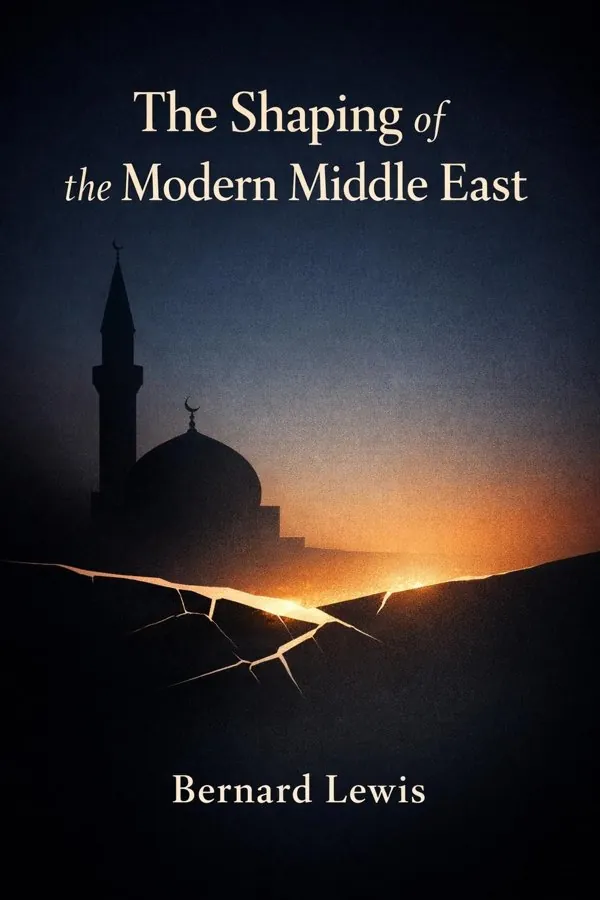
The Shaping of the Modern Middle East: Summary & Key Insights
 10 min13 chaptersAudio available
What Is The Shaping of the Modern Middle East About?
The Shaping of the Modern Middle East by Bernard Lewis is a world_history book spanning 13 pages. In this influential work, Bernard Lewis traces the political, social, and cultural transformations that have shaped the modern Middle East. Drawing on decades of scholarship, he examines the region’s encounter with the West, the decline of the Ottoman Empire, the rise of nationalism, and the continuing struggles over identity, religion, and modernization.
This FizzRead summary covers all 13 key chapters of The Shaping of the Modern Middle East in approximately 10 minutes, distilling the most important ideas, arguments, and takeaways from Bernard Lewis's work. Also available as an audio summary and Key Quotes Podcast.
The Shaping of the Modern Middle East
In this influential work, Bernard Lewis traces the political, social, and cultural transformations that have shaped the modern Middle East. Drawing on decades of scholarship, he examines the region’s encounter with the West, the decline of the Ottoman Empire, the rise of nationalism, and the continuing struggles over identity, religion, and modernization.
Who Should Read The Shaping of the Modern Middle East?
This book is perfect for anyone interested in world_history and looking to gain actionable insights in a short read. Whether you're a student, professional, or lifelong learner, the key ideas from The Shaping of the Modern Middle East by Bernard Lewis will help you think differently.
- ✓Readers who enjoy world_history and want practical takeaways
- ✓Professionals looking to apply new ideas to their work and life
- ✓Anyone who wants the core insights of The Shaping of the Modern Middle East in just 10 minutes
Want the full summary?
Get instant access to this book summary and 100K+ more with Fizz Moment.
Get Free SummaryAvailable on App Store • Free to download
Key Chapters
To grasp the modern Middle East, we must begin with its center of gravity in the early modern period—the Ottoman Empire. At its height, the empire was not only the political master of the Arab lands, Anatolia, the Balkans, and parts of North Africa; it was also the bearer of a universal Islamic order that connected religion, government, and social life. Ottoman administration was deeply hierarchical yet strikingly intricate: a balance between authority and autonomy. The sultan, as caliph, embodied both worldly and spiritual leadership. Beneath him stood a vast bureaucracy that sought to integrate linguistic, ethnic, and religious diversity under Islamic law and imperial decree.
One of the remarkable features of the Ottoman system was its flexibility. The millet system allowed religious communities—the Christians of Byzantium, the Jews of Sephardic exile, the Armenians of Anatolia—to preserve their internal autonomy so long as they acknowledged imperial sovereignty. Taxation, military service, and social status were stratified, yet not arbitrary: all operated within the logic of a sacred political order. For centuries, this gave the empire resilience. It was, as European travelers often observed, a world where faith and power were fused but not confused.
However, the world outside was changing. Europe was experimenting with new forms of statecraft, new sciences, new economies. The Ottoman structure, once formidable, began to show signs of strain as new technologies and modes of warfare rendered its centralized hierarchy cumbersome. Yet, even as decline loomed, the empire maintained a self-image rooted in divine legitimacy—the belief that the Sultan’s rule was sanctioned by an order older and higher than mere politics.
The decline of the Ottoman Empire was not sudden; it was a slow unraveling. The empire faced the twin pressures of internal inefficiency and external aggression. Economically, it lagged behind the industrializing West. Militarily, it fell behind in weaponry and organization. Intellectually, its scholars and administrators struggled to interpret a world whose sciences and philosophies were now foreign. Russia’s advance in the north and Europe’s encroachment by sea exposed vulnerabilities that reform alone could not immediately fix.
But much more than cannons and commerce, what eroded Ottoman strength was a crisis of confidence. The Islamic world had historically perceived itself as the fortress of divine civilization, shielded from non-Muslim disorder. Yet the West, previously regarded as backward and fragmented, now appeared powerful, organized, creative. Sultans and viziers alternated between denial and reform: sometimes trying to reassert traditional order through revival, at other times seeking salvation in imitation of Europe’s institutions.
Throughout the nineteenth century, Ottoman decline became a preoccupation for statesmen and scholars alike. The empire lost Greece, Serbia, Egypt, and finally nearly all of its European territories. With each loss came a moral reckoning: the realization that the old imperial unity was fracturing not only geographically but psychologically. This erosion was more than military weakness—it was the beginning of a new historical consciousness, one that would soon give rise to nationalism and new forms of identity.
+ 11 more chapters — available in the FizzRead app
All Chapters in The Shaping of the Modern Middle East
About the Author
Bernard Lewis (1916–2018) was a British-American historian and one of the world’s foremost scholars on Middle Eastern and Islamic history. He taught at the University of London and Princeton University, and authored numerous books that profoundly influenced Western understanding of the Islamic world.
Get This Summary in Your Preferred Format
Read or listen to the The Shaping of the Modern Middle East summary by Bernard Lewis anytime, anywhere. FizzRead offers multiple formats so you can learn on your terms — all free.
Available formats: App · Audio · PDF · EPUB — All included free with FizzRead
Download The Shaping of the Modern Middle East PDF and EPUB Summary
Key Quotes from The Shaping of the Modern Middle East
“To grasp the modern Middle East, we must begin with its center of gravity in the early modern period—the Ottoman Empire.”
“The decline of the Ottoman Empire was not sudden; it was a slow unraveling.”
Frequently Asked Questions about The Shaping of the Modern Middle East
The Shaping of the Modern Middle East by Bernard Lewis is a world_history book that explores key ideas across 13 chapters. In this influential work, Bernard Lewis traces the political, social, and cultural transformations that have shaped the modern Middle East. Drawing on decades of scholarship, he examines the region’s encounter with the West, the decline of the Ottoman Empire, the rise of nationalism, and the continuing struggles over identity, religion, and modernization.
You Might Also Like
The Age of Capital
Eric Hobsbawm
10 min
The Gulag Archipelago
Aleksandr Solzhenitsyn
10 min
Jerusalem: The Biography
Simon Sebag Montefiore
10 min
The Anglo-Saxons
James Campbell
10 min
The Boer War
Thomas Pakenham
10 min
The Industrial Revolutionaries: The Making of the Modern World 1776–1914
Gavin Weightman
10 minBrowse by Category
Ready to read The Shaping of the Modern Middle East?
Get the full summary and 100K+ more books with Fizz Moment.