
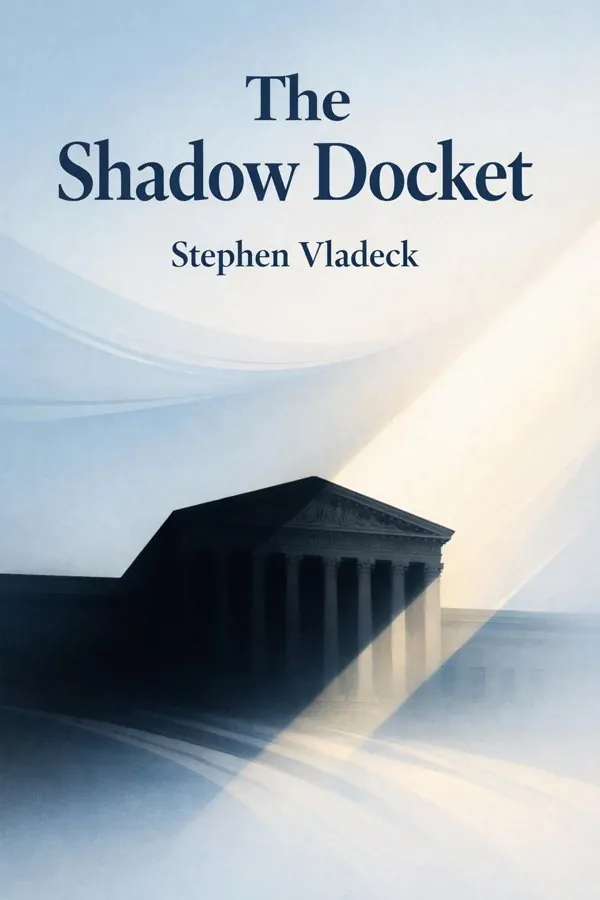
The Shadow Docket: How the Supreme Court Uses Stealth Rulings to Amass Power and Undermine the Republic: Summary & Key Insights
 10 min10 chaptersAudio available
What Is The Shadow Docket: How the Supreme Court Uses Stealth Rulings to Amass Power and Undermine the Republic About?
The Shadow Docket: How the Supreme Court Uses Stealth Rulings to Amass Power and Undermine the Republic by Stephen Vladeck is a law_crime book spanning 10 pages. In this incisive work, Stephen Vladeck exposes how the U.S. Supreme Court increasingly relies on its 'shadow docket'—a set of emergency orders and summary decisions issued without full briefing or oral argument—to shape American law and policy. Vladeck argues that this practice allows the Court to wield immense power with little transparency or accountability, affecting issues from voting rights to immigration. The book calls for greater public scrutiny and institutional reform to preserve democratic checks and balances.
This FizzRead summary covers all 10 key chapters of The Shadow Docket: How the Supreme Court Uses Stealth Rulings to Amass Power and Undermine the Republic in approximately 10 minutes, distilling the most important ideas, arguments, and takeaways from Stephen Vladeck's work. Also available as an audio summary and Key Quotes Podcast.
The Shadow Docket: How the Supreme Court Uses Stealth Rulings to Amass Power and Undermine the Republic
In this incisive work, Stephen Vladeck exposes how the U.S. Supreme Court increasingly relies on its 'shadow docket'—a set of emergency orders and summary decisions issued without full briefing or oral argument—to shape American law and policy. Vladeck argues that this practice allows the Court to wield immense power with little transparency or accountability, affecting issues from voting rights to immigration. The book calls for greater public scrutiny and institutional reform to preserve democratic checks and balances.
Who Should Read The Shadow Docket: How the Supreme Court Uses Stealth Rulings to Amass Power and Undermine the Republic?
This book is perfect for anyone interested in law_crime and looking to gain actionable insights in a short read. Whether you're a student, professional, or lifelong learner, the key ideas from The Shadow Docket: How the Supreme Court Uses Stealth Rulings to Amass Power and Undermine the Republic by Stephen Vladeck will help you think differently.
- ✓Readers who enjoy law_crime and want practical takeaways
- ✓Professionals looking to apply new ideas to their work and life
- ✓Anyone who wants the core insights of The Shadow Docket: How the Supreme Court Uses Stealth Rulings to Amass Power and Undermine the Republic in just 10 minutes
Want the full summary?
Get instant access to this book summary and 100K+ more with Fizz Moment.
Get Free SummaryAvailable on App Store • Free to download
Key Chapters
In the early years of the Supreme Court, emergency orders were rare and uncontroversial. When the Court issued them, they tended to be practical steps meant to preserve the status quo until a full hearing could occur. Before modern communication technology, the justices often acted through in-chambers decisions—single-justice rulings intended to handle time-sensitive matters. These motions were understood as temporary, procedural actions rather than substantive judgments.
For much of the twentieth century, the Court reinforced this modest conception. Emergency orders were seen as neutral tools to ensure stability, not to direct national policy. They were seldom reported widely or even compiled systematically. It was the 'merits docket'—the formal, deliberate adjudication of major constitutional controversies—that defined the Court’s authority and influence.
However, the seeds of transformation were being planted. As the Court’s caseload grew and as modern issues demanded swift judicial responses—such as injunctions in civil rights disputes or stays of execution—the interim authority of the justices began to expand. The judiciary’s internal culture shifted: efficiency started to blend with power. What was once an administrative measure slowly became a potential avenue for substantive control, even though the public still viewed the shadow docket as a procedural backwater.
Understanding this early equilibrium helps reveal how extraordinary the subsequent expansion has been. The point is that the Court’s emergency role was supposed to be narrow—restricted to immediate necessity. The legitimacy of such orders rested on their transitory nature, their lack of precedent, and their function as mere placeholders. Once they became a source of lasting legal effects, that legitimacy began to crack.
The late twentieth century brought unprecedented growth in the Court’s use of summary and emergency decrees. The proliferation of stay applications, injunction requests, and procedural appeals allowed the justices to act swiftly—and, sometimes, decisively—without full procedural examination. The rise of the federal government’s emergency applications accelerated this change. The Solicitor General began to seek immediate intervention from the Court not as a last resort but as a strategic move to secure political victories. These interventions became increasingly frequent during the Bush and Obama administrations, but the pattern exploded under the Trump administration.
Consider how immigration policy evolved during that time. Policies involving Deferred Action for Childhood Arrivals (DACA), asylum restrictions, and travel bans were repeatedly molded through unsigned orders. The Court’s decisions often arrived in terse paragraphs, without specifying its rationale or ideological divisions. Yet those few sentences could suspend or revive entire government programs.
The expansion of the shadow docket transformed the Court’s relationship to momentary power. Instead of reviewing settled law, it began to dictate what the law would temporarily be—decisions made in the dark, yet with lasting consequences. The justices themselves acknowledged this growing domain. The increasing divide between conservative and liberal members reflected disagreement not only over substance but over process. To some, the shadow docket’s flexibility was a pragmatic necessity; to others, it was a circumvention of the deliberation essential to legitimacy.
This acceleration was not accidental. Technological immediacy, political polarization, and the culture of litigation created pressures that made emergency rulings a potent instrument. The Supreme Court’s prestige shielded these moves from scrutiny. What remained invisible to most citizens—how and why these decisions were made—became a central theme in the evolving story of judicial power.
+ 8 more chapters — available in the FizzRead app
All Chapters in The Shadow Docket: How the Supreme Court Uses Stealth Rulings to Amass Power and Undermine the Republic
About the Author
Stephen I. Vladeck is a professor of law at the University of Texas School of Law, specializing in constitutional law, national security law, and the federal courts. He is a frequent commentator on Supreme Court issues and has written extensively on judicial transparency and the separation of powers.
Get This Summary in Your Preferred Format
Read or listen to the The Shadow Docket: How the Supreme Court Uses Stealth Rulings to Amass Power and Undermine the Republic summary by Stephen Vladeck anytime, anywhere. FizzRead offers multiple formats so you can learn on your terms — all free.
Available formats: App · Audio · PDF · EPUB — All included free with FizzRead
Download The Shadow Docket: How the Supreme Court Uses Stealth Rulings to Amass Power and Undermine the Republic PDF and EPUB Summary
Key Quotes from The Shadow Docket: How the Supreme Court Uses Stealth Rulings to Amass Power and Undermine the Republic
“In the early years of the Supreme Court, emergency orders were rare and uncontroversial.”
“The late twentieth century brought unprecedented growth in the Court’s use of summary and emergency decrees.”
Frequently Asked Questions about The Shadow Docket: How the Supreme Court Uses Stealth Rulings to Amass Power and Undermine the Republic
The Shadow Docket: How the Supreme Court Uses Stealth Rulings to Amass Power and Undermine the Republic by Stephen Vladeck is a law_crime book that explores key ideas across 10 chapters. In this incisive work, Stephen Vladeck exposes how the U.S. Supreme Court increasingly relies on its 'shadow docket'—a set of emergency orders and summary decisions issued without full briefing or oral argument—to shape American law and policy. Vladeck argues that this practice allows the Court to wield immense power with little transparency or accountability, affecting issues from voting rights to immigration. The book calls for greater public scrutiny and institutional reform to preserve democratic checks and balances.
You Might Also Like
Abortion and the Law in America: Roe v. Wade to the Present
Mary Ziegler
10 min
Black Edge: Inside Information, Dirty Money, and the Quest to Bring Down the Most Wanted Man on Wall Street
Sheelah Kolhatkar
10 min
Blood Feud: The Man Who Blew the Whistle on One of the Deadliest Prescription Drugs Ever
Kathleen Sharp
10 min
Catch and Kill: Lies, Spies, and a Conspiracy to Protect Predators
Ronan Farrow
10 min
Chaos: Charles Manson, the CIA, and the Secret History of the Sixties
Tom O'Neill with Dan Piepenbring
10 min
Code and Other Laws of Cyberspace
Lawrence Lessig
10 minBrowse by Category
Ready to read The Shadow Docket: How the Supreme Court Uses Stealth Rulings to Amass Power and Undermine the Republic?
Get the full summary and 100K+ more books with Fizz Moment.