
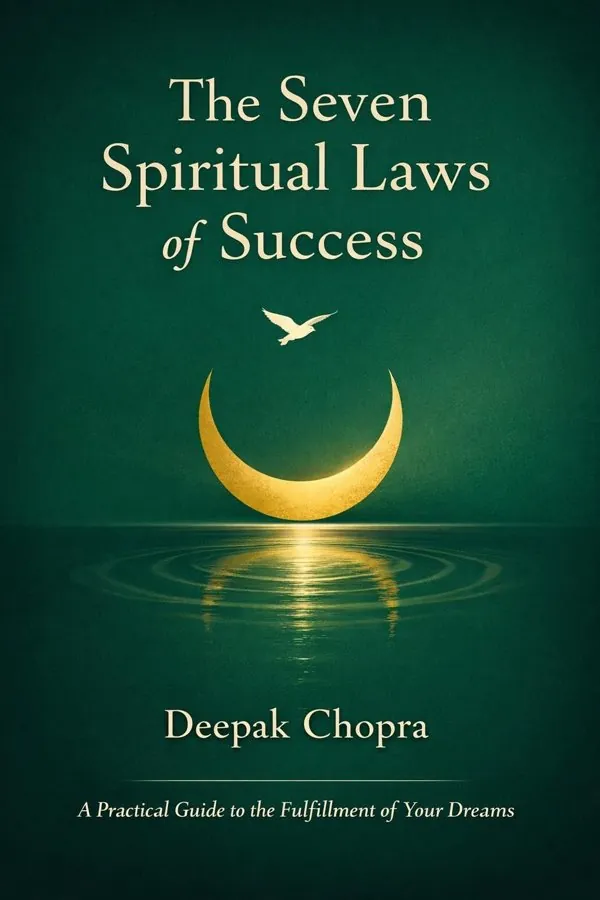
The Seven Spiritual Laws of Success: A Practical Guide to the Fulfillment of Your Dreams: Summary & Key Insights
 10 min8 chaptersAudio available
Key Takeaways from The Seven Spiritual Laws of Success: A Practical Guide to the Fulfillment of Your Dreams
Most people search for power in achievement, yet Chopra begins with a more radical claim: your deepest power exists before you accomplish anything at all.
What if abundance is not something you hoard but something you circulate?
Every moment is a crossroads, and Chopra’s Law of Karma reminds us that destiny is shaped less by fate than by choice.
We often assume that struggle proves seriousness, but Chopra’s Law of Least Effort suggests the opposite: nature accomplishes its work with remarkable ease.
A clear intention can quietly reshape an entire life.
What Is The Seven Spiritual Laws of Success: A Practical Guide to the Fulfillment of Your Dreams About?
The Seven Spiritual Laws of Success: A Practical Guide to the Fulfillment of Your Dreams by Deepak Chopra is a eastern_wisdom book spanning 8 pages. In The Seven Spiritual Laws of Success, Deepak Chopra offers a compact but influential vision of achievement that challenges the usual assumptions about ambition, effort, and wealth. Rather than defining success as status, control, or endless striving, Chopra argues that real success arises when we align ourselves with deeper laws embedded in consciousness and nature. Drawing from Vedic philosophy while using clear, contemporary language, he presents seven principles that connect inner awareness with outer fulfillment. These laws are not abstract religious ideals; they are practical habits of attention, action, and trust that can shape work, relationships, creativity, and purpose. What makes the book enduring is its promise that success does not have to be harsh, anxious, or exhausting. Chopra suggests that abundance and meaning become more accessible when we act from stillness, generosity, responsibility, and detachment rather than fear and force. As a physician, bestselling author, and leading voice in mind-body spirituality, he brings together Eastern wisdom and modern self-development in a way that feels both uplifting and usable. For readers seeking a more peaceful and purposeful definition of success, this book remains a concise guide with lasting impact.
This FizzRead summary covers all 8 key chapters of The Seven Spiritual Laws of Success: A Practical Guide to the Fulfillment of Your Dreams in approximately 10 minutes, distilling the most important ideas, arguments, and takeaways from Deepak Chopra's work. Also available as an audio summary and Key Quotes Podcast.
The Seven Spiritual Laws of Success: A Practical Guide to the Fulfillment of Your Dreams
In The Seven Spiritual Laws of Success, Deepak Chopra offers a compact but influential vision of achievement that challenges the usual assumptions about ambition, effort, and wealth. Rather than defining success as status, control, or endless striving, Chopra argues that real success arises when we align ourselves with deeper laws embedded in consciousness and nature. Drawing from Vedic philosophy while using clear, contemporary language, he presents seven principles that connect inner awareness with outer fulfillment. These laws are not abstract religious ideals; they are practical habits of attention, action, and trust that can shape work, relationships, creativity, and purpose.
What makes the book enduring is its promise that success does not have to be harsh, anxious, or exhausting. Chopra suggests that abundance and meaning become more accessible when we act from stillness, generosity, responsibility, and detachment rather than fear and force. As a physician, bestselling author, and leading voice in mind-body spirituality, he brings together Eastern wisdom and modern self-development in a way that feels both uplifting and usable. For readers seeking a more peaceful and purposeful definition of success, this book remains a concise guide with lasting impact.
Who Should Read The Seven Spiritual Laws of Success: A Practical Guide to the Fulfillment of Your Dreams?
This book is perfect for anyone interested in eastern_wisdom and looking to gain actionable insights in a short read. Whether you're a student, professional, or lifelong learner, the key ideas from The Seven Spiritual Laws of Success: A Practical Guide to the Fulfillment of Your Dreams by Deepak Chopra will help you think differently.
- ✓Readers who enjoy eastern_wisdom and want practical takeaways
- ✓Professionals looking to apply new ideas to their work and life
- ✓Anyone who wants the core insights of The Seven Spiritual Laws of Success: A Practical Guide to the Fulfillment of Your Dreams in just 10 minutes
Want the full summary?
Get instant access to this book summary and 100K+ more with Fizz Moment.
Get Free SummaryAvailable on App Store • Free to download
Key Chapters
Most people search for power in achievement, yet Chopra begins with a more radical claim: your deepest power exists before you accomplish anything at all. The Law of Pure Potentiality teaches that at the core of your being is pure consciousness, a field of infinite possibilities. Beneath your roles, titles, possessions, and personal history lies an unconditioned self that is not limited by social labels or past failures. According to Chopra, genuine success becomes possible when you stop identifying exclusively with the surface personality and reconnect with this deeper source.
This law matters because modern life trains us to define ourselves externally. We introduce ourselves by profession, income, or reputation, then wonder why success feels fragile. If your worth depends on outcomes, every setback threatens your identity. But if your essence is grounded in awareness itself, then creativity, resilience, and confidence arise more naturally. Stillness is not emptiness here; it is the birthplace of insight, energy, and originality.
Chopra recommends practices such as meditation, time in nature, and periods of nonjudgment. Imagine beginning each day with ten minutes of silence before checking messages or entering work stress. That small pause can shift your decisions from reactive to intentional. Or consider walking in a park without mentally categorizing everything you see. The moment you suspend constant evaluation, you create room for wonder and clarity.
This law does not ask you to withdraw from life. It asks you to remember that your actions are strongest when they emerge from inner stillness rather than inner noise. Actionable takeaway: create a daily ritual of silence, even for a few minutes, and practice seeing yourself as more than your roles, because lasting success grows from the part of you that is already whole.
What if abundance is not something you hoard but something you circulate? Chopra’s Law of Giving argues that the universe functions through exchange. Nothing in life is truly static: breath moves in and out, water flows, energy transfers, relationships deepen through reciprocity. When we interrupt this movement through fear, stinginess, or emotional withholding, we cut ourselves off from the very current of abundance we seek.
The law is often misunderstood as merely financial generosity, but Chopra means something broader. You can give attention, appreciation, affection, encouragement, ideas, time, and presence. A sincere compliment, a thoughtful introduction, or a moment of genuine listening may be as powerful as material gifts. Equally important is the ability to receive. Many people pride themselves on giving but feel uncomfortable accepting help, praise, or support. Yet refusing to receive is also a way of blocking flow.
In practical life, this law can transform both business and personal relationships. A leader who shares credit generously tends to build trust and loyalty. A friend who offers kindness without calculation creates stronger bonds. Even in commerce, value tends to return to those who focus on contribution, not just extraction. This does not mean becoming naive or self-sacrificing. It means understanding that life expands through circulation, not clutching.
One useful way to apply the law is to decide each morning what you will consciously give that day. It might be patience in a stressful meeting, gratitude to a family member, or a donation to a cause you value. At the same time, practice receiving with grace when support comes your way. Actionable takeaway: make giving and receiving a daily discipline by offering at least one genuine gift of value each day and accepting what comes back with openness instead of discomfort.
Every moment is a crossroads, and Chopra’s Law of Karma reminds us that destiny is shaped less by fate than by choice. Karma, in this context, is not punishment or reward handed down by an external force. It is the natural law of cause and effect operating through thought, intention, and action. What you repeatedly choose creates consequences, habits, relationships, and ultimately the life you inhabit.
This perspective is empowering because it moves responsibility back into your hands. Instead of seeing yourself as trapped by circumstances, you begin to notice how even small decisions matter. A habitual angry reaction can damage trust over time; a consistent practice of honesty can build a reputation that opens doors. Chopra encourages conscious decision-making by asking whether a choice is likely to bring happiness and fulfillment to yourself and others. This question interrupts autopilot and brings awareness into action.
In daily life, the law of karma can be applied before sending a risky email, entering a conflict, accepting a job, or making a purchase driven by ego. For example, if a promotion promises prestige but will drain your health and damage your family life, karma invites you to weigh deeper consequences rather than immediate gratification. Likewise, choosing patience in a heated argument may alter the entire future of a relationship.
Chopra also emphasizes witnessing your choices without guilt or denial. If past actions created painful outcomes, that recognition is not meant to shame you but to awaken better decisions now. Karma is dynamic, not fixed. Every present moment offers a new seed.
Actionable takeaway: before major and minor decisions alike, pause and ask, “What are the likely consequences of this choice for me and for others?” Then choose the path that aligns with both truth and long-term well-being.
We often assume that struggle proves seriousness, but Chopra’s Law of Least Effort suggests the opposite: nature accomplishes its work with remarkable ease. Grass does not strain to grow, planets do not force their orbit, and flowers do not compete to bloom. Human beings create unnecessary friction when they resist the present, defend the ego, and try to control everything through force. Success becomes exhausting when it is driven by inner conflict.
The law of least effort does not mean passivity, laziness, or low standards. It means intelligent action that aligns with reality instead of fighting it. Chopra describes three components: acceptance, responsibility, and defenselessness. Acceptance means meeting the present moment as it is before trying to change it. Responsibility means responding consciously rather than blaming others. Defenselessness means giving up the constant need to protect your self-image, win every argument, or prove yourself right.
In practice, imagine arriving at work to discover that a project has gone wrong. Resistance says, “This should not be happening.” Ego says, “Who can I blame?” Least effort says, “This is the situation. What is the wisest next step?” The same applies in relationships. If every disagreement becomes a battle for moral superiority, energy is wasted. If you stay flexible and curious, solutions emerge faster.
This law is especially relevant for high achievers who have built identity around pushing harder. Often the next level of effectiveness comes not from more force, but from less internal resistance. Calm people can act decisively because they are not spending energy on denial and drama.
Actionable takeaway: when facing stress, stop and name the facts of the moment without complaint, ask what is yours to respond to, and let go of the need to defend your ego. You may find that ease is not the enemy of achievement but its hidden ally.
A clear intention can quietly reshape an entire life. Chopra’s Law of Intention and Desire teaches that attention energizes possibility. When intention arises from the deeper field of awareness rather than restless ego, it has organizing power. Desire, in this sense, is not condemned. It becomes problematic only when it is driven by fear, insecurity, or compulsive attachment. Healthy desire gives direction to creative potential.
Chopra argues that consciousness is not separate from the world we experience; it participates in shaping it. Therefore, being careless with intention leads to scattered results, while being deliberate helps align circumstances, perception, and action. This does not mean magical thinking or instant manifestation. It means that clear inner commitments influence what you notice, what you prioritize, and how persistently you act.
A practical example is someone who intends to build a meaningful career rather than merely make money. That intention affects the jobs they consider, the mentors they pursue, the skills they build, and the compromises they refuse. Likewise, a person who sets the intention to create a more loving home may become more patient, more present, and more thoughtful in speech. The outer change begins with an inner declaration.
Chopra recommends planting intentions in the fertile ground of silence. After meditation or quiet reflection, write down your desires and hold them lightly in awareness. Revisit them without obsession. The point is not to grip the future but to clarify your direction while staying receptive to how life responds.
Actionable takeaway: identify a small number of heartfelt intentions in health, work, and relationships, return to them daily from a calm state of mind, and let your choices consistently support them. Intention becomes powerful when it is clear, repeated, and connected to your deepest values.
Many people believe they are committed to their goals when they are actually entangled in them. Chopra’s Law of Detachment offers a liberating distinction: you can have a clear intention without demanding a specific outcome on a specific timeline. Detachment is not indifference, resignation, or lack of passion. It is the willingness to release rigid control so that uncertainty can become a source of possibility rather than fear.
Why is this so important? Because attachment creates anxiety. The more tightly you cling to one outcome, the more threatened you feel by delay, change, and surprise. You stop listening, stop adapting, and stop noticing alternatives that may be better than what you first imagined. Detachment restores psychological flexibility. It allows you to act fully in the present while trusting that life may unfold through routes the ego cannot predict.
Think of a job seeker who is obsessed with one specific role at one company. Rejection may feel catastrophic because identity has fused with that outcome. A detached approach still prepares diligently, interviews seriously, and hopes sincerely, but remains open to unexpected paths. The same is true in relationships, creative work, and entrepreneurship. Control narrows vision; detachment expands it.
Chopra links detachment with embracing uncertainty. When you stop trying to eliminate the unknown, you enter the field where innovation, grace, and synchronicity can appear. This does not guarantee easy results, but it reduces suffering created by mental gripping.
Actionable takeaway: pursue your goals wholeheartedly, but regularly remind yourself, “I prefer this outcome, but I do not depend on it for my peace.” Then stay curious about alternative possibilities. Detachment turns uncertainty from an enemy into an opening.
Achievement without purpose often leads to a strange emptiness, and Chopra’s Law of Dharma addresses that void directly. Dharma refers to your unique purpose in life, the particular way your natural gifts are meant to serve others. According to Chopra, every person has a distinctive talent and a corresponding need in the world that talent can meet. Real success emerges when these two are joined.
This law reframes the question from “How can I get more?” to “What am I here to express?” That shift matters because many people climb ladders they never truly chose. They may gain money or recognition while feeling inwardly disconnected. Dharma restores alignment between inner nature and outer contribution. It does not require a grand public mission. A teacher, designer, parent, healer, builder, or organizer may all live their dharma in deeply meaningful ways.
Chopra suggests reflecting on three questions: What are my unique talents? What do I love doing so much that I lose track of time? How can I use those gifts to benefit others? For example, someone with a natural gift for empathy and communication may discover a calling in counseling, leadership, or community building. Someone who loves systems and clarity may find purpose in operations, teaching, or design. Purpose becomes more visible when you study both joy and usefulness.
Importantly, dharma is not just about career. It can shape the spirit with which you approach every role. A parent’s dharma may involve nurturing confidence; a manager’s dharma may involve helping others grow. When service and talent intersect, work stops feeling purely transactional.
Actionable takeaway: list your strongest natural abilities, identify where people genuinely benefit from them, and make one practical change that brings your daily life closer to that intersection. Purpose is not found only in thinking about life, but in expressing your gifts through service.
The real power of Chopra’s framework appears when the seven laws are practiced together rather than treated as isolated ideas. Pure potentiality gives you access to inner stillness. Giving keeps energy circulating. Karma makes you conscious of choice. Least effort reduces wasted resistance. Intention provides direction. Detachment prevents anxiety from hardening into control. Dharma ensures that your success is meaningful. Together, these laws redefine success as harmony between who you are, how you act, and what you create.
This integrated approach challenges the dominant belief that success comes mainly from force, competition, and relentless striving. Chopra does not deny the importance of action, but he insists that the quality of consciousness behind action matters just as much. A person may work hard and still create stress, confusion, or emptiness if they are driven by fear. Another may work with equal dedication but from clarity, generosity, and purpose, producing different results inwardly and outwardly.
A practical way to integrate the laws is to assign each day a specific focus while remembering the whole system. For example, Monday might begin with silence, Tuesday with deliberate giving, Wednesday with examining choices, and so on. Over time, these stop feeling like separate exercises and become a way of living. During a difficult project, you might set intention clearly, act with responsibility, avoid unnecessary conflict, remain detached from rigid outcomes, and ask how the work serves others.
The book’s central promise is not constant comfort but a more graceful relationship to success. Effortless success does not mean doing nothing; it means reducing inner friction so life can move through you more intelligently.
Actionable takeaway: choose one small practice for each law and use them together for a week. The goal is not perfection but alignment. Lasting success becomes more available when your mind, actions, and purpose stop pulling in different directions.
All Chapters in The Seven Spiritual Laws of Success: A Practical Guide to the Fulfillment of Your Dreams
About the Author
Deepak Chopra is an Indian-American author, speaker, and former physician best known for bringing mind-body spirituality into mainstream popular culture. Trained in internal medicine, he later became a leading advocate for integrative wellbeing, combining ideas from Ayurveda, meditation, consciousness studies, and personal development. Over the years, he has written numerous bestselling books on health, spirituality, leadership, and self-transformation, reaching a global audience interested in the connection between inner life and outer experience. Chopra has also founded organizations dedicated to wellbeing and spiritual inquiry, including The Chopra Foundation and The Chopra Center for Wellbeing. His work is especially recognized for translating Eastern philosophical concepts into accessible guidance for modern readers seeking greater balance, purpose, and fulfillment.
Get This Summary in Your Preferred Format
Read or listen to the The Seven Spiritual Laws of Success: A Practical Guide to the Fulfillment of Your Dreams summary by Deepak Chopra anytime, anywhere. FizzRead offers multiple formats so you can learn on your terms — all free.
Available formats: App · Audio · PDF · EPUB — All included free with FizzRead
Download The Seven Spiritual Laws of Success: A Practical Guide to the Fulfillment of Your Dreams PDF and EPUB Summary
Key Quotes from The Seven Spiritual Laws of Success: A Practical Guide to the Fulfillment of Your Dreams
“Most people search for power in achievement, yet Chopra begins with a more radical claim: your deepest power exists before you accomplish anything at all.”
“What if abundance is not something you hoard but something you circulate?”
“Every moment is a crossroads, and Chopra’s Law of Karma reminds us that destiny is shaped less by fate than by choice.”
“We often assume that struggle proves seriousness, but Chopra’s Law of Least Effort suggests the opposite: nature accomplishes its work with remarkable ease.”
“A clear intention can quietly reshape an entire life.”
Frequently Asked Questions about The Seven Spiritual Laws of Success: A Practical Guide to the Fulfillment of Your Dreams
The Seven Spiritual Laws of Success: A Practical Guide to the Fulfillment of Your Dreams by Deepak Chopra is a eastern_wisdom book that explores key ideas across 8 chapters. In The Seven Spiritual Laws of Success, Deepak Chopra offers a compact but influential vision of achievement that challenges the usual assumptions about ambition, effort, and wealth. Rather than defining success as status, control, or endless striving, Chopra argues that real success arises when we align ourselves with deeper laws embedded in consciousness and nature. Drawing from Vedic philosophy while using clear, contemporary language, he presents seven principles that connect inner awareness with outer fulfillment. These laws are not abstract religious ideals; they are practical habits of attention, action, and trust that can shape work, relationships, creativity, and purpose. What makes the book enduring is its promise that success does not have to be harsh, anxious, or exhausting. Chopra suggests that abundance and meaning become more accessible when we act from stillness, generosity, responsibility, and detachment rather than fear and force. As a physician, bestselling author, and leading voice in mind-body spirituality, he brings together Eastern wisdom and modern self-development in a way that feels both uplifting and usable. For readers seeking a more peaceful and purposeful definition of success, this book remains a concise guide with lasting impact.
More by Deepak Chopra
The Healing Self: A Revolutionary New Plan to Supercharge Your Immunity and Stay Well for Life
Deepak Chopra, M.D. and Rudolph E. Tanzi, Ph.D.
10 min
Metahuman: Unleashing Your Infinite Potential
Deepak Chopra
10 min
Ageless Body, Timeless Mind: The Quantum Alternative to Growing Old
Deepak Chopra
10 min
Super Brain: Unleashing the Explosive Power of Your Mind to Maximize Health, Happiness, and Spiritual Well-Being
Deepak Chopra, Rudolph E. Tanzi
10 minYou Might Also Like
A New Earth
Eckhart Tolle
10 min
The Daily Stoic
Ryan Holiday, Stephen Hanselman
10 min
Buddhism: Plain and Simple
Steve Hagen
10 min
Enchiridion
Epictetus
10 min
The Book of Tea
Kakuzō Okakura
10 min
The Light We Give: How Sikh Wisdom Can Transform Your Life
Simran Jeet Singh
10 minBrowse by Category
Ready to read The Seven Spiritual Laws of Success: A Practical Guide to the Fulfillment of Your Dreams?
Get the full summary and 100K+ more books with Fizz Moment.