
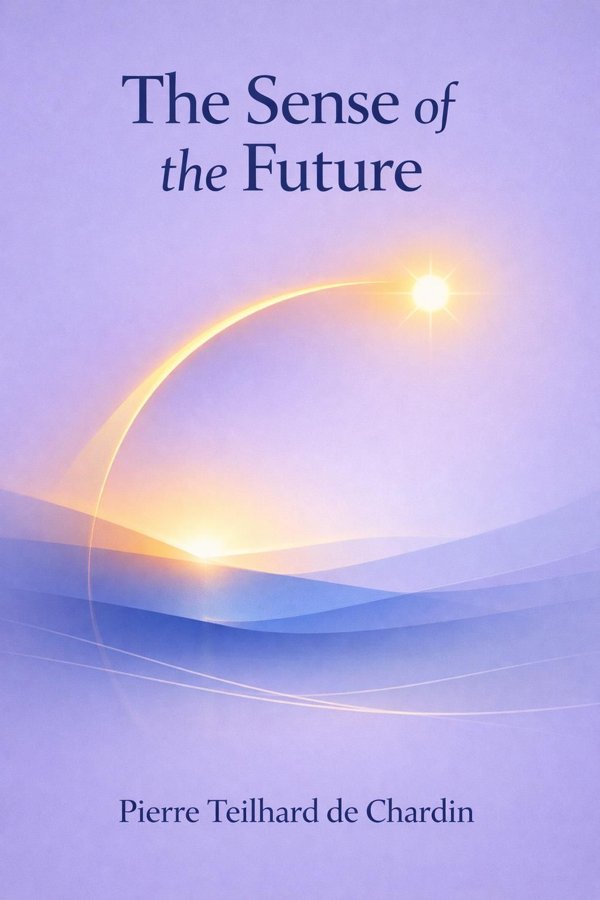
The Sense of the Future: Summary & Key Insights
 10 min9 chaptersAudio available
Key Takeaways from The Sense of the Future
A future worth believing in begins with a universe that is doing more than merely repeating itself.
The decisive turning point in evolution is not simply the appearance of life, but the emergence of a being that knows it knows.
Evolution, in his view, does not only diversify; it also converges.
Power without meaning can accelerate collapse as easily as progress.
A purely material future struggles to inspire sustained sacrifice.
What Is The Sense of the Future About?
The Sense of the Future by Pierre Teilhard de Chardin is a western_phil book spanning 9 pages. The Sense of the Future is Pierre Teilhard de Chardin’s passionate reflection on what it means for humanity to live with direction, hope, and spiritual responsibility in an evolving universe. Rather than treating the future as an empty stretch of time or a field of random events, Teilhard argues that the cosmos itself shows a pattern: matter gives rise to life, life gives rise to thought, and thought is being drawn toward greater unity and depth of consciousness. This short but powerful work condenses many of his central themes into a clear meditation on human destiny. What makes the book enduring is its unusual ambition. Teilhard does not separate science, philosophy, and religion into sealed compartments. As a Jesuit priest and trained paleontologist, he writes with the authority of someone who took both evolution and faith seriously. He asks whether modern humanity can recover confidence in the future without denying scientific knowledge or spiritual longing. His answer is yes: the future becomes meaningful when we see ourselves as active participants in a larger movement of cosmic and personal transformation. For readers interested in Western philosophy, theology, progress, and the moral meaning of evolution, this essay remains strikingly relevant.
This FizzRead summary covers all 9 key chapters of The Sense of the Future in approximately 10 minutes, distilling the most important ideas, arguments, and takeaways from Pierre Teilhard de Chardin's work. Also available as an audio summary and Key Quotes Podcast.
The Sense of the Future
The Sense of the Future is Pierre Teilhard de Chardin’s passionate reflection on what it means for humanity to live with direction, hope, and spiritual responsibility in an evolving universe. Rather than treating the future as an empty stretch of time or a field of random events, Teilhard argues that the cosmos itself shows a pattern: matter gives rise to life, life gives rise to thought, and thought is being drawn toward greater unity and depth of consciousness. This short but powerful work condenses many of his central themes into a clear meditation on human destiny.
What makes the book enduring is its unusual ambition. Teilhard does not separate science, philosophy, and religion into sealed compartments. As a Jesuit priest and trained paleontologist, he writes with the authority of someone who took both evolution and faith seriously. He asks whether modern humanity can recover confidence in the future without denying scientific knowledge or spiritual longing. His answer is yes: the future becomes meaningful when we see ourselves as active participants in a larger movement of cosmic and personal transformation. For readers interested in Western philosophy, theology, progress, and the moral meaning of evolution, this essay remains strikingly relevant.
Who Should Read The Sense of the Future?
This book is perfect for anyone interested in western_phil and looking to gain actionable insights in a short read. Whether you're a student, professional, or lifelong learner, the key ideas from The Sense of the Future by Pierre Teilhard de Chardin will help you think differently.
- ✓Readers who enjoy western_phil and want practical takeaways
- ✓Professionals looking to apply new ideas to their work and life
- ✓Anyone who wants the core insights of The Sense of the Future in just 10 minutes
Want the full summary?
Get instant access to this book summary and 100K+ more with Fizz Moment.
Get Free SummaryAvailable on App Store • Free to download
Key Chapters
A future worth believing in begins with a universe that is doing more than merely repeating itself. Teilhard’s first and most basic claim is that evolution should not be understood as a purely mechanical sequence of accidents. He sees it as a dynamic process in which the world has repeatedly produced greater complexity, richer forms of organization, and deeper interiority. Matter has not remained inert; it has generated life. Life has not remained instinctive; it has generated reflective thought. This broad pattern gives history a direction, even if it does not provide a simple blueprint.
For Teilhard, this does not mean evolution is smooth, easy, or guaranteed in every local outcome. Extinctions occur, civilizations collapse, and progress can be reversed. Yet across vast stretches of time, a tendency appears: the universe gathers itself into more integrated and more conscious forms. That tendency matters because it changes how we interpret human existence. We are not an accidental interruption in nature, but a continuation of a long process through which the cosmos becomes increasingly aware of itself.
A practical way to apply this idea is to rethink growth in your own life. Education, moral discipline, collaboration, and creativity can be seen as participating in the same movement toward complexity and consciousness. In organizations, this perspective encourages leaders to build systems that increase intelligence, cooperation, and meaning rather than mere efficiency. In culture, it supports a view of progress that includes ethical and spiritual development, not just material accumulation.
Actionable takeaway: When facing uncertainty, ask not only, “What is efficient?” but “What increases depth, connection, and consciousness?” That question aligns personal choices with Teilhard’s evolutionary vision.
The decisive turning point in evolution is not simply the appearance of life, but the emergence of a being that knows it knows. Teilhard calls attention to reflection: the capacity of consciousness to turn inward, examine itself, and become an object to itself. This ability marks the human threshold. Animals perceive, react, and adapt, but the human being can ask what it is, why it acts, and what future it ought to create.
This inward turn changes everything. Once reflection appears, evolution is no longer only biological. It becomes psychological, social, moral, and spiritual. Human beings can anticipate consequences, preserve knowledge, imagine alternatives, and orient themselves toward ideals. Reflection makes possible science, religion, art, law, and self-sacrifice. It also creates anxiety, conflict, and responsibility. Because we can imagine the future, we can either cooperate with the movement of growth or resist it.
Teilhard’s insight is especially useful in a distracted age. Many people live with immense informational power but little reflective depth. We know more and think less. His point is that true human advancement is not measured by data access alone, but by the quality of self-awareness guiding action. A student deciding on a career, a parent shaping a family culture, or a policymaker evaluating long-term consequences all exercise reflective consciousness when they move beyond impulse into deliberate meaning-making.
Practically, this means making room for forms of attention that strengthen reflection: journaling, philosophical reading, meditation, honest dialogue, and critical examination of motives. Societies, too, need institutions that cultivate reflection rather than constant stimulation.
Actionable takeaway: Build one daily habit that deepens self-awareness—such as ten minutes of journaling or silent thought—because for Teilhard, the future depends on consciousness becoming more lucid about itself.
One of Teilhard’s boldest insights is that the growth of humanity is not simply a matter of more people spreading outward, but of persons and cultures being drawn into increasing relation. Evolution, in his view, does not only diversify; it also converges. As consciousness expands, separate centers of thought begin to interact, overlap, and organize into larger unities. The human species becomes more interdependent, more communicative, and more collectively aware.
This convergence should not be confused with uniformity. Teilhard does not imagine a future where all differences disappear into a bland sameness. Genuine union, for him, preserves and even intensifies personality. The more integrated a whole becomes, the more meaningful the distinct role of each part. In that sense, the ideal future is not mass conformity but a higher-order unity among distinct persons and peoples.
This idea feels remarkably contemporary. Global supply chains, digital networks, scientific collaboration, migration, climate interdependence, and shared media all reveal a planet whose destinies are increasingly linked. The problem is that external connection does not automatically produce inner unity. We can be technologically linked while emotionally polarized and morally fragmented. Teilhard’s argument is that humanity’s task is to transform mere contact into communion.
In practical terms, convergence asks us to develop forms of cooperation able to hold diversity together. Teams function better when members bring different strengths into a common mission. Democracies remain healthy when disagreement is organized around a shared commitment to truth and the common good. International problems require institutions capable of coordinating action without erasing local identity.
Actionable takeaway: In your work and relationships, practice a form of unity that strengthens difference rather than suppressing it—ask how diverse perspectives can be integrated into a richer common purpose.
Power without meaning can accelerate collapse as easily as progress. Teilhard does not reject science or technology; on the contrary, he sees them as major expressions of humanity’s evolutionary advance. Scientific inquiry extends reflective consciousness into the structure of reality, while technology expands the reach of human action. Together they allow humanity to organize matter, energy, information, and social life on an unprecedented scale.
But Teilhard insists that these tools cannot justify themselves. Technical capability answers the question of how, not why. A civilization may become extremely effective at manipulating the world while remaining uncertain about what kind of world it ought to build. This creates the danger of spiritual imbalance: external development races ahead while inner purpose weakens. In that condition, science becomes fragmented, technology becomes merely instrumental, and human beings lose confidence in the meaning of progress.
Teilhard’s answer is not anti-modern retreat but integration. Science should be honored for revealing the dynamic and evolutionary nature of reality. Technology should be used to support higher forms of human unity, creativity, and consciousness. Yet both need ethical and spiritual orientation. Consider modern examples: artificial intelligence can improve education or amplify disinformation; biotechnology can heal disease or intensify inequality; digital networks can foster global learning or addictive distraction. Tools magnify intention.
For individuals, this means using technology in ways that deepen life instead of scattering it. For institutions, it means evaluating innovation by long-term human outcomes, not short-term novelty or profit alone. The deepest question becomes whether our inventions help humanity become more fully human.
Actionable takeaway: Before adopting any new tool or system, ask one guiding question: Does this increase genuine human flourishing, relationship, and awareness—or only speed and control?
A purely material future struggles to inspire sustained sacrifice. Teilhard believes that if evolution is interpreted only as blind movement, then human beings eventually lose the emotional and moral energy needed to commit themselves to the future. Why work, suffer, create, or cooperate across generations if everything ends in meaninglessness? For him, faith enters not as a denial of science, but as the horizon that makes scientific evolution spiritually intelligible.
His central proposal is that evolution has both an outer and an inner dimension. The outer dimension includes physical processes, biological emergence, and historical development. The inner dimension includes consciousness, value, aspiration, and love. Faith affirms that this movement is not absurd. It reveals that the universe is oriented toward fulfillment, and that personal commitment to truth, justice, and love participates in a deeper reality.
Teilhard’s Christian framework gives this vision a distinctly theological shape, but even readers outside that tradition can grasp the structure of his insight: civilizations require more than information; they need a believable reason to continue. Faith, broadly understood, names trust that the future can carry meaning and that personal dedication is not wasted. Without some confidence in transcendence, societies can become cynical, hedonistic, or fatalistic.
This matters in everyday life. Teachers work differently when they believe their labor contributes to more than test scores. Citizens endure difficulty more responsibly when they trust that history can bend toward greater justice. Individuals facing suffering can continue choosing love when they believe existence is not spiritually empty.
Actionable takeaway: Clarify the deeper conviction that sustains your long-term efforts. Whether religious or philosophical, identify the source of hope that lets you invest in a future larger than yourself.
Humanity has created not just cities and institutions, but a new layer of planetary reality: a sphere of thought. Teilhard calls this the noosphere, the domain formed by human consciousness as it expands across the Earth through language, culture, memory, symbols, education, and communication. Just as the biosphere names the web of life, the noosphere names the web of mind.
This concept helps explain why human evolution cannot be reduced to genetics. Once thought becomes collective, each generation inherits not only biological traits but accumulated knowledge, techniques, myths, laws, and moral frameworks. The noosphere grows whenever ideas are shared, preserved, criticized, and integrated. Books, schools, laboratories, digital platforms, libraries, and artistic traditions are all structures within this sphere.
Teilhard saw this long before the internet, which makes his insight feel prophetic. Today, billions of people inhabit a near-instantaneous communications environment. Yet the noosphere can become either more intelligent or more chaotic. Information overload, tribal propaganda, and superficial engagement can degrade collective thought. The issue is not whether humanity is connected; it is whether connection is being organized into wisdom.
Applied practically, the noosphere invites us to treat our intellectual and cultural contributions as part of a shared planetary inheritance. Writing responsibly, teaching well, preserving truth, and participating in constructive dialogue all strengthen the quality of collective consciousness. Even small acts matter. A mentor passing on hard-won insight, a scientist publishing careful research, or a citizen resisting misinformation contributes to the health of the noosphere.
Actionable takeaway: Treat every idea you share as a contribution to the mental environment of humanity. Choose accuracy, depth, and generosity over speed, outrage, or vanity.
A movement toward greater consciousness raises an unavoidable question: toward what? Teilhard’s answer is the Omega Point, the supreme center of convergence in which the evolutionary process finds fulfillment without erasing personal identity. Omega is not merely the end of chronological time, nor a mechanical destination that history drifts toward automatically. It is the ultimate pole of attraction drawing consciousness, freedom, and love toward complete union.
This is one of Teilhard’s most ambitious and controversial ideas. Philosophically, it means evolution is not just driven from behind by causal forces but also drawn forward by a final meaning. Spiritually, Omega is inseparable from his understanding of the divine, especially the cosmic Christ. The future is therefore not empty openness but a field of attraction. Human striving, creativity, and communion matter because they are moving toward a center that can gather all things without destroying their uniqueness.
Even readers who do not share Teilhard’s theology can appreciate the existential function of Omega. Human action becomes stronger when ordered toward an ultimate good. People endure hardship more courageously when they believe history has a real horizon of fulfillment. Without some equivalent of Omega, ideals weaken into preferences and sacrifice becomes harder to justify.
In ordinary life, Omega can be translated into the disciplined practice of orienting choices toward a highest value rather than immediate reward. Communities also need a shared horizon: truth, reconciliation, justice, holiness, or human flourishing. A life without a unifying end becomes scattered among competing impulses.
Actionable takeaway: Define the highest end that organizes your life, then evaluate your weekly choices by whether they move you toward that center or away from it.
If humanity is evolving toward greater consciousness and union, then morality cannot be limited to private rule-following. For Teilhard, ethics must be reimagined in light of the scale and direction of human becoming. The good is not whatever preserves comfort or individual advantage in the short term. The good is what supports the growth of persons-in-communion: what intensifies consciousness, deepens solidarity, and fosters creative participation in the future.
This gives ethics both a personal and collective dimension. Personally, virtues such as courage, fidelity, discipline, patience, and love become evolutionary powers because they help individuals rise above inertia and selfishness. Socially, justice, peace-building, education, and long-range responsibility become moral imperatives because they shape the conditions under which humanity can converge without destroying itself.
Teilhard’s ethics are especially relevant in periods of crisis. Climate change, social fragmentation, weaponized technology, and economic inequality all involve questions about whether human intelligence will be used in service of common destiny or narrow competition. A civilization with immense power but weak solidarity risks becoming evolutionarily self-defeating.
In practical settings, this vision encourages leaders to ask whether policies increase trust and participation. It pushes professionals to see work as contribution, not merely advancement. It challenges individuals to align daily habits with long-term human goods: learning instead of drifting, cooperation instead of contempt, care instead of indifference.
The key insight is that morality is not opposed to development; it is the condition for worthy development. Without ethical maturation, complexity becomes dangerous.
Actionable takeaway: When making a difficult decision, test it against a higher standard: Does this strengthen life, trust, and shared human growth, or does it shrink the future for others?
No society can sustain great effort if it secretly believes the future is empty. One of Teilhard’s deepest concerns is psychological and cultural: modern humanity risks losing the will to advance because it no longer knows what to hope for. Scientific understanding has expanded, but confidence in meaning has often diminished. As a result, people may become technically capable yet inwardly tired, skeptical, or resigned.
Teilhard therefore treats hope not as sentimental optimism but as an essential energy of evolution. To live with a sense of the future is to believe that tomorrow can bear more consciousness, more unity, and more fulfillment than today. This hope does not deny tragedy or conflict. Instead, it gives suffering a context in which effort remains worthwhile. It allows individuals and communities to invest themselves in unfinished processes whose results they may never fully see.
The distinction between hope and optimism matters. Optimism expects easy success. Hope commits itself despite uncertainty. A doctor treating difficult patients, an activist working on long-term reform, a scholar pursuing truth in obscurity, or a parent raising children with care all embody hope when they continue acting constructively without guarantees.
At a societal level, education, religion, art, and public institutions all shape collective hope. Narratives of inevitable decline corrode responsibility. Narratives of meaningful possibility energize it. Teilhard wants humanity to rediscover a future large enough to justify courage.
Actionable takeaway: Replace passive pessimism with one concrete act of future-building each day—teach, repair, encourage, study, create, or serve. Hope grows stronger when it becomes practice.
All Chapters in The Sense of the Future
About the Author
Pierre Teilhard de Chardin (1881–1955) was a French Jesuit priest, paleontologist, theologian, and philosopher whose work sought to bring modern evolutionary science into dialogue with Christian faith. Educated in both religious and scientific traditions, he participated in major paleontological research and became known for his sweeping vision of the cosmos as a dynamic process moving toward greater complexity and consciousness. His concepts of the noosphere and the Omega Point made him one of the most original religious thinkers of the twentieth century. Although some of his writings faced ecclesiastical resistance during his lifetime, they later gained wide readership among philosophers, theologians, scientists, and spiritually minded readers. Teilhard remains influential for his attempt to unite matter, life, mind, and divine purpose within a single evolutionary framework.
Get This Summary in Your Preferred Format
Read or listen to the The Sense of the Future summary by Pierre Teilhard de Chardin anytime, anywhere. FizzRead offers multiple formats so you can learn on your terms — all free.
Available formats: App · Audio · PDF · EPUB — All included free with FizzRead
Download The Sense of the Future PDF and EPUB Summary
Key Quotes from The Sense of the Future
“A future worth believing in begins with a universe that is doing more than merely repeating itself.”
“The decisive turning point in evolution is not simply the appearance of life, but the emergence of a being that knows it knows.”
“One of Teilhard’s boldest insights is that the growth of humanity is not simply a matter of more people spreading outward, but of persons and cultures being drawn into increasing relation.”
“Power without meaning can accelerate collapse as easily as progress.”
“A purely material future struggles to inspire sustained sacrifice.”
Frequently Asked Questions about The Sense of the Future
The Sense of the Future by Pierre Teilhard de Chardin is a western_phil book that explores key ideas across 9 chapters. The Sense of the Future is Pierre Teilhard de Chardin’s passionate reflection on what it means for humanity to live with direction, hope, and spiritual responsibility in an evolving universe. Rather than treating the future as an empty stretch of time or a field of random events, Teilhard argues that the cosmos itself shows a pattern: matter gives rise to life, life gives rise to thought, and thought is being drawn toward greater unity and depth of consciousness. This short but powerful work condenses many of his central themes into a clear meditation on human destiny. What makes the book enduring is its unusual ambition. Teilhard does not separate science, philosophy, and religion into sealed compartments. As a Jesuit priest and trained paleontologist, he writes with the authority of someone who took both evolution and faith seriously. He asks whether modern humanity can recover confidence in the future without denying scientific knowledge or spiritual longing. His answer is yes: the future becomes meaningful when we see ourselves as active participants in a larger movement of cosmic and personal transformation. For readers interested in Western philosophy, theology, progress, and the moral meaning of evolution, this essay remains strikingly relevant.
More by Pierre Teilhard de Chardin

You Might Also Like
A Little History of Philosophy
Nigel Warburton
10 min
Areopagitica
John Milton
10 min
How To Think Like A Philosopher: Essential Principles For Clear Thinking
Peter Cave
10 min
Language, Truth and Logic
A. J. Ayer
10 min
The Age of Reason
Thomas Paine
10 min
The Essays
Michel De Montaigne
10 minBrowse by Category
Ready to read The Sense of the Future?
Get the full summary and 100K+ more books with Fizz Moment.