
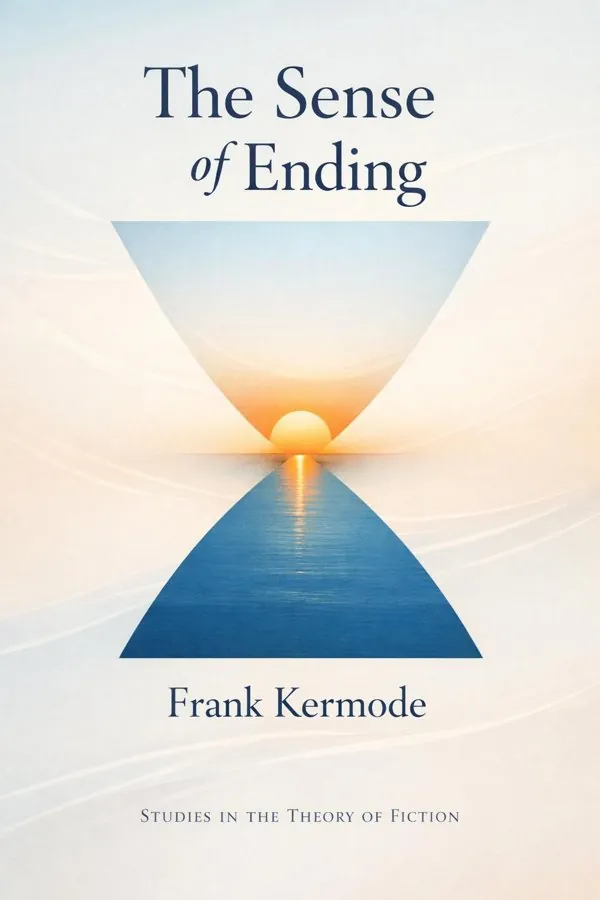
The Sense of an Ending: Studies in the Theory of Fiction: Summary & Key Insights
 10 min9 chaptersAudio available
Key Takeaways from The Sense of an Ending: Studies in the Theory of Fiction
Human beings rarely tolerate chaos for long; we instinctively turn uncertainty into a plot.
Life is lived in fragments, but fiction makes it feel whole.
A simple clock can teach a theory of narrative.
We understand events differently when we believe we are close to an ending.
The modern world weakens old certainties without weakening our need for them.
What Is The Sense of an Ending: Studies in the Theory of Fiction About?
The Sense of an Ending: Studies in the Theory of Fiction by Frank Kermode is a western_phil book spanning 9 pages. Why do human beings find it so difficult to live in open-ended time? In The Sense of an Ending, Frank Kermode offers one of the most influential answers in modern literary criticism: we endure the uncertainty of life by turning it into story. We imagine beginnings, middles, and especially endings in order to give shape to experience that otherwise feels chaotic, unfinished, and morally unclear. Drawing on biblical prophecy, apocalyptic writing, philosophy, and modern literature, Kermode shows that narrative is not merely entertainment. It is one of the chief ways individuals and cultures make time meaningful. What makes this book matter is that it moves far beyond literary technique. Kermode explains why endings grip us so powerfully, why historical crises revive visions of apocalypse, and why readers constantly reinterpret texts to fit changing times. His argument sheds light on novels, religion, politics, and even everyday self-understanding. As one of the twentieth century’s most respected literary critics, Kermode writes with rare authority, combining scholarly depth with intellectual elegance. The result is a classic study of how fiction helps us live between the “tick” of our beginning and the “tock” of our end.
This FizzRead summary covers all 9 key chapters of The Sense of an Ending: Studies in the Theory of Fiction in approximately 10 minutes, distilling the most important ideas, arguments, and takeaways from Frank Kermode's work. Also available as an audio summary and Key Quotes Podcast.
The Sense of an Ending: Studies in the Theory of Fiction
Why do human beings find it so difficult to live in open-ended time? In The Sense of an Ending, Frank Kermode offers one of the most influential answers in modern literary criticism: we endure the uncertainty of life by turning it into story. We imagine beginnings, middles, and especially endings in order to give shape to experience that otherwise feels chaotic, unfinished, and morally unclear. Drawing on biblical prophecy, apocalyptic writing, philosophy, and modern literature, Kermode shows that narrative is not merely entertainment. It is one of the chief ways individuals and cultures make time meaningful.
What makes this book matter is that it moves far beyond literary technique. Kermode explains why endings grip us so powerfully, why historical crises revive visions of apocalypse, and why readers constantly reinterpret texts to fit changing times. His argument sheds light on novels, religion, politics, and even everyday self-understanding. As one of the twentieth century’s most respected literary critics, Kermode writes with rare authority, combining scholarly depth with intellectual elegance. The result is a classic study of how fiction helps us live between the “tick” of our beginning and the “tock” of our end.
Who Should Read The Sense of an Ending: Studies in the Theory of Fiction?
This book is perfect for anyone interested in western_phil and looking to gain actionable insights in a short read. Whether you're a student, professional, or lifelong learner, the key ideas from The Sense of an Ending: Studies in the Theory of Fiction by Frank Kermode will help you think differently.
- ✓Readers who enjoy western_phil and want practical takeaways
- ✓Professionals looking to apply new ideas to their work and life
- ✓Anyone who wants the core insights of The Sense of an Ending: Studies in the Theory of Fiction in just 10 minutes
Want the full summary?
Get instant access to this book summary and 100K+ more with Fizz Moment.
Get Free SummaryAvailable on App Store • Free to download
Key Chapters
Human beings rarely tolerate chaos for long; we instinctively turn uncertainty into a plot. Kermode begins with the idea of apocalypse because it dramatizes our deepest habit of mind: the desire to see history as moving toward a meaningful end. Apocalyptic narratives do more than predict catastrophe. They convert confusion into pattern, placing present suffering inside a larger scheme that promises revelation, judgment, or renewal. In this sense, apocalypse is not only a religious idea but a model for how people structure time itself.
Kermode argues that when societies feel unstable, they often revive apocalyptic thinking. A period of war, political upheaval, or cultural decline encourages people to imagine that they are living near the end of an age. This belief is psychologically powerful because it flatters the present moment with significance. Instead of feeling lost in ordinary time, individuals can see themselves as participants in a decisive chapter of history.
Literature often borrows this structure even when it is not overtly religious. A novel may frame conflict as though it were rushing toward final disclosure; a political movement may describe itself as the last chance to save civilization; even personal crises can be narrated as turning points before a rebirth. The appeal lies in the same mechanism: endings make the middle bearable.
Kermode’s insight remains useful today. Media cycles constantly package events as existential finales: the end of democracy, the end of truth, the end of culture. Recognizing this apocalyptic impulse helps readers become more alert to how narratives intensify emotion and simplify complexity. Actionable takeaway: when a story insists that everything is culminating now, pause and ask what need for order that ending is satisfying.
Life is lived in fragments, but fiction makes it feel whole. For Kermode, the great function of fiction is not simply to imitate reality but to organize temporal experience. Human life unfolds as scattered episodes, delays, disappointments, and accidents. Stories transform that raw sequence into something patterned, where events seem to belong together and where the ending retrospectively explains what came before.
This helps explain why fiction matters so deeply. We do not seek stories only for diversion. We seek them because they model meaningful duration. A novel gives us a beginning that prepares, a middle that thickens with suspense, and an ending that confers significance. Even ambiguous or tragic endings still perform this work: they tell us that disorder can be contemplated as form.
Kermode’s point also clarifies why fiction can resemble religion, myth, or history without being identical to them. All these modes create frameworks that help people endure time. A family may narrate its past around a few decisive events; a nation may define itself through founding myths; a person may reinterpret setbacks as necessary chapters in a larger life story. The same narrating instinct is at work.
In practical terms, this idea can change how we read. Instead of asking only what a story means, we can ask how it arranges time. Why does it delay information? Why does it foreshadow an ending? Why does closure feel satisfying or evasive? These questions reveal fiction’s deeper power. Actionable takeaway: the next time you read a novel or tell your own life story, notice how much meaning comes not from facts alone but from the order in which they are arranged.
A simple clock can teach a theory of narrative. Kermode’s famous image of the “tick” and the “tock” shows how humans create significance by placing a middle between a beginning and an end. Tick and tock are merely sequential sounds, but once we hear them as a pair, the interval acquires structure. The second sound completes the first. Meaning emerges from relation, not from isolated moments.
Kermode uses this analogy to explain the human condition. We live in the interval between our beginning and our end, trying to make that middle intelligible. Narrative helps us do this by inserting pattern into duration. The middle of a story is never just empty extension; it is charged with expectation because the ending is imagined in advance. We read differently when we feel that a tock is coming.
This insight applies to all kinds of storytelling. In detective fiction, the mystery gains force because readers assume a final explanation. In biography, childhood details become meaningful because we know the adult fate. In everyday life, people reinterpret present struggle through anticipated outcomes: graduation, retirement, marriage, recovery, redemption. We constantly hear “tick” in light of an imagined “tock.”
Kermode’s point is subtle but profound. Endings do not simply terminate stories; they organize the middle long before they arrive. This is why uncertainty feels so difficult. When we cannot imagine an ending, the middle becomes shapeless and anxiety increases. Actionable takeaway: when a project, relationship, or life transition feels confusing, try articulating the ending you are assuming. Often the pressure in the present comes from an unexamined expectation about what the “tock” should be.
We understand events differently when we believe we are close to an ending. Kermode shows that interpretation is deeply affected by our sense of temporal position. Readers, critics, and cultures all ask different questions when they think they are living in a decisive moment. Texts are then mined for signs, coded meanings, and hidden prophecies that seem newly urgent because the present appears critical.
This helps explain why old works are continuously reinterpreted. A religious text, for example, may be read literally in one era, allegorically in another, politically in a third. The text itself remains, but the perceived nearness of the end changes the intensity and method of interpretation. Communities often become more inventive readers when they feel history tightening around them.
Kermode is especially interested in how this process produces both insight and distortion. On one hand, crises can sharpen interpretation by forcing readers to ask what truly matters. On the other hand, the desire for relevance can lead to overreading, where every symbol becomes a sign of immediate doom or salvation. This dynamic is easy to recognize today in online culture, where people treat films, books, and news events as coded messages about civilizational collapse or total transformation.
The broader lesson is that interpretation is never detached from time. We do not read from nowhere; we read from a felt present that colors what we notice. Becoming aware of that fact makes us better readers and better citizens. Actionable takeaway: when a text suddenly seems uncannily “about now,” ask how much of that meaning comes from the work itself and how much from your own sense that the current moment is nearing some kind of end.
The modern world weakens old certainties without weakening our need for them. Kermode argues that one of modernity’s central tensions is the collapse of inherited cosmic frameworks alongside the persistence of the human desire for pattern. Traditional religious systems once placed individuals within a meaningful history directed by divine purpose. As those systems lost authority for many readers, the hunger for order did not disappear. It migrated into secular narratives, aesthetic forms, and ideological visions.
This is why modern literature often feels so restless about endings. Writers can no longer rely on a universally shared framework of providence or salvation, yet they still must confront the same existential facts: mortality, contingency, historical upheaval, and the pressure to make the middle of life intelligible. The result is fiction that experiments with broken chronology, unstable narrators, ironic closure, or unresolved endings. These formal innovations are not merely stylistic games; they register a deeper crisis about how meaning can be made.
Kermode helps us see that the problem is not the absence of endings but the difficulty of believing in them. Modern people often oscillate between skepticism and longing. We distrust grand narratives, yet we keep inventing new ones. We reject prophecy, yet consume predictions. We dismiss myth, yet crave transformative plots in politics, technology, and self-help.
This idea has practical force because it explains why contemporary culture feels both cynical and melodramatic. We no longer fully trust the stories that organize life, but we cannot live without stories. Actionable takeaway: when confronted with modern irony, fragmentation, or ambiguity in art, treat it not as emptiness but as evidence of a culture struggling to imagine meaning without inherited guarantees.
Great works of literature do not merely contain stories; they test rival ways of imagining time. Kermode moves across texts from scripture to modern novels to show that literature is a laboratory for temporal form. Some works affirm linear movement toward fulfillment, while others disrupt chronology, suspend closure, or expose the artificiality of endings. By reading comparatively, he reveals how literary forms embody philosophical attitudes toward history, fate, and human expectation.
This matters because abstract theories of time can feel remote until we see them enacted in narrative. A tightly plotted novel suggests a world in which causes lead to consequences and endings gather meaning. A fragmented modernist text may suggest that consciousness experiences time as interruption, recurrence, or drift. Tragic drama may frame ending as necessity; satire may mock the very desire for final coherence. Literature, then, becomes a way of thinking through temporal existence rather than merely representing events.
For readers, this offers a richer approach to classic and modern texts alike. Instead of sorting books into simple categories such as realistic, symbolic, or difficult, we can ask: what kind of time does this work assume? Does it promise revelation? Delay it? Distrust it? Replace it with repetition? Such questions make literary analysis more alive and more connected to ordinary existence.
Kermode’s examples remind us that form is never neutral. The way a story begins, pauses, circles back, or concludes carries a theory of life within it. Actionable takeaway: when reading any major work, pay close attention to its treatment of time. The deepest argument of the book may lie less in what happens than in how the narrative moves toward, away from, or around its ending.
History seeks truth, fiction seeks form, yet both depend on narrative. Kermode is careful not to collapse fiction into history, but he insists that the two are structurally related. Historians must organize events into sequences, decide where periods begin and end, and explain how one moment leads to another. In doing so, they inevitably borrow narrative devices that resemble those of fiction: selection, emphasis, causality, and closure.
This does not mean history is invented in the same way a novel is invented. Rather, it means that making sense of historical reality requires plotting. Without some structure, the past is an immeasurable mass of data. Narrative turns it into something intelligible. The danger, Kermode suggests, is that we may mistake narrative convenience for historical necessity. Period labels, revolutions, turning points, and “end of an era” rhetoric can illuminate events, but they can also oversimplify them.
This insight is especially relevant in politics and media. Public commentators routinely narrate elections, wars, economic crises, and technological shifts as if they were dramatic arcs with clear climaxes. Such framing helps audiences understand complexity, yet it also creates false inevitability. People begin to believe that history naturally moves toward a destined end, when in fact many outcomes remain contingent.
Kermode’s contribution is to teach vigilance without cynicism. We cannot think historically without narrative, but we should remain alert to the shaping force of storytelling. Actionable takeaway: whenever you encounter a sweeping historical claim—“this changed everything,” “the old world is over,” “we are entering a new age”—ask what narrative plot is being imposed on events and what realities might be left out.
Even when modern culture declares itself disenchanted, myth does not disappear; it changes costume. Kermode shows that myth remains a powerful resource for organizing collective experience. Myths do not need to be literally believed in order to function. They can persist as deep narrative patterns that shape institutions, politics, literature, and personal identity. In this sense, modern secular societies often continue to rely on mythic structures while claiming to have outgrown them.
Kermode is interested in myth not as primitive error but as cultural form. Myths condense complexity into memorable plots: fall and redemption, exile and return, corruption and renewal, death and rebirth. These structures give emotional intelligibility to events that might otherwise seem random. A nation can narrate itself as chosen, betrayed, restored. A company can cast itself as a revolutionary force redeeming a stagnant industry. An individual can describe hardship as a descent before transformation.
The persistence of myth becomes especially visible in moments of crisis. Leaders appeal to origins, destiny, sacrifice, or rebirth. Popular culture repeatedly recycles hero narratives and end-times scenarios. Social movements often depend on mythic simplification to mobilize action. This can be energizing, but it can also narrow thought by forcing reality into familiar patterns.
Kermode’s lesson is not that myth is bad, but that unexamined myth is powerful. Once we see the narrative templates at work, we gain freedom to use them responsibly rather than be used by them. Actionable takeaway: when a public story feels emotionally overwhelming, identify its mythic pattern. Ask whether the narrative clarifies reality or merely seduces you with the comfort of an old and powerful form.
An ending never belongs to the author alone; it becomes meaningful only in the reader’s mind. Kermode emphasizes that readers are not passive recipients of closure. They actively connect beginning, middle, and end, deciding what counts as fulfillment, irony, failure, or revelation. A narrative’s final effect depends on habits of expectation shaped by culture, genre, and historical moment.
This is why the same ending can provoke opposite responses. One reader experiences ambiguity as profound honesty; another sees it as evasion. One generation praises a novel’s formal closure; another distrusts it as artificial. Readers bring their own assumptions about justice, realism, tragedy, and resolution. They do not simply discover meaning at the end; they help produce it.
Kermode’s theory therefore transforms reading into an ethical and intellectual practice. To read well is to notice one’s own appetite for endings. Do we demand that villains be punished, lovers unite, mysteries be solved, or suffering redeemed? What happens when a text denies those satisfactions? Such frustrations can reveal how deeply narrative expectation structures our emotional lives.
This insight extends beyond literature. We read careers, relationships, and political periods with the same participatory urge. We retrospectively assign coherence, declare lessons, and turn unfinished lives into complete statements. But real life often resists the neatness we impose.
Kermode invites readers to become more self-aware interpreters. Endings matter, but so does the interpretive machinery we bring to them. Actionable takeaway: after finishing a book, ask not only “What did the ending mean?” but also “What did I want the ending to do for me?” That question can reveal the hidden expectations driving your reading.
All Chapters in The Sense of an Ending: Studies in the Theory of Fiction
About the Author
Frank Kermode (1919–2010) was one of the most distinguished literary critics of the twentieth century. Born on the Isle of Man, he built a major academic career through his work on Renaissance literature, modern fiction, hermeneutics, and the theory of interpretation. He taught at leading universities, including University College London, Cambridge, Columbia, and Harvard, and became widely respected for bringing literary criticism into conversation with philosophy, history, and theology. Kermode wrote with unusual clarity and elegance, making complex ideas accessible without oversimplifying them. His books, essays, and reviews helped shape debates about canon, modernism, reading, and the cultural role of fiction. Knighted for his services to literature, he remains best known to many readers for The Sense of an Ending, a concise but deeply influential study of time, narrative, and the human need for meaning.
Get This Summary in Your Preferred Format
Read or listen to the The Sense of an Ending: Studies in the Theory of Fiction summary by Frank Kermode anytime, anywhere. FizzRead offers multiple formats so you can learn on your terms — all free.
Available formats: App · Audio · PDF · EPUB — All included free with FizzRead
Download The Sense of an Ending: Studies in the Theory of Fiction PDF and EPUB Summary
Key Quotes from The Sense of an Ending: Studies in the Theory of Fiction
“Human beings rarely tolerate chaos for long; we instinctively turn uncertainty into a plot.”
“Life is lived in fragments, but fiction makes it feel whole.”
“A simple clock can teach a theory of narrative.”
“We understand events differently when we believe we are close to an ending.”
“The modern world weakens old certainties without weakening our need for them.”
Frequently Asked Questions about The Sense of an Ending: Studies in the Theory of Fiction
The Sense of an Ending: Studies in the Theory of Fiction by Frank Kermode is a western_phil book that explores key ideas across 9 chapters. Why do human beings find it so difficult to live in open-ended time? In The Sense of an Ending, Frank Kermode offers one of the most influential answers in modern literary criticism: we endure the uncertainty of life by turning it into story. We imagine beginnings, middles, and especially endings in order to give shape to experience that otherwise feels chaotic, unfinished, and morally unclear. Drawing on biblical prophecy, apocalyptic writing, philosophy, and modern literature, Kermode shows that narrative is not merely entertainment. It is one of the chief ways individuals and cultures make time meaningful. What makes this book matter is that it moves far beyond literary technique. Kermode explains why endings grip us so powerfully, why historical crises revive visions of apocalypse, and why readers constantly reinterpret texts to fit changing times. His argument sheds light on novels, religion, politics, and even everyday self-understanding. As one of the twentieth century’s most respected literary critics, Kermode writes with rare authority, combining scholarly depth with intellectual elegance. The result is a classic study of how fiction helps us live between the “tick” of our beginning and the “tock” of our end.
You Might Also Like
A Little History of Philosophy
Nigel Warburton
10 min
Areopagitica
John Milton
10 min
How To Think Like A Philosopher: Essential Principles For Clear Thinking
Peter Cave
10 min
Language, Truth and Logic
A. J. Ayer
10 min
The Age of Reason
Thomas Paine
10 min
The Essays
Michel De Montaigne
10 minBrowse by Category
Ready to read The Sense of an Ending: Studies in the Theory of Fiction?
Get the full summary and 100K+ more books with Fizz Moment.