
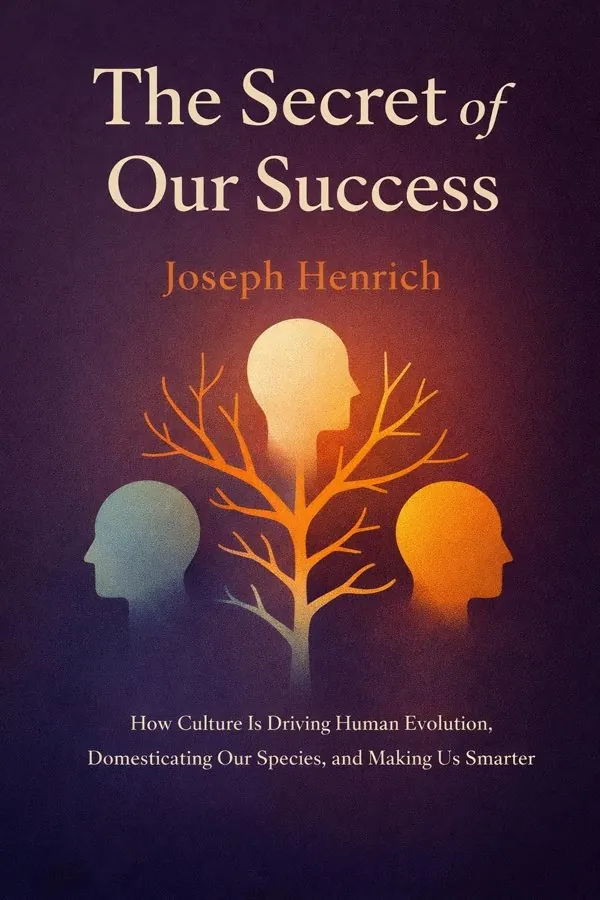
The Secret of Our Success: How Culture Is Driving Human Evolution, Domesticating Our Species, and Making Us Smarter: Summary & Key Insights
 10 min10 chaptersAudio available
Key Takeaways from The Secret of Our Success: How Culture Is Driving Human Evolution, Domesticating Our Species, and Making Us Smarter
One of the book’s most unsettling insights is that the average human being understands far less than civilization itself can do.
A child who imitates well may be better prepared for life than an adult who insists on discovering everything alone.
The real miracle of humanity is not that we learn, but that what we learn can accumulate across generations.
Humans do not need specialized claws, fur, or digestive systems for every habitat because culture functions as a flexible adaptive toolkit.
One of Henrich’s boldest claims is that culture does not merely ride on top of biology; it changes biology itself.
What Is The Secret of Our Success: How Culture Is Driving Human Evolution, Domesticating Our Species, and Making Us Smarter About?
The Secret of Our Success: How Culture Is Driving Human Evolution, Domesticating Our Species, and Making Us Smarter by Joseph Henrich is a civilization book spanning 10 pages. Why do humans thrive in nearly every environment on Earth, from Arctic ice to dense rainforests, while physically stronger or faster animals remain limited to narrower ecological niches? In The Secret of Our Success, Joseph Henrich offers a striking answer: our species did not triumph because individuals became exceptionally rational or inventive on their own, but because humans evolved to learn from one another. Culture, in his account, is not a decorative layer placed atop biology. It is an evolutionary force that reshaped our minds, bodies, social systems, and even our genes. Drawing on anthropology, psychology, evolutionary biology, and economics, Henrich shows how accumulated traditions, norms, tools, and institutions allowed ordinary people to solve problems no lone genius could master from scratch. His argument challenges cherished assumptions about intelligence, progress, and human nature. This book matters because it explains not only humanity’s deep past, but also the foundations of innovation, education, cooperation, and social trust today. As a leading scholar of cultural evolution, Henrich brings unusual authority and interdisciplinary depth to one of the most important questions in human history: what really made us successful?
This FizzRead summary covers all 10 key chapters of The Secret of Our Success: How Culture Is Driving Human Evolution, Domesticating Our Species, and Making Us Smarter in approximately 10 minutes, distilling the most important ideas, arguments, and takeaways from Joseph Henrich's work. Also available as an audio summary and Key Quotes Podcast.
The Secret of Our Success: How Culture Is Driving Human Evolution, Domesticating Our Species, and Making Us Smarter
Why do humans thrive in nearly every environment on Earth, from Arctic ice to dense rainforests, while physically stronger or faster animals remain limited to narrower ecological niches? In The Secret of Our Success, Joseph Henrich offers a striking answer: our species did not triumph because individuals became exceptionally rational or inventive on their own, but because humans evolved to learn from one another. Culture, in his account, is not a decorative layer placed atop biology. It is an evolutionary force that reshaped our minds, bodies, social systems, and even our genes. Drawing on anthropology, psychology, evolutionary biology, and economics, Henrich shows how accumulated traditions, norms, tools, and institutions allowed ordinary people to solve problems no lone genius could master from scratch. His argument challenges cherished assumptions about intelligence, progress, and human nature. This book matters because it explains not only humanity’s deep past, but also the foundations of innovation, education, cooperation, and social trust today. As a leading scholar of cultural evolution, Henrich brings unusual authority and interdisciplinary depth to one of the most important questions in human history: what really made us successful?
Who Should Read The Secret of Our Success: How Culture Is Driving Human Evolution, Domesticating Our Species, and Making Us Smarter?
This book is perfect for anyone interested in civilization and looking to gain actionable insights in a short read. Whether you're a student, professional, or lifelong learner, the key ideas from The Secret of Our Success: How Culture Is Driving Human Evolution, Domesticating Our Species, and Making Us Smarter by Joseph Henrich will help you think differently.
- ✓Readers who enjoy civilization and want practical takeaways
- ✓Professionals looking to apply new ideas to their work and life
- ✓Anyone who wants the core insights of The Secret of Our Success: How Culture Is Driving Human Evolution, Domesticating Our Species, and Making Us Smarter in just 10 minutes
Want the full summary?
Get instant access to this book summary and 100K+ more with Fizz Moment.
Get Free SummaryAvailable on App Store • Free to download
Key Chapters
One of the book’s most unsettling insights is that the average human being understands far less than civilization itself can do. We often imagine modern achievement as the result of extraordinary individual intelligence, yet Henrich shows that even highly capable people depend on cultural knowledge they did not invent and often cannot fully explain. A person can drive a car, use a smartphone, or bake bread without understanding combustion engineering, semiconductor physics, or the chemistry of yeast. Human success rests less on isolated reasoning than on access to a vast inherited storehouse of techniques, beliefs, habits, and know-how.
Henrich uses examples from small-scale societies and modern life alike to make this point. Indigenous Arctic peoples survived in conditions that would quickly kill a lone outsider, not because each individual independently discovered how to build kayaks, sew insulated clothing, or hunt marine mammals, but because generations had accumulated and transmitted effective practices. The same principle applies in advanced economies. Surgeons, coders, architects, and teachers all rely on bodies of knowledge created collectively over time.
This reframes intelligence. What matters most is not whether one person can reinvent the world, but whether a community can preserve, improve, and pass on successful solutions. Our minds are adapted to absorb social information, trust skilled models, and participate in systems of shared learning. Individual cognition remains important, but it is amplified by networks of culture.
A useful application is to stop overvaluing self-sufficiency and start investing more in learning communities. If you want to become more capable, do not only ask, “How smart am I?” Ask, “What traditions, mentors, institutions, and knowledge networks am I connected to?” Build access to strong collective intelligence, because that is where human power really lives.
The real miracle of humanity is not that we learn, but that what we learn can accumulate across generations. Henrich calls this cumulative cultural evolution: the process through which useful ideas, skills, tools, and institutions are preserved, refined, and combined over time. This means later generations can start where earlier generations left off instead of beginning at zero.
A single person might not know how to invent a bow, weave a fishing net, domesticate crops, forge steel, create writing, or design a legal code from first principles. Yet when each generation inherits a cultural package and adds small improvements, astonishing complexity becomes possible. Human societies can therefore produce technologies and systems that exceed the understanding of any one individual. Many traditional practices are “smarter” than the people using them because they embody generations of successful tinkering, selection, and retention.
Henrich contrasts this with the common belief that progress comes primarily from solitary genius. Innovation does matter, but breakthroughs usually depend on large stores of prior cultural knowledge. The inventor of a modern vaccine, for example, inherits centuries of accumulated work in biology, chemistry, statistics, laboratory methods, manufacturing, and institutions of trust.
This idea also explains why isolated populations can lose technologies. If a group becomes too small or too disconnected, it may not retain enough skilled practitioners to preserve complex techniques. Culture grows not automatically, but through social transmission, population structure, and stable learning systems.
The practical takeaway is to treat knowledge preservation as seriously as innovation. In organizations, families, and schools, document what works, create repeatable systems, and teach them clearly. Progress is not just about new ideas. It depends on maintaining chains of transmission so valuable know-how does not disappear.
Humans do not need specialized claws, fur, or digestive systems for every habitat because culture functions as a flexible adaptive toolkit. Henrich shows that our species entered deserts, mountains, forests, islands, and frozen coastlines not by waiting for slow biological evolution alone, but by developing and transmitting local knowledge. Culture let people adapt far faster than genes by creating food-processing methods, hunting strategies, shelter designs, navigation systems, and social routines suited to each setting.
His case studies are among the book’s most compelling. Consider survival in the Arctic. Outsiders might assume success there depends on exceptional individual toughness, but Henrich emphasizes the elaborate cultural package required: insulated clothing made with precise sewing techniques, sophisticated hunting tools, food knowledge, snow shelters, transportation methods, and norms of sharing. Remove that package, and even intelligent modern people would struggle to survive. Similar logic applies in tropical zones, river systems, and dry grasslands, where cumulative local expertise determines what is safe, efficient, and sustainable.
This perspective changes how we think about adaptation. It is not just a matter of biological traits inside the body. It often resides in practices outside the body but inside the group. Culture stores ecological intelligence. That is why migration, colonization, and development efforts can fail when imported solutions ignore local knowledge built over generations.
In practical terms, this insight encourages humility whenever entering an unfamiliar environment, market, or community. Local practices that look odd may encode hard-won adaptations to hidden constraints. Before replacing them, ask what problem they may be solving.
The actionable takeaway: when facing a new context, learn from those who have long operated successfully within it. Whether you are joining a company, moving countries, or starting in a new industry, assume local customs contain adaptive information and study them before trying to redesign everything.
One of Henrich’s boldest claims is that culture does not merely ride on top of biology; it changes biology itself. Human evolution did not stop once culture appeared. Instead, cultural practices altered environments and selection pressures, which in turn shaped our genes. This process, often called gene-culture coevolution, means culture and biology evolved together in a continuous feedback loop.
A classic example is adult lactose tolerance. In populations that domesticated dairy animals and developed traditions of milk consumption, genetic variants allowing adults to digest lactose became more advantageous and spread. The cultural practice came first, creating a new nutritional niche; genes then followed. Similar dynamics may help explain changes related to diet, disease exposure, sociality, and even psychological tendencies.
Henrich extends this logic beyond metabolism. Once humans began living in larger, more interdependent social groups governed by norms and institutions, traits that supported cooperation, self-control, norm-following, and reduced reactive aggression may have become more beneficial. Culture changed the game, and human biology adapted to the new rules.
This is a crucial corrective to simplistic debates that frame nature and nurture as opposites. Henrich shows they are deeply entangled. Environments are often culturally constructed, and those environments then influence genetic evolution.
For modern readers, the lesson is that repeated social practices can have long-term biological consequences. Public health, diet, family structure, education, and work patterns may shape future populations more deeply than we assume.
The actionable takeaway is to think in feedback loops. Instead of asking whether a behavior is cultural or biological, ask how cultural habits create pressures that reinforce certain biological traits over time. Better systems today can produce better developmental and evolutionary outcomes tomorrow.
Large-scale human cooperation is not natural in the simple sense of emerging automatically from goodwill. It is engineered through culture. Henrich argues that social norms and institutions allow humans to cooperate with strangers, coordinate complex tasks, resolve disputes, and sustain trust across time. Without these shared rules and expectations, many of the advantages of cumulative culture would collapse.
Norms tell people what counts as acceptable behavior, what deserves punishment, and what actions earn respect. Institutions formalize these expectations through systems such as law, marriage, markets, religion, property rights, and governance. Importantly, people often internalize norms so deeply that they feel morally right rather than externally imposed. This internalization reduces the cost of constant enforcement and makes group life more stable.
Henrich’s broader point is that institutions are themselves products of cultural evolution. Societies experiment, intentionally or not, with different rules. Some arrangements support cooperation better than others and become more stable or more competitive. Over time, this can generate highly effective systems that no one designed in full from scratch.
This helps explain why transplanting institutions across societies can be difficult. Rules work within wider cultural ecologies of beliefs, values, sanctions, and learned expectations. A formal policy without supporting norms may fail.
In everyday life, this idea applies to teams, organizations, and communities. Clear norms around punctuality, honesty, information sharing, accountability, and conflict resolution can dramatically improve performance. Culture is not just atmosphere; it is a coordination technology.
The actionable takeaway: if you want a group to function better, do not rely only on talent or motivation. Make the norms visible, reinforce them consistently, and build institutions that support the behavior you want repeated.
What makes one society outperform another is often not superior individuals, but superior group-level practices. Henrich argues that cultural group selection helps explain why certain norms, institutions, and belief systems spread. Groups with better cooperation, stronger coordination, more effective punishment of free riders, and more successful social learning often grow, endure, attract imitators, or defeat rival groups.
This does not mean every historical winner was morally better, nor that group competition is always violent. Competition can occur through migration, trade, imitation, prestige, demographic expansion, or differential survival. If one community develops practices that improve agriculture, warfare, trust, fertility, or economic productivity, neighboring groups may copy those practices or be displaced by them. In this way, culture evolves not only within groups but between them.
Henrich uses this framework to challenge overly individualistic models of evolution and social behavior. Human beings are shaped by membership in groups that enforce norms and channel behavior. The success of a group can feed back into the success of the cultural traits it carries.
This idea is especially relevant to organizations and nations. Companies do not succeed solely because they hire smart people. They succeed when they develop operating cultures that align incentives, encourage learning, and sustain coordinated effort. Likewise, societies benefit from institutions that support trust, innovation, and prosocial behavior.
The practical takeaway is to evaluate cultures competitively. Ask not just whether a belief or practice feels good internally, but whether it helps the group adapt, cooperate, and persist. If you lead a team, build norms that improve the group’s overall effectiveness, because group success will often determine individual success as well.
A striking part of Henrich’s argument is that human beings may have domesticated themselves. Domesticated animals often display a package of traits: reduced aggression, greater social tolerance, more juvenile features, and increased capacity to live under human control. Henrich suggests that cultural evolution created selection pressures in human societies that favored similar changes in us. As norms, institutions, and coalitions increasingly punished highly aggressive, disruptive individuals, people better suited to cooperative social life gained advantages.
This self-domestication thesis helps explain aspects of human psychology and anatomy. Compared with some extinct human relatives, modern humans may show signs associated with reduced reactive aggression and enhanced social learning. Living in tightly connected groups required people who could tolerate proximity, follow norms, read intentions, and coordinate with others. Culture effectively selected for minds and temperaments compatible with complex collective life.
Importantly, this does not mean humans became peaceful saints. We remain capable of violence, dominance, and conflict. The point is that our species may have shifted toward forms of behavior more compatible with large-scale sociality. The spread of punishment systems, reputation tracking, and coalition-based sanctions could all contribute to this process.
For modern readers, the concept offers a way to understand how environments shape personality and conduct. Repeated social consequences influence which behaviors flourish. Workplaces, schools, and communities can either reward aggression and selfishness or favor cooperation and self-control.
The actionable takeaway is to shape environments, not just individuals. If you want better behavior in a group, create systems that reliably discourage destructive conduct and reward prosocial norms. Over time, culture can make certain traits more common and more stable.
Humans are smart, but Henrich argues that our intelligence is specialized in an often-overlooked way: we are built to acquire, store, navigate, and deploy culture. This cultural intelligence hypothesis shifts attention from raw problem-solving power to the cognitive abilities that make social learning possible. Humans excel at imitation, language, norm detection, teaching, perspective-taking, shared attention, and tracking who knows what. These capacities allow us to plug into collective knowledge systems far more effectively than other species.
This helps explain why children are so remarkably attentive to social cues. They do not merely learn facts; they learn who to trust, what counts as normal, how to interpret symbols, and which practices carry prestige. Even our curiosity often follows social pathways. We want to know what others know, what they value, and how they behave.
Henrich’s view also challenges educational models that focus too narrowly on individual testing or abstract reasoning detached from community. If human intelligence is culturally scaffolded, then cognition develops best within rich social environments that provide examples, narratives, rituals, tools, and participation in meaningful practices.
In professional life, the same principle applies. New employees become effective not just by reading manuals but by absorbing tacit knowledge: how decisions are really made, who holds expertise, which norms matter, and how work gets coordinated. Cultural fluency is often as important as technical skill.
The actionable takeaway is to strengthen your learning through social embedding. Join communities of practice, ask experts to narrate their thinking, and pay attention to tacit norms as much as explicit instructions. To become smarter in a human way, do not only gather information; learn how a culture organizes and uses it.
It is easy to think that modern science, markets, and technology have liberated us from tradition. Henrich argues the opposite: contemporary prosperity depends on cultural evolution as much as ancient survival did. Formal education, bureaucratic systems, legal frameworks, scientific norms, professional standards, and institutions of trust are all cultural products that make advanced societies possible. The modern world is not less cultural than the ancient world; it is culturally denser.
This matters because many current debates assume that information alone changes behavior. But people adopt innovations through social channels shaped by trust, prestige, identity, norms, and institutions. Public health campaigns, organizational reforms, educational improvements, and technological transitions often succeed or fail not because evidence is absent, but because cultural transmission is weak or misaligned.
Henrich’s framework also illuminates why polarization, institutional breakdown, or erosion of trust can be so damaging. When the cultural mechanisms that sustain cooperation weaken, societies may lose not only harmony but also practical problem-solving capacity. Collective intelligence depends on stable channels for storing knowledge, rewarding competence, and coordinating action.
For leaders, this means culture is not a soft side issue. It is infrastructure. A company with poor onboarding, weak trust, and inconsistent norms wastes talent. A society that undermines expertise or fragments common standards makes progress harder.
The actionable takeaway is to treat culture as a design priority. Whether in a family, team, school, or nation, invest in rituals, incentives, institutions, and narratives that help useful knowledge spread and cooperation endure. The future will belong not only to the most inventive people, but to the groups best able to transmit and scale what works.
All Chapters in The Secret of Our Success: How Culture Is Driving Human Evolution, Domesticating Our Species, and Making Us Smarter
About the Author
Joseph Henrich is a leading scholar of human evolutionary biology, cultural evolution, and cooperation. He has taught at major universities, including Harvard University, and is widely recognized for research that bridges anthropology, psychology, economics, and evolutionary science. Henrich’s work focuses on how cultural practices, social norms, and institutions shape human behavior, cognition, and even genetic evolution. He is especially known for challenging narrow assumptions about human universals by showing how behavior varies across societies. In The Secret of Our Success, he brings together years of interdisciplinary research to explain how cumulative culture, rather than individual genius alone, made humans uniquely adaptable and successful. His writing is valued for combining rigorous scholarship with big, accessible ideas about what makes our species distinct.
Get This Summary in Your Preferred Format
Read or listen to the The Secret of Our Success: How Culture Is Driving Human Evolution, Domesticating Our Species, and Making Us Smarter summary by Joseph Henrich anytime, anywhere. FizzRead offers multiple formats so you can learn on your terms — all free.
Available formats: App · Audio · PDF · EPUB — All included free with FizzRead
Download The Secret of Our Success: How Culture Is Driving Human Evolution, Domesticating Our Species, and Making Us Smarter PDF and EPUB Summary
Key Quotes from The Secret of Our Success: How Culture Is Driving Human Evolution, Domesticating Our Species, and Making Us Smarter
“One of the book’s most unsettling insights is that the average human being understands far less than civilization itself can do.”
“A child who imitates well may be better prepared for life than an adult who insists on discovering everything alone.”
“The real miracle of humanity is not that we learn, but that what we learn can accumulate across generations.”
“Humans do not need specialized claws, fur, or digestive systems for every habitat because culture functions as a flexible adaptive toolkit.”
“One of Henrich’s boldest claims is that culture does not merely ride on top of biology; it changes biology itself.”
Frequently Asked Questions about The Secret of Our Success: How Culture Is Driving Human Evolution, Domesticating Our Species, and Making Us Smarter
The Secret of Our Success: How Culture Is Driving Human Evolution, Domesticating Our Species, and Making Us Smarter by Joseph Henrich is a civilization book that explores key ideas across 10 chapters. Why do humans thrive in nearly every environment on Earth, from Arctic ice to dense rainforests, while physically stronger or faster animals remain limited to narrower ecological niches? In The Secret of Our Success, Joseph Henrich offers a striking answer: our species did not triumph because individuals became exceptionally rational or inventive on their own, but because humans evolved to learn from one another. Culture, in his account, is not a decorative layer placed atop biology. It is an evolutionary force that reshaped our minds, bodies, social systems, and even our genes. Drawing on anthropology, psychology, evolutionary biology, and economics, Henrich shows how accumulated traditions, norms, tools, and institutions allowed ordinary people to solve problems no lone genius could master from scratch. His argument challenges cherished assumptions about intelligence, progress, and human nature. This book matters because it explains not only humanity’s deep past, but also the foundations of innovation, education, cooperation, and social trust today. As a leading scholar of cultural evolution, Henrich brings unusual authority and interdisciplinary depth to one of the most important questions in human history: what really made us successful?
More by Joseph Henrich

You Might Also Like
The Structure of Scientific Revolutions
Thomas S. Kuhn
10 min
Genius
Harold Bloom
10 min
A Cultural History of the Medieval Age
Various Editors
10 min
A History of God: The 4,000-Year Quest of Judaism, Christianity and Islam
Karen Armstrong
10 min
A History of the World in 10½ Chapters
Julian Barnes
10 min
A Short History of Progress
Ronald Wright
10 minBrowse by Category
Ready to read The Secret of Our Success: How Culture Is Driving Human Evolution, Domesticating Our Species, and Making Us Smarter?
Get the full summary and 100K+ more books with Fizz Moment.