
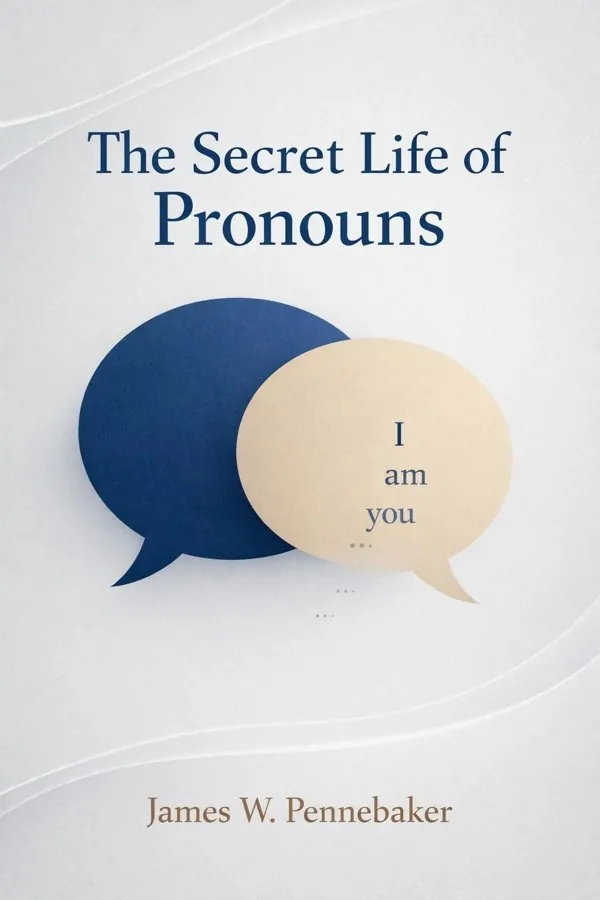
The Secret Life of Pronouns: What Our Words Say About Us: Summary & Key Insights
 10 min5 chaptersAudio available
What Is The Secret Life of Pronouns: What Our Words Say About Us About?
The Secret Life of Pronouns: What Our Words Say About Us by James W. Pennebaker is a psychology book spanning 5 pages. In this groundbreaking work, social psychologist James W. Pennebaker explores how the smallest words we use—such as pronouns, articles, and prepositions—reveal our personalities, emotions, and social relationships. Drawing on decades of research in linguistics and psychology, Pennebaker demonstrates how language patterns can uncover hidden aspects of our identity, from leadership style to emotional state, and even predict future behavior.
This FizzRead summary covers all 5 key chapters of The Secret Life of Pronouns: What Our Words Say About Us in approximately 10 minutes, distilling the most important ideas, arguments, and takeaways from James W. Pennebaker's work. Also available as an audio summary and Key Quotes Podcast.
The Secret Life of Pronouns: What Our Words Say About Us
In this groundbreaking work, social psychologist James W. Pennebaker explores how the smallest words we use—such as pronouns, articles, and prepositions—reveal our personalities, emotions, and social relationships. Drawing on decades of research in linguistics and psychology, Pennebaker demonstrates how language patterns can uncover hidden aspects of our identity, from leadership style to emotional state, and even predict future behavior.
Who Should Read The Secret Life of Pronouns: What Our Words Say About Us?
This book is perfect for anyone interested in psychology and looking to gain actionable insights in a short read. Whether you're a student, professional, or lifelong learner, the key ideas from The Secret Life of Pronouns: What Our Words Say About Us by James W. Pennebaker will help you think differently.
- ✓Readers who enjoy psychology and want practical takeaways
- ✓Professionals looking to apply new ideas to their work and life
- ✓Anyone who wants the core insights of The Secret Life of Pronouns: What Our Words Say About Us in just 10 minutes
Want the full summary?
Get instant access to this book summary and 100K+ more with Fizz Moment.
Get Free SummaryAvailable on App Store • Free to download
Key Chapters
It may seem fanciful to claim that a person’s use of pronouns can reveal traits like leadership, honesty, or emotional health, but decades of data repeatedly show this to be true. The frequency and patterns of small words correlate with enduring personality dimensions and transient moods alike. People high in dominance or confidence tend to use fewer first-person pronouns—they literally focus less on themselves—and more direct objects, verbs, and imperatives. In contrast, those feeling uncertain or socially subordinate often mark their inner state with a higher rate of self-reference.
Emotion, too, leaves its trace in the simplest phrases. When someone grieves or feels anxious, their verbal world narrows: sentences become shorter, pronouns more self-absorbed, articles fewer, as if the speaker’s attention collapses inward. In contrast, happiness expands language outward. We make more references to others, we use more social words, and we unconsciously broaden our perspective.
I have always found this duality striking: the same psychological shift that therapists hear in tone or gesture also manifests automatically in linguistic structure. Unlike facial expression, however, words create a durable record that can be analyzed systematically. By examining transcripts of presidential speeches, we can see how stress tightens syntax and how confidence relaxes it; in essays by patients coping with trauma, we can observe recovery as the gradual return of articles and prepositions—a sign of renewed cognitive coherence.
Language is not merely a reflection of who we are, but a record of who we are becoming. Watching function words change over time offers a window into adaptation itself, showing the rhythm by which people rebuild meaning after loss or rise to new roles of authority.
+ 3 more chapters — available in the FizzRead app
All Chapters in The Secret Life of Pronouns: What Our Words Say About Us
About the Author
James W. Pennebaker is a professor of psychology at the University of Texas at Austin, known for his pioneering research on language, emotion, and health. His work has significantly influenced the fields of social psychology and computational linguistics, particularly through his development of the Linguistic Inquiry and Word Count (LIWC) text analysis program.
Get This Summary in Your Preferred Format
Read or listen to the The Secret Life of Pronouns: What Our Words Say About Us summary by James W. Pennebaker anytime, anywhere. FizzRead offers multiple formats so you can learn on your terms — all free.
Available formats: App · Audio · PDF · EPUB — All included free with FizzRead
Download The Secret Life of Pronouns: What Our Words Say About Us PDF and EPUB Summary
Key Quotes from The Secret Life of Pronouns: What Our Words Say About Us
“When we think about language, we typically imagine the big, colorful words—the nouns that anchor meaning and the verbs that move ideas.”
“It may seem fanciful to claim that a person’s use of pronouns can reveal traits like leadership, honesty, or emotional health, but decades of data repeatedly show this to be true.”
Frequently Asked Questions about The Secret Life of Pronouns: What Our Words Say About Us
The Secret Life of Pronouns: What Our Words Say About Us by James W. Pennebaker is a psychology book that explores key ideas across 5 chapters. In this groundbreaking work, social psychologist James W. Pennebaker explores how the smallest words we use—such as pronouns, articles, and prepositions—reveal our personalities, emotions, and social relationships. Drawing on decades of research in linguistics and psychology, Pennebaker demonstrates how language patterns can uncover hidden aspects of our identity, from leadership style to emotional state, and even predict future behavior.
More by James W. Pennebaker
You Might Also Like
The Body Keeps the Score
Bessel van der Kolk
10 min
Surrounded by Idiots
Thomas Erikson
10 min
Emotional Intelligence
Daniel Goleman
10 min
Attached
Amir Levine
10 min
Why Does He Do That
Lundy Bancroft
10 min
Women Who Run with the Wolves
Clarissa Pinkola Estés
10 minBrowse by Category
Ready to read The Secret Life of Pronouns: What Our Words Say About Us?
Get the full summary and 100K+ more books with Fizz Moment.