
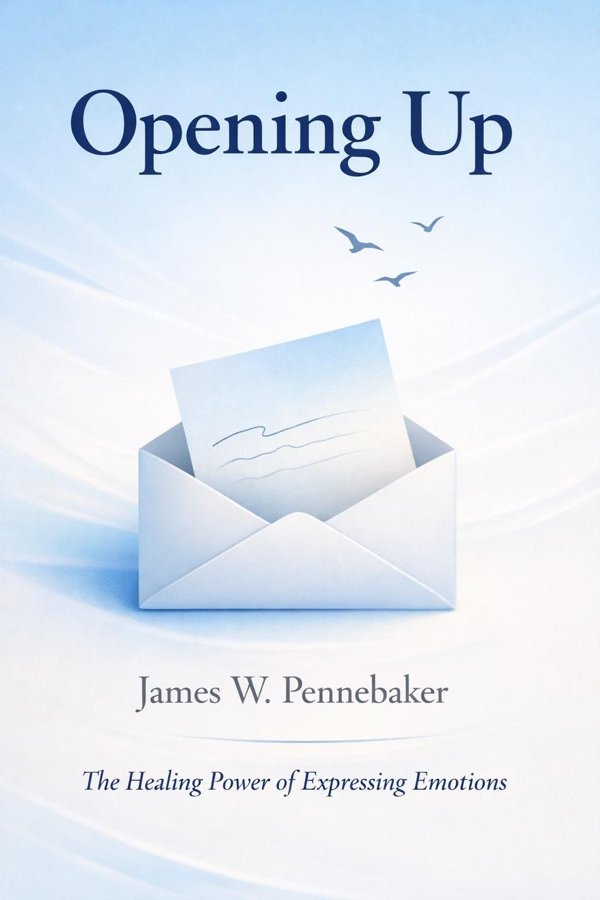
Opening Up: The Healing Power of Expressing Emotions: Summary & Key Insights
 10 min9 chaptersAudio available
Key Takeaways from Opening Up: The Healing Power of Expressing Emotions
One of the book’s central insights is unsettling but liberating: keeping emotional secrets often drains more energy than people realize.
A painful memory often lives in the mind as fragments—sensations, images, reactions, and unfinished questions.
Many people assume that expressing emotion means unloading feelings until pressure is released.
One of Pennebaker’s most fascinating contributions is the idea that the words people use reveal how they are processing emotional experience.
A powerful nuance in Opening Up is that emotional disclosure is beneficial, but it is not a one-size-fits-all cure.
What Is Opening Up: The Healing Power of Expressing Emotions About?
Opening Up: The Healing Power of Expressing Emotions by James W. Pennebaker is a psychology book. What happens when painful experiences remain unspoken for years? In Opening Up, psychologist James W. Pennebaker argues that silence carries a real psychological and physical cost, while honest emotional expression can become a powerful tool for healing. Drawing on decades of research, clinical observation, and experiments on expressive writing, Pennebaker explores how people process trauma, stress, grief, and inner conflict—and why putting difficult experiences into words can improve well-being. This book matters because it bridges science and everyday life. Rather than offering vague advice to “share your feelings,” Pennebaker shows how structured emotional disclosure can reduce stress, clarify thoughts, strengthen resilience, and even support physical health. He also explains that opening up does not always mean dramatic confession to another person; it can happen through writing, private reflection, conversation, or storytelling. As a leading social psychologist and pioneer in the study of expressive writing, Pennebaker brings unusual authority to this topic. His work helped transform emotional disclosure from a soft, intuitive idea into a research-backed practice. Opening Up is both a compelling explanation of why emotional honesty matters and a practical guide for using it wisely.
This FizzRead summary covers all 9 key chapters of Opening Up: The Healing Power of Expressing Emotions in approximately 10 minutes, distilling the most important ideas, arguments, and takeaways from James W. Pennebaker's work. Also available as an audio summary and Key Quotes Podcast.
Opening Up: The Healing Power of Expressing Emotions
What happens when painful experiences remain unspoken for years? In Opening Up, psychologist James W. Pennebaker argues that silence carries a real psychological and physical cost, while honest emotional expression can become a powerful tool for healing. Drawing on decades of research, clinical observation, and experiments on expressive writing, Pennebaker explores how people process trauma, stress, grief, and inner conflict—and why putting difficult experiences into words can improve well-being.
This book matters because it bridges science and everyday life. Rather than offering vague advice to “share your feelings,” Pennebaker shows how structured emotional disclosure can reduce stress, clarify thoughts, strengthen resilience, and even support physical health. He also explains that opening up does not always mean dramatic confession to another person; it can happen through writing, private reflection, conversation, or storytelling.
As a leading social psychologist and pioneer in the study of expressive writing, Pennebaker brings unusual authority to this topic. His work helped transform emotional disclosure from a soft, intuitive idea into a research-backed practice. Opening Up is both a compelling explanation of why emotional honesty matters and a practical guide for using it wisely.
Who Should Read Opening Up: The Healing Power of Expressing Emotions?
This book is perfect for anyone interested in psychology and looking to gain actionable insights in a short read. Whether you're a student, professional, or lifelong learner, the key ideas from Opening Up: The Healing Power of Expressing Emotions by James W. Pennebaker will help you think differently.
- ✓Readers who enjoy psychology and want practical takeaways
- ✓Professionals looking to apply new ideas to their work and life
- ✓Anyone who wants the core insights of Opening Up: The Healing Power of Expressing Emotions in just 10 minutes
Want the full summary?
Get instant access to this book summary and 100K+ more with Fizz Moment.
Get Free SummaryAvailable on App Store • Free to download
Key Chapters
A painful memory often lives in the mind as fragments—sensations, images, reactions, and unfinished questions. Pennebaker’s breakthrough insight is that writing helps transform this inner chaos into a coherent story. That act of organizing experience is not merely expressive; it is psychologically healing.
When people write about emotionally charged events, they begin to connect what happened with what it meant. They move from raw reaction to interpretation. This matters because the brain handles an organized narrative differently from an unresolved emotional storm. Writing encourages pattern-making: causes, consequences, lessons, conflicts, and changes over time. In many cases, that process reduces rumination and gives a person a greater sense of control.
Pennebaker’s expressive writing studies are famous for a reason. Participants who wrote openly about traumatic or stressful experiences for short periods across a few days often showed measurable improvements in mood, immune function, doctor visits, or performance. Not every effect is dramatic or immediate, but the pattern is powerful: language can help the mind digest what it has struggled to contain.
Imagine someone grieving the death of a parent. At first, the loss may feel like an overwhelming set of emotions. But writing can help the person articulate love, anger, regret, gratitude, and fear. That does not erase grief. It makes grief more speakable, and therefore more livable.
The key is honesty, not literary skill. The page does not require politeness, clarity, or perfection. It simply asks for truth.
Actionable takeaway: For the next three days, write for 15 to 20 minutes about a difficult experience, focusing not only on what happened but also on what it has meant to your life.
Many people assume that expressing emotion means unloading feelings until pressure is released. Pennebaker makes an important distinction: healing does not come from venting alone. It comes from meaningful emotional processing. In other words, expression is most helpful when it helps a person understand, integrate, and reframe experience rather than simply repeat distress.
This distinction matters because endless emotional release can sometimes keep people stuck. Replaying anger without insight, retelling pain without reflection, or repeatedly dramatizing an injury may intensify suffering rather than resolve it. Pennebaker’s research suggests that beneficial expression often includes both emotional language and cognitive language. People improve when they not only describe what they felt, but also make sense of why it happened, what changed, and how they now understand themselves.
For example, a person angry about workplace betrayal could vent for hours about unfair treatment. That may feel temporarily satisfying, but without deeper reflection it may reinforce resentment. A more healing approach would include questions like: Why did this hurt so much? What beliefs were violated? What did I learn about trust, boundaries, and my own needs? What will I do differently now?
This idea also helps explain why some conversations leave people lighter and wiser, while others leave them more agitated. Productive expression involves emotional honesty plus meaning-making. It connects the heart and the mind.
Pennebaker is not arguing against strong feelings. He is showing that expression becomes transformative when it creates understanding. Feeling and thinking must work together for healing to take root.
Actionable takeaway: The next time you talk or write about something painful, include three reflective questions: Why did this affect me so deeply? What does it reveal? What am I learning from it now?
One of Pennebaker’s most fascinating contributions is the idea that the words people use reveal how they are processing emotional experience. Tiny shifts in language can signal major changes in coping, perspective, and healing. This makes expression not only therapeutic but also measurable.
In his work, Pennebaker found that people who benefit most from expressive writing often begin to use more words that suggest insight, causation, and narrative integration—terms like “because,” “realize,” “understand,” and “learned.” They may also show flexibility in pronouns and tense, suggesting movement between immersion and reflection. The important point is that language patterns can reflect the mind’s effort to build meaning.
This is helpful in everyday life because it teaches us to listen differently—to ourselves and to others. A person who says, “I can’t stop thinking about what happened” is in a different place from someone who says, “I’m beginning to understand why it still hurts.” The second statement signals psychological movement. It does not mean the pain is gone; it means the person is integrating it.
Even journaling can become more useful when people notice their language. Are they repeating the same story identically each time? Are they discovering causes, acknowledging mixed feelings, or recognizing growth? Progress often appears first in words before it is fully felt.
This insight also gives emotional healing a scientific edge. Feelings can seem vague, but language leaves clues. Our narratives reveal whether we are trapped in an experience or beginning to reshape it.
Actionable takeaway: Review a recent journal entry or difficult email draft and underline words that show insight, change, or cause-and-effect; then add a paragraph that begins with “What I understand now is…”
A powerful nuance in Opening Up is that emotional disclosure is beneficial, but it is not a one-size-fits-all cure. Pennebaker emphasizes that context, timing, personality, and method all matter. This protects the reader from a simplistic lesson like “always share more.” Sometimes disclosure heals; other times it overwhelms, backfires, or lands in the wrong environment.
For some people, private writing is safer and more effective than immediate conversation. For others, speaking with a trusted friend, therapist, or support group creates accountability and connection. Some need time before they can approach a painful event directly. Others may benefit from writing around the experience at first, then moving closer as their tolerance grows.
The audience also matters. Confiding in someone dismissive, judgmental, or emotionally unavailable can deepen shame. Similarly, forcing disclosure before a person is ready may feel invasive rather than freeing. Pennebaker’s approach is grounded in honesty, but also in practicality: expression should serve integration, not perform vulnerability for others.
Think of someone struggling with childhood trauma. Sharing details at a family gathering would likely be harmful. Writing privately, speaking to a trauma-informed therapist, or discussing the experience with one trusted person may be far more constructive. Healthy disclosure requires emotional safety and an appropriate container.
This idea is especially valuable today, when social media often blurs the line between authentic expression and public exposure. Not all openness is wise, and not all privacy is repression. The question is whether expression helps the person process and heal.
Actionable takeaway: Before disclosing something painful, ask yourself three questions: Why am I sharing this, with whom, and in what setting will I feel safest and most understood?
Perhaps the most surprising idea in the book is that emotional expression may influence physical health, not just mood. Pennebaker’s research helped popularize the notion that suppressing major emotional experiences can contribute to bodily stress, while structured disclosure may support measurable health improvements. This does not mean writing is a magical cure, but it does suggest that mind and body are more deeply connected than many people assume.
When individuals suppress distress, their bodies may remain in a state of subtle activation. Stress hormones, muscle tension, poor sleep, and recurring vigilance can gradually wear them down. By contrast, expressing and organizing painful experience may reduce some of this internal strain. Studies associated with expressive writing have found links to fewer doctor visits, improved immune markers, better adjustment to stress, and improved functioning in some populations.
A practical example is someone recovering from a breakup while pretending everything is fine. They may develop headaches, exhaustion, or frequent colds during the months they are suppressing grief. Once they begin writing or talking honestly about the loss, they may not only feel emotionally lighter but also sleep better and function more steadily.
Pennebaker does not overstate the case. Emotional disclosure is not a replacement for medical care, nor does every health problem arise from repression. But the message is profound: emotional truths have biological consequences, and attending to them can become part of whole-person health.
This perspective expands psychology beyond feelings alone. It reminds readers that unresolved emotional life does not stay neatly contained in the mind.
Actionable takeaway: If stress has been affecting your sleep, tension, or concentration, add a brief expressive writing session to your self-care routine for one week and notice whether your body feels any different.
Trauma and loss often shatter assumptions about who we are, what the world is like, and what the future holds. Pennebaker shows that emotional healing involves more than release; it requires reconstruction. People become more resilient when they can fit painful experiences into a broader life story that includes meaning, adaptation, and continued identity.
This is not about forced positivity. Pennebaker does not suggest that every painful event contains a hidden blessing. Instead, he shows that people cope better when they can answer questions such as: What changed in me? What did this experience reveal? How do I understand my past now? Meaning helps transform suffering from an isolated wound into part of a coherent narrative.
For example, someone who survived serious illness may eventually write not only about fear and pain, but also about vulnerability, changed priorities, or a renewed appreciation for relationships. A person who endured rejection may come to see the event as a turning point in self-respect. The event remains difficult, but it no longer defines the whole self.
Resilience, in this view, is not emotional toughness or denial. It is the ability to metabolize experience into a story one can live with. Writing supports this because it encourages sequence, perspective, and reflection. Over time, language helps identity evolve.
This idea also explains why simply “forgetting about it” rarely works for major emotional events. If the experience altered your inner world, it must be woven into your understanding of yourself. Meaning is the bridge between pain and growth.
Actionable takeaway: Write a one-page reflection beginning with the sentence, “This experience changed the way I see…” and follow it wherever it leads, especially toward shifts in values, relationships, or identity.
A common misconception is that healing requires another person’s response. Pennebaker challenges this by showing that even private expression can be profoundly helpful. Sometimes the critical act is not being heard by someone else, but hearing oneself clearly for the first time.
This is especially important for people who lack supportive listeners, distrust vulnerability, or are processing experiences too raw to discuss openly. In Pennebaker’s work, participants often improved simply by writing privately about their deepest thoughts and feelings. No one needed to read their words. The therapeutic value came from emotional honesty and narrative organization, not necessarily social feedback.
Private writing creates a unique psychological space. It allows contradiction, shame, anger, grief, and confusion to exist without immediate judgment. A person can admit what they would never yet say aloud: “I loved him and resent him,” “I feel guilty even though it wasn’t my fault,” or “I’m not the person I used to be.” These admissions reduce internal fragmentation. They make the self more integrated.
That does not mean solitude is always enough. Some issues benefit greatly from therapy, support groups, or conversation. But Pennebaker expands the reader’s sense of possibility: healing can begin in complete privacy. The blank page can become a witness, container, and tool for change.
In a culture that often celebrates public sharing, this is a reassuring message. You do not need to perform your pain for healing to begin. You may start quietly, honestly, and on your own terms.
Actionable takeaway: Create a completely private writing ritual—on paper or digitally—for 15 minutes, and give yourself permission to write what you would never yet say out loud.
Although much of Opening Up focuses on private health and emotional processing, Pennebaker also points to a social truth: appropriately expressing emotions can improve relationships. When people hide significant inner experiences, they often become harder to know, less available, and more reactive. Emotional openness, when paired with judgment and respect, creates intimacy, trust, and mutual understanding.
This does not require dramatic confessions or constant self-disclosure. Often, healthier relationships emerge when people communicate more honestly about what they feel, need, fear, or remember. A partner who says, “I became distant because I felt ashamed after losing my job,” offers something far more connective than silence or irritability. A friend who admits, “I’ve been overwhelmed and withdrawing,” prevents misunderstanding. Emotional clarity reduces the need for others to guess.
Pennebaker’s broader message is that unprocessed emotion does not stay private. It leaks into relationships through defensiveness, avoidance, sarcasm, numbness, or conflict. Expressing emotion directly can prevent these indirect consequences. It allows others to respond to reality rather than symptoms.
Still, the best openness is thoughtful, not impulsive. Productive disclosure respects boundaries, context, and timing. It aims for understanding rather than blame. When done well, it invites closeness and reduces emotional isolation.
This principle applies in families, friendships, romantic partnerships, and even workplaces. Teams function better when people can respectfully articulate stress, uncertainty, and concern instead of burying tension until it explodes.
Actionable takeaway: Choose one important relationship and name one feeling or experience you have been withholding; share it in a calm, specific way that emphasizes honesty and understanding rather than accusation.
All Chapters in Opening Up: The Healing Power of Expressing Emotions
About the Author
James W. Pennebaker is a prominent American social psychologist and researcher best known for his groundbreaking work on expressive writing, emotional disclosure, and the psychology of language. Over his career, he has explored how people translate difficult experiences into words and how that process affects mental and physical health. His research helped establish that writing about trauma, stress, and emotional upheaval can produce measurable benefits, making him one of the most influential figures in this area of psychology. Pennebaker has held major academic positions, including at the University of Texas at Austin, and has published widely on language, health, personality, and social behavior. His work stands out for combining scientific rigor with practical relevance, helping both scholars and general readers better understand the healing power of emotional expression.
Get This Summary in Your Preferred Format
Read or listen to the Opening Up: The Healing Power of Expressing Emotions summary by James W. Pennebaker anytime, anywhere. FizzRead offers multiple formats so you can learn on your terms — all free.
Available formats: App · Audio · PDF · EPUB — All included free with FizzRead
Download Opening Up: The Healing Power of Expressing Emotions PDF and EPUB Summary
Key Quotes from Opening Up: The Healing Power of Expressing Emotions
“One of the book’s central insights is unsettling but liberating: keeping emotional secrets often drains more energy than people realize.”
“A painful memory often lives in the mind as fragments—sensations, images, reactions, and unfinished questions.”
“Many people assume that expressing emotion means unloading feelings until pressure is released.”
“One of Pennebaker’s most fascinating contributions is the idea that the words people use reveal how they are processing emotional experience.”
“A powerful nuance in Opening Up is that emotional disclosure is beneficial, but it is not a one-size-fits-all cure.”
Frequently Asked Questions about Opening Up: The Healing Power of Expressing Emotions
Opening Up: The Healing Power of Expressing Emotions by James W. Pennebaker is a psychology book that explores key ideas across 9 chapters. What happens when painful experiences remain unspoken for years? In Opening Up, psychologist James W. Pennebaker argues that silence carries a real psychological and physical cost, while honest emotional expression can become a powerful tool for healing. Drawing on decades of research, clinical observation, and experiments on expressive writing, Pennebaker explores how people process trauma, stress, grief, and inner conflict—and why putting difficult experiences into words can improve well-being. This book matters because it bridges science and everyday life. Rather than offering vague advice to “share your feelings,” Pennebaker shows how structured emotional disclosure can reduce stress, clarify thoughts, strengthen resilience, and even support physical health. He also explains that opening up does not always mean dramatic confession to another person; it can happen through writing, private reflection, conversation, or storytelling. As a leading social psychologist and pioneer in the study of expressive writing, Pennebaker brings unusual authority to this topic. His work helped transform emotional disclosure from a soft, intuitive idea into a research-backed practice. Opening Up is both a compelling explanation of why emotional honesty matters and a practical guide for using it wisely.
More by James W. Pennebaker
You Might Also Like
The Body Keeps the Score
Bessel van der Kolk
10 min
Surrounded by Idiots
Thomas Erikson
10 min
Emotional Intelligence
Daniel Goleman
10 min
Attached
Amir Levine
10 min
Why Does He Do That
Lundy Bancroft
10 min
Women Who Run with the Wolves
Clarissa Pinkola Estés
10 minBrowse by Category
Ready to read Opening Up: The Healing Power of Expressing Emotions?
Get the full summary and 100K+ more books with Fizz Moment.